Create and Interpret Fractional Line Plots
Help Questions
4th Grade Math › Create and Interpret Fractional Line Plots
Based on the line plot of student jump distances, how many students jumped farther than $$1\frac{1}{4}$$ feet but not more than $$1\frac{3}{4}$$ feet?
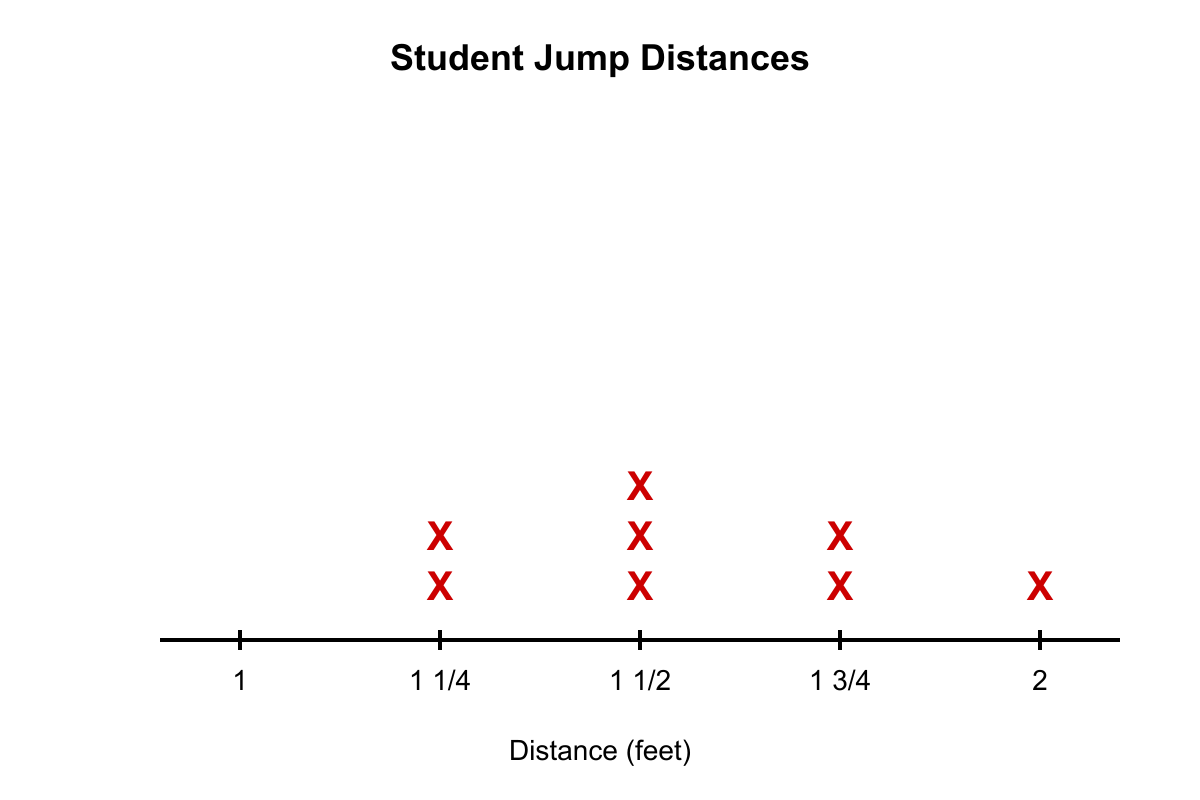
3 students because only the middle measurement qualifies for inclusion
5 students because this includes all data points in the specified range
4 students since the range excludes the lower boundary condition
7 students when counting both boundary values in the inequality
Explanation
Students who jumped farther than $$1\frac{1}{4}$$ feet (not including $$1\frac{1}{4}$$) but not more than $$1\frac{3}{4}$$ feet (including $$1\frac{3}{4}$$) are those at $$1\frac{1}{2}$$ feet (3 students) and $$1\frac{3}{4}$$ feet (2 students). Total: $$3 + 2 = 5$$ students. Choice B incorrectly includes students at $$1\frac{1}{4}$$ feet. Choice C only counts one measurement. Choice D miscounts the frequencies.
Students measured their hand spans in inches. According to the line plot shown, what fraction of students had hand spans of $$\frac{3}{4}$$ inch or greater?
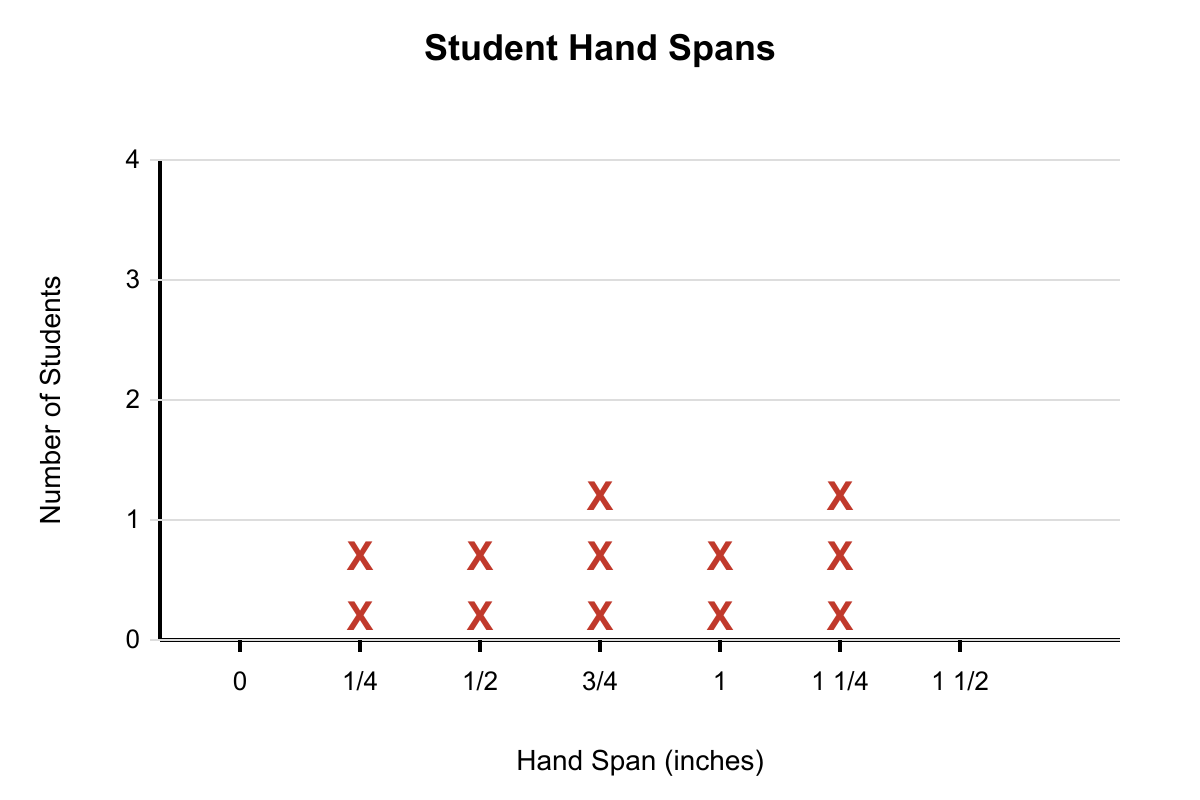
$$\frac{2}{3}$$ of the students because 8 out of 12 students qualify
$$\frac{5}{8}$$ of the students after counting all qualifying measurements
$$\frac{3}{5}$$ of the students based on the frequency distribution shown
$$\frac{1}{2}$$ of the students when including the boundary measurement
Explanation
Students with hand spans $$\frac{3}{4}$$ inch or greater: at $$\frac{3}{4}$$ there are 3 students, at $$1$$ there are 2 students, at $$1\frac{1}{4}$$ there are 3 students. Total qualifying: $$3 + 2 + 3 = 8$$ students. Total students: $$2 + 2 + 3 + 2 + 3 = 12$$ students. Fraction: $$\frac{8}{12} = \frac{2}{3}$$. Choice B gives $$\frac{6}{12}$$. Choice C gives $$\frac{9}{15}$$. Choice D gives $$\frac{10}{16}$$, all using wrong counts.
The line plot shows the weights of packages in pounds. What is the total weight of all packages that weigh less than $$1$$ pound?
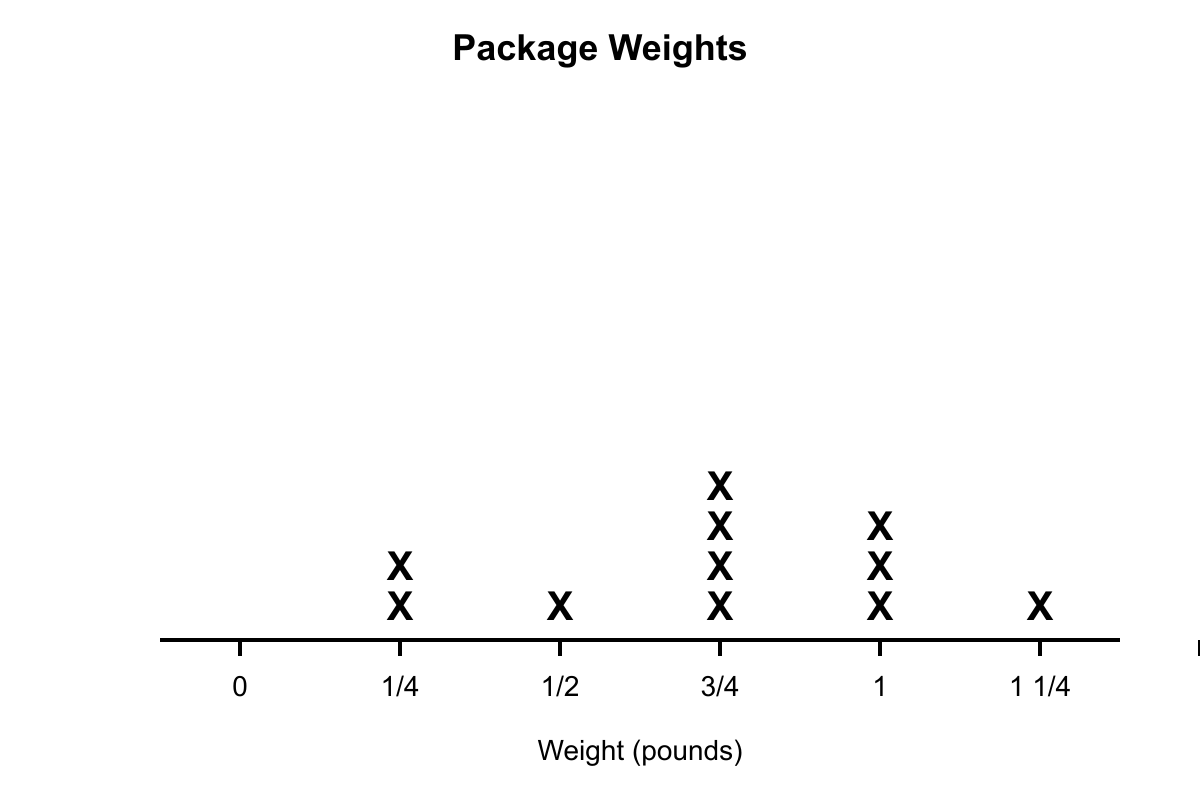
$$2\frac{1}{2}$$ pounds because $$\frac{1}{4} + \frac{1}{2} + \frac{3}{4} = 1\frac{1}{2}$$ pounds for one of each
$$4\frac{1}{4}$$ pounds including all packages below the 1-pound threshold
$$3\frac{3}{4}$$ pounds when accounting for the frequency of each weight measurement
$$1\frac{1}{2}$$ pounds because only 3 different weight values are involved
Explanation
Packages under 1 pound: at $$\frac{1}{4}$$ pound there are 2 packages ($$2 \times \frac{1}{4} = \frac{1}{2}$$), at $$\frac{1}{2}$$ pound there is 1 package ($$1 \times \frac{1}{2} = \frac{1}{2}$$), and at $$\frac{3}{4}$$ pound there are 4 packages ($$4 \times \frac{3}{4} = 3$$). Total: $$\frac{1}{2} + \frac{1}{2} + 3 = 3\frac{3}{4}$$ pounds. Choice A ignores frequencies. Choice C includes packages at 1 pound. Choice D miscalculates the total.