All questions
Question 1
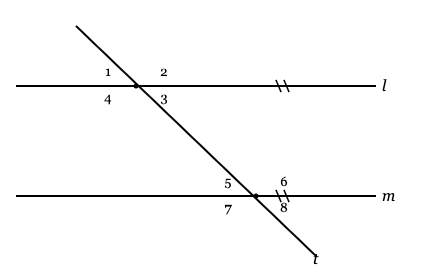
In the diagram, lines l and m are parallel and are intersected by a transversal line t. If the measure of angle 1 is 70°, what is the measure of angle 7?
- 20°
- 70°
- 110° (correct answer)
- 160°
Explanation: This is a parallel lines and transversals question testing supplementary angle relationships. Choice C (110°) is correct — using standard transversal labeling (angles 1–4 at the upper intersection, 5–8 at the lower), angles 1, 3, 5, and 8 are all congruent, and angles 2, 4, 6, and 8 are all supplementary to 1, 3, 5, and 8. So if angle 1 is 70, that mens that angle 8 is 70, and that means that angle 7 is 110.
Question 2
Two lines intersect. One of the angles formed is 120∘. Angle x is adjacent to the 120∘ angle, sharing a side with it, and the other sides form a straight line (a linear pair). What is the measure of angle x?
- 240∘
- 120∘
- 30∘
- 60∘ (correct answer)
Explanation: The angles form a linear pair, being adjacent and forming a straight line. Linear pairs are supplementary, so their measures add to 180∘. Subtract the given 120∘ from 180∘: x = 180∘ - 120∘ = 60∘. This applies the straight-angle property. Choice B of 120∘ might result from assuming equality instead of supplement. Question 3
Lines m and n are parallel and cut by a transversal. An interior angle on the left side of the transversal at the top intersection is 70∘. The alternate interior angle at the bottom intersection is labeled x.
   m  ⇒ ⇒ ⇒
     70°\
         \
          \
   n  ⇒ ⇒ ⇒
        / x
If lines m and n are parallel, what is the measure of angle x?
- 110∘
- 70∘ (correct answer)
- 20∘
- 90∘
Explanation: The 70° angle and angle x are alternate interior angles created by a transversal intersecting parallel lines m and n. Alternate interior angles are equal in measure when the lines are parallel, as they lie on opposite sides of the transversal between the parallels. Therefore, angle x measures 70°. This property helps prove lines are parallel or find unknown angles in such configurations. Choice A of 110° might stem from incorrectly treating them as supplementary instead of alternate interior.
Question 4
Lines m and n are parallel (⇒). A transversal t intersects them. The angle labeled x is an exterior angle at line n on the right side of the transversal. The angle labeled 95∘ is the corresponding exterior angle at line m on the right side of the transversal.
m  ⇒  ───────────────
            / 95°
           / t
          /
         /
        /  x
n  ⇒  ───────────────
If lines m and n are parallel, what is the measure of angle x?
- 85∘
- 95∘ (correct answer)
- 180∘
- 90∘
Explanation: The angles x and 95° are corresponding angles formed by parallel lines m and n with transversal t. When two parallel lines are cut by a transversal, corresponding angles are always equal. Therefore, x = 95°. Choice A (85°) might result from incorrectly treating these as supplementary angles, which would be the case for same-side interior angles but not corresponding angles.
Question 5
In the diagram, lines m and n are parallel, cut by transversal t. The angle labeled 40∘ is above line m and to the right of t. Angle x is above line n and to the right of t.
If lines m and n are parallel, what is the measure of angle x?
- 140∘
- 40∘ (correct answer)
- 90∘
- 180∘
Explanation: The angles are corresponding angles formed by the transversal intersecting the parallel lines. When lines are parallel, corresponding angles are congruent and thus equal in measure. Since the given angle is 40°, angle x also measures 40°. This equality holds due to the parallel lines property. Choice A, 140°, might come from incorrectly treating the angles as supplementary.
Question 6
Two lines intersect at point O. The angle labeled x is adjacent to an angle labeled 80∘ and together they form a straight line.
   \ 80° /
    \   /
-----O-----
    / x  \
What is the measure of angle x?
- 80∘
- 100∘ (correct answer)
- 160∘
- 10∘
Explanation: The angles 80° and x are adjacent angles that form a linear pair on a straight line. Adjacent angles on a straight line are supplementary, meaning they add up to 180°. Therefore, 80° + x = 180°, which gives us x = 180° - 80° = 100°. Choice A (80°) incorrectly assumes the angles are vertical angles (equal) rather than supplementary adjacent angles.
Question 7
If angle C and angle D are supplementary and angle C measures 110∘, what is the measure of angle D?
- 120∘
- 110∘
- 90∘
- 70∘ (correct answer)
Explanation: Supplementary angles are two angles whose measures sum to 180°. If angle C and angle D are supplementary, then C + D = 180°. Since angle C measures 110°, we have 110° + D = 180°, so D = 180° - 110° = 70°. Choice B (110°) incorrectly assumes the angles are equal.
Question 8
Two angles form a linear pair on a straight line. One angle measures 125∘, and the adjacent angle is labeled x.
-----------O-----------
        125° | x
What is the measure of angle x?
- 305∘
- 125∘
- 65∘
- 55∘ (correct answer)
Explanation: The 125° angle and angle x form a linear pair along a straight line. Angles in a linear pair are supplementary, meaning their measures add up to 180°. Subtracting 125° from 180° gives x = 55°. Linear pairs always sum to 180° because they are adjacent angles on a straight line. Choice B of 125° incorrectly assumes the angles are equal rather than supplementary.
Question 9
Lines m and n are parallel and cut by a transversal. The two same-side (consecutive) interior angles are labeled x and 105∘.
   m  ⇒ ⇒ ⇒
      \ x
       \
        \
   n  ⇒ ⇒ ⇒
        105°/
If lines m and n are parallel, what is the value of x?
- 45∘
- 105∘
- 180∘
- 75∘ (correct answer)
Explanation: Angle x and the 105° angle are consecutive interior angles (same-side interior) formed by a transversal crossing parallel lines m and n. When lines are parallel, consecutive interior angles are supplementary and add up to 180°. Thus, x = 180° - 105° = 75°. This relationship is key for understanding angle sums in parallel line setups. Choice C of 180° might confuse the sum with a single angle measure.
Question 10
In the diagram, angle m and angle n are vertical angles. If angle m measures 55∘, what is the measure of angle n?
- 125∘
- 55∘ (correct answer)
- 90∘
- 180∘
Explanation: Vertical angles are formed when two lines intersect and are opposite each other across the intersection point. Vertical angles are always equal in measure. Since angle m measures 55∘, angle n must also measure 55∘. Choice A (125∘) incorrectly uses the supplementary angle relationship. Question 11
Lines m and n are parallel, and a transversal t crosses them. The angle in the upper intersection that is above line m and to the right of t is 50∘. The corresponding angle at the lower intersection (above line n and to the right of t) is labeled x.
   m  ⇒ ⇒ ⇒
       / 50°
      /
     /
   n  ⇒ ⇒ ⇒
       / x
If lines m and n are parallel, what is the measure of angle x?
- 130∘
- 40∘
- 50∘ (correct answer)
- 90∘
Explanation: The 50∘ angle and angle x are corresponding angles formed by a transversal crossing parallel lines m and n. When a transversal intersects parallel lines, corresponding angles are congruent and have equal measures. Thus, angle x measures 50∘, matching the given corresponding angle. Corresponding angles occupy the same relative position at each intersection, such as both above the line and to the right of the transversal. Choice A of 130∘ could arise from confusing corresponding with supplementary relationships. Question 12
In the diagram, lines x and y are parallel, and line z is a transversal. If angle 4 is 120o, what is the measure of angle 2, the alternate interior angle?
- 60°
- 120° (correct answer)
- 150°
- 180°
Explanation: Angles 4 and 2 are alternate interior angles formed by parallel lines x and y cut by transversal z. When parallel lines are cut by a transversal, alternate interior angles are equal. Since angle 4 is 120°, angle 2 must also be 120°. Choice A incorrectly uses 60°, which would be the supplementary angle.
Question 13
If angle A is supplementary to angle B and angle A measures 120o, what is the measure of angle B?
- 45°
- 120°
- 90°
- 60° (correct answer)
Explanation: Angles A and B are supplementary, meaning they add up to 180°. Using the supplementary angle relationship: A + B = 180°. Since angle A measures 120°, we have 120° + B = 180°, so B = 180° - 120° = 60°. Choice B incorrectly uses 120°, which would be if angles were equal.
Question 14
Two lines intersect and form four angles. If one angle is 30o, what is the measure of its adjacent angle?
- 60°
- 30°
- 150° (correct answer)
- 90°
Explanation: When two lines intersect, adjacent angles are supplementary and add up to 180°. Since one angle is 30°, its adjacent angle measures 180° - 30° = 150°. The adjacent angles form a linear pair along a straight line. Choice B incorrectly uses 30°, which would be the vertical angle instead.
Question 15
If angle F is a right angle, what is the measure of angle F?
- 90° (correct answer)
- 45°
- 180°
- 120°
Explanation: A right angle is defined as an angle that measures exactly 90°. This is a fundamental definition in geometry. By definition, any right angle has a measure of 90°. Choices B, C, and D represent acute, straight, and obtuse angles respectively.
Question 16
In the diagram, lines m and n are parallel (marked with matching arrows ⇒) and a transversal t intersects them. The angle labeled 110∘ is an interior angle on the left side of the transversal at line m. The angle labeled x is the interior angle on the same (left) side of the transversal at line n.
m  ⇒  ───────────────
          \ 110°
           \
            \ t
             \
              \ x
n  ⇒  ───────────────
What is the measure of angle x?
- 70∘ (correct answer)
- 110∘
- 180∘
- 90∘
Explanation: The angles x and 110° are same-side interior angles (also called co-interior or consecutive interior angles) formed by parallel lines m and n with transversal t. When two parallel lines are cut by a transversal, same-side interior angles are supplementary, meaning they add up to 180°. Therefore, x + 110° = 180°, which gives us x = 180° - 110° = 70°. Choice B incorrectly assumes the angles are equal (corresponding or alternate interior relationship).
Question 17
Lines l and m are parallel, cut by transversal t. An interior angle measures (4x+10)° and its alternate interior angle measures (2x+50)°. What is x?
- 10
- 15
- 20 (correct answer)
- 30
Explanation: This is a parallel lines and transversal question testing alternate interior angle relationships set up algebraically. Choice C (20) is correct — alternate interior angles formed by a transversal crossing parallel lines are always equal. Set the two expressions equal: 4x + 10 = 2x + 50. Subtract 2x from both sides: 2x + 10 = 50. Subtract 10: 2x = 40. Divide by 2: x = 20. Choice A (10) results from a subtraction error, arriving at 2x = 20 → x = 10 instead of 2x = 40. Choice B (15) comes from a mid-solve arithmetic error. Choice D (30) results from setting the angles as supplementary (summing to 180°) instead of equal: 4x + 10 + 2x + 50 = 180 → 6x + 60 = 180 → x = 20... interestingly, the supplementary path also gives 20 here, so D (30) likely comes from a coefficient error: 5x + 60 = 180 → 5x = 120 → x = 24 → rounded, or from misreading the equations. Pro tip: Alternate interior angles are the "Z angles" — they sit on opposite sides of the transversal between the parallel lines and are always equal. Set them equal and solve. If the angles were co-interior (same side), they'd be supplementary.
Question 18
Lines a and b are parallel, cut by transversal c. If angle 9 is 125∘, what is the measure of angle 7, the alternate interior angle?
- 75∘
- 55∘
- 125∘ (correct answer)
- 65∘
Explanation: Angles 9 and 7 are alternate interior angles formed by parallel lines a and b cut by transversal c. When parallel lines are cut by a transversal, alternate interior angles are equal. Since angle 9 is 125∘, angle 7 must also be 125∘. Choice B incorrectly uses 55∘, which would be the supplementary angle. Question 19
Two angles form a linear pair. If one angle measures 135o, what is the measure of the other angle?
- 45° (correct answer)
- 135°
- 95°
- 55°
Explanation: Two angles that form a linear pair are supplementary and add up to 180°. Since one angle measures 135°, the other angle = 180° - 135° = 45°. Linear pairs are adjacent angles whose non-common sides form a straight line. Choice B incorrectly uses 135°, treating the angles as equal instead of supplementary.
Question 20
Lines j and k are parallel, cut by transversal l. If angle 7 is 95o, what is the measure of angle 3, the corresponding angle?
- 85°
- 95° (correct answer)
- 75°
- 105°
Explanation: Angles 7 and 3 are corresponding angles formed by parallel lines j and k cut by transversal l. When parallel lines are cut by a transversal, corresponding angles are equal. Since angle 7 is 95°, angle 3 must also be 95°. Choice A incorrectly uses 85°, which results from subtracting instead of applying the equality rule.