All questions
Question 1
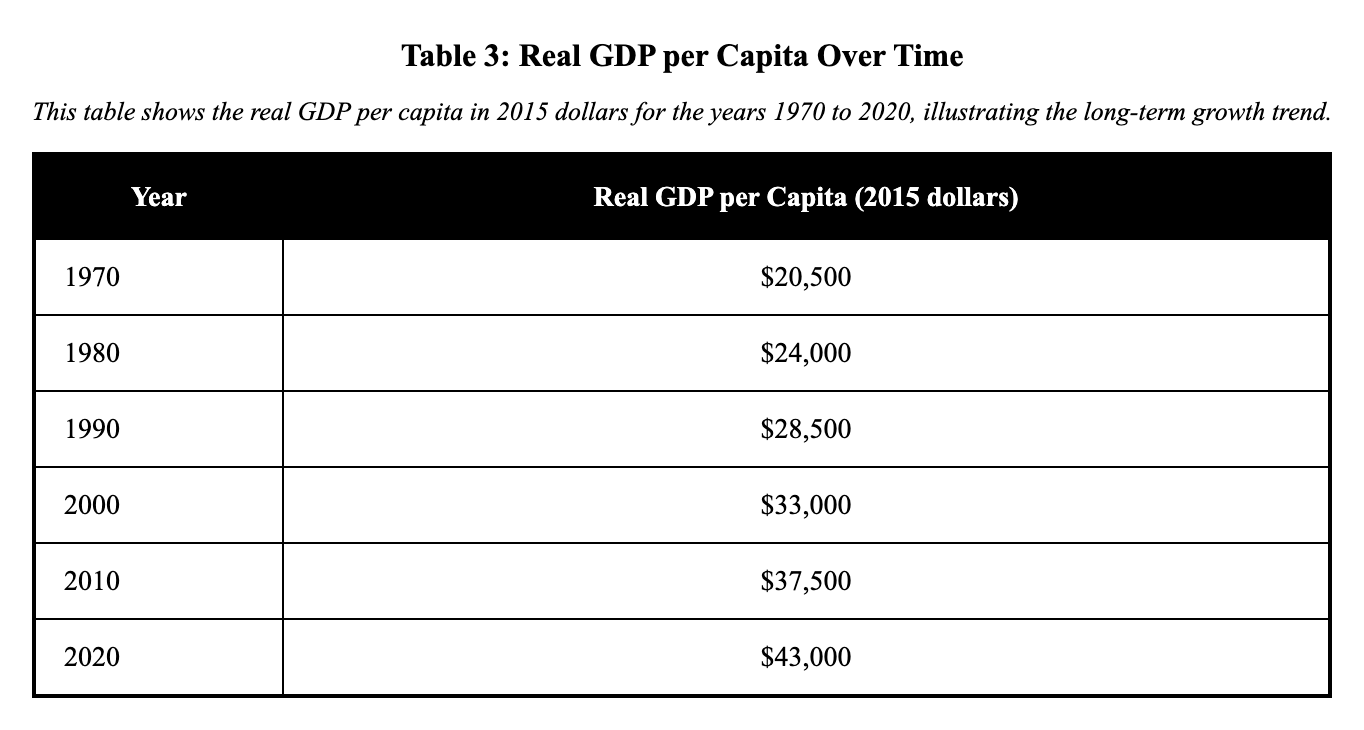
Based on the information shown in the table, which statement best identifies the secondary reinforcing factor that supports the long-run growth trend?
The country's primary growth driver is technological progress in manufacturing. In addition, the government expanded access to community colleges and apprenticeship programs.
Table 3. Real GDP per capita (2015 dollars)
- 1970: $20,500
- 1980: $24,000
- 1990: $28,500
- 2000: $33,000
- 2010: $37,500
- 2020: $43,000
- Human capital investment reinforces growth by raising worker productivity and supporting a higher long-run level of output per person. (correct answer)
- A cyclical rebound reinforces growth by returning real GDP per capita to its prior peak after each recession.
- Higher inflation reinforces growth by increasing nominal incomes, which raises measured real GDP per capita.
- Higher consumer spending reinforces growth by permanently increasing aggregate demand and potential output.
- Population growth reinforces growth by raising total real GDP, even if real GDP per capita does not rise.
Explanation: Economic growth is characterized by a long-term upward trend in real GDP per capita, fueled by determinants like technological advancements and human capital investments that boost productivity and potential output. The table depicts this trend with real GDP per capita growing from $20,500 in 1970 to $43,000 in 2020, where technological progress in manufacturing is primary, reinforced by expanded community colleges and apprenticeships. Choice A correctly highlights human capital investment as a secondary reinforcing factor, as it raises worker productivity and supports higher long-run output per person. A common misconception appears in option B, which conflates cyclical rebounds with growth, but rebounds merely restore output to potential without increasing it. To spot growth effectively, examine outward PPC shifts or sustained per-capita gains, which reveal underlying expansions in capacity rather than temporary demand boosts.
Question 2
Based on the information shown in the table, which statement best explains why the country experienced long-run economic growth rather than a short-run business-cycle expansion?
Assume the economy experienced recessions in 1991, 2001, and 2009, but the long-run trend in output per person continued.
Table 1. Real GDP per capita (2017 dollars)
- 1990: $32,000
- 2000: $38,000
- 2010: $44,000
- 2020: $52,000
- The increase reflects a cyclical recovery as real GDP per capita returns to its previous peak after each recession.
- The increase reflects long-run growth because productive capacity rose, consistent with higher potential output per person over decades. (correct answer)
- The increase reflects long-run growth because the price level likely rose, increasing nominal GDP per capita in each decade.
- The increase reflects long-run growth because government spending increased, which permanently raises aggregate demand each decade.
- The increase reflects long-run growth because total real GDP rose, even if the population grew at the same rate as output.
Explanation: Economic growth refers to the sustained increase in a country's productive capacity, typically measured by rising real GDP per capita over long periods, which reflects improvements in factors like technology, capital, and labor productivity. In this case, the table shows real GDP per capita steadily increasing from $32,000 in 1990 to $52,000 in 2020, despite recessions in 1991, 2001, and 2009, indicating a long-run trend beyond mere cyclical recoveries. The correct choice, B, explains this growth through rising productive capacity and higher potential output per person, as these supply-side improvements allow for sustained output gains over decades. A common misconception is option A, which confuses short-run cyclical recoveries—where output returns to its previous potential after a recession—with actual long-run growth that expands potential output itself. To identify economic growth in the future, look for sustained per-capita gains over multiple decades or outward shifts in the production possibilities curve (PPC), which signal enhanced resource efficiency and capacity.
Question 3
A country implements long-lasting reforms that strengthen property rights, reduce corruption, and improve contract enforcement from 1995 to 2025. Over the same period, real GDP per capita rises from $25,000 to $38,000 (in constant dollars), even though the economy experiences normal recessions and expansions along the way. Based on the information shown, which statement best explains the long-run growth?
Primary driver: institutional improvements; secondary reinforcing factor: physical capital accumulation through higher private investment.
- Higher inflation increased nominal incomes, which necessarily raises real GDP per capita.
- The economy's recovery from recession raised output back to potential, creating growth.
- Improved institutions increased incentives to invest and innovate, raising potential output. (correct answer)
- Higher government purchases increased aggregate demand, permanently increasing real output.
- Population growth increased total real GDP, which is the same as per-capita growth.
Explanation: Economic growth requires expanding an economy's productive potential, not just short-run demand increases. The scenario describes institutional reforms (property rights, reduced corruption) that create better incentives for investment and innovation, with real GDP per capita rising from $25,000 to $38,000 despite normal business cycles. Option C correctly identifies improved institutions as the driver, as they encourage productive investments that raise potential output. A misconception is thinking higher government purchases (option D) permanently increase real output—they only shift aggregate demand. Look for structural changes that enhance productivity or investment incentives as true growth sources.
Question 4
A country's potential output increases over time primarily because firms adopt new technologies that raise productivity. A secondary reinforcing factor is increased spending on education and training that improves workforce skills. The economy still experiences periodic demand-driven recessions. Based on the information shown, which statement best identifies the mechanism generating the long-run increase in real GDP per capita?
- Technological progress raises productivity and potential output, reinforced by human capital investment over time. (correct answer)
- Higher aggregate demand raises real GDP per capita permanently, reinforced by higher inflation over time.
- Lower unemployment during recoveries raises potential output, reinforced by higher nominal wages over time.
- Higher government purchases raise trend output permanently, reinforced by higher consumer spending over time.
- Higher total output implies higher living standards, reinforced by faster population growth over time.
Explanation: Economic growth occurs through mechanisms that expand an economy's productive capacity, enabling sustained increases in output per person over time. The primary mechanism described is technological progress that raises productivity—allowing more output from given inputs—which directly increases potential output and shifts LRAS rightward (choice A). Human capital investment through education and training reinforces this by enhancing workers' ability to utilize new technologies effectively, creating a complementary growth dynamic. A critical misconception is that demand-side factors like spending can generate long-run growth; while demand affects short-run output, only supply-side improvements in productivity create sustained growth. To identify growth mechanisms, look for factors that enhance productive efficiency: technology, physical capital, human capital, and supportive institutions.
Question 5
Based on the information shown, which interpretation best matches long-run economic growth in a production possibilities curve (PPC) framework?
A country increases its national saving rate for 20 years, leading to higher investment in factories and equipment. Over the same period, occasional recessions occur but do not change the long-run trend.
Figure description: The PPC for Year 1 and Year 20 are shown with Year 20 lying entirely outside Year 1.
- The outward shift indicates higher potential output due to physical capital accumulation, even if short-run output sometimes falls below potential. (correct answer)
- The outward shift indicates a short-run expansion caused by higher aggregate demand that increases output above potential.
- The outward shift indicates higher nominal output because prices rose, allowing more goods to be purchased at current prices.
- The outward shift indicates higher output because consumption rose, which by itself increases productive capacity over time.
- The outward shift indicates higher living standards because total GDP rose, regardless of changes in population size.
Explanation: Economic growth involves a persistent rise in real output per person due to enhancements in productive resources, distinguishable from short-run fluctuations by shifts in models like the production possibilities curve (PPC). The figure shows the PPC for Year 20 lying entirely outside Year 1, reflecting the country's increased saving rate and investment in factories and equipment over 20 years, despite occasional recessions. Option A accurately interprets this outward shift as higher potential output from physical capital accumulation, which expands the economy's capacity even if short-run output dips below potential. A frequent misconception is option B, equating the shift with short-run demand-driven expansions, but these do not move the PPC outward; they only move along it. For future analysis, focus on outward PPC shifts or sustained per-capita gains to confirm long-run growth, as these demonstrate lasting improvements in productivity and resources.
Question 6
A country reports that real GDP per capita is higher in 2020 than in 2010, even though real GDP falls during 2012–2013 and 2017–2018. Policymakers note that the economy's productive capacity expanded due to sustained investment in new machinery, while a smaller additional effect came from improved worker training. Based on the information shown, which statement best distinguishes the long-run growth from business-cycle movements?
- Long-run growth reflects a rightward shift of potential output, while recessions reflect short-run deviations from potential. (correct answer)
- Long-run growth reflects rising nominal GDP, while recessions reflect falling nominal GDP from deflation.
- Long-run growth reflects higher aggregate demand, while recessions reflect lower aggregate demand with no output gap.
- Long-run growth reflects higher government spending, while recessions reflect lower government spending each year.
- Long-run growth reflects higher total GDP, while recessions reflect changes in GDP per capita only.
Explanation: Economic growth and business cycles represent fundamentally different phenomena that often occur simultaneously in market economies. Long-run growth reflects increases in potential output (productive capacity) that shift the production possibilities curve outward, while recessions represent short-run deviations where actual output falls below potential (choice A). The scenario shows this distinction: real GDP per capita rose over the decade despite temporary declines, indicating that productive capacity expanded through capital investment and worker training even as cyclical fluctuations continued. A key misconception is conflating these concepts—growth is about expanding what the economy can produce, while cycles are about fluctuations around that expanding capacity. To distinguish them, focus on multi-year trends in per-capita output (growth) versus temporary deviations from trend (cycles).
Question 7
Over several decades, a country adopts new production methods (automation and improved logistics) that allow firms to produce more output with the same quantities of labor and capital. Real GDP per capita rises steadily despite occasional recessions. Based on the information shown, which statement best identifies the primary source of long-run growth?
- Technological progress that increases total factor productivity and shifts LRAS to the right. (correct answer)
- A rise in aggregate demand that increases real GDP in the short run without changing LRAS.
- Inflation that increases nominal GDP and therefore increases real GDP per capita.
- A recovery from recession that returns output to potential without increasing potential output.
- Higher population growth that raises total output even if output per person is unchanged.
Explanation: Economic growth occurs when an economy's ability to produce goods and services expands over time, typically shown by rightward shifts in the long-run aggregate supply (LRAS) curve. The scenario describes technological progress through automation and improved logistics, which increases total factor productivity (choice A)—the efficiency with which inputs are converted into outputs. This allows firms to produce more with the same resources, fundamentally expanding productive capacity rather than just utilizing existing capacity more fully. A frequent misconception is that higher spending or demand creates growth; while demand changes affect short-run output, only supply-side improvements generate sustained growth. To identify true growth, look for productivity enhancements through technology, capital accumulation, human capital, or institutional improvements.
Question 8
A country's real GDP per capita increases from $25,000 to $35,000 over 40 years. The primary change is sustained investment in infrastructure and equipment, while a secondary reinforcing factor is improved contract enforcement that reduces uncertainty for investors. Short-run fluctuations in output continue around the long-run trend. Based on the information shown, which option best identifies the causes of the long-run increase in productive capacity?
- Physical capital accumulation supported by institutional improvements that encourage investment over time. (correct answer)
- An increase in aggregate demand supported by higher inflation that raises nominal spending over time.
- A cyclical recovery supported by falling unemployment that returns output to its prior level over time.
- A rise in the price level supported by higher nominal wages that increases measured real output over time.
- An increase in total GDP supported by population growth that raises output even if output per person is unchanged.
Explanation: Economic growth results from expanding an economy's productive capacity through supply-side improvements that enable higher output per person over time. The 40% increase in real GDP per capita stems primarily from physical capital accumulation via sustained infrastructure and equipment investment, which directly expands productive capacity (choice A). Institutional improvements in contract enforcement reduce investment uncertainty, encouraging more capital formation by protecting returns—creating a reinforcing cycle of growth. A key misconception is that nominal changes or population growth alone create per-capita growth; real growth requires productivity improvements through capital, technology, or institutions. To identify growth sources, examine factors that enhance productive capacity: physical capital deepening combined with institutional quality represents a classic growth combination.
Question 9
In Country C, firms adopt advanced robotics and AI-based scheduling across multiple industries over a 15-year period. Output per worker rises steadily, and real GDP per capita increases even though the unemployment rate remains near its natural rate.
Based on the information shown, which change best describes the long-run macroeconomic effect of these developments?
- Long-run aggregate supply increases as productivity rises, raising potential output and real GDP per capita over time. (correct answer)
- Aggregate demand increases permanently, raising real GDP per capita without changing potential output in the long run.
- The price level rises, which increases nominal GDP per capita and therefore increases real GDP per capita.
- Government spending increases, which by itself causes a permanent outward shift of long-run aggregate supply.
- Unemployment falls below the natural rate for many years, which defines long-run economic growth.
Explanation: Economic growth is characterized by an increase in an economy's long-run potential output, often resulting from productivity improvements that shift the long-run aggregate supply (LRAS) curve rightward. In Country C, the adoption of robotics and AI raises output per worker, leading to higher real GDP per capita despite stable unemployment near the natural rate, indicating a LRAS shift. This productivity rise expands potential output, enabling sustained growth without inflationary pressures from demand-side factors. A common misconception is that falling unemployment below the natural rate defines growth, as in option E, but that's a short-run phenomenon, not a long-term expansion. The steady per-capita increase here confirms productivity-driven growth. To verify growth, seek outward PPC shifts or sustained per-capita gains, which signal lasting productive capacity increases.
Question 10
In Country J, the share of GDP devoted to investment (I) rises for 15 years, and new factories and equipment increase the capital stock. At the same time, a gradual improvement in workforce training raises average worker skills. Real GDP per capita increases steadily over the period.
Based on the information shown, which statement best identifies the primary driver and a reinforcing factor behind Country J's long-run growth?
- Primary: higher investment that raises physical capital; Reinforcing: more workforce training that raises human capital. (correct answer)
- Primary: higher price level that raises nominal GDP; Reinforcing: more workforce training that raises nominal wages.
- Primary: cyclical recovery to full employment; Reinforcing: higher investment that raises aggregate demand temporarily.
- Primary: higher consumer spending that raises potential output; Reinforcing: more workforce training that raises demand.
- Primary: faster population growth that raises GDP per capita; Reinforcing: higher investment that raises total GDP.
Explanation: Economic growth results from accumulating physical and human capital, which increase productivity and real GDP per capita over time. In Country J, rising investment shares build the capital stock through factories and equipment, primarily driving growth, while workforce training reinforces it by enhancing human capital and skills. This combination sustains higher potential output. A misconception is that faster population growth primarily raises per-capita GDP, as in option E, but it typically increases total GDP without per-capita benefits unless productivity rises. The steady per-capita increase here points to capital factors. Use outward PPC shifts or sustained per-capita gains as a strategy to analyze long-run growth sources.
Question 11
Based on the information shown, which conclusion is most consistent with long-run growth rather than a business-cycle fluctuation?
A country reports that real GDP per capita is higher in 2020 than in 2000, even though real GDP fell in 2009 and unemployment rose sharply that year. Over 2000–2020, firms adopted automation and improved supply-chain software.
- The economy experienced long-run growth because technological progress increased labor productivity and raised potential output over time. (correct answer)
- The economy experienced long-run growth because real GDP rose above potential during booms, which permanently raises LRAS.
- The economy experienced long-run growth because nominal GDP per capita rose as the overall price level increased.
- The economy experienced long-run growth because higher government purchases increased aggregate demand in each expansion.
- The economy experienced long-run growth because total real GDP rose, even if real GDP per capita was unchanged.
Explanation: Economic growth entails a sustained elevation in an economy's potential output per capita, driven by supply-side factors like technology and capital, rather than short-term demand variations or inflation. The information indicates real GDP per capita higher in 2020 than 2000, despite a 2009 recession with falling GDP and rising unemployment, bolstered by automation and supply-chain software adoption. Option A rightly concludes this as long-run growth from technological progress enhancing labor productivity and potential output over time. Misconception in option B wrongly suggests booms permanently raise LRAS, but demand-driven expansions are temporary and do not expand capacity. A useful strategy is to identify outward PPC shifts or persistent per-capita gains, distinguishing true growth from business-cycle fluctuations.
Question 12
In Econland, firms steadily adopt automation and data-driven logistics from 2005 to 2025, and workers receive training to operate the new systems. Over the same period, real GDP per capita rises in most years, including years when unemployment is already near its natural rate. Based on the information shown, which factor is the primary driver of Econland's long-run economic growth?
Primary driver: technological progress; secondary reinforcing factor: human capital investment.
- An increase in the price level that raises nominal GDP per capita over time.
- A short-run rebound in real GDP as the economy returns to full employment.
- Technological progress that increases productivity and shifts potential output upward. (correct answer)
- A rise in aggregate demand from higher government purchases that permanently raises output.
- An increase in total real GDP due only to population growth rather than per-capita gains.
Explanation: Economic growth occurs when an economy's productive capacity expands, shifting the production possibilities curve outward. The scenario describes firms adopting automation and workers receiving training, with real GDP per capita rising even when unemployment is at its natural rate—this rules out cyclical explanations. Option C correctly identifies technological progress as the primary driver, as new technologies increase productivity and shift potential output upward. A key misconception is thinking government spending alone (option D) can create permanent growth without productivity gains. To identify growth drivers, look for factors that enhance productivity: technology, education, capital accumulation, or institutional improvements.
Question 13
A country's real GDP per capita rises steadily from 1990 to 2020 (in constant dollars). Over the same period, the economy experiences repeated short-run recessions and expansions, but the long-run trend continues upward. Based on the information shown, which statement best distinguishes long-run growth from business-cycle fluctuations?
Primary driver: technological progress; secondary reinforcing factor: physical capital accumulation.
- Long-run growth reflects rising potential output, while business cycles are short-run deviations around it. (correct answer)
- Long-run growth occurs when the price level rises, while business cycles occur when it falls.
- Long-run growth is any increase in nominal GDP, while business cycles change real GDP only.
- Long-run growth is caused by higher consumption spending, while business cycles are caused by saving.
- Long-run growth is measured by total GDP, while business cycles are measured only per capita.
Explanation: Economic growth represents the long-run expansion of an economy's productive capacity, while business cycles are short-run fluctuations around that trend. The scenario describes steady real GDP per capita growth from 1990-2020 despite repeated recessions and expansions. Option A correctly distinguishes these: long-run growth reflects rising potential output (from technology, capital, etc.), while business cycles are temporary deviations above or below potential. A misconception is thinking growth relates to price levels (option B) rather than real production. To separate growth from cycles, focus on multi-decade trends in real per-capita measures versus short-run unemployment or output gap changes.
Question 14
Country H experiences a recession in Year 1, followed by a recovery in Year 2. In addition, the government funds infrastructure projects and firms increase investment in machinery for a decade. Real GDP per capita is higher in Year 10 than in Year 0.
Based on the information shown, which statement best distinguishes the decade-long change from the short-run recovery?
- The decade-long rise reflects higher potential output from capital accumulation, while the Year 2 rebound is cyclical. (correct answer)
- The decade-long rise reflects higher nominal GDP from inflation, while the Year 2 rebound is real growth.
- The decade-long rise reflects higher aggregate demand only, while the Year 2 rebound shifts long-run aggregate supply.
- The decade-long rise reflects population growth, while the Year 2 rebound increases GDP per capita automatically.
- The decade-long rise reflects higher government spending, while the Year 2 rebound eliminates scarcity.
Explanation: Economic growth entails a sustained expansion of potential output, distinct from short-run recoveries that merely return to existing capacity. In Country H, the decade-long rise in real GDP per capita from infrastructure and machinery investment reflects capital accumulation increasing potential output, while the Year 2 rebound is a cyclical recovery from recession. This distinguishes growth from business cycle movements, as investment builds long-term capacity. A misconception is that population growth automatically raises per-capita GDP, as in option D, but it often dilutes per-capita measures without productivity gains. The information highlights capital's role in sustained growth. To differentiate, seek outward PPC shifts or sustained per-capita gains over time.
Question 15
Based on the information shown in the table, which interpretation best supports the claim that the country's productive capacity increased over time?
The country raised its investment share of GDP for several decades and expanded its highway and port systems.
Table 4. Real GDP per capita (2009 dollars)
- 1960: $12,000
- 1980: $18,000
- 2000: $26,000
- 2020: $36,000
- Physical capital accumulation is consistent with a rightward shift of LRAS, raising potential output per person over the long run. (correct answer)
- A short-run increase in aggregate demand is consistent with a higher price level and higher real output in the long run.
- Higher inflation is consistent with rising real GDP per capita because nominal wages and prices increase together.
- Higher consumption is consistent with rising potential output because spending directly creates new productive resources.
- Population growth is consistent with rising living standards because total real GDP increases as the labor force expands.
Explanation: Economic growth is the ongoing increase in real GDP per capita resulting from expanded productive capacity, often through investments in physical capital that shift the long-run aggregate supply (LRAS) curve. The table shows this with real GDP per capita advancing from $12,000 in 1960 to $36,000 in 2020, aligned with the country's higher investment share and infrastructure expansions like highways and ports. Choice A properly supports this as physical capital accumulation shifting LRAS rightward, elevating potential output per person long-term. A misconception in option B claims short-run demand increases lead to long-run output gains, but these only affect prices and temporary output without building capacity. To verify growth, look for outward PPC shifts or sustained per-capita gains, which confirm enhancements in resources and efficiency.
Question 16
In Country D, researchers develop a new production process that reduces the amount of energy needed per unit of output. Firms gradually adopt the process over 10 years, and real GDP per capita rises over the decade despite normal cyclical fluctuations. Based on the information shown, which cause best explains the long-run increase in real GDP per capita?
- Technological progress increases total factor productivity, shifting LRAS right and raising potential output over time. (correct answer)
- A decrease in the price level increases real balances, shifting AD right and permanently raising real GDP per capita.
- A temporary increase in consumer spending raises aggregate demand, creating long-run growth without affecting productivity.
- Higher nominal wages raise household income, which necessarily increases real GDP per capita in the long run.
- Higher population growth raises total output, which by itself implies higher real GDP per capita over the decade.
Explanation: Economic growth occurs when technological progress or other factors permanently expand an economy's productive capacity, enabling sustained increases in output per person. The scenario describes a new energy-efficient production process adopted over 10 years, with rising real GDP per capita despite normal fluctuations. Choice A correctly identifies this as technological progress increasing total factor productivity - the innovation allows more output from the same inputs, shifting LRAS rightward and raising potential output permanently. A common misconception in choice C suggests temporary demand increases create long-run growth, but AD shifts only affect short-run output levels, not the economy's productive capacity. To recognize sources of long-run growth, look for innovations that enhance productivity: new technologies, processes, or methods that enable the economy to produce more with existing resources, creating sustained per-capita gains.
Question 17
Country F implements reforms that strengthen contract enforcement and reduce corruption. Over the next 20 years, private investment rises and real GDP per capita trends upward, even though recessions still occur occasionally.
Based on the information shown, which mechanism best explains why these reforms can raise long-run economic growth?
- Improved institutions increase incentives to invest and innovate, raising potential output per person over time. (correct answer)
- Improved institutions raise the price level, increasing nominal GDP per capita and therefore real GDP per capita.
- Improved institutions eliminate business cycles, so all increases in real GDP per capita are cyclical recoveries.
- Improved institutions increase consumer spending, which alone permanently increases productive capacity each year.
- Improved institutions raise total GDP mainly by increasing population growth, not by changing GDP per capita.
Explanation: Economic growth occurs when factors like better institutions enhance productivity and investment, leading to higher real GDP per capita over the long run. In Country F, reforms strengthening contract enforcement and reducing corruption boost private investment, resulting in upward-trending real GDP per capita despite occasional recessions. These institutions incentivize innovation and investment, expanding potential output per person sustainably. One misconception is that such reforms mainly increase population growth to raise total GDP, as in option E, but growth is about per-capita improvements, not just scale. The data show institutional changes driving productivity gains. Look for outward PPC shifts or sustained per-capita gains to identify genuine economic growth beyond short-run effects.
Question 18
Based on the information shown in the table, which claim is most consistent with long-run growth in potential output per person?
The country's primary growth driver is physical capital accumulation financed by higher saving. A secondary reinforcing factor is technological progress that improves the efficiency of new capital.
Table 6. Real GDP per capita (2018 dollars)
- 1985: $25,000
- 1995: $29,000
- 2005: $34,000
- 2015: $40,000
- 2025: $47,000
- Higher saving can increase investment and the capital stock, and new technology can raise productivity, shifting LRAS right over time. (correct answer)
- Higher saving can increase consumption demand, and new technology can raise prices, shifting AD right permanently over time.
- Higher saving can increase nominal GDP per capita, and new technology can raise the price level, increasing measured real output.
- Higher saving can increase government purchases, and new technology can increase spending, permanently raising potential output.
- Higher saving can increase total GDP, and new technology can raise population growth, ensuring higher GDP per capita.
Explanation: Economic growth involves sustained increases in potential output per person, primarily through capital accumulation and technology that shift the long-run aggregate supply (LRAS) curve rightward. The table shows real GDP per capita growing from $25,000 in 1985 to $47,000 in 2025, driven by higher saving financing capital and reinforced by technological efficiency gains. Choice A consistently claims higher saving boosts investment and capital stock, with technology raising productivity, shifting LRAS over time. A misconception in option B suggests saving increases consumption demand and technology raises prices, but growth relies on supply-side factors, not permanent AD shifts. To assess growth, watch for outward PPC shifts or sustained per-capita gains, which indicate lasting productivity improvements rather than demand or nominal effects.
Question 19
Based on the information shown in the table, which explanation best accounts for the long-run increase in living standards?
The country's primary growth driver is institutional improvement: courts began enforcing contracts more reliably, and corruption declined. A secondary factor was rising investment in machinery.
Table 5. Real GDP per capita (2010 dollars)
- 1995: $9,000
- 2005: $12,000
- 2015: $16,000
- 2025: $21,000
- Improved institutions can raise potential output by encouraging investment and innovation, increasing real GDP per capita over time. (correct answer)
- Improved institutions can raise real GDP by increasing aggregate demand, keeping output above potential for many years.
- Improved institutions can raise measured output mainly by increasing the price level, which increases nominal GDP per capita.
- Improved institutions can raise long-run output mainly by increasing consumer spending, which permanently shifts AD right.
- Improved institutions can raise living standards mainly by increasing total GDP, even if GDP per capita does not change.
Explanation: Economic growth manifests as rising living standards through higher real GDP per capita, often propelled by institutional improvements that foster investment and innovation. The table reveals growth from $9,000 in 1995 to $21,000 in 2025, attributed to better contract enforcement, reduced corruption, and secondary machinery investments. Choice A correctly explains improved institutions raising potential output by encouraging investment, thus increasing real GDP per capita over time. A misconception in option B posits institutions boost demand to keep output above potential, but growth requires supply-side shifts, not prolonged demand effects. For identification, seek outward PPC shifts or sustained per-capita gains, signaling true capacity expansion beyond nominal or total output changes.
Question 20
Based on the information shown in the table, which change is the most likely primary driver of the long-run increase in potential output?
The country implemented a patent system and expanded broadband infrastructure in the 2000s, while also increasing worker training programs.
Table 2. Real GDP per capita (2012 dollars)
- 1980: $18,000
- 1990: $22,000
- 2000: $27,000
- 2010: $34,000
- 2020: $41,000
- A sustained rise in total factor productivity from technological progress that shifts LRAS right over time. (correct answer)
- A temporary increase in aggregate demand that raises real GDP above potential during expansions.
- A sustained increase in the price level that makes measured output per person appear higher in nominal terms.
- A one-time increase in government purchases that permanently increases real GDP per capita each decade.
- A rise in total real GDP caused by population growth, even if output per person is unchanged.
Explanation: Economic growth is the long-term expansion of an economy's potential output, often driven by factors such as technological progress, capital accumulation, and improvements in human capital, leading to higher real GDP per capita. The table illustrates this with real GDP per capita rising from $18,000 in 1980 to $41,000 in 2020, supported by the country's patent system, broadband infrastructure, and worker training programs. Choice A correctly identifies a sustained rise in total factor productivity from technological progress as the primary driver, shifting the long-run aggregate supply (LRAS) curve rightward and increasing potential output. One misconception is in option B, which mistakes temporary aggregate demand increases for long-run growth, but these only cause short-run fluctuations above potential without expanding capacity. A transferable strategy is to seek evidence of outward PPC shifts or consistent per-capita output gains, as these indicate true growth rather than cyclical or inflationary effects.