All questions
Question 1
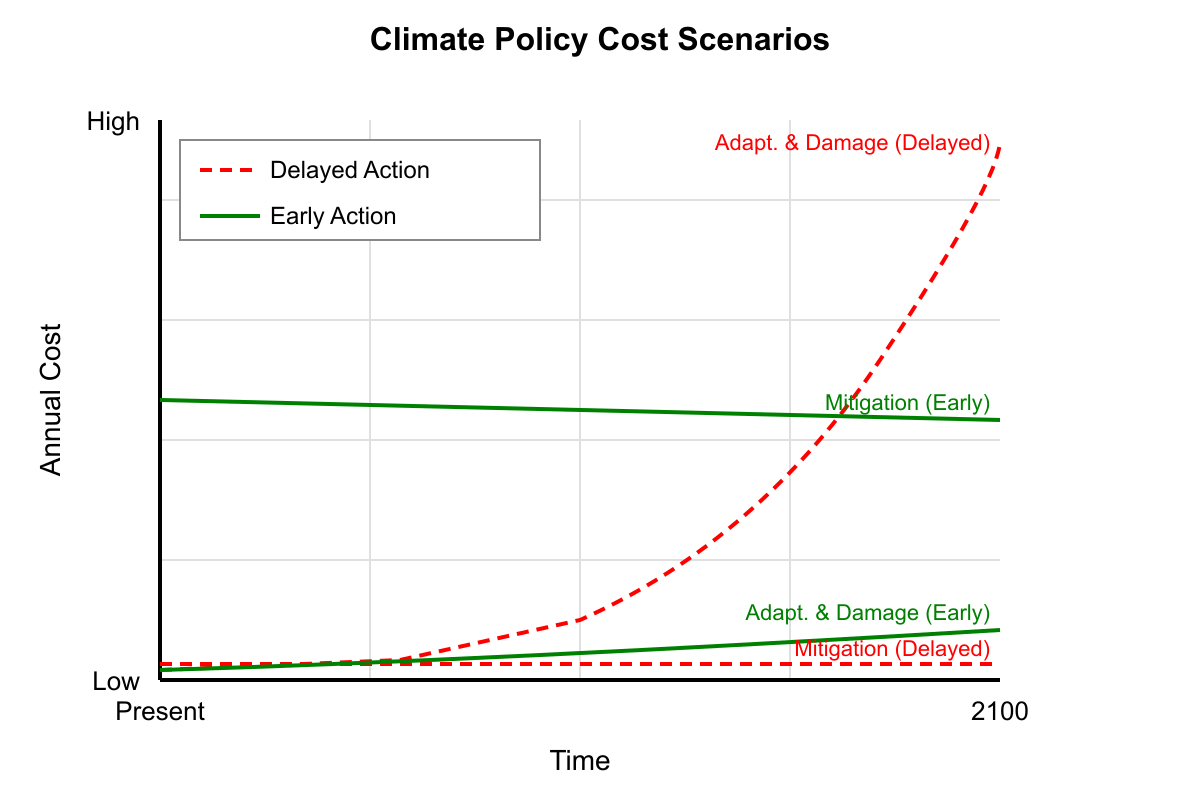
The graph shows projected costs for two different climate policy pathways over time. Which of the following statements most accurately interprets the central tradeoff illustrated by the two scenarios?
- The 'Early Action' scenario is ultimately more expensive because mitigation costs are high from the beginning.
- The 'Delayed Action' scenario allows for technological improvements that make future adaptation and mitigation less costly.
- Investing in mitigation in the near term, while costly upfront, is projected to lead to much lower total costs in the long run by reducing future climate damages and the need for adaptation. (correct answer)
- The graph shows that mitigation costs and adaptation costs are independent of each other, and policy should focus on reducing adaptation costs first.
Explanation: The graph illustrates a key concept in climate economics: the tradeoff between paying for mitigation now versus paying for adaptation and damages later. The 'Early Action' scenario shows a moderate, sustained cost for mitigation, but this investment keeps the 'Adaptation & Damage Cost' line very low. In contrast, the 'Delayed Action' scenario has low mitigation costs but results in exponentially rising adaptation and damage costs, leading to a much higher total cost by 2100. Therefore, the graph's central message is that near-term investment in mitigation is more cost-effective in the long run. A and B misinterpret the graph's outcome. D is incorrect as the graph explicitly shows that the level of mitigation action directly influences future adaptation costs.
Question 2
A large-scale afforestation project is proposed for a vast semi-arid savanna ecosystem, with the goal of sequestering carbon to mitigate climate change. Ecologists warn that, while it would achieve the carbon goal, planting dense forests in this native grassland environment could drastically lower the water table and threaten native species adapted to open, grassy habitats. This scenario highlights a potential conflict between:
- A climate mitigation goal and the conservation of a region's biodiversity and hydrological balance. (correct answer)
- A climate adaptation strategy and a climate mitigation strategy.
- A local environmental benefit and a global climate negative.
- A short-term mitigation success and a long-term mitigation failure.
Explanation: The proposal pits a single-minded climate mitigation goal (carbon sequestration) against other critical environmental values, namely the preservation of a unique, non-forest ecosystem (savanna) and the stability of its water resources. This is a classic example of a tradeoff where a climate solution can have unintended, severe negative consequences for biodiversity and ecosystem function. B is incorrect because afforestation is mitigation, not adaptation. C is reversed; the climate benefit is global, while the environmental harm is local/regional. D is not the best fit; the project might succeed at mitigation long-term, but at a high ecological cost.
Question 3
To protect against sea-level rise, a city invests in building a massive concrete seawall. In contrast, a neighboring city restores coastal wetlands and dunes. What is a key potential tradeoff of the seawall (a 'hard' engineering solution) that is largely avoided by the wetland restoration (a 'nature-based' solution)?
- The seawall can cause 'coastal squeeze,' where intertidal habitats are lost as they are trapped between the rising sea and the fixed barrier. (correct answer)
- The seawall provides a fixed level of protection that may be insufficient for future, more extreme sea-level rise.
- The seawall is significantly more expensive to maintain over the long term than a natural ecosystem.
- The seawall is a mitigation strategy, while the wetland is an adaptation strategy, creating a conflict in goals.
Explanation: When you encounter questions about coastal protection strategies, focus on understanding the fundamental differences between hard engineering solutions (like seawalls) and nature-based solutions (like wetland restoration), particularly their environmental impacts.
Coastal squeeze is a critical concept in coastal management. This phenomenon occurs when rising sea levels push marine environments landward, but hard structures like seawalls prevent this natural migration. The result is a "squeeze" where intertidal habitats—mudflats, salt marshes, and beaches—become progressively narrower and eventually disappear entirely. These ecosystems need space to migrate inland as sea levels rise, but the rigid seawall creates an impermeable barrier. In contrast, restored wetlands and dunes can naturally adapt and migrate inland over time, maintaining their ecological functions.
Let's examine why the other options miss the mark. Option B incorrectly suggests seawalls have fixed protection levels—they can actually be built to various heights and upgraded. Option C makes a broad cost claim that isn't universally true, as maintenance costs vary significantly based on local conditions and design. Option D fundamentally mischaracterizes both strategies; seawalls are adaptation (adjusting to sea-level rise), not mitigation (reducing greenhouse gas emissions), and both strategies actually serve the same adaptive goal.
The key study tip for coastal management questions: remember that hard engineering solutions often create unintended ecological consequences by disrupting natural processes, while nature-based solutions work with these processes. Watch for questions that test your understanding of how human infrastructure can trap or constrain natural ecosystem responses to environmental change.
Question 4
Consider two communities: Community A experiences a record-breaking flood and responds by building its levees two feet higher than the last flood crest. Community B uses climate projection models to estimate the 100-year flood level for the year 2050 and revises its building codes and infrastructure plans accordingly. The actions of these communities best illustrate the difference between:
- Mitigation (Community A) and adaptation (Community B).
- Hard engineering (Community A) and soft engineering (Community B).
- Reactive adaptation (Community A) and proactive (or anticipatory) adaptation (Community B). (correct answer)
- Structural protection (Community B) and institutional changes (Community A).
Explanation: Both communities are engaging in adaptation. However, Community A is responding to a disaster that has already happened, which is known as reactive adaptation. Community B is planning for future climate conditions based on scientific projections, which is known as proactive or anticipatory adaptation. This is a key conceptual distinction in adaptation planning. A is incorrect because both are adapting. B is an oversimplification; both could involve hard engineering. D reverses the classifications; building codes (B) are institutional, while levees (A) are structural.
Question 5
A government program heavily subsidizes the cultivation of corn for biofuel production, aiming to replace a portion of its gasoline consumption. While this is intended as a climate mitigation strategy, a significant tradeoff is that it leads to rising food prices and requires converting large areas of natural habitat to farmland. This unintended negative consequence is an example of:
- A synergistic policy, where climate and economic goals are mutually reinforced.
- A failure of adaptation, as the policy does not protect the nation from climate impacts.
- Maladaptation, where a strategy to cope with climate change results in increased vulnerability for some groups.
- A conflict between a mitigation strategy and other key sustainability goals like food security and biodiversity. (correct answer)
Explanation: The scenario describes a classic tradeoff where a mitigation strategy (biofuels to reduce GHG emissions) has negative impacts on other important areas (food prices, land use, biodiversity). This represents a conflict with broader sustainability goals. Option A is incorrect because the consequences are negative, not synergistic. Option B is incorrect because the primary goal of the policy is mitigation, not adaptation. Option C, while related, is less precise; maladaptation typically refers to adaptation actions that backfire or increase vulnerability, whereas this question concerns a mitigation action with negative side-effects.
Question 6
A city in a warm climate initiates a program to paint roofs and pavements with reflective white coatings. The primary intended outcome is to reduce the urban heat island effect, lowering local air temperatures and decreasing the need for air conditioning. This program is best described as:
- Primarily a mitigation strategy, because it directly reflects solar energy that would otherwise be trapped by greenhouse gases.
- Primarily an adaptation strategy, because its main goal is to reduce the community's vulnerability to extreme heat. (correct answer)
- A geoengineering strategy, as it involves altering the Earth's energy balance on a large scale.
- Neither mitigation nor adaptation, as it is a standard urban planning technique unrelated to climate change.
Explanation: The program's primary goal is to cope with an impact of climate change—increased extreme heat. Therefore, it is an adaptation strategy. While there is a secondary mitigation benefit (reducing energy use for A/C, thus lowering emissions), the main purpose is to adapt to higher temperatures. A is incorrect because reflecting sunlight locally doesn't affect the concentration of greenhouse gases. C is incorrect as this is a local-scale action, not a large-scale intervention in the global climate system like stratospheric aerosol injection. D is incorrect because these programs are now explicitly part of climate action plans.
Question 7
Geoengineering strategies are large-scale interventions in the Earth's climate system. Consider two proposed types: Solar Radiation Management (SRM), which aims to reflect sunlight back to space, and Carbon Dioxide Removal (CDR), which aims to capture and sequester atmospheric CO₂. How do these strategies relate to the concepts of mitigation and adaptation?
- SRM is a form of mitigation because it lowers global temperatures, while CDR is a form of adaptation because it helps ecosystems recover.
- SRM is best conceptualized as addressing climate impacts (adaptation), as it counters warming without reducing GHG levels; CDR is a form of mitigation as it addresses the root cause (GHG concentration). (correct answer)
- Both SRM and CDR are mitigation strategies because they are proactive, large-scale interventions designed to control the global climate.
- Both SRM and CDR are adaptation strategies because they do not involve reducing emissions at their source, but rather deal with the consequences.
Explanation: This question tests a subtle distinction. Mitigation targets the root cause of warming: the concentration of greenhouse gases. CDR techniques, like direct air capture, directly reduce this concentration, so they are a form of mitigation. Adaptation addresses the impacts or symptoms of warming. SRM techniques, like stratospheric aerosol injection, aim to reduce incoming solar radiation to cool the planet, treating the symptom (high temperature) without addressing the root cause (high GHG levels). Therefore, SRM functions more like an adaptation or symptom-relief strategy, whereas CDR is true mitigation.
Question 8
A coastal city is experiencing more frequent flooding during high tides and storms. City planners propose two initiatives: 1) converting the city's vehicle fleet to electric power and subsidizing residential solar panels, and 2) updating zoning laws to restrict new development in areas identified as future floodplains. How are these two initiatives best classified?
- Initiative 1 is adaptation because it reduces the city's vulnerability to energy price shocks; Initiative 2 is mitigation because it reduces future property damage.
- Initiative 1 is mitigation because it reduces greenhouse gas emissions; Initiative 2 is adaptation because it lowers the community's vulnerability to climate impacts. (correct answer)
- Both initiatives are forms of mitigation because they aim to reduce the overall environmental impact of the city.
- Both initiatives are forms of adaptation because they are direct responses to the observed problem of flooding.
Explanation: Mitigation strategies aim to reduce the causes of climate change (i.e., greenhouse gas emissions), while adaptation strategies aim to reduce vulnerability to the effects of climate change. Initiative 1 (electric vehicles, solar panels) reduces the city's carbon footprint, which is a mitigation effort. Initiative 2 (zoning changes) is a direct response to the impact of sea-level rise and flooding, aiming to reduce future harm, which is an adaptation effort. A incorrectly classifies both. C and D incorrectly lump both initiatives into a single category, failing to distinguish between addressing causes versus effects.
Question 9
A nationwide campaign is launched to reduce plastic pollution by banning single-use plastic bags and promoting reusable containers. How does this policy primarily relate to the core goals of climate change mitigation and adaptation?
- It is a strong mitigation strategy because plastic production is a major source of greenhouse gas emissions.
- It is a key adaptation strategy because reducing plastic waste makes ecosystems more resilient to climate impacts.
- It is a form of both mitigation and adaptation by reducing emissions and enhancing ecosystem health.
- It is primarily a general environmental policy with only indirect and relatively minor links to core climate mitigation and adaptation goals. (correct answer)
Explanation: This question tests the ability to distinguish climate-specific strategies from general environmentalism. While plastic production does consume fossil fuels and generate emissions, it is a relatively small fraction compared to energy, transport, and industry. Thus, reducing plastic use is not considered a primary mitigation lever. Similarly, while less plastic is good for ecosystems, it is not a direct, core strategy for adapting to climate impacts like sea-level rise or drought. The policy's main goal is waste reduction, making its connection to climate change indirect and secondary compared to strategies like shifting to renewable energy or building flood defenses.
Question 10
An inland agricultural community facing increasingly severe droughts invests heavily in building a pipeline to draw water from a distant mountain river, whose flow is primarily sustained by a rapidly shrinking glacier. Why might this strategy be considered a form of maladaptation?
- Because the pipeline infrastructure is expensive and has a large carbon footprint to build and operate.
- Because it relies on a climate-vulnerable water source, potentially locking the community into a future of greater water insecurity. (correct answer)
- Because it is a technological solution rather than a natural one, such as planting drought-resistant crops.
- Because it only addresses the symptoms of drought rather than the root cause, which is global greenhouse gas emissions.
Explanation: Maladaptation refers to adaptation actions that may have short-term benefits but ultimately increase vulnerability in the long term. By investing in infrastructure that depends on a water source (a glacier) that is itself disappearing due to climate change, the community is setting itself up for a more severe crisis in the future when that source fails. This creates a dependency on an unreliable resource. A describes a mitigation tradeoff, not maladaptation. C presents a false dichotomy; technological solutions are not inherently maladaptive. D is incorrect because adaptation, by definition, addresses symptoms (impacts), not root causes; that is the role of mitigation.
Question 11
A farmer in a region prone to droughts adopts no-till agricultural practices, where the soil is not disturbed after a harvest and crop residue is left on the surface. This practice is promoted as a climate-friendly strategy. What are the respective mitigation and adaptation benefits of this change?
- Mitigation: enhanced carbon sequestration in the soil. Adaptation: improved soil moisture retention. (correct answer)
- Mitigation: increased reflection of sunlight from the residue. Adaptation: reduced need for synthetic fertilizers.
- Mitigation: decreased water usage from the farm. Adaptation: capture of nitrogen from the atmosphere.
- Mitigation: reduced soil erosion. Adaptation: increased carbon content in the soil.
Explanation: When you encounter climate strategy questions, remember that mitigation reduces greenhouse gas emissions or enhances carbon storage, while adaptation helps communities cope with climate impacts that are already occurring.
No-till farming provides clear benefits in both categories. For mitigation, leaving soil undisturbed allows organic matter to accumulate and decompose slowly, creating long-term carbon storage in the soil - this is enhanced carbon sequestration. For adaptation in drought-prone regions, the crop residue left on the surface acts like a protective blanket, reducing evaporation and helping soil retain moisture during dry periods.
Looking at the incorrect options: Option B misidentifies the mechanisms - while crop residue may reflect some sunlight, this isn't the primary mitigation benefit, and reduced fertilizer use is more of an economic benefit than climate adaptation. Option C reverses the relationship - decreased water usage could be seen as adaptation to drought, but nitrogen capture isn't a significant mitigation benefit of no-till practices. Option D completely flips the concepts - soil erosion reduction helps the farm adapt to weather extremes, while increased soil carbon content mitigates climate change by storing atmospheric CO₂.
The key study tip here is to clearly distinguish mitigation (preventing/reducing climate change) from adaptation (adjusting to climate change effects). Mitigation typically involves carbon, emissions, or energy, while adaptation focuses on resilience to weather extremes, sea level rise, or temperature changes. Always ask yourself: "Does this reduce the cause of climate change or help deal with its effects?"
Question 12
A developing country plans to build a large hydroelectric dam. The project is promoted as a climate solution because it will generate carbon-free electricity (mitigation) and the reservoir will provide a reliable water supply for irrigation during projected future droughts (adaptation). However, the project requires the relocation of thousands of people and will permanently flood a biodiverse forest. Which statement provides the most complete assessment of this project?
- The project is a perfect example of sustainable development with no significant downsides.
- The project is primarily a mitigation strategy, with the adaptation claims being used to justify its negative impacts.
- The project represents a combination of mitigation and adaptation strategies but involves significant social and ecological tradeoffs. (correct answer)
- The project is primarily an adaptation strategy, as its main purpose is to manage water resources in a changing climate.
Explanation: When evaluating large-scale environmental projects, you need to assess both their intended benefits and unintended consequences across multiple dimensions: climate impact, social effects, and ecological outcomes. This question tests your ability to recognize the complexity of real-world sustainability challenges.
The hydroelectric dam project clearly demonstrates both climate mitigation (reducing carbon emissions through renewable energy) and adaptation (building resilience against future droughts through water storage). However, the project also creates significant negative impacts: forced displacement of communities and destruction of biodiverse ecosystems. This makes option C correct—it's the only choice that acknowledges both the legitimate climate benefits and the serious tradeoffs involved.
Option A is wrong because it ignores the substantial downsides mentioned in the scenario. No project that displaces thousands of people and destroys forests can be called sustainable "with no significant downsides." Option B incorrectly suggests the adaptation benefits are merely justification rather than genuine—the reservoir really would provide drought resilience. Option D mischaracterizes the project's scope by claiming water management is the "main purpose" when the carbon-free electricity generation is equally central.
Remember that on earth science exams, questions about environmental projects often test whether you can think holistically rather than focusing on just one aspect. Real sustainability assessments require weighing multiple competing factors—environmental benefits, social costs, and ecological impacts—rather than viewing projects as simply "good" or "bad."
Question 13
To cope with more frequent and severe droughts, a city water utility invests in diversifying its water portfolio. Instead of relying solely on a surface reservoir, it implements large-scale water recycling, a new desalination plant, and an aquifer storage and recovery system. This multi-pronged approach is primarily an example of which adaptation principle?
- Building redundancy and resilience to reduce vulnerability to a single point of failure. (correct answer)
- Implementing a mitigation strategy by reducing the energy intensity of water treatment.
- Focusing on a single, robust engineering solution to climate-proof the water supply.
- Prioritizing nature-based solutions over technological ones for long-term sustainability.
Explanation: The core principle demonstrated is building resilience through diversification and redundancy. By developing multiple, independent water sources (recycling, desalination, groundwater), the city is no longer solely dependent on its reservoir, which is vulnerable to drought. If one source fails, others can compensate. This reduces the system's overall vulnerability. B is incorrect; desalination is very energy-intensive, likely increasing emissions (a mitigation tradeoff). C is the opposite of what is being done; the city is moving away from a single solution. D is also incorrect, as the solutions described are primarily technological, not nature-based.
Question 14
A national building code is updated to require that all new construction be 30% more energy efficient. What is the most accurate classification and primary rationale for this policy in the context of climate change?
- It is an adaptation policy because energy-efficient buildings are more resilient to power outages during extreme weather events.
- It is a mitigation policy because it directly sequesters carbon in the building materials used for construction.
- It is a mitigation policy because reducing energy consumption in buildings lowers the overall demand for electricity, a major source of greenhouse gas emissions. (correct answer)
- It is an adaptation policy because it lowers energy costs for occupants, helping them adapt to the economic impacts of climate change.
Explanation: When analyzing climate policies, you need to distinguish between mitigation (reducing greenhouse gas emissions) and adaptation (adjusting to climate change impacts). The key is identifying whether the policy primarily addresses the cause or the effects of climate change.
This building code requiring 30% greater energy efficiency is fundamentally a mitigation policy. Buildings consume about 40% of global energy, and most electricity still comes from fossil fuel combustion that releases CO₂. By mandating more efficient buildings, the policy directly reduces energy demand, which translates to lower greenhouse gas emissions from power plants. This addresses the root cause of climate change by reducing the emissions entering the atmosphere.
Answer A incorrectly classifies this as adaptation. While energy-efficient buildings might be somewhat more resilient during power outages, the policy's primary purpose isn't preparing for extreme weather—it's reducing energy consumption overall.
Answer B misunderstands mitigation mechanisms. The policy doesn't work by sequestering carbon in building materials. Carbon sequestration involves capturing and storing CO₂, whereas this policy reduces emissions through lower energy demand.
Answer D also misclassifies this as adaptation. Though lower energy costs might help occupants economically, the policy's main objective isn't helping people adjust to climate impacts—it's preventing those impacts by reducing emissions.
Remember: mitigation policies target emission sources (energy, transportation, industry), while adaptation policies help communities cope with unavoidable climate impacts (sea-level rise, extreme weather, changing precipitation patterns). Focus on the policy's primary mechanism and objective.
Question 15
Geoengineering strategies are large-scale interventions in the Earth's climate system. Consider two proposed types: Solar Radiation Management (SRM), which aims to reflect sunlight back to space, and Carbon Dioxide Removal (CDR), which aims to capture and sequester atmospheric CO₂. How do these strategies relate to the concepts of mitigation and adaptation?
- SRM is a form of mitigation because it lowers global temperatures, while CDR is a form of adaptation because it helps ecosystems recover.
- SRM is best conceptualized as addressing climate impacts (adaptation), as it counters warming without reducing GHG levels; CDR is a form of mitigation as it addresses the root cause (GHG concentration). (correct answer)
- Both SRM and CDR are mitigation strategies because they are proactive, large-scale interventions designed to control the global climate.
- Both SRM and CDR are adaptation strategies because they do not involve reducing emissions at their source, but rather deal with the consequences.
Explanation: This question tests a subtle distinction. Mitigation targets the root cause of warming: the concentration of greenhouse gases. CDR techniques, like direct air capture, directly reduce this concentration, so they are a form of mitigation. Adaptation addresses the impacts or symptoms of warming. SRM techniques, like stratospheric aerosol injection, aim to reduce incoming solar radiation to cool the planet, treating the symptom (high temperature) without addressing the root cause (high GHG levels). Therefore, SRM functions more like an adaptation or symptom-relief strategy, whereas CDR is true mitigation.
Question 16
A farmer in a region prone to droughts adopts no-till agricultural practices, where the soil is not disturbed after a harvest and crop residue is left on the surface. This practice is promoted as a climate-friendly strategy. What are the respective mitigation and adaptation benefits of this change?
- Mitigation: enhanced carbon sequestration in the soil. Adaptation: improved soil moisture retention. (correct answer)
- Mitigation: increased reflection of sunlight from the residue. Adaptation: reduced need for synthetic fertilizers.
- Mitigation: decreased water usage from the farm. Adaptation: capture of nitrogen from the atmosphere.
- Mitigation: reduced soil erosion. Adaptation: increased carbon content in the soil.
Explanation: When you encounter climate strategy questions, remember that mitigation reduces greenhouse gas emissions or enhances carbon storage, while adaptation helps communities cope with climate impacts that are already occurring.
No-till farming provides clear benefits in both categories. For mitigation, leaving soil undisturbed allows organic matter to accumulate and decompose slowly, creating long-term carbon storage in the soil - this is enhanced carbon sequestration. For adaptation in drought-prone regions, the crop residue left on the surface acts like a protective blanket, reducing evaporation and helping soil retain moisture during dry periods.
Looking at the incorrect options: Option B misidentifies the mechanisms - while crop residue may reflect some sunlight, this isn't the primary mitigation benefit, and reduced fertilizer use is more of an economic benefit than climate adaptation. Option C reverses the relationship - decreased water usage could be seen as adaptation to drought, but nitrogen capture isn't a significant mitigation benefit of no-till practices. Option D completely flips the concepts - soil erosion reduction helps the farm adapt to weather extremes, while increased soil carbon content mitigates climate change by storing atmospheric CO₂.
The key study tip here is to clearly distinguish mitigation (preventing/reducing climate change) from adaptation (adjusting to climate change effects). Mitigation typically involves carbon, emissions, or energy, while adaptation focuses on resilience to weather extremes, sea level rise, or temperature changes. Always ask yourself: "Does this reduce the cause of climate change or help deal with its effects?"
Question 17
To protect against sea-level rise, a city invests in building a massive concrete seawall. In contrast, a neighboring city restores coastal wetlands and dunes. What is a key potential tradeoff of the seawall (a 'hard' engineering solution) that is largely avoided by the wetland restoration (a 'nature-based' solution)?
- The seawall can cause 'coastal squeeze,' where intertidal habitats are lost as they are trapped between the rising sea and the fixed barrier. (correct answer)
- The seawall provides a fixed level of protection that may be insufficient for future, more extreme sea-level rise.
- The seawall is significantly more expensive to maintain over the long term than a natural ecosystem.
- The seawall is a mitigation strategy, while the wetland is an adaptation strategy, creating a conflict in goals.
Explanation: When you encounter questions about coastal protection strategies, focus on understanding the fundamental differences between hard engineering solutions (like seawalls) and nature-based solutions (like wetland restoration), particularly their environmental impacts.
Coastal squeeze is a critical concept in coastal management. This phenomenon occurs when rising sea levels push marine environments landward, but hard structures like seawalls prevent this natural migration. The result is a "squeeze" where intertidal habitats—mudflats, salt marshes, and beaches—become progressively narrower and eventually disappear entirely. These ecosystems need space to migrate inland as sea levels rise, but the rigid seawall creates an impermeable barrier. In contrast, restored wetlands and dunes can naturally adapt and migrate inland over time, maintaining their ecological functions.
Let's examine why the other options miss the mark. Option B incorrectly suggests seawalls have fixed protection levels—they can actually be built to various heights and upgraded. Option C makes a broad cost claim that isn't universally true, as maintenance costs vary significantly based on local conditions and design. Option D fundamentally mischaracterizes both strategies; seawalls are adaptation (adjusting to sea-level rise), not mitigation (reducing greenhouse gas emissions), and both strategies actually serve the same adaptive goal.
The key study tip for coastal management questions: remember that hard engineering solutions often create unintended ecological consequences by disrupting natural processes, while nature-based solutions work with these processes. Watch for questions that test your understanding of how human infrastructure can trap or constrain natural ecosystem responses to environmental change.
Question 18
A developing country plans to build a large hydroelectric dam. The project is promoted as a climate solution because it will generate carbon-free electricity (mitigation) and the reservoir will provide a reliable water supply for irrigation during projected future droughts (adaptation). However, the project requires the relocation of thousands of people and will permanently flood a biodiverse forest. Which statement provides the most complete assessment of this project?
- The project is a perfect example of sustainable development with no significant downsides.
- The project is primarily a mitigation strategy, with the adaptation claims being used to justify its negative impacts.
- The project represents a combination of mitigation and adaptation strategies but involves significant social and ecological tradeoffs. (correct answer)
- The project is primarily an adaptation strategy, as its main purpose is to manage water resources in a changing climate.
Explanation: When evaluating large-scale environmental projects, you need to assess both their intended benefits and unintended consequences across multiple dimensions: climate impact, social effects, and ecological outcomes. This question tests your ability to recognize the complexity of real-world sustainability challenges.
The hydroelectric dam project clearly demonstrates both climate mitigation (reducing carbon emissions through renewable energy) and adaptation (building resilience against future droughts through water storage). However, the project also creates significant negative impacts: forced displacement of communities and destruction of biodiverse ecosystems. This makes option C correct—it's the only choice that acknowledges both the legitimate climate benefits and the serious tradeoffs involved.
Option A is wrong because it ignores the substantial downsides mentioned in the scenario. No project that displaces thousands of people and destroys forests can be called sustainable "with no significant downsides." Option B incorrectly suggests the adaptation benefits are merely justification rather than genuine—the reservoir really would provide drought resilience. Option D mischaracterizes the project's scope by claiming water management is the "main purpose" when the carbon-free electricity generation is equally central.
Remember that on earth science exams, questions about environmental projects often test whether you can think holistically rather than focusing on just one aspect. Real sustainability assessments require weighing multiple competing factors—environmental benefits, social costs, and ecological impacts—rather than viewing projects as simply "good" or "bad."
Question 19
A city government addresses increased flood risk in a low-lying residential area by offering to buy the properties at market value, demolishing the homes, and converting the area into a park that can absorb floodwaters. While this is an effective adaptation strategy, what is a primary social equity tradeoff that must be considered?
- The cost of purchasing the properties may divert funds from mitigation efforts like renewable energy projects.
- The new park may not be able to handle the most extreme future floods projected by climate models.
- The strategy may lead to the displacement of an established community, potentially breaking up social networks and access to local services. (correct answer)
- Converting residential land to parkland reduces the city's property tax base, impacting its budget for other services.
Explanation: When evaluating climate adaptation strategies, you need to consider not just their environmental effectiveness, but also their social impacts, particularly on vulnerable communities. Managed retreat—where governments buy out properties in high-risk areas—is a common flood adaptation strategy, but it raises significant social equity concerns.
The correct answer is C because displacement fundamentally disrupts people's lives beyond just losing their homes. When entire neighborhoods are bought out, residents lose their established social networks, proximity to family and friends, familiarity with local services like schools and healthcare, and often their sense of community identity. Low-income residents may be particularly vulnerable since they have fewer resources to relocate to similar neighborhoods and may end up in areas with fewer services or opportunities.
Answer A incorrectly frames this as a mitigation versus adaptation funding issue, but the question specifically asks about social equity tradeoffs, not budget allocation between climate strategies. Answer B focuses on the technical effectiveness of the flood management approach rather than social impacts—while future flood capacity is important, it's not a social equity concern. Answer D addresses economic impacts on the city's budget, which is a valid consideration but not the primary social equity issue affecting the displaced residents themselves.
When you see questions about climate adaptation strategies, always consider who bears the costs and benefits. Effective solutions from an engineering perspective can still create significant social justice concerns, especially for marginalized communities who often have the least voice in planning decisions.
Question 20
A national building code is updated to require that all new construction be 30% more energy efficient. What is the most accurate classification and primary rationale for this policy in the context of climate change?
- It is an adaptation policy because energy-efficient buildings are more resilient to power outages during extreme weather events.
- It is a mitigation policy because it directly sequesters carbon in the building materials used for construction.
- It is a mitigation policy because reducing energy consumption in buildings lowers the overall demand for electricity, a major source of greenhouse gas emissions. (correct answer)
- It is an adaptation policy because it lowers energy costs for occupants, helping them adapt to the economic impacts of climate change.
Explanation: When analyzing climate policies, you need to distinguish between mitigation (reducing greenhouse gas emissions) and adaptation (adjusting to climate change impacts). The key is identifying whether the policy primarily addresses the cause or the effects of climate change.
This building code requiring 30% greater energy efficiency is fundamentally a mitigation policy. Buildings consume about 40% of global energy, and most electricity still comes from fossil fuel combustion that releases CO₂. By mandating more efficient buildings, the policy directly reduces energy demand, which translates to lower greenhouse gas emissions from power plants. This addresses the root cause of climate change by reducing the emissions entering the atmosphere.
Answer A incorrectly classifies this as adaptation. While energy-efficient buildings might be somewhat more resilient during power outages, the policy's primary purpose isn't preparing for extreme weather—it's reducing energy consumption overall.
Answer B misunderstands mitigation mechanisms. The policy doesn't work by sequestering carbon in building materials. Carbon sequestration involves capturing and storing CO₂, whereas this policy reduces emissions through lower energy demand.
Answer D also misclassifies this as adaptation. Though lower energy costs might help occupants economically, the policy's main objective isn't helping people adjust to climate impacts—it's preventing those impacts by reducing emissions.
Remember: mitigation policies target emission sources (energy, transportation, industry), while adaptation policies help communities cope with unavoidable climate impacts (sea-level rise, extreme weather, changing precipitation patterns). Focus on the policy's primary mechanism and objective.