All questions
Question 1
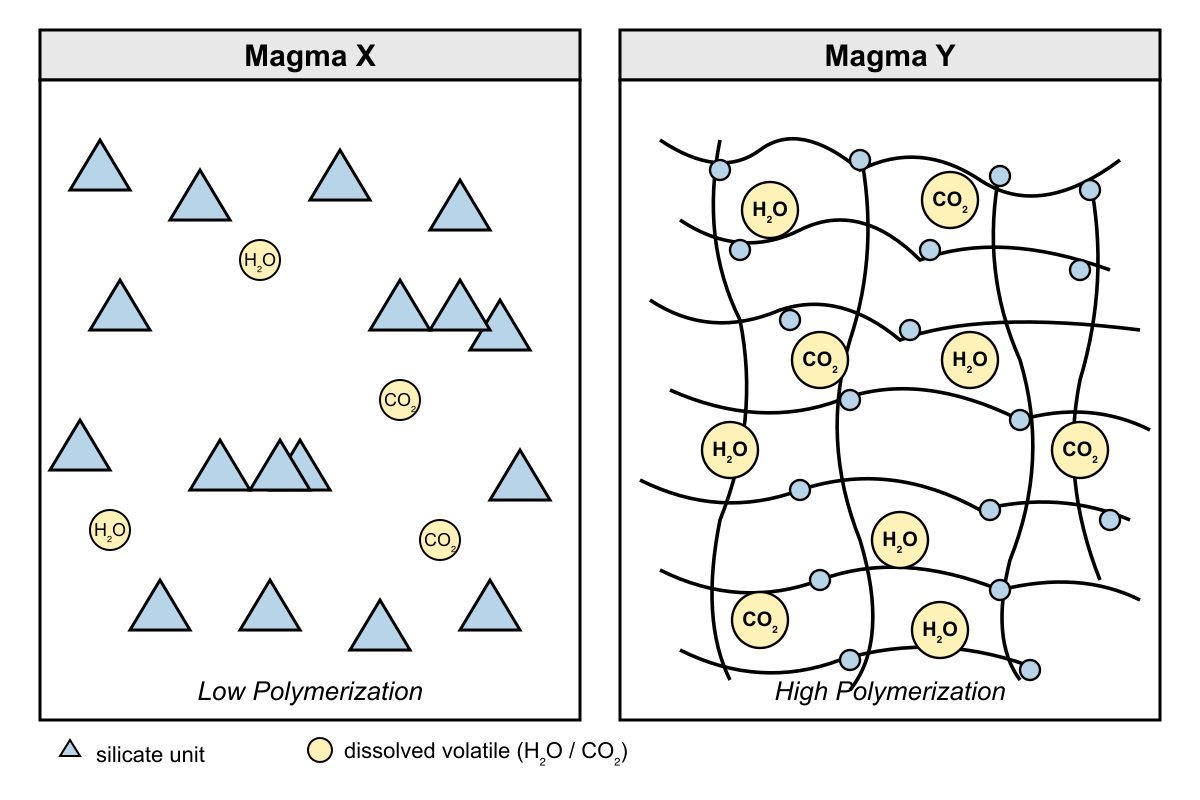
The diagram below shows two schematic representations of magma at a molecular level. Based on these diagrams, which statement correctly predicts the likely eruption styles?
- Magma X would be more explosive because its simple structure allows gas bubbles to move and coalesce freely into larger, more powerful pockets.
- Magma Y would likely produce a highly explosive eruption due to its interconnected silicate network and high concentration of volatiles. (correct answer)
- Magma X would erupt effusively as a lava flow, while Magma Y would be too viscous to ever reach the surface.
- Both magmas would erupt effusively, as the presence of volatiles (H₂O, CO₂) is known to decrease the viscosity of all magma types.
Explanation: Magma Y is depicted with a complex, interconnected network of silicate structures, which represents a high degree of polymerization. This is characteristic of high-silica (felsic) magma, which has very high viscosity. The diagram also shows a large number of volatile molecules (H₂O, CO₂). The combination of high viscosity (which traps gases) and high volatile content is the classic recipe for a highly explosive eruption. Magma X, with its simple, disconnected structures and fewer volatiles, represents a low-viscosity, low-gas magma that would erupt effusively.
Question 2
Two magmas have identical chemical compositions and volatile contents. However, Magma A is 1100°C, while Magma B is 900°C. Assuming all other factors are equal, how would their eruption styles most likely differ?
- Magma A would be more likely to erupt explosively because its higher temperature would cause volatiles to expand more rapidly.
- Magma B would be more likely to erupt explosively because its lower temperature results in a significantly higher viscosity. (correct answer)
- Both magmas would erupt with identical styles because eruption style is determined by composition and volatile content, which are the same.
- Magma B would produce faster and more extensive lava flows due to the thermal energy difference.
Explanation: Temperature has an inverse relationship with viscosity; a hotter magma is less viscous (more fluid), and a cooler magma is more viscous (thicker). Although the magmas have the same composition and volatile content, the cooler Magma B will be substantially more viscous. This higher viscosity will impede the escape of dissolved gases, allowing pressure to build up and increasing the probability of a violent, explosive eruption. Magma A's lower viscosity would allow gases to escape more easily, favoring a more effusive eruption.
Question 3
A thick geologic deposit is identified as a welded tuff, which consists of volcanic ash and pumice fragments that were hot enough to fuse together after deposition. The existence of this deposit implies that its source eruption was:
- effusive, involving the slow cooling and solidification of a low-viscosity lava flow.
- explosive, producing a high-temperature pyroclastic flow from a viscous, gas-rich magma. (correct answer)
- phreatic, caused by a steam explosion that ejected fragments of pre-existing rock without new magma.
- intrusive, with the magma body cooling beneath the surface and later being exposed by erosion.
Explanation: A welded tuff is a hallmark of a large, explosive eruption. The ash and pumice fragments are created by the violent fragmentation of magma. For these fragments to be hot enough to weld together after they have been deposited on the ground, they must have been transported from the vent very rapidly and at very high temperatures. This occurs in a pyroclastic flow. Pyroclastic flows are generated during explosive eruptions of viscous, gas-rich magma (typically dacitic to rhyolitic).
Question 4
A large, mafic magma chamber located within thick continental crust undergoes extensive fractional crystallization before any eruption occurs. How does this magmatic process alter the likely eruption style?
- The eruption is more likely to be effusive because crystallization removes solid components, making the magma more fluid.
- The eruption is more likely to be explosive because the residual magma becomes enriched in silica and thus more viscous. (correct answer)
- The eruption style is unlikely to change because the initial volatile content of the magma remains the same.
- The eruption is more likely to be effusive because the loss of heat during crystallization results in a less energetic magma.
Explanation: Fractional crystallization in a mafic magma involves the early formation and removal of minerals that are low in silica (e.g., olivine, pyroxene). This process systematically removes magnesium and iron from the melt while leaving silica behind. As a result, the remaining liquid magma becomes progressively enriched in silica, evolving its composition towards intermediate or felsic. This increase in silica content leads to a significant increase in viscosity, which enhances the magma's ability to trap gases and makes a future eruption far more likely to be explosive.
Question 5
A monitoring team at a stratovolcano observes that gas emissions have become richer in sulfur dioxide (SO₂) and that the ground is swelling. These data suggest a new batch of undegassed magma is rising from depth. How would this influx of new magma most likely change the immediate eruption hazard?
- The hazard increases, as the injection of gas-rich magma can pressurize the volcanic system and trigger a violent eruption. (correct answer)
- The hazard decreases, as the new, hotter magma will lower the viscosity of the resident magma, allowing trapped gas to escape.
- The hazard shifts from explosive to effusive, as the undegassed magma is likely more mafic and fluid.
- The hazard is unchanged because ground swelling is a common, non-threatening phenomenon at active volcanoes.
Explanation: Ground swelling (inflation) indicates that magma is accumulating beneath the volcano, increasing pressure. A shift to SO₂-rich gas emissions signals that a fresh, gas-rich (undegassed) magma is nearing the surface. The injection of this new, hot, volatile-rich magma into the existing magma chamber can rapidly increase the pressure of the entire system. This pressurization can destabilize the existing, often more evolved and viscous, magma, leading to a catastrophic failure of the overlying rock and triggering a highly explosive eruption.
Question 6
During a prolonged eruption from a single magma chamber, geochemical analysis of successive ash deposits shows a steady increase in silica (SiO₂) concentration. How would this compositional change most likely affect the eruption's style and associated hazards over time?
- The eruption would become progressively more effusive, with lava flows traveling farther from the vent.
- The eruption would become more explosive, with an increasing likelihood of powerful blasts and pyroclastic flows. (correct answer)
- The eruption's intensity would decrease as the magma becomes too thick to move, eventually ceasing all activity.
- The eruption style would remain constant, but the color of the resulting volcanic rock would become darker.
Explanation: An increase in silica (SiO₂) concentration significantly increases the viscosity of the magma due to greater polymerization of silica tetrahedra. Higher viscosity magma is more effective at trapping dissolved gases (volatiles). As this more viscous, gas-rich magma rises, the trapped gases expand, leading to a higher potential for explosive fragmentation. This increases the likelihood of explosive blasts, large ash columns, and dangerous pyroclastic flows.
Question 7
The viscosity of a silicate magma is primarily controlled by the degree of polymerization of silica tetrahedra. Which of the following scenarios describes a magma most likely to result in an effusive eruption dominated by fluid lava flows?
- A low-temperature, felsic magma where silicate structures form extensive, interconnected networks.
- A high-temperature, mafic magma where silicate chains are short and movement between them is easy. (correct answer)
- A magma chamber that has assimilated a large amount of continental crust, increasing its overall SiO₂ content.
- A magma in which dissolved water has exsolved to form a high concentration of bubbles that obstruct flow paths.
Explanation: Effusive eruptions are characterized by fluid, low-viscosity lava. Viscosity is low when the polymerization of silica tetrahedra is limited. This condition is met in high-temperature, mafic (low-silica) magmas. The high heat provides kinetic energy that helps break bonds, and the lower silica content means there are fewer building blocks to form complex networks. The result is a fluid magma where gases can escape easily, allowing it to erupt effusively.
Question 8
Future astronauts on another planet discover a vast volcanic province composed primarily of broad, gently sloping shield volcanoes, each hundreds of kilometers in diameter. Based on these landforms, what is the most logical inference about the properties of the magma that formed them?
- The magma had a high viscosity and a high gas content, resulting in frequent, powerful eruptions from a central vent.
- The magma was extremely rich in silica but poor in dissolved gases, causing it to ooze out and pile up in thick layers.
- The magma had a low viscosity and a low silica content, allowing it to flow easily over great distances. (correct answer)
- The magma had a very low temperature, which caused it to solidify rapidly into steep-sided volcanic cones.
Explanation: Shield volcanoes are built up by successive, voluminous flows of fluid lava. For lava to travel hundreds of kilometers and form gentle slopes, it must have a very low viscosity. Low viscosity in silicate magmas is characteristic of low silica content (i.e., mafic or basaltic compositions). In such fluid magmas, dissolved gases can escape readily without building up enough pressure for a catastrophic explosion, leading to the effusive style of eruption that builds shield volcanoes.
Question 9
A body of magma at great depth contains a high concentration of dissolved water. As this magma rises towards the surface, what is the primary mechanism that can trigger a catastrophic, explosive eruption?
- The magma's temperature increases as it rises, which causes the dissolved water to flash boil.
- The dissolved water chemically reacts with the silicate melt, releasing a burst of thermal energy.
- The reduction in confining pressure causes the dissolved water to exsolve and form rapidly expanding bubbles. (correct answer)
- The water acts as a flux, significantly decreasing the magma's viscosity and causing it to accelerate up the conduit.
Explanation: The solubility of volatiles like water in magma is highly dependent on pressure. At great depth, high confining pressure keeps the water dissolved. As the magma rises, this pressure decreases. This reduction in pressure is called decompression. Decompression lowers the solubility of the water, forcing it to come out of solution (exsolve) and form gas bubbles. In a viscous magma, these bubbles cannot escape. They continue to grow and expand violently as pressure drops further, ultimately fragmenting the magma into ash and driving an explosive eruption.
Question 10
Two magmas possess identical high volatile contents and viscosities. Magma A rises slowly through a pre-existing network of interconnected fractures, while Magma B ascends rapidly through a single, well-sealed conduit. How will their surface eruptions most likely differ?
- Magma B will likely erupt explosively, while Magma A may erupt more effusively as a degassed lava. (correct answer)
- Magma A will be more explosive because the fractured rock provides additional material to be ejected.
- Magma B will be less explosive because the rapid ascent does not allow time for gas bubbles to form.
- Both will erupt with identical explosivity because their intrinsic magma properties are the same.
Explanation: For an explosive eruption to occur, volatiles must remain trapped until the magma reaches a low-pressure environment near the surface. In the case of Magma A, the slow ascent through a fractured network provides pathways for the dissolved gases to escape from the magma before it reaches the surface. This degassing process reduces the internal pressure. In contrast, Magma B's rapid ascent through a sealed conduit prevents gas from escaping. When this pressurized magma reaches the surface, the sudden drop in confining pressure causes catastrophic bubble growth and a violent, explosive eruption.
Question 11
Hawaiian-style eruptions are characterized by spectacular fire fountains that can jet molten rock hundreds of meters into the air. This specific eruption style is a direct consequence of which combination of magma properties?
- High viscosity and high gas content, which cause the magma to fragment into a towering ash column.
- High viscosity and low gas content, which results in the slow extrusion of a solidifying plug.
- Low viscosity and low gas content, which leads to a quiet, steady outpouring of lava from a fissure.
- Low viscosity and high gas content, which allows rapid gas expansion to propel fluid lava without complete fragmentation. (correct answer)
Explanation: Fire fountains are driven by the rapid expansion of gas bubbles. This requires a relatively high gas content. However, unlike highly explosive Plinian eruptions, the magma is fluid (low viscosity). This low viscosity allows the gas bubbles to expand and coalesce easily, creating a powerful jet that propels clots of liquid lava. The magma is not viscous enough to trap the gas to the point of catastrophic fragmentation into fine ash, but it is gas-rich enough to create the fountaining effect. This combination of low viscosity and high gas content is characteristic of Hawaiian-style basaltic eruptions.
Question 12
A monitoring team at a stratovolcano observes that gas emissions have become richer in sulfur dioxide (SO₂) and that the ground is swelling. These data suggest a new batch of undegassed magma is rising from depth. How would this influx of new magma most likely change the immediate eruption hazard?
- The hazard increases, as the injection of gas-rich magma can pressurize the volcanic system and trigger a violent eruption. (correct answer)
- The hazard decreases, as the new, hotter magma will lower the viscosity of the resident magma, allowing trapped gas to escape.
- The hazard shifts from explosive to effusive, as the undegassed magma is likely more mafic and fluid.
- The hazard is unchanged because ground swelling is a common, non-threatening phenomenon at active volcanoes.
Explanation: Ground swelling (inflation) indicates that magma is accumulating beneath the volcano, increasing pressure. A shift to SO₂-rich gas emissions signals that a fresh, gas-rich (undegassed) magma is nearing the surface. The injection of this new, hot, volatile-rich magma into the existing magma chamber can rapidly increase the pressure of the entire system. This pressurization can destabilize the existing, often more evolved and viscous, magma, leading to a catastrophic failure of the overlying rock and triggering a highly explosive eruption.
Question 13
Pumice is a volcanic rock characterized by such high vesicularity that it can often float on water. The formation of pumice is most indicative of a magma that:
- was viscous and gas-rich, and was quenched rapidly during an explosive eruption. (correct answer)
- was fluid and gas-poor, and cooled slowly within a thick, insulated lava flow.
- had low viscosity but high gas content, allowing all gas to escape before the rock solidified.
- erupted effusively and was flash-frozen by flowing into a large body of water.
Explanation: The high vesicularity (full of bubble holes) of pumice indicates that the original magma was very rich in dissolved gases. As the magma erupted and pressure was released, these gases formed bubbles. The glassy texture of pumice and the stretched, thin walls between bubbles show that the magma was quenched (cooled extremely rapidly), freezing the bubbles in place before they could escape. This process requires a viscous magma (typically felsic) to trap the bubbles and an explosive eruption to eject and rapidly cool the frothy material.
Question 14
Magma at Volcano A has 5% dissolved H₂O and a viscosity of 10⁴ Pa·s. Magma at Volcano B has 3% dissolved H₂O and a viscosity of 10⁷ Pa·s. Which volcano likely poses a greater risk for a large-scale, catastrophic explosive eruption, and why?
- Volcano A, because its higher water content provides significantly more potential energy for gas expansion.
- Both volcanoes pose an equal risk, as the lower viscosity of Volcano A is perfectly compensated by its higher gas content.
- Volcano B, because its extremely high viscosity is far more effective at trapping gases and allowing immense pressure to build. (correct answer)
- Neither poses a significant explosive risk, as Volcano A's viscosity is too low and Volcano B's gas content is too low.
Explanation: When analyzing volcanic explosion risk, you need to consider how gas content and magma viscosity work together to create dangerous pressure buildup. Both factors matter, but their interaction determines the explosive potential.
High-viscosity magma acts like thick honey, making it extremely difficult for dissolved gases to escape as they expand during magma ascent. Even though Volcano B has lower water content (3% vs 5%), its viscosity of 10⁷ Pa·s is 1,000 times higher than Volcano A's 10⁴ Pa·s. This creates a highly effective "pressure cooker" effect where gases become trapped and compressed to dangerous levels before finally breaking free in catastrophic eruptions.
Volcano A's lower viscosity allows gases to escape more gradually through the magma column, reducing pressure buildup despite having more dissolved water. While it may produce more frequent smaller eruptions, the explosive potential is limited.
Answer A incorrectly assumes that higher gas content alone determines explosion risk, ignoring the critical role of viscosity in trapping those gases. Answer B suggests these factors perfectly balance out, but the extreme viscosity difference at Volcano B creates disproportionately higher risk than the modest difference in gas content can offset. Answer D dismisses both volcanoes as low-risk, failing to recognize that Volcano B's combination of substantial gas content with extreme viscosity creates ideal conditions for explosive eruptions.
Remember: for volcanic explosion risk, think "gas + trap = blast." High viscosity is the most effective trap, even when gas content is somewhat lower.
Question 15
A volcanic system evolves over a long period. The magma becomes progressively cooler and assimilates significant amounts of silica-rich continental crust. Which sequence of volcanic landforms would most likely result from this evolutionary path?
- A large caldera that is subsequently filled in by a series of fluid basalt flows.
- A sequence of nearly identical cinder cones, indicating a stable and unchanging magma source.
- A series of small lava domes that gradually merge to form a broad shield volcano.
- An older, broad lava shield overlain by a younger, steep-sided composite cone. (correct answer)
Explanation: When you encounter questions about volcanic evolution, focus on how changing magma composition affects the types of landforms produced. This question tests your understanding of how volcanic systems change as magma cools and incorporates crustal material over time.
As a volcanic system evolves, the magma becomes cooler and assimilates silica-rich continental crust, dramatically changing its composition from low-silica (mafic) to high-silica (felsic). Early in the system's life, hot, fluid, low-silica magma creates broad, gently-sloped shield volcanoes through numerous fluid lava flows. Later, as the magma becomes cooler and more silica-rich, it becomes much more viscous and gas-rich, leading to explosive eruptions that build steep-sided composite cones (stratovolcanoes). This creates the classic sequence described in answer D: an older shield volcano overlain by a younger composite cone.
Answer A is incorrect because calderas form from explosive eruptions of evolved magmas, not the fluid basalt flows described. Answer B contradicts the premise entirely - identical cinder cones would indicate no compositional change, while the question specifies progressive cooling and crustal assimilation. Answer C reverses the expected sequence; small domes typically form from evolved, viscous magmas, while shield volcanoes form from fluid, primitive magmas.
Remember this key principle: as volcanic systems evolve and magma becomes more silica-rich, landforms transition from broad and gentle (shields) to steep and explosive (composite cones). The physical properties of magma directly control the resulting landform architecture.
Question 16
During a prolonged eruption from a single magma chamber, geochemical analysis of successive ash deposits shows a steady increase in silica (SiO₂) concentration. How would this compositional change most likely affect the eruption's style and associated hazards over time?
- The eruption would become progressively more effusive, with lava flows traveling farther from the vent.
- The eruption would become more explosive, with an increasing likelihood of powerful blasts and pyroclastic flows. (correct answer)
- The eruption's intensity would decrease as the magma becomes too thick to move, eventually ceasing all activity.
- The eruption style would remain constant, but the color of the resulting volcanic rock would become darker.
Explanation: An increase in silica (SiO₂) concentration significantly increases the viscosity of the magma due to greater polymerization of silica tetrahedra. Higher viscosity magma is more effective at trapping dissolved gases (volatiles). As this more viscous, gas-rich magma rises, the trapped gases expand, leading to a higher potential for explosive fragmentation. This increases the likelihood of explosive blasts, large ash columns, and dangerous pyroclastic flows.
Question 17
An island arc volcano forms at a convergent plate boundary where hydrated oceanic crust subducts. What magma properties and resulting eruption style are most characteristic of this tectonic setting?
- Low viscosity and low volatile content, leading to effusive eruptions that form shield volcanoes.
- High viscosity and low volatile content, leading to the slow extrusion of lava domes.
- Low viscosity and high volatile content, leading to fire fountaining and spatter cones.
- High viscosity and high volatile content, leading to explosive eruptions that form composite volcanoes. (correct answer)
Explanation: Subduction of hydrated oceanic crust introduces water into the mantle wedge, which acts as a flux to promote melting. This process typically generates andesitic to rhyolitic magma, which is high in silica. High silica content leads to high viscosity. The water from the subducting slab becomes dissolved in the magma as a volatile. The combination of high viscosity (which traps gas) and high volatile content (which provides explosive force upon decompression) leads to explosive eruptions characteristic of composite volcanoes (stratovolcanoes).
Question 18
Two magmas have identical chemical compositions and volatile contents. However, Magma A is 1100°C, while Magma B is 900°C. Assuming all other factors are equal, how would their eruption styles most likely differ?
- Magma A would be more likely to erupt explosively because its higher temperature would cause volatiles to expand more rapidly.
- Magma B would be more likely to erupt explosively because its lower temperature results in a significantly higher viscosity. (correct answer)
- Both magmas would erupt with identical styles because eruption style is determined by composition and volatile content, which are the same.
- Magma B would produce faster and more extensive lava flows due to the thermal energy difference.
Explanation: Temperature has an inverse relationship with viscosity; a hotter magma is less viscous (more fluid), and a cooler magma is more viscous (thicker). Although the magmas have the same composition and volatile content, the cooler Magma B will be substantially more viscous. This higher viscosity will impede the escape of dissolved gases, allowing pressure to build up and increasing the probability of a violent, explosive eruption. Magma A's lower viscosity would allow gases to escape more easily, favoring a more effusive eruption.
Question 19
Future astronauts on another planet discover a vast volcanic province composed primarily of broad, gently sloping shield volcanoes, each hundreds of kilometers in diameter. Based on these landforms, what is the most logical inference about the properties of the magma that formed them?
- The magma had a high viscosity and a high gas content, resulting in frequent, powerful eruptions from a central vent.
- The magma was extremely rich in silica but poor in dissolved gases, causing it to ooze out and pile up in thick layers.
- The magma had a low viscosity and a low silica content, allowing it to flow easily over great distances. (correct answer)
- The magma had a very low temperature, which caused it to solidify rapidly into steep-sided volcanic cones.
Explanation: Shield volcanoes are built up by successive, voluminous flows of fluid lava. For lava to travel hundreds of kilometers and form gentle slopes, it must have a very low viscosity. Low viscosity in silicate magmas is characteristic of low silica content (i.e., mafic or basaltic compositions). In such fluid magmas, dissolved gases can escape readily without building up enough pressure for a catastrophic explosion, leading to the effusive style of eruption that builds shield volcanoes.
Question 20
A thick geologic deposit is identified as a welded tuff, which consists of volcanic ash and pumice fragments that were hot enough to fuse together after deposition. The existence of this deposit implies that its source eruption was:
- effusive, involving the slow cooling and solidification of a low-viscosity lava flow.
- explosive, producing a high-temperature pyroclastic flow from a viscous, gas-rich magma. (correct answer)
- phreatic, caused by a steam explosion that ejected fragments of pre-existing rock without new magma.
- intrusive, with the magma body cooling beneath the surface and later being exposed by erosion.
Explanation: A welded tuff is a hallmark of a large, explosive eruption. The ash and pumice fragments are created by the violent fragmentation of magma. For these fragments to be hot enough to weld together after they have been deposited on the ground, they must have been transported from the vent very rapidly and at very high temperatures. This occurs in a pyroclastic flow. Pyroclastic flows are generated during explosive eruptions of viscous, gas-rich magma (typically dacitic to rhyolitic).