All questions
Question 1
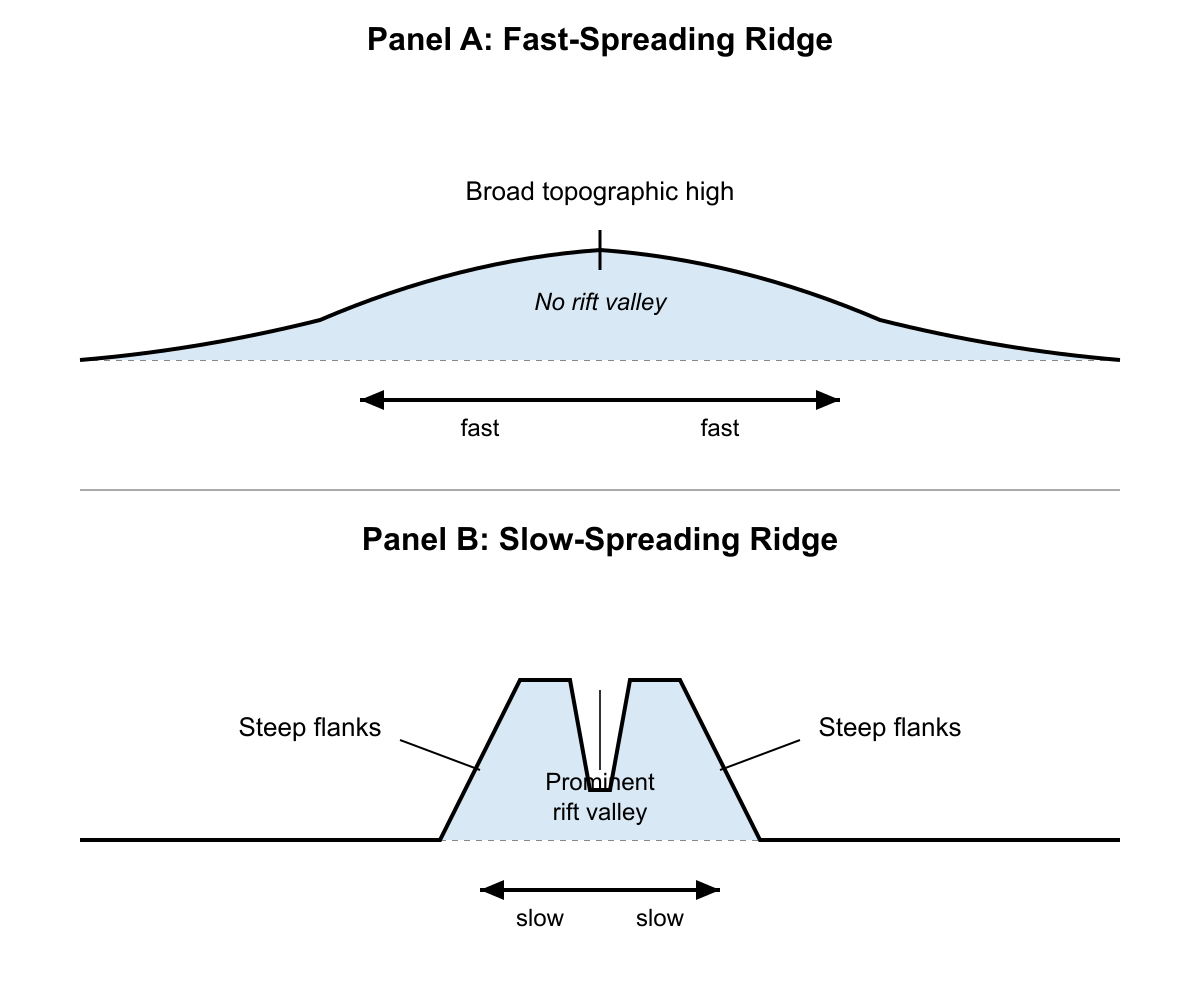
The diagram compares the typical morphology of fast- and slow-spreading mid-ocean ridges. If global tectonic patterns shifted from a long period dominated by slow-spreading ridges to one dominated by fast-spreading ridges, what would be the most probable consequence for the Earth system?
- Lower global sea levels and a cooler climate, because fast-spreading ridges are less voluminous and radiate heat more efficiently.
- Higher global sea levels and a warmer climate, because fast-spreading ridges are broader and have greater volcanic output. (correct answer)
- No significant change in sea level or climate, as the total volume of oceanic crust produced per year would remain constant.
- More frequent and larger earthquakes, but no predictable long-term change in sea level or global temperature.
Explanation: The correct answer is B. Fast-spreading ridges have a higher heat flow and magma supply, which makes the newly formed oceanic lithosphere hotter and more buoyant. This buoyancy results in a broader, more elevated ridge profile compared to the narrow, steep-sided profile of a slow-spreading ridge. A world dominated by fast-spreading ridges would thus have mid-ocean ridge systems that take up more volume, displacing ocean water and leading to higher global sea levels. The increased magmatic activity also means a higher rate of CO₂ degassing, which would contribute to a warmer, greenhouse climate. Option A states the opposite effects. Option C is incorrect because even if crustal production rate is the same, the morphology and volume of the ridges differ, which is key to sea level. Option D is incorrect; there would be predictable changes to climate and sea level.
Question 2
The chemical weathering of silicate rocks is a critical component of Earth's long-term carbon cycle. How does this process function as a climatic feedback loop in response to a tectonically-driven global warming event?
- As temperatures rise, weathering slows down, creating a positive feedback that accelerates warming by reducing CO₂ consumption.
- As temperatures rise, weathering accelerates, creating a negative feedback that counteracts warming by increasing the rate of CO₂ drawdown. (correct answer)
- Weathering rates are independent of temperature but increase with tectonic uplift, meaning there is no direct climatic feedback.
- As temperatures rise, physical weathering increases but chemical weathering decreases, leading to a net neutral effect on atmospheric CO₂.
Explanation: The correct answer is B. Chemical weathering rates are highly dependent on temperature and precipitation. A warmer world generally has a more vigorous hydrologic cycle. The combination of higher temperatures and more water accelerates the chemical reactions that break down silicate minerals. These reactions, such as the hydrolysis of feldspar into clay, consume atmospheric CO₂ (in the form of carbonic acid). Therefore, if the climate warms for any reason, weathering rates increase, which pulls more CO₂ out of the atmosphere, tending to cool the climate back down. This is a classic long-term negative feedback. Option A describes the opposite effect. Option C is incorrect as weathering is strongly dependent on climate. Option D incorrectly decouples physical and chemical weathering; increased physical weathering typically exposes more surface area, enhancing chemical weathering.
Question 3
Geochemical evidence from marine sediments reveals a multi-million-year period of exceptionally intense global silicate weathering. Which of the following tectonic scenarios is the least likely to be the cause of this event?
- The long-term stability of a low-relief, arid supercontinent that has experienced little recent tectonic activity. (correct answer)
- The formation of a major mountain range and plateau via a continental collision in a humid climatic zone.
- The initial stages of continental rifting, creating new, steep escarpments along nascent continental margins.
- The emplacement of a large igneous province (LIP) composed of easily-weathered basalt across a tropical region.
Explanation: When you encounter questions about silicate weathering, think about the conditions that accelerate chemical breakdown of rocks: high temperatures, abundant water, fresh rock surfaces, and reactive minerals.
Intense global silicate weathering requires optimal conditions for chemical reactions between rocks and water. The correct answer is A because a stable, low-relief, arid supercontinent provides the worst possible conditions for enhanced weathering. Low relief means minimal topographic gradients and slow erosion rates, limiting exposure of fresh rock surfaces. Aridity means insufficient water for chemical reactions. Long-term stability indicates no new tectonic activity to create fresh surfaces or uplift that could enhance precipitation patterns.
Let's examine why the other scenarios would actually promote intense weathering. Option B describes mountain building in humid conditions - perfect for weathering because uplift exposes fresh rocks to abundant moisture and creates steep gradients for rapid erosion. Option C involves continental rifting, which creates new steep escarpments with fresh, unweathered rock surfaces exposed to atmospheric conditions. Option D describes a large igneous province of basalt in the tropics - basalt is highly susceptible to chemical weathering, and tropical conditions provide the heat and moisture needed for rapid breakdown.
Remember that enhanced silicate weathering requires the "perfect storm" of conditions: fresh rock surfaces, abundant water, and warm temperatures. When evaluating tectonic scenarios, look for processes that either expose new rocks or create conditions that accelerate chemical reactions - stable, arid environments do neither.
Question 4
Consider a hypothetical scenario in which all plate tectonic activity on Earth suddenly ceases. Assuming other geological and biological processes continue, what is the most probable long-term consequence for Earth's climate?
- The climate would rapidly stabilize, as the primary drivers of both CO₂ release (volcanism) and CO₂ consumption (mountain building) would halt simultaneously.
- A runaway greenhouse effect would occur as the crust thickens, trapping mantle heat and causing massive releases of stored carbon.
- Global sea levels would rise dramatically as the motionless oceanic plates cool and contract, deepening the ocean basins.
- A gradual decline in atmospheric CO₂ would lead to a significantly colder planet, as outgassing would stop but weathering of existing topography would continue. (correct answer)
Explanation: The correct answer is D. Plate tectonics is the primary driver of CO₂ release into the atmosphere through volcanism at mid-ocean ridges, subduction zones, and hotspots. If tectonics ceased, this major source of CO₂ would be cut off. However, the processes that remove CO₂, primarily silicate weathering and burial of organic carbon, would continue as long as there is topography, rock, and a hydrologic cycle. Without the volcanic source to replenish it, atmospheric CO₂ would be slowly but steadily drawn down, leading to a long-term global cooling trend and eventually a much colder Earth. Option A is incorrect because the sink (weathering) would not halt immediately. Option B is incorrect; the major CO₂ source would be removed. Option C describes the opposite effect; deepening basins would cause sea level to fall, not rise.
Question 5
Imagine a hypothetical rocky planet with active plate tectonics and a CO₂-rich atmosphere, but completely lacking surface water. How would the absence of a hydrologic cycle most significantly alter the long-term relationship between tectonics and climate?
- Without water to lubricate subduction zones, plate tectonics would quickly cease, leading to a stable but cold climate.
- Wind-driven erosion would become the primary mechanism for CO₂ drawdown, creating a climate regulation system similar to Earth's.
- The primary CO₂ sink, silicate weathering via carbonic acid, would be disabled, likely causing volcanic CO₂ to accumulate and create a runaway greenhouse effect. (correct answer)
- The planet's climate would be much more stable, as the unpredictable effects of ice ages and ocean circulation would be absent.
Explanation: The correct answer is C. On Earth, the critical link between tectonic uplift and climate cooling is water-based chemical weathering. Carbonic acid (formed from CO₂ and water) reacts with silicate minerals, removing CO₂ from the atmosphere. Without water, this entire process cannot occur. Tectonic activity would continue to release CO₂ through volcanism (the source), but the primary, tectonically-modulated sink for that CO₂ would be absent. This would break the long-term climate feedback loop, allowing CO₂ to build up in the atmosphere over geologic time, likely leading to an extremely hot, Venus-like climate. Option A contradicts the premise that tectonics is active. Option B is incorrect because wind erosion is a physical process that does not consume CO₂. Option D is incorrect because the climate would likely be unstable in the direction of extreme heat, not more stable.
Question 6
The Cenozoic Era (the last 66 million years) is characterized by a significant, albeit unsteady, long-term cooling trend. The collision of the Indian and Eurasian plates, initiating the uplift of the Himalayas and the Tibetan Plateau, is a key tectonic event of this era. What is the primary mechanism by which this orogeny contributed to global cooling?
- The high altitude of the plateau increased Earth's average albedo, reflecting more solar radiation directly back to space.
- The mountain range acted as a barrier, preventing warm air from reaching the poles and allowing polar ice caps to expand.
- The uplift exposed vast quantities of fresh silicate rock to erosion and chemical weathering, which drew down atmospheric CO₂. (correct answer)
- The volcanic activity associated with the continental collision released sulfate aerosols that created a long-lasting atmospheric haze.
Explanation: The correct answer is C. The uplift-weathering hypothesis is the leading explanation. The immense uplift of the Himalayas and Tibetan Plateau exposed vast amounts of silicate minerals to chemical weathering, particularly enhanced by the Asian monsoon (which was itself intensified by the uplift). This weathering process consumes atmospheric CO₂, a greenhouse gas, leading to long-term global cooling. Option A is incorrect because while snow and ice on the mountains have high albedo, the vast area of exposed rock has a low albedo, and this is not the primary cooling mechanism. Option B describes a regional atmospheric effect, not the primary driver of long-term global climate change. Option D is incorrect because continental collisions involve relatively little volcanism compared to subduction zones, and sulfate aerosols have a very short residence time in the atmosphere, making them incapable of causing multi-million-year cooling trends.
Question 7
During the mid-Cretaceous period, geologic evidence points to significantly faster average rates of seafloor spreading compared to today. What was the combined effect of this rapid tectonic activity on global sea level and climate?
- Lower sea level due to the creation of deeper ocean basins and a cooler climate due to increased heat loss from the mantle.
- Higher sea level due to the thermal expansion of the oceanic lithosphere and a warmer 'greenhouse' climate due to increased volcanic CO₂ emissions. (correct answer)
- Stable sea level as basin subsidence balanced ridge volume, and a volatile climate with rapid swings between warm and cool periods.
- Higher sea level due to water displacement, but a cooler 'icehouse' climate as rapid subduction consumed carbon-rich sediments.
Explanation: The correct answer is B. Faster seafloor spreading creates mid-ocean ridges that are hotter, less dense, and therefore broader and more buoyant. These larger ridges occupy more volume in the ocean basins, displacing water onto the continents and causing a significant rise in sea level (a marine transgression). Additionally, the increased magmatic activity associated with faster spreading releases greater volumes of CO₂ into the atmosphere, enhancing the greenhouse effect and leading to a warmer climate. Options A and D incorrectly describe the effects. Option A presents the opposite effects. Option D correctly identifies the sea-level effect but incorrectly describes the climate effect; volcanic outgassing of CO₂ far outweighs the consumption of carbon by subduction in this scenario.
Question 8
The onset and persistence of major ice ages, like the late Paleozoic and the Cenozoic glaciations, are strongly influenced by the arrangement of continents. Which tectonic configuration is most conducive to initiating a long-lasting ice age?
- A single, large supercontinent straddling the equator, which promotes global aridity and desertification.
- Numerous small, dispersed continents mostly located in tropical and subtropical latitudes.
- A configuration where significant landmasses are located at or near the poles, allowing for the accumulation of continental ice sheets. (correct answer)
- A configuration that allows for a strong, unimpeded circum-equatorial ocean current, efficiently distributing heat across the globe.
Explanation: The correct answer is C. Large-scale continental ice sheets, which are a defining feature of major ice ages, can only form and persist on land. Therefore, having large continents located in high-latitude, polar regions where temperatures are low enough for snow to accumulate year-round is a critical prerequisite for glaciation. Both the late Paleozoic (Gondwana over the South Pole) and Cenozoic (Antarctica over the South Pole, and continents surrounding the Arctic basin) glaciations occurred during such configurations. Option A is incorrect because equatorial continents do not support ice sheets. Option B describes a configuration that promotes warm, maritime climates. Option D describes a state that would inhibit glaciation by preventing polar cooling.
Question 9
The eruption of a Large Igneous Province (LIP), such as the Deccan Traps, releases vast quantities of gas and lava over hundreds of thousands of years. What is the most likely net effect of such a sustained event on the long-term global climate?
- A profound and lasting icehouse climate, as the weathering of the fresh basaltic rock consumes atmospheric CO₂ more rapidly than it is released.
- A period of climatic instability with no long-term trend, as short-term aerosol cooling and long-term greenhouse warming cancel each other out.
- A significant long-term warming trend, as the sustained release of greenhouse gases like CO₂ overwhelms the short-lived cooling effect of sulfate aerosols. (correct answer)
- A major drop in sea level, as the weight of the erupted lava causes the continental crust to subside significantly, increasing ocean basin volume.
Explanation: The correct answer is C. While individual eruptions within the LIP event produce sulfate aerosols that cause cooling for a few years, the overall event lasts for a very long time. The crucial factor is the different atmospheric residence times of the volcanic emissions. Sulfate aerosols last for 1-3 years, while CO₂ lasts for centuries to millennia. Over the duration of the LIP eruption, CO₂ accumulates in the atmosphere, leading to a powerful, long-term greenhouse effect and global warming. This is a common trap question where students focus on the short-term cooling effect of volcanic ash. Option A is incorrect because weathering is a much slower process than volcanic degassing during the eruption phase. Option D describes a regional effect that is minor compared to the global climate impact.
Question 10
Plate collisions can create vast mountain ranges. How does the general orientation of a mountain range influence its long-term impact on regional and global climate systems?
- North-south ranges are more effective at driving global cooling because they disrupt the planet's rotational momentum.
- North-south ranges, such as the Andes, accelerate weathering more effectively because they are exposed to more varied climate zones along their length.
- The orientation of a mountain range has a negligible climatic effect compared to its maximum elevation and overall length.
- East-west ranges, such as the Alps and Himalayas, create more profound climatic barriers, altering continental-scale atmospheric circulation and creating strong monsoons. (correct answer)
Explanation: When you encounter questions about mountain ranges and climate, focus on how these massive barriers interact with atmospheric circulation patterns. The key is understanding that mountains don't just affect local weather—they can reshape entire continental climate systems.
East-west oriented mountain ranges like the Himalayas and Alps create the most dramatic climatic impacts because they act as perpendicular barriers to prevailing wind patterns. The Himalayas, for example, block moisture-laden air masses moving northward from the Indian Ocean, forcing them upward where they cool and release precipitation. This creates the intense monsoon system that defines South Asian climate. Similarly, these ranges create stark contrasts between their windward (wet) and leeward (dry) sides, establishing rain shadows that can extend for hundreds of miles.
Option A incorrectly suggests that mountain orientation affects Earth's rotational momentum, which is physically impossible—mountains are far too small relative to Earth's mass. Option B misunderstands weathering patterns; while north-south ranges like the Andes do span multiple climate zones, this doesn't make them more effective at accelerating weathering processes than the intense precipitation and temperature gradients created by east-west barriers. Option C underestimates orientation's importance—even ranges of identical elevation and length will have vastly different climatic effects depending on how they align with atmospheric circulation.
Remember this pattern: east-west mountain ranges are climate game-changers because they intercept and redirect the dominant atmospheric flows, while north-south ranges tend to channel air masses rather than block them entirely.
Question 11
During the Neoproterozoic 'Snowball Earth' episodes, the planet was almost entirely ice-covered. Given that the high albedo of the ice would resist melting, which tectonically-driven process is the most plausible mechanism for escaping this extreme climate state?
- The gradual accumulation of volcanic CO₂ in the atmosphere, which eventually triggered a super-greenhouse effect. (correct answer)
- A rapid increase in geothermal heat flow due to a mantle overturn event, which melted the ice from the bottom up.
- The movement of continents toward the equator, which exposed the ice sheets to more intense solar radiation.
- A sudden burst of seafloor spreading, which raised sea levels and caused the ice sheets to break apart.
Explanation: When you encounter questions about extreme climate states like Snowball Earth, think about the feedback mechanisms that could either perpetuate or break these conditions. The key challenge here is understanding how Earth could escape from a state where high ice albedo reflects most incoming solar radiation, creating a self-reinforcing cooling effect.
The most plausible escape mechanism is the gradual accumulation of volcanic CO₂ in the atmosphere (A). Even during ice ages, volcanic activity continues, steadily releasing carbon dioxide. Unlike other greenhouse gases, CO₂ accumulates because the normal weathering processes that remove it from the atmosphere are severely slowed when most rock surfaces are covered by ice. Over millions of years, this CO₂ buildup would eventually create such a strong greenhouse effect that it could overcome the ice albedo feedback and trigger rapid, global deglaciation.
Option B is incorrect because mantle overturn events don't significantly increase surface geothermal heat flow—the ice sheets are kilometers thick and insulated from below. Option C misunderstands the scale: continental drift is far too slow to provide timely climate rescue, and equatorial positioning alone wouldn't overcome the albedo problem. Option D fails because seafloor spreading doesn't rapidly raise sea levels enough to break apart continental ice sheets, and even if it did, floating ice would maintain the same albedo effect.
Remember that climate feedback loops are crucial in Earth science—look for mechanisms that can overcome existing feedbacks rather than just incremental changes that work within them.
Question 12
Geologists find widespread evidence for a major, sustained marine transgression (sea-level rise) throughout the Cretaceous rock record. Which combination of tectonic and climatic factors provides the most complete explanation for this observation?
- A greenhouse climate with no major ice sheets, combined with a period of rapid seafloor spreading. (correct answer)
- An icehouse climate with large polar ice sheets, combined with slow seafloor spreading creating deep ocean basins.
- Rapid erosion of coastal mountain ranges, combined with thermal subsidence of continental interiors.
- A lull in tectonic activity, combined with a greenhouse climate that caused thermal expansion of the oceans.
Explanation: When you encounter questions about long-term sea level changes, you need to consider both tectonic processes that affect ocean basin volume and climatic factors that control water volume. Marine transgressions (sea level rise) can result from either more water in the oceans or less space for that water.
The Cretaceous Period experienced one of the highest sea levels in Earth's history due to two complementary factors. A greenhouse climate with elevated atmospheric CO₂ prevented the formation of major ice sheets, keeping more water in liquid form in the oceans rather than locked up as ice. Simultaneously, rapid seafloor spreading created extensive mid-ocean ridge systems. These ridges are topographically elevated and voluminous, displacing ocean water upward and onto continental margins - like adding rocks to a bathtub.
Option B is incorrect because an icehouse climate with large ice sheets would lower sea level by storing water as ice, and slow seafloor spreading would create deeper, more voluminous ocean basins that could hold more water. Option C misses the mark because coastal erosion and thermal subsidence are local processes that cannot explain widespread global transgression. Option D fails because reduced tectonic activity would actually create more ocean basin capacity as mid-ocean ridges cooled and subsided, counteracting any thermal expansion effects.
Remember that major, long-term sea level changes require global-scale processes. Look for answers that combine both climatic factors (affecting water volume) and tectonic factors (affecting ocean basin capacity) working in the same direction.
Question 13
The East African Rift is an example of active continental rifting. If this process continues for tens of millions of years, what is the most significant expected consequence for long-term global climate?
- The creation of a new ocean basin and mid-ocean ridge, which will become a long-term source of volcanic CO₂ to the atmosphere. (correct answer)
- A global cooling event caused by the rapid weathering of newly exposed rock in the rift valley walls.
- A significant drop in global sea level as ocean water is drawn into the deep, newly formed rift basin.
- The formation of a tall, continuous mountain range along the rift, which will block global atmospheric circulation.
Explanation: When you encounter questions about continental rifting and long-term geological processes, focus on the ultimate outcome: what happens when continents actually split apart to form new ocean basins.
Continental rifting like the East African Rift represents the early stage of continental breakup. If this process continues for tens of millions of years, the rift will eventually widen enough that ocean water floods in, creating a new ocean basin. This new ocean will develop its own mid-ocean ridge system - an underwater volcanic mountain chain where new oceanic crust forms. Mid-ocean ridges are massive, continuous sources of volcanic activity that release substantial amounts of CO₂ into the atmosphere through both direct volcanic emissions and seafloor weathering processes. This makes option A correct.
Option B incorrectly assumes that rock weathering in rift valleys would dominate global climate - while weathering does occur, it's localized and wouldn't override the much larger-scale volcanic CO₂ emissions from a new ocean ridge system. Option C misunderstands the scale: even deep rift valleys hold trivial amounts of water compared to global ocean volume, so sea level wouldn't drop significantly. Option D confuses rifting with mountain building - rifting pulls continents apart and creates valleys, not mountain ranges that would block circulation.
Remember that continental rifting questions often test whether you can trace the process to its ultimate conclusion. Think beyond the initial rift valley to the eventual formation of new ocean basins with their associated volcanic activity and climate impacts.
Question 14
The Cenozoic Era (the last 66 million years) is characterized by a significant, albeit unsteady, long-term cooling trend. The collision of the Indian and Eurasian plates, initiating the uplift of the Himalayas and the Tibetan Plateau, is a key tectonic event of this era. What is the primary mechanism by which this orogeny contributed to global cooling?
- The high altitude of the plateau increased Earth's average albedo, reflecting more solar radiation directly back to space.
- The mountain range acted as a barrier, preventing warm air from reaching the poles and allowing polar ice caps to expand.
- The uplift exposed vast quantities of fresh silicate rock to erosion and chemical weathering, which drew down atmospheric CO₂. (correct answer)
- The volcanic activity associated with the continental collision released sulfate aerosols that created a long-lasting atmospheric haze.
Explanation: The correct answer is C. The uplift-weathering hypothesis is the leading explanation. The immense uplift of the Himalayas and Tibetan Plateau exposed vast amounts of silicate minerals to chemical weathering, particularly enhanced by the Asian monsoon (which was itself intensified by the uplift). This weathering process consumes atmospheric CO₂, a greenhouse gas, leading to long-term global cooling. Option A is incorrect because while snow and ice on the mountains have high albedo, the vast area of exposed rock has a low albedo, and this is not the primary cooling mechanism. Option B describes a regional atmospheric effect, not the primary driver of long-term global climate change. Option D is incorrect because continental collisions involve relatively little volcanism compared to subduction zones, and sulfate aerosols have a very short residence time in the atmosphere, making them incapable of causing multi-million-year cooling trends.
Question 15
The onset and persistence of major ice ages, like the late Paleozoic and the Cenozoic glaciations, are strongly influenced by the arrangement of continents. Which tectonic configuration is most conducive to initiating a long-lasting ice age?
- A single, large supercontinent straddling the equator, which promotes global aridity and desertification.
- Numerous small, dispersed continents mostly located in tropical and subtropical latitudes.
- A configuration where significant landmasses are located at or near the poles, allowing for the accumulation of continental ice sheets. (correct answer)
- A configuration that allows for a strong, unimpeded circum-equatorial ocean current, efficiently distributing heat across the globe.
Explanation: The correct answer is C. Large-scale continental ice sheets, which are a defining feature of major ice ages, can only form and persist on land. Therefore, having large continents located in high-latitude, polar regions where temperatures are low enough for snow to accumulate year-round is a critical prerequisite for glaciation. Both the late Paleozoic (Gondwana over the South Pole) and Cenozoic (Antarctica over the South Pole, and continents surrounding the Arctic basin) glaciations occurred during such configurations. Option A is incorrect because equatorial continents do not support ice sheets. Option B describes a configuration that promotes warm, maritime climates. Option D describes a state that would inhibit glaciation by preventing polar cooling.
Question 16
Geologists find widespread evidence for a major, sustained marine transgression (sea-level rise) throughout the Cretaceous rock record. Which combination of tectonic and climatic factors provides the most complete explanation for this observation?
- A greenhouse climate with no major ice sheets, combined with a period of rapid seafloor spreading. (correct answer)
- An icehouse climate with large polar ice sheets, combined with slow seafloor spreading creating deep ocean basins.
- Rapid erosion of coastal mountain ranges, combined with thermal subsidence of continental interiors.
- A lull in tectonic activity, combined with a greenhouse climate that caused thermal expansion of the oceans.
Explanation: When you encounter questions about long-term sea level changes, you need to consider both tectonic processes that affect ocean basin volume and climatic factors that control water volume. Marine transgressions (sea level rise) can result from either more water in the oceans or less space for that water.
The Cretaceous Period experienced one of the highest sea levels in Earth's history due to two complementary factors. A greenhouse climate with elevated atmospheric CO₂ prevented the formation of major ice sheets, keeping more water in liquid form in the oceans rather than locked up as ice. Simultaneously, rapid seafloor spreading created extensive mid-ocean ridge systems. These ridges are topographically elevated and voluminous, displacing ocean water upward and onto continental margins - like adding rocks to a bathtub.
Option B is incorrect because an icehouse climate with large ice sheets would lower sea level by storing water as ice, and slow seafloor spreading would create deeper, more voluminous ocean basins that could hold more water. Option C misses the mark because coastal erosion and thermal subsidence are local processes that cannot explain widespread global transgression. Option D fails because reduced tectonic activity would actually create more ocean basin capacity as mid-ocean ridges cooled and subsided, counteracting any thermal expansion effects.
Remember that major, long-term sea level changes require global-scale processes. Look for answers that combine both climatic factors (affecting water volume) and tectonic factors (affecting ocean basin capacity) working in the same direction.
Question 17
The East African Rift is an example of active continental rifting. If this process continues for tens of millions of years, what is the most significant expected consequence for long-term global climate?
- The creation of a new ocean basin and mid-ocean ridge, which will become a long-term source of volcanic CO₂ to the atmosphere. (correct answer)
- A global cooling event caused by the rapid weathering of newly exposed rock in the rift valley walls.
- A significant drop in global sea level as ocean water is drawn into the deep, newly formed rift basin.
- The formation of a tall, continuous mountain range along the rift, which will block global atmospheric circulation.
Explanation: When you encounter questions about continental rifting and long-term geological processes, focus on the ultimate outcome: what happens when continents actually split apart to form new ocean basins.
Continental rifting like the East African Rift represents the early stage of continental breakup. If this process continues for tens of millions of years, the rift will eventually widen enough that ocean water floods in, creating a new ocean basin. This new ocean will develop its own mid-ocean ridge system - an underwater volcanic mountain chain where new oceanic crust forms. Mid-ocean ridges are massive, continuous sources of volcanic activity that release substantial amounts of CO₂ into the atmosphere through both direct volcanic emissions and seafloor weathering processes. This makes option A correct.
Option B incorrectly assumes that rock weathering in rift valleys would dominate global climate - while weathering does occur, it's localized and wouldn't override the much larger-scale volcanic CO₂ emissions from a new ocean ridge system. Option C misunderstands the scale: even deep rift valleys hold trivial amounts of water compared to global ocean volume, so sea level wouldn't drop significantly. Option D confuses rifting with mountain building - rifting pulls continents apart and creates valleys, not mountain ranges that would block circulation.
Remember that continental rifting questions often test whether you can trace the process to its ultimate conclusion. Think beyond the initial rift valley to the eventual formation of new ocean basins with their associated volcanic activity and climate impacts.
Question 18
The closure of the Isthmus of Panama, a tectonic event completed around 3 million years ago, fundamentally rerouted ocean currents between the Atlantic and Pacific. What was a major, long-term climatic consequence of this gateway closure?
- It initiated the El Niño-Southern Oscillation by preventing the westward flow of warm water across the Pacific.
- It strengthened the Gulf Stream, increasing heat and moisture transport to the North Atlantic, which may have contributed to Northern Hemisphere glaciation. (correct answer)
- It caused widespread anoxia in the Atlantic Ocean by cutting off deep-water circulation from the Pacific.
- It led to a global warming trend by trapping warm equatorial water in the Atlantic basin, raising average ocean temperatures.
Explanation: The correct answer is B. Before the Isthmus closed, water flowed freely between the Atlantic and Pacific. Its closure redirected Atlantic surface currents northward, forming the modern, strong Gulf Stream. This current transported a large amount of heat and moisture to high northern latitudes. The increased moisture provided the necessary precipitation (snow) to build the large continental ice sheets of the subsequent Pleistocene ice ages. Option A is incorrect; ENSO is a Pacific phenomenon not directly caused by the Isthmus closure. Option C is incorrect; the closure primarily affected surface currents, not the deep-water circulation that governs ocean anoxia. Option D is incorrect; while it warmed the North Atlantic region, the downstream effect of increased snowfall and ice sheet growth contributed to overall cooling, not warming.
Question 19
The chemical weathering of silicate rocks is a critical component of Earth's long-term carbon cycle. How does this process function as a climatic feedback loop in response to a tectonically-driven global warming event?
- As temperatures rise, weathering slows down, creating a positive feedback that accelerates warming by reducing CO₂ consumption.
- As temperatures rise, weathering accelerates, creating a negative feedback that counteracts warming by increasing the rate of CO₂ drawdown. (correct answer)
- Weathering rates are independent of temperature but increase with tectonic uplift, meaning there is no direct climatic feedback.
- As temperatures rise, physical weathering increases but chemical weathering decreases, leading to a net neutral effect on atmospheric CO₂.
Explanation: The correct answer is B. Chemical weathering rates are highly dependent on temperature and precipitation. A warmer world generally has a more vigorous hydrologic cycle. The combination of higher temperatures and more water accelerates the chemical reactions that break down silicate minerals. These reactions, such as the hydrolysis of feldspar into clay, consume atmospheric CO₂ (in the form of carbonic acid). Therefore, if the climate warms for any reason, weathering rates increase, which pulls more CO₂ out of the atmosphere, tending to cool the climate back down. This is a classic long-term negative feedback. Option A describes the opposite effect. Option C is incorrect as weathering is strongly dependent on climate. Option D incorrectly decouples physical and chemical weathering; increased physical weathering typically exposes more surface area, enhancing chemical weathering.
Question 20
Geochemical evidence from marine sediments reveals a multi-million-year period of exceptionally intense global silicate weathering. Which of the following tectonic scenarios is the least likely to be the cause of this event?
- The long-term stability of a low-relief, arid supercontinent that has experienced little recent tectonic activity. (correct answer)
- The formation of a major mountain range and plateau via a continental collision in a humid climatic zone.
- The initial stages of continental rifting, creating new, steep escarpments along nascent continental margins.
- The emplacement of a large igneous province (LIP) composed of easily-weathered basalt across a tropical region.
Explanation: When you encounter questions about silicate weathering, think about the conditions that accelerate chemical breakdown of rocks: high temperatures, abundant water, fresh rock surfaces, and reactive minerals.
Intense global silicate weathering requires optimal conditions for chemical reactions between rocks and water. The correct answer is A because a stable, low-relief, arid supercontinent provides the worst possible conditions for enhanced weathering. Low relief means minimal topographic gradients and slow erosion rates, limiting exposure of fresh rock surfaces. Aridity means insufficient water for chemical reactions. Long-term stability indicates no new tectonic activity to create fresh surfaces or uplift that could enhance precipitation patterns.
Let's examine why the other scenarios would actually promote intense weathering. Option B describes mountain building in humid conditions - perfect for weathering because uplift exposes fresh rocks to abundant moisture and creates steep gradients for rapid erosion. Option C involves continental rifting, which creates new steep escarpments with fresh, unweathered rock surfaces exposed to atmospheric conditions. Option D describes a large igneous province of basalt in the tropics - basalt is highly susceptible to chemical weathering, and tropical conditions provide the heat and moisture needed for rapid breakdown.
Remember that enhanced silicate weathering requires the "perfect storm" of conditions: fresh rock surfaces, abundant water, and warm temperatures. When evaluating tectonic scenarios, look for processes that either expose new rocks or create conditions that accelerate chemical reactions - stable, arid environments do neither.