All questions
Question 1
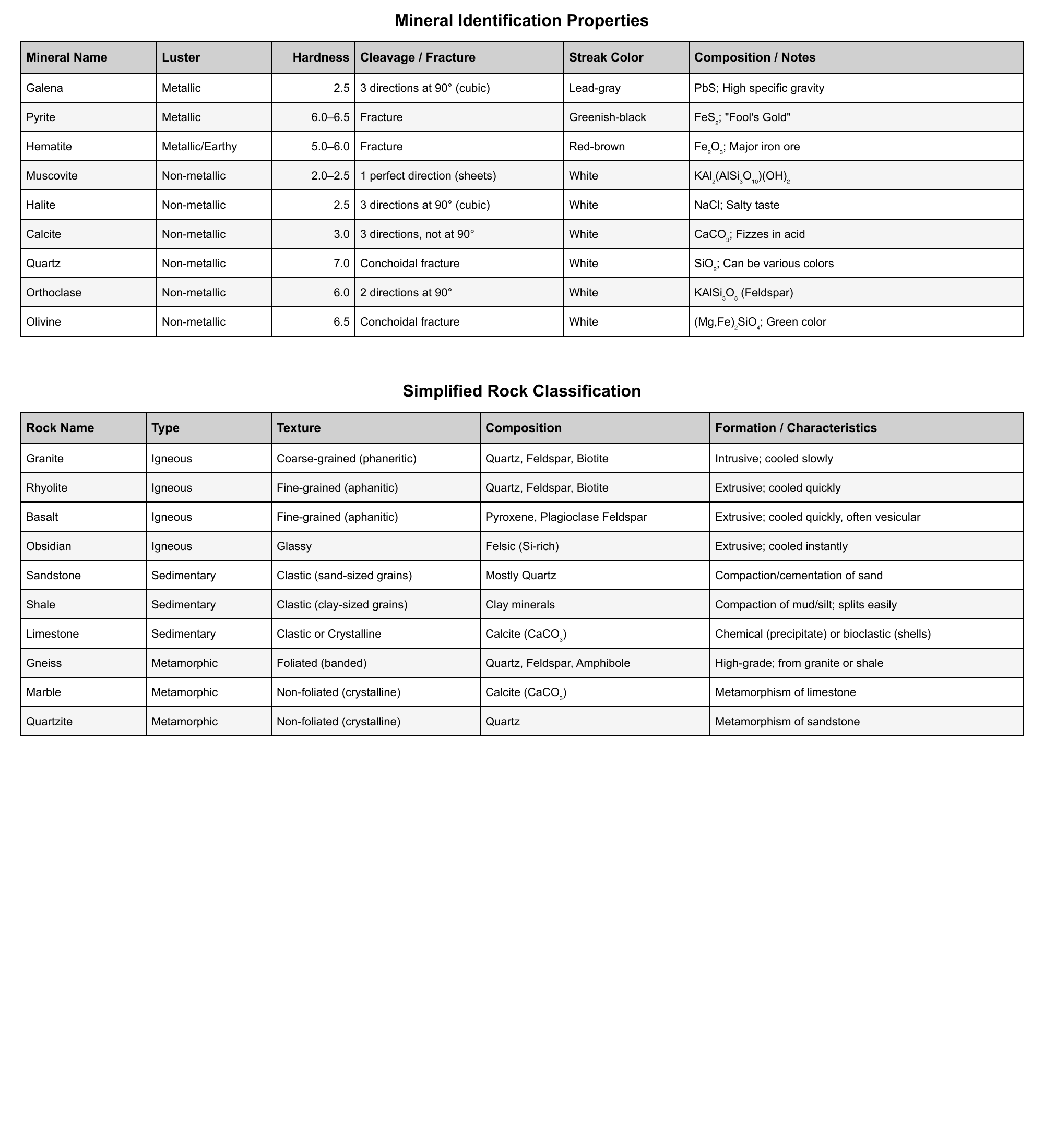
Which pair of rocks from the table share the same primary mineral composition, with one being sedimentary and the other being its metamorphic equivalent?
- Sandstone and Quartzite (correct answer)
- Limestone and Marble
- Shale and Gneiss
- Granite and Rhyolite
Explanation: Both Sandstone (sedimentary) and Quartzite (metamorphic) are composed primarily of Quartz. Table 2 specifically notes that Quartzite forms from the 'Metamorphism of sandstone.' While Limestone and Marble also share Calcite composition, the question asks for sedimentary-metamorphic pairs, and Sandstone-Quartzite represents the clearest example of this relationship in the table.
Question 2
An unknown mineral can scratch Orthoclase but cannot scratch Quartz. The mineral has a non-metallic luster and shows conchoidal fracture. Based on the provided rock and mineral identification tables, what is the mineral?
- Pyrite
- Hematite
- Orthoclase
- Olivine (correct answer)
Explanation: This is a multi-step problem. First, determine the hardness range. The mineral scratches Orthoclase (hardness 6.0) but not Quartz (hardness 7.0), so its hardness is between 6.0 and 7.0. Next, check the table for minerals in this range with the other specified properties. Pyrite has a metallic luster. Hematite has a hardness of 5.0-6.0. Orthoclase has a hardness of 6.0 and shows cleavage, not fracture. Olivine has a hardness of 6.5, a non-metallic luster, and conchoidal fracture, matching all criteria.
Question 3
An igneous rock sample is black, has no visible crystals, and has a shiny, glass-like appearance. According to the rock and mineral identification tables, what process led to the formation of this rock?
- Slow cooling of magma deep underground, allowing large crystals to form.
- Compaction and cementation of fine-grained volcanic sediments.
- Instantaneous cooling of lava on the surface, preventing crystal growth. (correct answer)
- High-pressure metamorphism of a dark-colored sedimentary rock.
Explanation: A rock with a 'glassy' texture is identified as Obsidian in Table 2. The 'Formation / Characteristics' column for Obsidian states it is 'Extrusive; cooled instantly'. This extremely rapid, or instantaneous, cooling prevents the formation of mineral crystals, resulting in the glassy appearance. Slow cooling (A) produces coarse-grained rocks like Granite. Compaction (B) forms sedimentary rocks. Metamorphism (D) would create a crystalline metamorphic rock.
Question 4
A rock sample is observed to have a texture of intergrown, coarse mineral crystals. Its mineral composition is identified as quartz, feldspar, and biotite. During a lab activity, a student incorrectly identifies this rock as Rhyolite. According to the rock and mineral identification tables, which observation did the student most likely misinterpret?
- The rock's mineral composition, which actually matches Basalt.
- The rock's texture, as Rhyolite is fine-grained. (correct answer)
- The rock's type, as it is metamorphic rather than igneous.
- The presence of quartz, which is not found in igneous rocks.
Explanation: The described rock with coarse grains of quartz, feldspar, and biotite is Granite, according to Table 2. The student identified it as Rhyolite. Both Granite and Rhyolite share the same composition (quartz, feldspar, biotite). However, their textures are different. Granite is coarse-grained (phaneritic), while Rhyolite is fine-grained (aphanitic). Therefore, the student most likely misinterpreted the texture of the rock.
Question 5
A student tests an unknown mineral and finds it has a metallic luster and leaves a greenish-black streak. The student cannot determine its hardness relative to other minerals in the table but notes that it is harder than glass (hardness ~5.5). Using the provided rock and mineral identification tables, which rock type is LEAST likely to contain this mineral?
- Igneous
- Sedimentary
- Metamorphic
- Bioclastic (correct answer)
Explanation: First, identify the mineral. Metallic luster, greenish-black streak, and hardness > 5.5 points to Pyrite (Hardness 6.0-6.5). Pyrite (FeS₂) is a sulfide mineral that can form in igneous, metamorphic, and some sedimentary environments. A bioclastic rock, such as the Limestone described in Table 2, is formed from the remains of living organisms (shells, etc.), which are primarily composed of calcite. It is the least likely rock type to contain significant amounts of hydrothermally-formed Pyrite.
Question 6
A field geologist discovers an igneous rock with a fine-grained texture, composed primarily of pyroxene and plagioclase feldspar. Some samples of the rock contain numerous small holes (vesicles). Using the provided rock and mineral identification tables, which conclusion about the rock's formation is most likely correct?
- The rock formed from magma that cooled slowly deep within the Earth's crust.
- The rock formed from lava that cooled quickly on the Earth's surface. (correct answer)
- The rock formed from the compaction and cementation of volcanic ash.
- The rock formed from intense heat and pressure applied to a pre-existing rock.
Explanation: First, the rock must be identified. A fine-grained igneous rock made of pyroxene and plagioclase feldspar is Basalt, according to Table 2. The 'Formation / Characteristics' column for Basalt states it is 'Extrusive; cooled quickly, often vesicular'. Extrusive rocks form from lava cooling on the surface. Slow cooling (A) creates coarse-grained rocks like granite. Compaction (C) forms sedimentary rocks. Heat and pressure (D) form metamorphic rocks.
Question 7
A rock is composed of sand-sized grains of weathered minerals cemented together. According to the rock and mineral identification tables, if this rock undergoes intense heat and pressure without melting, it will most likely become which other rock?
- Gneiss
- Shale
- Quartzite (correct answer)
- Granite
Explanation: First, identify the initial rock. A rock made of sand-sized grains cemented together is Sandstone, as per Table 2. The question then asks what rock Sandstone becomes after undergoing metamorphism (intense heat and pressure). The entry for Quartzite in Table 2 lists its formation as 'Metamorphism of sandstone'. Therefore, Sandstone will become Quartzite.
Question 8
The notes for the mineral Quartz state that it 'can be various colors'. What does this imply about using color for mineral identification, and which other property of Quartz listed in the table is more reliable?
- Color is a primary diagnostic tool; its hardness is a more reliable property.
- Color is often unreliable; its hardness of 7 is a more reliable property. (correct answer)
- Color is always consistent; its non-metallic luster is more reliable.
- Color is unreliable for all minerals; its white streak is less reliable than color.
Explanation: The fact that Quartz can be various colors indicates that color is not a consistent, diagnostic property for this mineral and is therefore unreliable for identification. The question asks for another, more reliable property from the table. Hardness is a very consistent physical property. For Quartz, its hardness is always 7. This makes it a much more reliable identification tool than its variable color. Luster (C) and streak (D) are also reliable, but hardness is a key distinguishing feature listed and a better answer than the incorrect statements in C and D.
Question 9
A student is identifying a mineral sample that has a metallic luster and a hardness of approximately 5.5. When scraped on a ceramic plate, it leaves a distinct red-brown streak. Using the provided rock and mineral identification tables, what can be inferred about this mineral's primary economic use?
- It is a source of lead (Pb) due to its high specific gravity.
- It is a major ore of iron (Fe) because of its composition. (correct answer)
- It is often mistaken for gold, giving it the name 'Fool's Gold'.
- It is used in construction as a primary component of plaster.
Explanation: The properties described (metallic/earthy luster, hardness 5.0-6.0, red-brown streak) match Hematite in Table 1. The 'Composition / Notes' column for Hematite indicates its composition is Fe₂O₃ and that it is a 'Major iron ore'. Therefore, its primary economic use is as an ore of iron.
Question 10
A geologist examines two common rock-forming minerals, Halite and Calcite. Using the provided rock and mineral identification tables, which property provides the most definitive way to distinguish between them?
- Hardness, because Halite is significantly harder than Calcite.
- Streak color, as one produces a colored streak while the other does not.
- Reaction to acid, as Calcite fizzes and Halite does not. (correct answer)
- Luster, because Halite has a metallic luster and Calcite has a non-metallic luster.
Explanation: According to Table 1, both Halite and Calcite have a non-metallic luster and a white streak, making these properties unhelpful for differentiation. Their hardness values are close (2.5 for Halite, 3.0 for Calcite), which can be difficult to distinguish accurately without proper tools. However, the 'Composition / Notes' column for Calcite explicitly states it 'Fizzes in acid,' a unique chemical property not shared by Halite. This is the most definitive test listed.
Question 11
A geologist is studying a metamorphic rock that exhibits distinct banding of light and dark minerals. The rock does not react with acid. Using the provided rock and mineral identification tables, what is this rock and what was its most likely parent rock?
- Marble, which forms from Limestone.
- Quartzite, which forms from Sandstone.
- Gneiss, which can form from Granite. (correct answer)
- Basalt, which is an igneous rock.
Explanation: The description 'distinct banding of light and dark minerals' refers to a foliated texture, specifically the kind found in Gneiss. Table 2 confirms that Gneiss is a foliated (banded) metamorphic rock. The table also states that Gneiss can form from the 'high-grade regional metamorphism of granite or shale'. Since Granite is one of the options, this is a plausible parent rock. Marble (A) is non-foliated and would react with acid. Quartzite (B) is non-foliated. Basalt (D) is igneous, not metamorphic.
Question 12
A student has a mineral that shows no cleavage, does not react with acid, and has a hardness of approximately 6.5. Its streak is white. Using the provided rock and mineral identification tables, which mineral can be definitively ruled out from the possibilities?
- Quartz
- Olivine
- Orthoclase (correct answer)
- Pyrite
Explanation: The question asks which mineral can be ruled out. Let's check the given properties against the options. The mineral shows no cleavage (fracture). Orthoclase is listed as having '2 directions at 90°' cleavage, so it can be ruled out. Quartz has fracture and hardness 7. Olivine has fracture and hardness 6.5. Pyrite has fracture and hardness 6.0-6.5, but its streak is greenish-black, not white, so it can also be ruled out. However, Orthoclase is the best answer because the lack of cleavage is a direct contradiction. The student must use the process of elimination based on the most certain negative evidence.
Question 13
A student has two mineral samples, A and B, which are identical in volume. However, sample A feels noticeably heavier than sample B. Using the provided rock and mineral identification tables, which pair of minerals could samples A and B be, respectively?
- A: Quartz, B: Calcite
- A: Pyrite, B: Hematite
- A: Galena, B: Halite (correct answer)
- A: Muscovite, B: Orthoclase
Explanation: The feeling of being 'heavier' for the same volume relates to the property of specific gravity or density. The question requires finding a pair of minerals where A has a significantly higher specific gravity than B. In Table 1, the 'Composition / Notes' column for Galena explicitly mentions 'High specific gravity'. Halite does not have this property and is known to have a low specific gravity. Therefore, Galena would feel much heavier than an equal-sized sample of Halite. The other pairs do not have such a pronounced and noted difference in specific gravity.
Question 14
A student describes a mineral as being soft enough to be scratched by a fingernail (hardness ~2.5), peeling off in thin, flexible sheets, and having a non-metallic luster. Which mineral from the rock and mineral identification tables matches this description?
- Halite
- Muscovite (correct answer)
- Galena
- Calcite
Explanation: The key property here is 'peeling off in thin, flexible sheets', which describes cleavage in one perfect direction. According to Table 1, Muscovite has '1 perfect direction (sheets)' of cleavage. Its hardness is 2.0-2.5, consistent with being scratched by a fingernail, and it has a non-metallic luster. Halite (A) has cubic cleavage. Galena (C) has a metallic luster. Calcite (D) has cleavage in 3 directions, not in sheets.
Question 15
A student performing mineral tests finds that a sample has a hardness of 6.0, a white streak, and two directions of cleavage at 90 degrees. Based on this information, the student concludes the mineral is part of the feldspar group. Which rock in the rock and mineral identification tables is primarily composed of this mineral group and quartz?
- Basalt
- Sandstone
- Marble
- Granite (correct answer)
Explanation: The properties described (hardness 6.0, white streak, 2 cleavage directions at 90°) identify the mineral as Orthoclase, which is a type of feldspar, according to Table 1. The second step is to find a rock in Table 2 composed of feldspar and quartz. Table 2 shows that Granite has a composition of 'Quartz, Feldspar, Biotite'. Basalt (A) is composed of pyroxene and plagioclase feldspar. Sandstone (B) is mostly quartz. Marble (C) is made of calcite.
Question 16
A mineral sample has a hardness of 7 and a non-metallic luster, and it breaks with a conchoidal fracture. According to the rock and mineral identification tables, a rock composed almost entirely of this mineral could be either a sedimentary or a metamorphic rock. What are these two rocks?
- Limestone and Marble
- Shale and Gneiss
- Granite and Rhyolite
- Sandstone and Quartzite (correct answer)
Explanation: First, the mineral with hardness 7, non-metallic luster, and conchoidal fracture is identified as Quartz from Table 1. The second step is to find a sedimentary rock and a metamorphic rock in Table 2 that are composed mostly of Quartz. Sandstone is a clastic sedimentary rock listed as 'Mostly Quartz'. Quartzite is a non-foliated metamorphic rock listed with a composition of 'Quartz'. Therefore, Sandstone and Quartzite are the correct pair.
Question 17
A student is given a mineral that breaks into perfect cubes, has a lead-gray streak, and has a metallic luster. After identifying the mineral using the provided tables, the student attempts to scratch a sample of Calcite with it. What would be the expected outcome?
- The mineral will not scratch Calcite because it is softer. (correct answer)
- The mineral will scratch Calcite because it is harder.
- Neither mineral will scratch the other as they have the same hardness.
- The outcome cannot be determined because the hardness of Calcite is variable.
Explanation: The mineral with cubic cleavage (3 directions at 90°), lead-gray streak, and metallic luster is Galena, according to Table 1. Galena's hardness is listed as 2.5. Calcite's hardness is listed as 3.0. Since Galena (2.5) is softer than Calcite (3.0), it will not be able to scratch Calcite. This requires a two-step process of identifying the unknown mineral and then comparing its hardness to a known mineral from the table.
Question 18
A student correctly identifies a rock as Marble. According to the rock and mineral identification tables, which of the following properties would the rock's primary constituent mineral exhibit?
- A hardness of 7 and conchoidal fracture.
- A metallic luster and a lead-gray streak.
- Cleavage in 3 directions not at 90° and a reaction to acid. (correct answer)
- Perfect cleavage in one direction and a hardness of 2.0-2.5.
Explanation: This is a two-table question. First, find Marble in Table 2. Its composition is listed as Calcite. Second, find the properties of Calcite in Table 1. Calcite has a hardness of 3.0, cleavage in '3 directions, not at 90°', and it 'Fizzes in acid'. Option C matches these properties. Option A describes Quartz. Option B describes Galena. Option D describes Muscovite.
Question 19
A mineral is determined to have a hardness between 5.0 and 6.5 and displays fracture rather than cleavage. Its luster could be interpreted as either metallic or dull/earthy. Using the provided rock and mineral identification tables, which additional test would be most useful to definitively identify the mineral?
- A test for cleavage planes, to confirm it is fracture.
- A streak test, to check for a red-brown or greenish-black color. (correct answer)
- An acid test, to see if the mineral fizzes.
- A taste test, to determine if the mineral is salty.
Explanation: The properties given (hardness 5.0-6.5, fracture) narrow the possibilities in Table 1 to Pyrite and Hematite. Pyrite has a hardness of 6.0-6.5 and a metallic luster. Hematite has a hardness of 5.0-6.0 and can have a metallic or earthy luster. Since the luster is ambiguous, another property must be used. Comparing the two, their streak colors are very different: Pyrite's is greenish-black, and Hematite's is red-brown. A streak test would therefore be the most useful diagnostic test to distinguish between them.
Question 20
An intrusive igneous rock weathers and erodes, and the resulting sediments are transported by a river before being deposited, compacted, and cemented. Based on the rock and mineral identification tables, if the original rock was Granite, what sedimentary rock is most likely to form from its weathered quartz and feldspar grains?
- Shale, from the weathering of feldspar into clay particles.
- Limestone, from the precipitation of dissolved mineral components.
- Sandstone, composed primarily of the resistant quartz grains. (correct answer)
- Conglomerate, formed from the cementation of large rock fragments.
Explanation: This question models a part of the rock cycle. Granite is composed of quartz, feldspar, and biotite. During weathering, quartz is very resistant and remains as sand-sized grains, while feldspar often weathers into clay. The transported sediment would be rich in sand-sized quartz grains. According to Table 2, a clastic sedimentary rock composed of sand-sized quartz grains is Sandstone. Shale (A) forms from clay-sized particles. Limestone (B) has a chemical or biological origin. Conglomerate (D) would require much larger rock fragments than those produced by granite weathering.