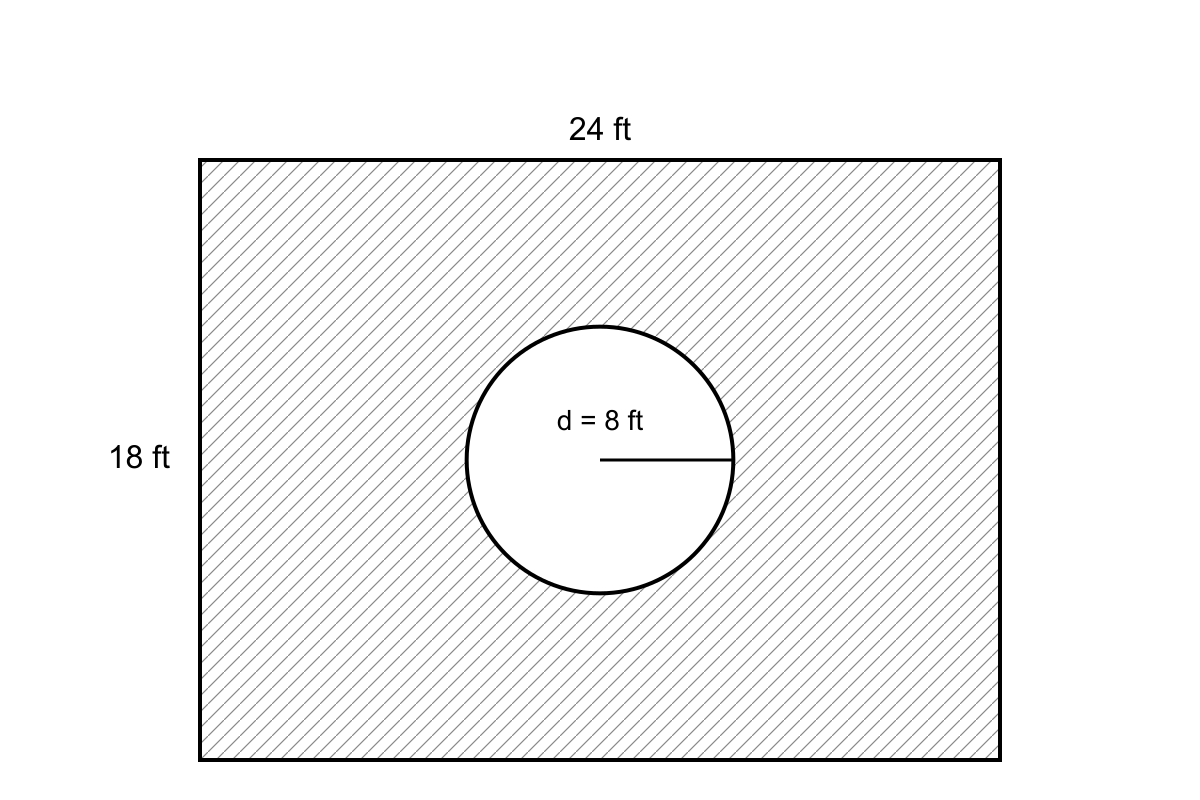
Refer to the figure. A rectangular garden measures 24 feet by 18 feet. A circular fountain with a diameter of 8 feet is centered inside the garden. The remaining area is to be covered with sod that costs $2.75 per square foot. What is the approximate cost of the sod? (Use $π≈3.14 $)
Practice Geometry 2d in GED Math with focused quiz questions that help you check what you know, review explanations, and build confidence with test-style prompts.
What this quiz covers
This quiz focuses on Geometry 2d, giving you a quick way to practice the rules, question types, and explanations that matter most for GED Math.
How to use this quiz
Try each quiz question before looking at the correct answer. Use the explanations to review missed ideas, then come back to similar questions until the pattern feels familiar.
All questions
Question 1
Refer to the figure. A rectangular garden measures 24 feet by 18 feet. A circular fountain with a diameter of 8 feet is centered inside the garden. The remaining area is to be covered with sod that costs $2.75 per square foot. What is the approximate cost of the sod? (Use $π≈3.14 $)
$1,049.44
$1,134.72
$1,188.00
$1,048.72 (correct answer)
Explanation: Garden area = 24×18=432 sq ft. Fountain radius = 4 ft, so fountain area = π(4)2=50.24 sq ft. Sod area = 432−50.24=381.76 sq ft. Cost = 381.76×2.75=$1,048.72. A uses radius 4 but subtracts wrongly. B uses diameter as radius. C ignores the fountain.
Question 2
The figure shows a trapezoidal pool deck with parallel sides 22 ft and 30 ft, and a height of 16 ft. A rectangular pool measuring 8 ft by 12 ft is located inside the deck. What is the area of the deck surface only (not including the pool)?
320 ft2 (correct answer)
416 ft2
512 ft2
304 ft2
Explanation: Trapezoid area = 21(22+30)(16)=21(52)(16)=416 ft². Pool area = 8×12=96 ft². Deck area = 416 − 96 = 320 ft². B is trapezoid without subtracting pool. C adds the pool. D uses wrong base sum.
Question 3
Refer to the figure. A parallelogram has a base of 20 in and a slant side of 13 in. The height from the base to the opposite side is 12 in. If the parallelogram is enlarged so that each dimension is multiplied by 1.5, what will be the area of the enlarged parallelogram?
540 in2 (correct answer)
360 in2
585 in2
240 in2
Explanation: Original area = base × height = 20 × 12 = 240 in². When linear dimensions scale by 1.5, area scales by 1.5² = 2.25. New area = 240 × 2.25 = 540 in². B scales by 1.5 only (incorrect). C uses slant side × base (wrong formula). D is original area.
Question 4
Refer to the figure shown. A rhombus has diagonals of lengths 24 cm and 10 cm. What is the perimeter of the rhombus?
52 cm (correct answer)
68 cm
48 cm
120 cm
Explanation: Diagonals of a rhombus bisect each other at right angles, forming 4 right triangles with legs 12 and 5. Each side = 122+52=169=13 cm. Perimeter = 4 × 13 = 52 cm. B uses diagonals as sides. C uses wrong half-lengths. D is the area formula result.
Question 5
Use the figure. A regular hexagon is inscribed in a circle with radius 10 inches. What is the area of the shaded region (inside the circle but outside the hexagon)? Round to the nearest tenth. (Use π≈3.14.)
54.1 in2 (correct answer)
14.0 in2
74.2 in2
113.1 in2
Explanation: Circle area = π(10)2=314 in². Regular hexagon inscribed in circle of radius r has area 233r2=233(100)≈259.8 in². Shaded = 314 − 259.8 = 54.2 ≈ 54.1 in². B uses wrong hexagon formula (with apothem). C uses square instead of hexagon. D is half the circle.
Question 6
Use the figure shown. A right triangle has legs of 9 cm and 12 cm. A square is constructed on the hypotenuse, outside the triangle. What is the combined area of the triangle and the square?
279 cm2 (correct answer)
225 cm2
333 cm2
171 cm2
Explanation: Hypotenuse = 92+122=225=15 cm. Square area = 15² = 225 cm². Triangle area = 21(9)(12)=54 cm². Total = 225 + 54 = 279 cm². B forgets the triangle. C uses wrong hypotenuse (21). D uses (9+12)² − 225.
Question 7
Refer to the figure below. What is the total area of the L-shaped patio?
68 sq ft
72 sq ft
84 sq ft (correct answer)
96 sq ft
Explanation: Split the L-shape into two rectangles: top rectangle is 8 ft × 6 ft = 48 sq ft; bottom rectangle is 6 ft × 6 ft = 36 sq ft. Total area = 48 + 36 = 84 sq ft.
A: 68 results from calculation errors.
B: 72 omits part of one rectangle.
D: 96 assumes the full outer bounding rectangle without subtracting the missing corner.
Question 8
A rectangular garden is 24 feet long and 15 feet wide. What is the perimeter of the garden?
78 ft (correct answer)
60 ft
48 ft
72 ft
Explanation: Perimeter questions test your understanding of the distance around a shape's boundary. When you see a rectangular garden or similar figure, you need to add up all four sides to find the total perimeter.For a rectangle, the perimeter formula is: P=2l+2w where l is length and w is width. This works because rectangles have two pairs of equal sides. With a length of 24 feet and width of 15 feet, you calculate: P=2(24)+2(15)=48+30=78 feet.Looking at the wrong answers: Choice B (60 ft) likely comes from incorrectly adding 24 + 15 + 15 + 6, possibly misremembering one of the dimensions. Choice C (48 ft) is a common trap—this is what you get if you only double the length (2×24=48) and forget to include the width at all. Choice D (72 ft) might result from doubling just one dimension incorrectly, such as calculating 2(24)+2(12) if you misread 15 as 12.The correct answer is A (78 ft).Remember this key strategy: For rectangle perimeter problems, always double-check that you're adding all four sides. Either use the formula P=2l+2w or manually add l+w+l+w. Both methods should give you the same answer, so if they don't match, you know to recalculate before selecting your answer.
Question 9
A circular pond has a radius of 9 meters. Using π≈3.14, what is the circumference of the pond?
28.3 m
56.5 m (correct answer)
113.0 m
254.5 m
Explanation: When you encounter a question about the circumference of a circle, you're working with one of geometry's most fundamental formulas. The circumference is the distance around the outside of a circle, and it's calculated using the formula C=2πr, where r is the radius.With a radius of 9 meters and π≈3.14, you substitute these values: C=2×3.14×9=6.28×9=56.52 meters. Rounded to one decimal place, this gives you 56.5 meters, which is answer choice B.Looking at the wrong answers: Choice A (28.3 m) represents a common error where students forget to multiply by 2, calculating only πr instead of 2πr. This gives 3.14×9=28.26, which rounds to 28.3. Choice C (113.0 m) likely comes from accidentally using the area formula A=πr2 instead of circumference, giving 3.14×92=3.14×81=254.34, then perhaps dividing by something. Choice D (254.5 m) is exactly what you'd get if you calculated the area using πr2=3.14×81=254.34.Remember this key distinction: circumference uses 2πr and measures distance around the circle, while area uses πr2 and measures space inside the circle. Always double-check which measurement the question is asking for, as mixing up these formulas is one of the most common traps on geometry problems.
Question 10
A trapezoid has parallel sides of lengths 18 inches and 26 inches. If the area of the trapezoid is 176 square inches, what is its height?
6 inches
8 inches (correct answer)
10 inches
12 inches
Explanation: The area formula for a trapezoid is A = ½h(b₁ + b₂), where h is the height and b₁, b₂ are the parallel sides. Substituting: 176 = ½h(18 + 26) = ½h(44) = 22h. Solving: h = 176/22 = 8 inches. Choice A (6) would result from using 176 = 6 × 44/2 = 132, not 176. Choice C (10) would give area = 220. Choice D (12) would give area = 264.
Question 11
A rhombus has diagonals of lengths 16 cm and 12 cm. If each side of the rhombus is extended by 20% while maintaining the rhombus shape, what is the area of the new rhombus?
115.2 square cm
124.8 square cm
138.2 square cm (correct answer)
142.6 square cm
Explanation: The original rhombus has area = ½ × d₁ × d₂ = ½ × 16 × 12 = 96 square cm. When each side is extended by 20%, the rhombus is scaled by a factor of 1.2. Since the diagonals are also scaled by this factor, the new diagonals are 16 × 1.2 = 19.2 cm and 12 × 1.2 = 14.4 cm. The new area = ½ × 19.2 × 14.4 = ½ × 276.48 = 138.24 ≈ 138.2 square cm. Alternatively, since area scales by the square of the linear scale factor: new area = 96 × (1.2)² = 96 × 1.44 = 138.24 square cm. Choice A might result from scaling by 1.2 instead of 1.2². Choice B might come from calculation errors. Choice D might result from incorrect scaling of the diagonals.
Question 12
A regular hexagon has a perimeter of 48 centimeters. What is the area of the hexagon in square centimeters? (Use 3≈1.732)
166.3 square centimeters (correct answer)
172.8 square centimeters
178.4 square centimeters
184.2 square centimeters
Explanation: A regular hexagon with perimeter 48 cm has each side length = 48/6 = 8 cm. The area formula for a regular hexagon with side length s is A = (3√3/2)s². With s = 8: A = (3√3/2)(8)² = (3√3/2)(64) = 96√3. Using √3 ≈ 1.732: A = 96 × 1.732 = 166.272 ≈ 166.3 square cm. Choice B might result from using an incorrect formula. Choice C might come from calculation errors. Choice D might result from using the wrong value for √3.