What this quiz covers
This quiz focuses on Geometry 3d, giving you a quick way to practice the rules, question types, and explanations that matter most for GED Math.
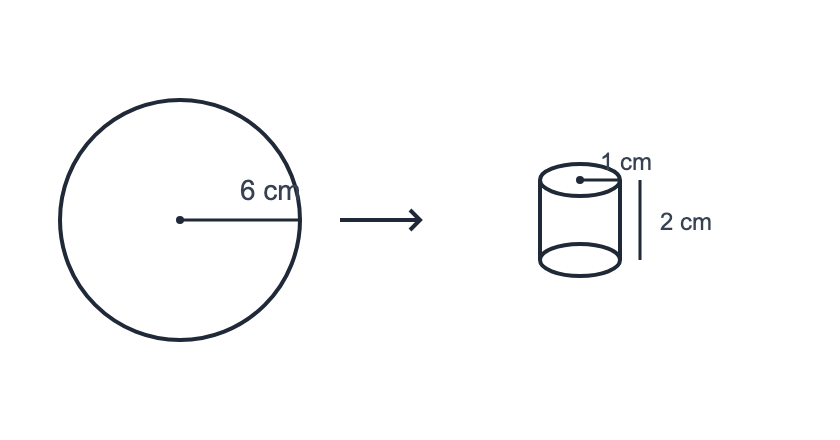
Refer to the figure. A solid metal sphere of radius 6 cm is melted and recast into small cylinders, each with radius 1 cm and height 2 cm. Assuming no metal is lost, what is the maximum number of complete small cylinders that can be made?
GED Math Quiz
Practice Geometry 3d in GED Math with focused quiz questions that help you check what you know, review explanations, and build confidence with test-style prompts.
This quiz focuses on Geometry 3d, giving you a quick way to practice the rules, question types, and explanations that matter most for GED Math.
Try each quiz question before looking at the correct answer. Use the explanations to review missed ideas, then come back to similar questions until the pattern feels familiar.
Refer to the figure. A solid metal sphere of radius 6 cm is melted and recast into small cylinders, each with radius 1 cm and height 2 cm. Assuming no metal is lost, what is the maximum number of complete small cylinders that can be made?
Explanation: Sphere volume: 34π(6)3=288π. Cylinder volume: π(1)2(2)=2π. Number: 288π/2π=144. A forgets the 34 factor. C uses sphere volume formula 34πr3 but divides wrongly. D doubles the answer.
A grain silo is shown in the figure. It consists of a cylinder with a hemisphere on top. The cylindrical portion has a radius of 4 feet and a height of 15 feet. Refer to the figure. What is the total volume of the silo, in cubic feet, rounded to the nearest cubic foot?
Explanation: Cylinder volume: π(4)2(15)=240π. Hemisphere volume: 21⋅34π(4)3=3128π. Total: 240π+3128π=3848π≈888. Choice A uses only the cylinder. Choice C adds a full sphere instead of a hemisphere. Choice D adds a cone with height 4 instead of a hemisphere.
A cone has the dimensions shown. Refer to the figure. If the radius is doubled and the height is halved, by what factor does the volume change?
Explanation: Original volume V=31πr2h. New volume: 31π(2r)2(h/2)=31π⋅4r2⋅h/2=2V. A assumes effects cancel (forgetting radius is squared). C forgets to halve the height. D reverses the logic.
Refer to the figure. A cylindrical water tank has an inner radius of 3 feet and a height of 8 feet. The tank is currently filled with water to 43 of its capacity. How many cubic feet of water are in the tank? (Use π≈3.14.)
Explanation: Full volume: π(3)2(8)=72π≈226.08. Three-quarters: 0.75(226.08)=169.56. A takes 41 instead of 43. C gives full tank volume. D uses diameter 6 as radius.
Refer to the figure. A sphere is inscribed in a cube of edge length 10 cm so that the sphere touches all six faces. What is the volume of the empty space inside the cube but outside the sphere, in cubic cm, to the nearest whole number?
Explanation: Cube volume: 1000. Sphere radius is half the edge = 5. Sphere volume: 34π(5)3≈523.6. Empty space: 1000−523.6≈476.4≈477. B gives the sphere volume. C uses radius 10. D gives cube volume only.
Refer to the figure. A cone has a radius of 5 cm and a height of 12 cm. What is the lateral (side) surface area of the cone, in square centimeters? Leave the answer in terms of π.
Explanation: Slant height: ℓ=52+122=169=13. Lateral area: πrℓ=π(5)(13)=65π. A uses height 12 as slant. C uses diameter. D is base area only.
Refer to the figure. A cylindrical candle has a diameter of 8 cm and a height of 15 cm. A wax manufacturer wants to wrap the curved (lateral) surface and the top circular face of each candle with a decorative film. How many square centimeters of film are needed per candle? (Use π≈3.14.)
Explanation: Radius = 4 cm. Lateral area: 2πrh=2π(4)(15)=120π≈376.8. Top circle: π(4)2=16π≈50.24. Total: 376.8+50.24=427.04. A omits the top. C includes both top and bottom. D uses diameter as radius for one term.
Refer to the figure. A hemispherical bowl has an inner radius of 6 inches. Water is poured into the bowl until it is filled to a depth equal to the full radius (completely full). The water is then poured into a cylindrical container with an inner radius of 4 inches. To what height, in inches, will the water rise in the cylinder?
Explanation: Hemisphere volume: 21⋅34π(6)3=32π(216)=144π. Set equal to cylinder volume: π(4)2h=16πh=144π, so h=9. A uses ratio 6/...incorrectly. C uses full sphere formula. D forgets to square the cylinder radius.
Refer to the figure. A regular hexagonal prism has a base edge length of 4 cm and a height of 10 cm. What is the volume of the prism, in cubic centimeters? (The area of a regular hexagon with side s is 233s2.)
Explanation: Base area: 233(4)2=243. Volume: 243⋅10=2403. A uses half the base area. C doubles the answer (perhaps confused with surface area). D uses 33s2 (forgot the 21).
A cylindrical water tank has a radius of 4 feet and a height of 12 feet. If the tank is currently filled to 75% of its capacity, how many cubic feet of water need to be added to fill it completely?
Explanation: First, find the total volume: V=πr2h=π(4)2(12)=192π cubic feet. Currently filled to 75%, so current volume is 0.75×192π=144π cubic feet. Water needed: 192π−144π=48π cubic feet. Choice B is the total volume, choice C is the current volume, and choice D incorrectly uses radius instead of radius squared in the calculation.
A shipping box is a right rectangular prism that measures 18 in long, 12 in wide, and 10 in high. What is the volume of the box?
Explanation: When you encounter a problem asking for the volume of a rectangular prism (or box), you're working with one of the most fundamental 3D geometry formulas. Volume measures how much space is inside a three-dimensional object, and for rectangular prisms, you simply multiply length × width × height. For this shipping box, you have all three dimensions: 18 inches long, 12 inches wide, and 10 inches high. Multiply these together: 18×12×10=2,160 cubic inches. Notice that volume is always expressed in cubic units (in3, ft3, etc.) because you're multiplying three linear measurements. Let's examine why the other answers are incorrect. Answer B (1,440 in3) results from multiplying only two dimensions correctly and making an error with the third—perhaps calculating 18×12×8 instead of 18×12×10. Answer C (600 in3) comes from adding the dimensions instead of multiplying them (18+12+10=40, then possibly multiplying by something incorrectly). Answer D (360 in3) appears to come from multiplying only some of the dimensions, like 18×10=180, then doubling it. Remember: for any rectangular prism volume problem, always multiply all three dimensions—length × width × height. Double-check that you're multiplying (not adding) and that your final answer includes cubic units. This formula appears frequently on the GED, so master it completely.
A cylindrical can has a radius of 4 cm and a height of 15 cm. What is the surface area of the can to the nearest square centimeter? (Use π=3.14.)
Explanation: When you encounter a surface area problem for a cylinder, you need to visualize what surfaces make up the complete shape: two circular bases (top and bottom) plus the curved side that wraps around.
The surface area formula for a cylinder is SA=2πr2+2πrh, where the first term represents the two circular bases and the second term represents the curved lateral surface.
With r=4 cm and h=15 cm:
Rounded to the nearest square centimeter, this gives us 477 cm², which is answer choice B.
Looking at the wrong answers: A) 1,510 cm² is far too large and likely comes from a major calculation error or using the wrong formula entirely. C) 380 cm² is close to just the lateral surface area (376.8), suggesting someone forgot to include the circular bases. D) 301 cm² is too small and might result from various computational mistakes or only calculating one base plus lateral area.
Remember that cylinder surface area problems always involve three components: top circle, bottom circle, and the rectangular "wrapper" that forms the curved side. Missing any of these parts will lead you to an incorrect answer choice.
A cone-shaped paper cup has a radius of 5 cm and a height of 9 cm. How many cubic centimeters of water can the cup hold when filled to the brim? (Use π=3.14.)
Explanation: When you encounter volume problems involving three-dimensional shapes, you need to identify the shape and apply the correct formula. This cone problem requires the volume formula for a cone: V=31πr2h. Let's substitute the given values: radius = 5 cm, height = 9 cm, and π=3.14. V=31×3.14×52×9 V=31×3.14×25×9 V=31×706.5 V=235.5 cm3 Rounding to the nearest whole number gives us 235 cm3, which is answer A. Now let's examine why the other answers are wrong. Answer B (471 cm3) represents a common error where students forget to divide by 3 in the cone formula, essentially calculating 32πr2h instead. Answer C (706 cm3) occurs when students completely omit the 31 factor and use the cylinder formula πr2h instead. Answer D (848 cm3) suggests using an incorrect formula altogether, possibly confusing cone volume with surface area calculations. The key strategy for cone volume problems is remembering that a cone's volume is exactly one-third of a cylinder with the same base and height. Always double-check that you've included the 31 factor in your calculation, as this is the most frequent mistake students make on these problems.
A cube has a total surface area of 486 cm2. What is the volume of the cube?
Explanation: This problem tests your understanding of surface area and volume formulas for cubes, and how to work backwards from given information to find what you need. A cube has 6 identical square faces. If each face has side length s, then each face has area s2, making the total surface area 6s2. Since the surface area is 486 cm2, you can set up the equation: 6s2=486. Dividing both sides by 6 gives s2=81, so s=9 cm. Now that you know the side length, you can find the volume using V=s3=93=729 cm3. This confirms that A is correct. Looking at the wrong answers: B (216 cm3) equals 63, which suggests someone incorrectly used s=6 as the side length—this comes from mistakenly thinking s2=36 instead of s2=81. C (125 cm3) equals 53, indicating the error of using s=5. D (64 cm3) equals 43, showing the mistake of using s=4. These wrong answers likely result from computational errors when solving 6s2=486 or from incorrectly taking the square root of 81. Remember: when working with cube problems, always identify what information you're given and what formulas connect that to what you need to find. Surface area problems often require you to find the side length first, then use it to calculate volume.
The ice‐cream scoop forms a perfect sphere with a diameter of 6 cm. What is the volume of one scoop? (Use π=3.14.)
Explanation: When you encounter a sphere volume problem, you're working with three-dimensional geometry. The key is identifying what information you have and applying the correct volume formula. For any sphere, the volume formula is V=34πr3, where r is the radius. Since the problem gives you a diameter of 6 cm, you first need to find the radius: r=26=3 cm. Now substitute into the formula: V=34×3.14×33=34×3.14×27. Calculate step by step: 3.14×27=84.78, then 34×84.78=3339.12=113.04 cm³. Rounding gives us 113 cm³. Looking at the wrong answers: Answer B (226 cm³) appears to result from forgetting the 34 coefficient and just calculating πr3, then doubling it. Answer C (452 cm³) likely comes from using the diameter instead of radius in the formula, calculating 34π×63 but making arithmetic errors. Answer D (904 cm³) represents using the full diameter cubed without the proper fractional coefficient. Study tip: Always write down the sphere volume formula first, then carefully identify whether you're given radius or diameter. Most errors on sphere problems come from confusing these two measurements or forgetting the 34 coefficient that makes spheres different from cylinders.