What this quiz covers
This quiz focuses on Linear Equations, giving you a quick way to practice the rules, question types, and explanations that matter most for GED.
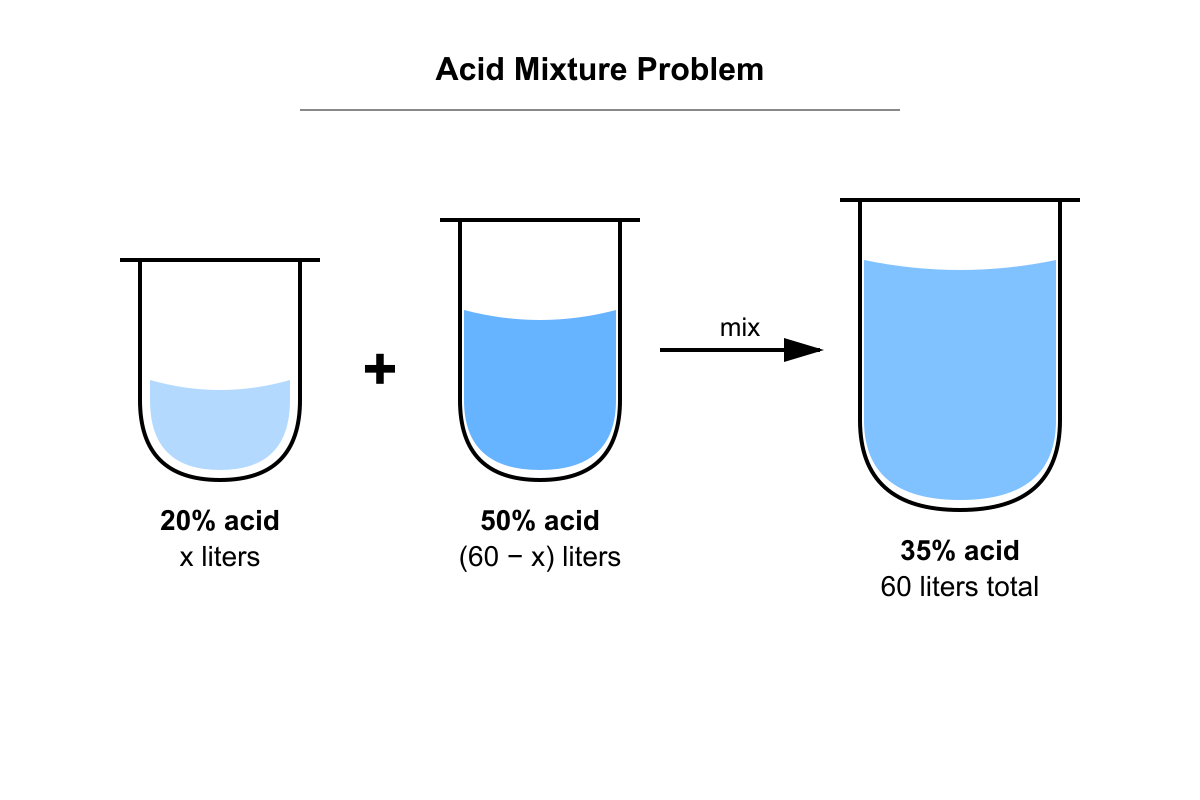
The diagram below represents a mixture problem. A chemist combines a solution that is 20% acid with a solution that is 50% acid to produce 60 liters of a solution that is 35% acid. Based on the diagram, how many liters of the 20% solution are used?
GED Quiz
Practice Linear Equations in GED with focused quiz questions that help you check what you know, review explanations, and build confidence with test-style prompts.
This quiz focuses on Linear Equations, giving you a quick way to practice the rules, question types, and explanations that matter most for GED.
Try each quiz question before looking at the correct answer. Use the explanations to review missed ideas, then come back to similar questions until the pattern feels familiar.
The diagram below represents a mixture problem. A chemist combines a solution that is 20% acid with a solution that is 50% acid to produce 60 liters of a solution that is 35% acid. Based on the diagram, how many liters of the 20% solution are used?
Explanation: Let x = liters of 20% solution. Then 60−x = liters of 50% solution. Equation: 0.20x+0.50(60−x)=0.35(60). Solving: 0.20x+30−0.50x=21, so −0.30x=−9, x=30. Distractor A: solved for wrong variable; B: used 40% instead of 35%; D: arithmetic error in decimal.
The coordinate plane below shows a line ℓ and a point Q not on the line. Based on the graph, write the equation of the line through Q parallel to ℓ, and find its x-intercept.
Explanation: Line ℓ passes through (0, 4) and (2, 0), so slope = −2. Parallel line through Q=(3,3): y−3=−2(x−3), so y=−2x+9. Set y=0: x=9/2. Distractor A: sign error on both slope and point; B: used perpendicular slope; C: forgot to negate.
A company's profit P (in thousands of dollars) is related to the number of units sold x by the equation P=12x−150. If the company needs a profit of at least $90,000, what is the minimum number of units they must sell?
Explanation: Since P is in thousands, a profit of $90,000 means $P = 90.Settinguptheinequality:12x - 150 ≥ 90.Solving:12x ≥ 240,sox ≥ 20.Theminimumis20units.ChoiceAresultsfromforgettingtheprofitisinthousandsandsolving12x - 150 = 90.ChoiceCcomesfromtheerror12x - 150 = 90 + 150.ChoiceDassumestheequationisP = 12x - 180insteadofP = 12x - 150$.
A plumber charges a service call fee plus an hourly rate. After working 3 hours, the total cost is $185. After working 7 hours, the total cost is $305. If the plumber worked for 5.5 hours, what would be the total cost?
Explanation: Let the service fee be b and hourly rate be m. From the given information: 3m+b=185 and 7m+b=305. Subtracting the first equation from the second: 4m=120, so m=30. Substituting back: 3(30)+b=185, so b=95. For 5.5 hours: 5.5(30)+95=165+95=245. Choice A results from using 4 hours instead of 5.5. Choice C uses the wrong hourly rate of $40. Choice D assumes no service fee and uses 290÷5.5≈52.7 per hour.
A cell phone plan charges $25 per month plus $0.15 for each text message sent. Another plan charges $40 per month with unlimited texting. After how many text messages will the two plans cost the same amount?
Explanation: Let t = number of text messages. Plan 1 cost: 25+0.15t. Plan 2 cost: $40. Setting equal: 25+0.15t=40. Solving: 0.15t=15, so t=100. Choice A results from using $0.20 instead of $0.15 per text. Choice C comes from solving 25+0.12t=40. Choice D assumes the first plan charges $0.10 per text message instead of $0.15.
The coordinate plane below shows two lines, ℓ1 and ℓ2, that intersect at point P. Based on the graph shown, what is the sum of the x- and y-coordinates of P?
Explanation: Line ℓ1 passes through (0, -3) and (1, 0), so slope = 3: y=3x−3. Line ℓ2 passes through (0, 7) and (2, 3), so slope = -2: y=−2x+7. Setting equal: 3x−3=−2x+7, so 5x=10, x=2. Then y=3(2)−3=3. Sum = 2+3=5. Distractor A: sign error yielding x=-1, y=0. B: reading only x-coordinate. D: adding intercepts instead of coordinates.
The number line below shows the solution to a linear equation of the form ∣ax−b∣=c where a,b,c are positive integers with a>1. Based on the number line, which equation has exactly this solution set?
Explanation: From the number line, solutions are x=1 and x=6. For ∣ax−b∣=c, the solutions are x=ab−c and x=ab+c. Testing option B: ∣2x−7∣=5 gives 2x−7=±5, so 2x=7±5, yielding x=1 or x=6. ✓ Option A gives x=−1,6; option C gives x=−1,5; option D gives x=−6,1.
Refer to the graph, which shows the distance (in miles) traveled by two cyclists as a function of time (in hours). Cyclist A started at time 0, while Cyclist B started at a later time. Use the graph to determine how many hours after Cyclist A starts does Cyclist B catch up.
Explanation: Cyclist A: passes (0,0) and (4,40), so dA=10t. Cyclist B: passes (1,0) and (4,45), so slope = 15, dB=15(t−1)=15t−15. Catch-up: 10t=15t−15, 5t=15, t=3. That's 3 hours. Hmm answer B. For answer C (4 hours): set dA=10t, dB=15t−20 (starts at t=4/3, not clean). Let A: dA=12t, B: dB=16(t−1)=16t−16, catch: 12t=16t−16, 4t=16, t=4. ✓ So A's speed 12 mph, B's 16 mph, B starts 1 hour late. Distractor A: divided by wrong difference; B: forgot head start; D: added start time.
Use the system of equations displayed in the coordinate plane below to determine the value of 2x−y at the point of intersection.
Explanation: From the graph, line 1: y=2x−4 (through (0,-4) and (2,0)). Line 2: y=−x+5 (through (0,5) and (5,0)). Setting equal: 2x−4=−x+5, so 3x=9, x=3, y=2. Then 2x−y=6−2=4. Distractor A: sign error; B: computed x - y; D: doubled one coordinate.
The chart below displays ticket pricing at a theater: adult tickets cost $12 and child tickets cost $8. On a certain night, the theater sold a total of $200 ticketsfortotalrevenueof \2{,}120. Use the chart to find how many MORE adult tickets than child tickets were sold.
Explanation: Let a = adult tickets, c = child tickets. System: a+c=200 and 12a+8c=2120. From first equation: c=200−a. Substitute: 12a+8(200−a)=2120, so 12a+1600−8a=2120, 4a=520, a=130. Then c=70. Difference = 130−70=60.
Solve the equation 5(x−2)=3x+6 for x.
Explanation: When you encounter an equation with parentheses and variables on both sides, your goal is to isolate the variable by systematically eliminating everything else. This requires distributing, combining like terms, and using inverse operations. Start by distributing the 5 on the left side: 5(x−2)=5x−10. Now your equation becomes 5x−10=3x+6. Next, collect all terms with x on one side by subtracting 3x from both sides: 5x−3x−10=3x−3x+6, which simplifies to 2x−10=6. Add 10 to both sides to isolate the term with x: 2x=16. Finally, divide both sides by 2: x=8. You can verify this by substituting back into the original equation: 5(8−2)=5(6)=30 and 3(8)+6=24+6=30 ✓ Looking at the wrong answers: Choice B (x=4) would give you 5(2)=10 on the left but 12+6=18 on the right. Choice C (x=2) results in 5(0)=0 versus 6+6=12. Choice D (x=−2) produces 5(−4)=−20 compared to −6+6=0. Remember to always check your solution by substituting back into the original equation. This catches arithmetic errors and confirms you've solved correctly, which is especially valuable on timed exams like the GED.
For what value of k will the equation 3x+k=7x−12 have the solution x=5?
Explanation: Substitute x=5 into the equation: 3(5)+k=7(5)−12. Simplifying: 15+k=35−12=23. Solving: k=23−15=8. Choice B results from the error k=35−23. Choice C comes from forgetting to subtract 12 on the right side. Choice D assumes the equation is 3x+k=7x+8 instead of the given equation.