All questions
Question 1
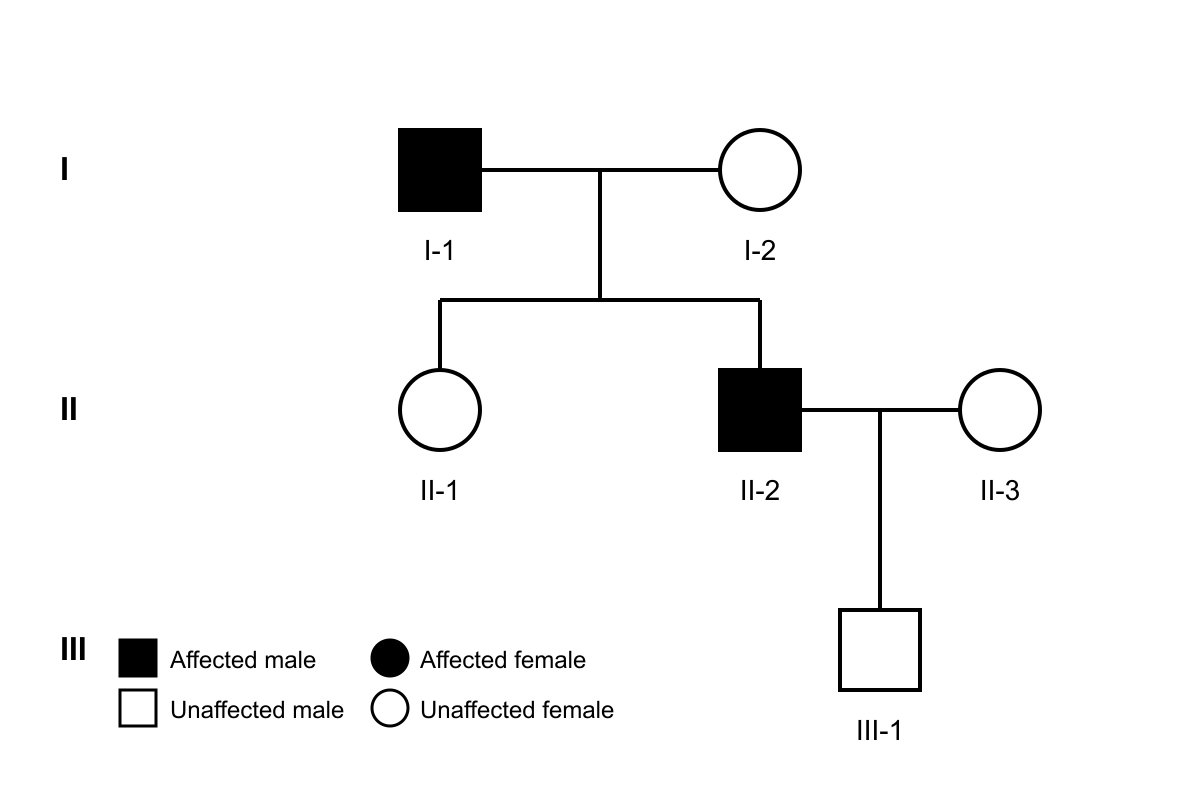
The pedigree illustrates a rare genetic condition. Analysis of all family members reveals that only males are affected and the trait is passed from father to all his sons. Individual II-2 and his partner II-3 have a son, III-1, who is unexpectedly unaffected. Assuming no issues with paternity, what does the phenotype of III-1 definitively rule out?
- Autosomal dominant inheritance
- X-linked recessive inheritance
- Y-linked inheritance (correct answer)
- Autosomal recessive inheritance
Explanation: The initial description suggests Y-linked inheritance (father-to-all-sons transmission, no affected females). In Y-linked inheritance, an affected father passes his Y chromosome, and thus the trait, to all of his male offspring. The fact that the affected father II-2 has an unaffected son III-1 directly contradicts this pattern. Therefore, the phenotype of III-1 definitively rules out Y-linked inheritance. The other modes remain possible under certain assumptions about carrier status and genotypes.
Question 2
Refer to the pedigree of a family with a rare autosomal dominant disorder characterized by incomplete penetrance. Individual II-2 is phenotypically unaffected. He marries an unaffected woman, II-3, from outside the family. They have an affected son, III-1. What is the genotype of individual II-2?
- Homozygous dominant (AA)
- Heterozygous (Aa) (correct answer)
- Homozygous recessive (aa)
- His genotype cannot be determined from the pedigree.
Explanation: The disorder is autosomal dominant. Let 'A' be the dominant allele causing the disorder. Individual I-1 is affected, so his genotype is A_. Individual III-1 is affected (genotype A_) but his mother II-3 is an unaffected outsider, so her genotype is assumed to be aa. Therefore, III-1 must have inherited the 'A' allele from his father, II-2. Even though II-2 is phenotypically unaffected, he must carry the 'A' allele to pass it to his son. This is a case of non-penetrance. Thus, the genotype of II-2 must be heterozygous (Aa).
Question 3
An autosomal dominant disorder with 80% penetrance is shown in the pedigree. Individual II-1 is affected. He marries an unaffected woman from outside the family. What is the probability that their first child will be phenotypically affected?
- 0.8
- 0.5
- 0.4 (correct answer)
- 0.2
Explanation: Let 'A' be the dominant allele. Individual II-1 is affected, and he has an unaffected father (I-1, genotype aa). Therefore, II-1 must have inherited the 'A' allele from his affected mother (I-2) and must be heterozygous (Aa). He marries an unaffected woman (genotype aa). The probability that their child inherits the 'A' allele is 1/2. However, the disorder has 80% penetrance, meaning that only 80% of individuals with the 'A' allele will actually show the phenotype. Therefore, the total probability of the child being phenotypically affected is P(inherits A) * P(phenotype is expressed | has A) = 0.5 * 0.8 = 0.40.
Question 4
The pedigree displays an autosomal dominant trait. Individual III-1 is the first affected member of her generation. She has an unaffected brother, III-2. What can be inferred about the genotype of their father, individual II-2?
- He must be homozygous dominant (AA).
- He must be heterozygous (Aa). (correct answer)
- He must be homozygous recessive (aa).
- His genotype cannot be determined with certainty.
Explanation: Individual I-1 is affected (A_) and has an unaffected child, II-3 (aa). This means I-1 must be heterozygous (Aa). Individual II-2 is an affected son of I-1 (Aa) and I-2 (aa). Therefore, the genotype of II-2 must be heterozygous (Aa). The information about generation III confirms this. II-2 (Aa) and his unaffected partner II-1 (aa) have an affected child III-1 (Aa) and an unaffected child III-2 (aa). Having an unaffected child (III-2) proves that the affected parent (II-2) must carry the recessive allele 'a', confirming his heterozygous genotype.
Question 5
The pedigree provided shows a family affected by a rare X-linked recessive condition. Individual II-3 is an unaffected female who marries an unaffected male, II-4. They are expecting their first child. What is the probability that their son will be affected?
- 1/8
- 1/4 (correct answer)
- 1/2
- 0
Explanation: Let X^R be the normal allele and X^r be the recessive allele for the condition. Since I-1 and I-2 are unaffected but have an affected son (II-2, genotype XrY), the mother (I-2) must be a carrier (XRXr). The father (I-1) is X^RY. Their daughter, II-3, is unaffected. Her possible genotypes are X^RX^R and X^RX^r, each with a 1/2 probability. For her to have an affected son (XrY), she must be a carrier. The probability of having an affected son is P(II-3 is carrier) * P(son inherits Xr from carrier mother). This is (1/2) * (1/2) = 1/4. The genotype of the father (II-4, XRY) is irrelevant for the son's condition, as sons inherit the Y chromosome from their father. Question 6
The provided pedigree shows a family with a genetic disorder. The mode of inheritance is uncertain, but autosomal dominant, autosomal recessive, and X-linked recessive modes are all considered possible. Which statement regarding the genotype of individual I-2 is correct?
- If the mode is autosomal dominant, her genotype must be homozygous recessive. (correct answer)
- If the mode is autosomal recessive, her genotype must be homozygous dominant.
- If the mode is X-linked recessive, her genotype must be homozygous recessive.
- Her genotype must be heterozygous regardless of the mode of inheritance.
Explanation: Let's analyze each plausible mode:
-
Autosomal Dominant (AD): The father I-1 is affected (Aa) and the son II-1 is affected (Aa). For this to occur with an unaffected mother (I-2), her genotype must be homozygous recessive (aa). This is a valid statement.
-
Autosomal Recessive (AR): The father I-1 is affected (aa) and the son II-1 is affected (aa). To have an affected child, the phenotypically unaffected mother (I-2) must be a carrier, making her heterozygous (Aa). So, choice B is incorrect.
-
X-linked Recessive (XR): The father I-1 is affected (XaY) and the son II-1 is affected (XaY). A son inherits his X chromosome from his mother. For the son to be affected, the phenotypically unaffected mother (I-2) must be a carrier, making her heterozygous (XAXa). So, choice C is incorrect. Choice D is incorrect because her genotype is aa in the AD case but heterozygous in the AR and XR cases.
Question 7
A rare genetic disorder that is X-linked dominant is segregating in the family shown. Based on the phenotypes in the pedigree, what is the genotype of individual I-2?
- X^A X^A
- X^A X^a (correct answer)
- X^a X^a
- Her genotype cannot be determined with certainty.
Explanation: Let X^A be the dominant allele causing the disorder and X^a be the recessive normal allele. Individual I-2 is an affected female. Her partner, I-1, is an unaffected male, so his genotype is X^aY. They have an unaffected daughter, II-3. For a daughter to be unaffected, her genotype must be X^aX^a. She inherits one X chromosome from each parent. She must have inherited an X^a from her father (I-1) and an X^a from her mother (I-2). Since we know I-2 possesses an X^a allele but is phenotypically affected, she must also carry the dominant X^A allele. Therefore, her genotype is unequivocally X^AX^a.
Question 8
A rare trait's inheritance is shown. The pattern is consistent with both autosomal dominant (with I-1 being heterozygous) and X-linked recessive (with I-2 being a carrier) inheritance. If individual II-2 marries a phenotypically normal woman from a family with no history of the trait, which mode of inheritance would result in a 50% chance of their son being affected?
- Autosomal dominant only (correct answer)
- X-linked recessive only
- Both modes of inheritance
- Neither mode of inheritance
Explanation: Let's analyze the two possibilities for the son of II-2 and a normal woman.
-
Autosomal Dominant (AD): Individual II-2 is affected, and his father I-1 is heterozygous (Aa), mother I-2 is normal (aa). So, II-2's genotype is Aa. He marries a normal woman (aa). Their children have a 1/2 (50%) chance of inheriting the 'A' allele and being affected, regardless of gender. So a son has a 50% chance.
-
X-linked Recessive (XR): Individual II-2 is affected, so his genotype is X^rY. He marries a normal woman with no family history, so her genotype is X^RX^R. They can have daughters who are carriers (XRXr) and sons who are normal (XRY). None of their sons can be affected. The probability is 0%.
Therefore, only the autosomal dominant mode results in a 50% chance of an affected son.
Question 9
Examine the pedigree for a rare genetic disorder. If this disorder is autosomal recessive, what is the genotype of individual II-2?
- Homozygous dominant
- Heterozygous (correct answer)
- Homozygous recessive
- Genotype cannot be determined
Explanation: If the disorder is autosomal recessive, affected individuals (like II-1) have the genotype 'aa'. Individual II-2 is phenotypically unaffected. Her parents, I-1 and I-2, are also unaffected. However, they produced an affected child (II-1), which means both I-1 and I-2 must be heterozygous carriers (Aa). Individual II-2 is an unaffected child of this Aa x Aa cross. Her possible genotypes are AA and Aa. Normally, we would say there is a 2/3 chance she is a carrier. However, we must look at her children. She has an affected son, III-2 (genotype aa). To produce an 'aa' child, she must contribute an 'a' allele. Therefore, individual II-2 must be heterozygous (Aa). Her carrier status is confirmed by her affected offspring.
Question 10
The following pedigree shows an autosomal recessive disorder. The allele frequency of the recessive allele in the general population is 1/70. Individual III-1 marries an unrelated, unaffected individual (III-2) from the general population. What is the approximate probability that their first child (IV-1) will be affected?
- 1/140
- 1/210
- 1/420 (correct answer)
- 1/560
Explanation: Step 1: Determine the probability that III-1 is a carrier. Her mother, II-2, is the unaffected sister of an affected individual (II-1). Their parents (I-1, I-2) must be carriers (Aa). The probability that II-2 is a carrier is 2/3. III-1's father, II-3, is an unaffected outsider, assumed to be AA. The probability that III-1 is a carrier is P(II-2 is carrier) * P(III-1 inherits 'a' from II-2) = (2/3) * (1/2) = 1/3.
Step 2: Determine the probability that III-2 is a carrier. III-2 is an unrelated individual from the general population. The carrier frequency can be estimated using the Hardy-Weinberg equation, 2pq. Given q = 1/70, and p ≈ 1, the carrier frequency is 2 * 1 * (1/70) = 2/70 = 1/35.
Step 3: Calculate the probability of an affected child. P(affected) = P(III-1 is carrier) * P(III-2 is carrier) * P(child is aa from two carriers) = (1/3) * (1/35) * (1/4) = 1/420.
Question 11
The pedigree shows a rare autosomal recessive trait. If individuals III-1 and III-2 have a child, what is the probability that the child will be a carrier of the trait?
- 1/3 (correct answer)
- 1/2
- 2/3
- 1/4
Explanation: Let the alleles be A (normal) and a (trait). Individual I-1 is affected (aa). Her partner I-2 is unaffected. They have an unaffected son, II-2. For this to happen, I-2 must be at least heterozygous (Aa), but since they have an unaffected child (II-2), this doesn't help. Let's re-examine. The trait is rare. I-1 is affected (aa). II-3 is affected (aa). Since II-3's parents (I-3, I-4) are unaffected, they must be carriers (Aa). Their unaffected son, II-4, has a 2/3 chance of being a carrier. Now let's look at the main line. Individual II-2 is the son of an affected mother I-1(aa) and an unaffected father I-2(A_). II-2 is unaffected, so his genotype must be Aa (he gets 'a' from mother, 'A' from father). He is an obligate carrier. II-2(Aa) marries II-1, an unaffected woman from outside the family (assume AA). Their daughter III-1 has a 1/2 chance of being a carrier (Aa). Individual III-2 is the daughter of II-4 and II-5. We determined P(II-4 is carrier) = 2/3. II-5 is an outsider (AA). So, P(III-2 is carrier) = P(II-4 is carrier) * 1/2 = (2/3) * (1/2) = 1/3. Now, the cross is III-1 (P(carrier)=1/2) x III-2 (P(carrier)=1/3). The probability of a carrier child (Aa) is: P(child is Aa) = P(III-1 is Aa)P(III-2 is AA)P(child is Aa) + P(III-1 is AA)P(III-2 is Aa)P(child is Aa) + P(III-1 is Aa)P(III-2 is Aa)P(child is Aa). P(III-1 is AA)=1/2. P(III-2 is AA)=2/3. The calculation is: (1/2)(2/3)(1/2) + (1/2)(1/3)(1/2) + (1/2)(1/3)(1/2) = 1/6 + 1/12 + 1/12 = 4/12 = 1/3.
Question 12
The pedigree shows a rare X-linked dominant disorder. Individual II-1 marries an unaffected man. A prenatal test indicates their fetus (III-1) is male. What is the probability this son will be affected by the disorder?
- 100%
- 50% (correct answer)
- 25%
- 0%
Explanation: Let X^D be the dominant allele and X^d be the recessive allele. The mother, I-2, is affected. Her partner, I-1, is unaffected (XdY). They have an unaffected son, II-2 (XdY). Since I-2 has an unaffected son, she must have passed him her X^d allele. Therefore, the affected mother I-2 must be heterozygous (XDXd). Their affected daughter, II-1, inherited one X from each parent. She must have inherited X^d from her father (I-1). Since she is affected, she must have inherited X^D from her mother (I-2). Thus, II-1's genotype is X^DX^d. She marries an unaffected man (XdY). A son inherits his X chromosome from his mother. The probability that a son of the heterozygous mother (XDXd) will inherit the X^D allele is 1/2 or 50%. Question 13
In the provided pedigree for an autosomal dominant trait, most affected individuals are heterozygous. However, one individual is known to be homozygous dominant, which for this trait results in a more severe phenotype (not distinguished in the shading). Which individual is most likely homozygous dominant (AA)?
- I-1
- II-2
- II-3
- III-1 (correct answer)
Explanation: To be homozygous dominant (AA), an individual must inherit a dominant allele 'A' from both parents. This means both parents must carry at least one 'A' allele. Let's examine the parents of each affected individual:
- I-1: We don't see their parents, so we cannot determine their genotype this way.
- II-2: Parents are I-1 (affected) and I-2 (unaffected, aa). Since II-2 has an unaffected parent, they can only be heterozygous (Aa).
- II-3: Parents are I-1 (affected) and I-2 (unaffected, aa). Same as II-2, they must be heterozygous (Aa).
- III-1: Parents are II-2 and II-3. Both are affected. Since we determined they are both heterozygous (Aa), their child III-1 has a 1/4 chance of being homozygous dominant (AA), a 1/2 chance of being heterozygous (Aa), and a 1/4 chance of being homozygous recessive (aa). Since III-1 is affected, they are either AA or Aa. They are the only individual in the pedigree who could possibly be homozygous dominant.
Question 14
The pedigree provided is for a condition where the mode of inheritance is unknown. Which mode of inheritance is definitively excluded by the information presented?
- Autosomal recessive
- Autosomal dominant
- X-linked dominant (correct answer)
- X-linked recessive
Explanation: Let's test each mode of inheritance:
- Autosomal recessive: Possible if I-1 and I-2 are both heterozygous carriers (Aa), producing an affected son II-2 (aa).
- Autosomal dominant: Possible if I-1 is heterozygous (Aa) and I-2 is homozygous recessive (aa), producing an affected son II-2 (Aa). This requires the trait to have incomplete penetrance since I-1 is unaffected, but this possibility isn't ruled out.
- X-linked dominant: In this mode, an affected father passes the trait to all of his daughters. Individual I-1 is an affected father. He has an unaffected daughter, II-1. This is a direct contradiction of X-linked dominant inheritance. Therefore, this mode is definitively excluded.
- X-linked recessive: Possible if the mother I-2 is a carrier (XAXa) and the father I-1 is unaffected (XAY), producing an affected son II-2 (XaY).