All questions
Question 1
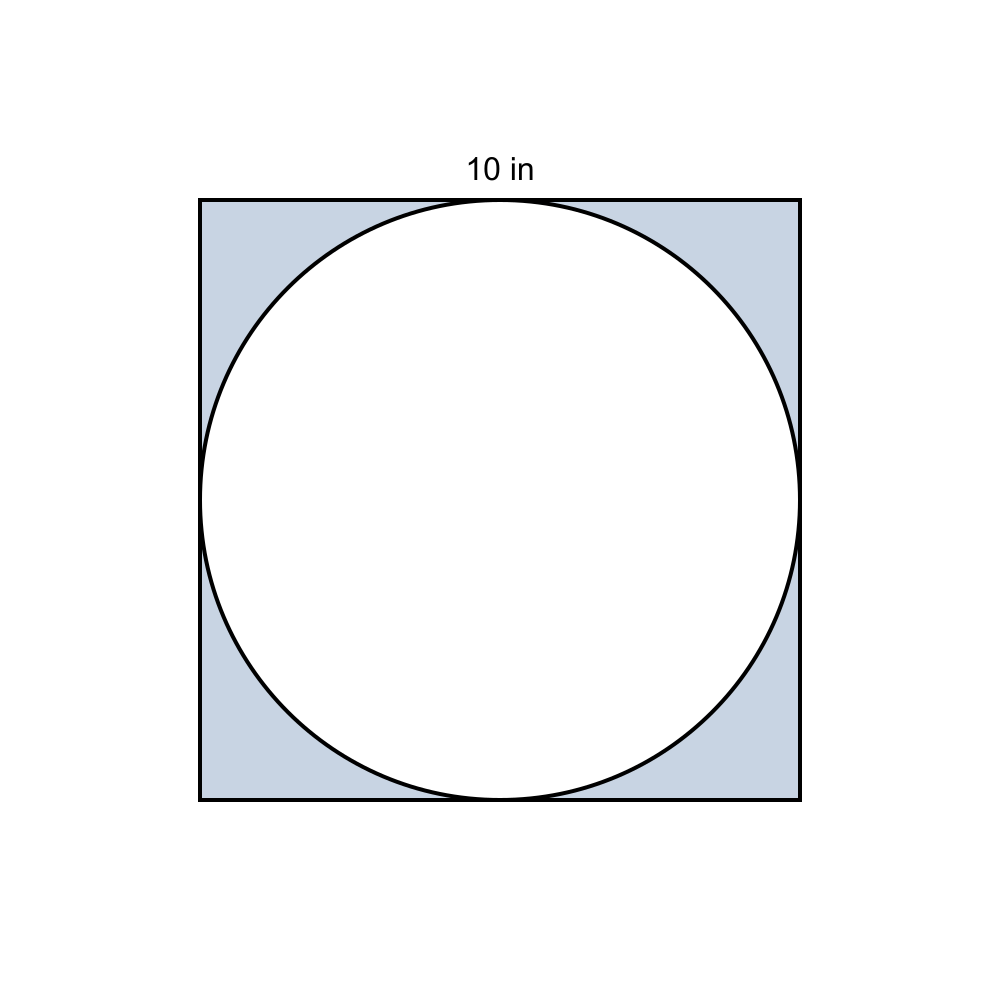
In the figure, a circle is inscribed in a square. If the square has side length 10 inches, what is the area of the shaded region (inside the square but outside the circle), in square inches?
- 14.25
- 21.50 (correct answer)
- 21.46
- 78.50
Explanation: Square area = 102=100 in². Inscribed circle has radius 5 in, so circle area = π(5)2=25π≈25(3.14)=78.50 in². Shaded area = 100−78.50=21.50 in². (A) uses incorrect radius or calculation. (C) uses a slightly different π approximation. (D) gives the circle area instead of the shaded area. Question 2
A sphere is inscribed inside a cube as shown. If the cube has edge length 10 cm, what is the volume of the empty space inside the cube but outside the sphere, in cubic centimeters?
- 476.67 (correct answer)
- 523.33
- 606.50
- 720.00
Explanation: Cube volume = 103=1000 cm³. Sphere radius = 5 cm (half the edge). Sphere volume = 34πr3=34(3.14)(125)≈523.33 cm³. Empty space = 1000−523.33≈476.67 cm³. (B) gives the sphere volume itself. (C) uses radius 10 (diameter as radius) in a combined miscalculation. (D) uses πr2 instead of 34πr3. Question 3
A cylindrical water tank has a radius of 5 meters and is filled with water to a height of 8 meters. If the radius of the tank is doubled, but the volume of water remains the same, what will be the new height of the water in the tank?
- 2 meters (correct answer)
- 4 meters
- 1 meter
- 1.5 meters
Explanation: First, calculate the original volume of water: V = πr²h = π(5)²(8) = 200π cubic meters. The new radius is double the original, so the new radius is 10 meters. The volume of water is unchanged. Let the new height be h_new. The volume formula with the new radius is V = π(10)²(h_new) = 100π(h_new). Set the volumes equal: 200π = 100π(h_new). Divide both sides by 100π to solve for h_new, which gives h_new = 2 meters.
Question 4
A pizza with a 16-inch diameter is cut into 8 equal slices. A smaller pizza with a 12-inch diameter is cut into 6 equal slices. What is the positive difference in area between one slice of the larger pizza and one slice of the smaller pizza?
- 2π sq in (correct answer)
- 4π sq in
- 8π sq in
- 28π sq in
Explanation: For the larger pizza, the radius is 16/2 = 8 inches. Its total area is A = π(8)² = 64π sq in. The area of one slice is 64π / 8 = 8π sq in. For the smaller pizza, the radius is 12/2 = 6 inches. Its total area is A = π(6)² = 36π sq in. The area of one slice is 36π / 6 = 6π sq in. The positive difference between the slice areas is 8π - 6π = 2π sq in.
Question 5
A concrete pipe is a cylinder with a length of 10 feet. It has an outer diameter of 3 feet and an inner diameter of 2 feet. What is the volume of the concrete used to make the pipe, in cubic feet? (Use π ≈ 3.14)
- 15.7 cu ft
- 39.25 cu ft (correct answer)
- 70.65 cu ft
- 109.9 cu ft
Explanation: This problem requires finding the volume of a hollow cylinder by subtracting the inner volume from the outer volume. The outer radius is 3÷2 = 1.5 ft and the inner radius is 2÷2 = 1 ft. The length is 10 ft. The volume of the outer cylinder is V_outer = πr²h = 3.14 × (1.5)² × 10 = 3.14 × 2.25 × 10 = 70.65 cu ft. The volume of the inner hollow space is V_inner = πr²h = 3.14 × (1)² × 10 = 31.4 cu ft. The volume of concrete is the difference: 70.65 - 31.4 = 39.25 cubic feet.
Question 6
A rectangular garden measures 12 feet by 15 feet. Inside the garden, a circular fountain with a diameter of 6 feet is installed. What is the area of the garden remaining for planting, in square feet? (Use π ≈ 3.14)
- 151.74 sq ft (correct answer)
- 161.16 sq ft
- 174.00 sq ft
- 68.84 sq ft
Explanation: First, calculate the total area of the rectangular garden: Area = length × width = 15 ft × 12 ft = 180 sq ft. Next, calculate the area of the circular fountain. The diameter is 6 feet, so the radius is half of that, which is 3 feet. The area of a circle is A = πr². Using r = 3, the area is A = 3.14 × (3)² = 3.14 × 9 = 28.26 sq ft. To find the remaining area for planting, subtract the fountain's area from the garden's area: 180 sq ft - 28.26 sq ft = 151.74 sq ft.
Question 7
A block of wood is a rectangular prism with dimensions 2 inches by 4 inches by 5 inches. If a hole with a radius of 1 inch is drilled all the way through the block, parallel to the 5-inch side, what is the volume of the remaining wood? (Use π ≈ 3.14)
- 24.30 cu in (correct answer)
- 32.44 cu in
- 40.00 cu in
- 20.60 cu in
Explanation: First, calculate the initial volume of the rectangular block: V_block = 2 in × 4 in × 5 in = 40 cubic inches. Next, calculate the volume of the cylindrical hole that was removed. The hole has a radius of 1 inch and its height is the length of the side it passes through, which is 5 inches. The volume of the cylinder is V_hole = πr²h = 3.14 × (1)² × 5 = 3.14 × 5 = 15.7 cubic inches. The volume of the remaining wood is the initial volume minus the volume of the hole: 40 cu in - 15.7 cu in = 24.3 cubic inches.
Question 8
A right square pyramid is shown. Based on the figure, what is the total surface area of the pyramid, in square inches?
- 144
- 180
- 240 (correct answer)
- 260
Explanation: Base area = 122=144 in². Slant height given is 8 in. Each triangular face has area 21(12)(8)=48 in². Four faces = 192 in². Wait: total = 144+192=336. That doesn't match either. Recompute with base 8, slant 11: base = 64, lateral = 4·(½·8·11) = 176, total = 240. (A) base only plus half lateral. (B) uses slant height 8 with base 8: 64+128=192... (D) uses height instead of slant height incorrectly. Question 9
A storage container is in the shape of the composite solid shown: a rectangular prism with a triangular prism (like a roof) on top. Based on the figure, what is the total volume of the container, in cubic feet?
- 360
- 420 (correct answer)
- 480
- 540
Explanation: Rectangular prism volume = 10×6×5=300 ft³. Triangular prism (roof) volume = (area of triangular cross-section) × length = 21(6)(4)×10=120 ft³. Total volume = 300+120=420 ft³. (A) uses an incorrect triangular area calculation. (C) miscalculates the rectangular prism volume. (D) forgets the 21 factor in the triangular prism volume calculation. Question 10
A rectangular room is 14 feet long, 10 feet wide, and 8 feet high. The four walls and the ceiling are to be painted. What is the total area to be painted in square feet?
- 192 sq ft
- 384 sq ft
- 524 sq ft (correct answer)
- 664 sq ft
Explanation: First, calculate the area of the four walls (the lateral surface area). The perimeter of the floor is 2(14 + 10) = 2(24) = 48 feet. The area of the walls is the perimeter multiplied by the height: 48 ft × 8 ft = 384 sq ft. Next, calculate the area of the ceiling, which is the same as the area of the floor: 14 ft × 10 ft = 140 sq ft. The total area to be painted is the sum of the walls' area and the ceiling's area: 384 sq ft + 140 sq ft = 524 sq ft.
Question 11
A cylindrical can has a volume of 72π cubic centimeters and a height of 8 centimeters. What is the circumference of its base?
- 3π cm
- 6π cm (correct answer)
- 9π cm
- 12π cm
Explanation: The volume of a cylinder is V = πr²h. We are given V = 72π and h = 8. So, 72π = πr²(8). Divide both sides by 8π: 9 = r². Taking the square root gives the radius r = 3 cm. The question asks for the circumference of the base, which is C = 2πr. Substituting r = 3, we get C = 2π(3) = 6π centimeters.
Question 12
The diagonal of a square is 10 inches long. What is the area of the square in square inches?
- 20 sq in
- 50 sq in (correct answer)
- 100 sq in
- 200 sq in
Explanation: Let the side length of the square be 's'. The diagonal, 'd', forms a right triangle with two sides of the square. By the Pythagorean theorem, s² + s² = d². This simplifies to 2s² = d². We are given d = 10, so 2s² = 10² = 100. The area of the square is A = s². From the equation 2s² = 100, we can solve for s² by dividing by 2: s² = 50. Therefore, the area of the square is 50 square inches.
Question 13
A company manufactures cylindrical cans. The height of a can is 10 cm and the diameter of its base is 8 cm. What is the total surface area of the can in terms of π?
- 80π sq cm
- 96π sq cm
- 112π sq cm (correct answer)
- 144π sq cm
Explanation: The total surface area of a cylinder is SA = 2πr² + 2πrh. The diameter is 8 cm, so the radius r = 4 cm. The height h = 10 cm. The area of the two circular bases is 2πr² = 2π(4)² = 2π(16) = 32π sq cm. The lateral surface area (the side) is 2πrh = 2π(4)(10) = 80π sq cm. The total surface area is the sum of these two parts: 32π + 80π = 112π sq cm.
Question 14
The area of a circle is 144π square units. What is the circumference of the circle?
- 12π units
- 24π units (correct answer)
- 36π units
- 144π units
Explanation: The formula for the area of a circle is A = πr². We are given A = 144π. So, 144π = πr². Dividing both sides by π gives r² = 144. Taking the square root of both sides gives r = 12 units. The formula for the circumference of a circle is C = 2πr. Substituting r = 12, we get C = 2π(12) = 24π units.
Question 15
A rectangular sandbox has a length of 8 feet and a width of 6 feet. It is filled with sand to a uniform depth of 9 inches. What is the volume of sand in the sandbox in cubic feet?
- 36 cu ft (correct answer)
- 48 cu ft
- 72 cu ft
- 432 cu ft
Explanation: To find the volume in cubic feet, all dimensions must be in feet. The length is 8 ft and the width is 6 ft. The depth is 9 inches. To convert inches to feet, divide by 12: 9 inches = 9/12 feet = 0.75 feet. Now, calculate the volume: V = length × width × depth = 8 ft × 6 ft × 0.75 ft = 48 × 0.75 = 36 cubic feet.
Question 16
The ratio of the volumes of two cubes is 8:27. What is the ratio of their surface areas?
- 2:3
- 4:9 (correct answer)
- 8:27
- 16:81
Explanation: Let the side lengths of the two cubes be s₁ and s₂. The ratio of their volumes is (s₁)³ / (s₂)³ = 8/27. Taking the cube root of both sides gives s₁/s₂ = 2/3. The surface area of a cube is 6s². The ratio of their surface areas is (6(s₁)²) / (6(s₂)²) = (s₁/s₂)² . Since s₁/s₂ = 2/3, the ratio of the surface areas is (2/3)² = 4/9.
Question 17
A parallelogram has an area of 72 square centimeters and a base of 9 centimeters. A triangle has the same area and the same base as the parallelogram. What is the height of the triangle?
- 4 cm
- 8 cm
- 16 cm (correct answer)
- 18 cm
Explanation: This is a multi-step problem. First, find the height of the parallelogram. Area = base × height. 72 = 9 × h_para. So, h_para = 8 cm. Now, consider the triangle. The triangle's area is 72 sq cm and its base is 9 cm. The area formula for a triangle is A = (1/2)bh. 72 = (1/2) × 9 × h_tri. Multiply both sides by 2: 144 = 9 × h_tri. Divide by 9: h_tri = 16 cm. The height of the triangle is 16 cm.
Question 18
A semi-circular protractor has a diameter of 10 centimeters. What is the perimeter of the protractor in centimeters? (Use π ≈ 3.14)
- 15.70 cm
- 25.70 cm (correct answer)
- 31.40 cm
- 41.40 cm
Explanation: The perimeter of the protractor consists of two parts: the curved semi-circular arc and the straight diameter. The length of the full circumference of a circle with diameter 10 cm is C = πd = 3.14 × 10 = 31.4 cm. The length of the semi-circular arc is half of this, which is 31.4 / 2 = 15.7 cm. The length of the straight edge is the diameter, which is 10 cm. The total perimeter is the sum of the arc and the diameter: 15.7 cm + 10 cm = 25.70 cm.
Question 19
The length of a rectangle is increased by 20% and its width is decreased by 10%. What is the percent change in the area of the rectangle?
- 8% increase (correct answer)
- 10% increase
- 10% decrease
- 12% increase
Explanation: Let the original length be L and the original width be W. The original area is A = LW. The new length is L' = L + 0.20L = 1.2L. The new width is W' = W - 0.10W = 0.9W. The new area is A' = L'W' = (1.2L)(0.9W) = 1.08LW. The change in area is A' - A = 1.08LW - LW = 0.08LW. The percent change is (change / original) × 100 = (0.08LW / LW) × 100 = 0.08 × 100 = 8%. Since the result is positive, it is an 8% increase.
Question 20
A solid metal cube with a side length of 6 inches is melted down and recast into a solid cylinder with a radius of 3 inches. What is the height of the cylinder?
- 8/π inches
- 12/π inches
- 24/π inches (correct answer)
- 36/π inches
Explanation: The volume of the material remains the same. First, calculate the volume of the cube: V_cube = s³ = 6³ = 216 cubic inches. Next, use the volume formula for the cylinder, V_cylinder = πr²h. We know the volume must be 216 and the radius is 3. So, 216 = π(3)²h = 9πh. To solve for the height h, divide both sides by 9π: h = 216 / (9π) = 24/π inches.