Praxis Math Quiz: Interpret Slope And Intercepts
20 questions · exam conditions
0:00
Interpret Slope And InterceptsQuestion 1 of 20

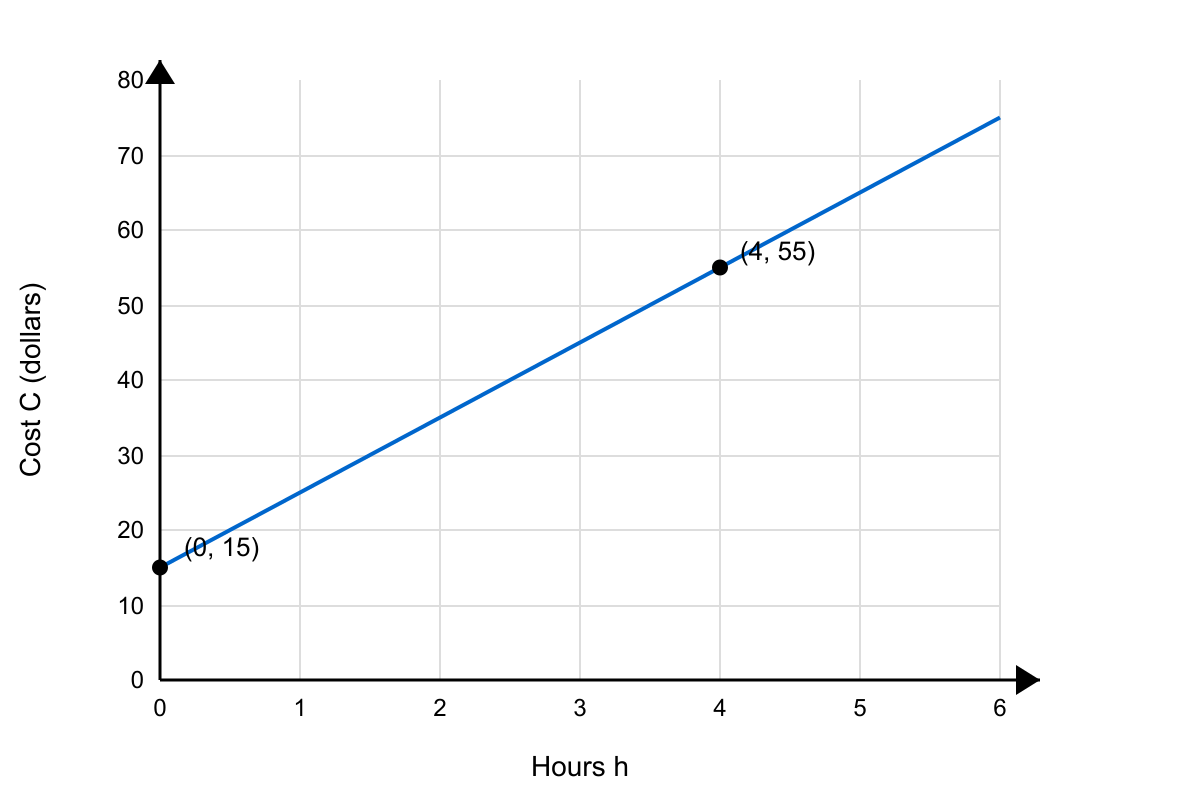
The line shown below represents the total cost CC (in dollars) of renting a kayak for hh hours. Based on the graph, which equation correctly models the cost?
Question graphic
C=15hC = 15h
C=10h+15C = 10h + 15
C=15h+10C = 15h + 10
C=7.5h+15C = 7.5h + 15
← Back to quizzes

Praxis Math Quiz

Praxis Math Quiz: Interpret Slope And Intercepts

Practice Interpret Slope And Intercepts in Praxis Math with focused quiz questions that help you check what you know, review explanations, and build confidence with test-style prompts.

What this quiz covers

This quiz focuses on Interpret Slope And Intercepts, giving you a quick way to practice the rules, question types, and explanations that matter most for Praxis Math.

How to use this quiz

Try each quiz question before looking at the correct answer. Use the explanations to review missed ideas, then come back to similar questions until the pattern feels familiar.

All questions

Question 1

The line shown below represents the total cost CC (in dollars) of renting a kayak for hh hours. Based on the graph, which equation correctly models the cost?

  1. C=15hC = 15h
  2. C=10h+15C = 10h + 15 (correct answer)
  3. C=15h+10C = 15h + 10
  4. C=7.5h+15C = 7.5h + 15
Explanation: The y-intercept (at h=0h=0) is 15 (a flat fee of $15). The line passes through (0,15)(0,15) and (4,55)(4,55), giving slope 551540=10\frac{55-15}{4-0}=10. So C=10h+15C=10h+15. (A) ignores the y-intercept. (C) swaps slope and intercept. (D) uses rise-over-wrong-run, computing 55150(4)\frac{55-15}{0-(-4)} incorrectly or halving the slope.

Question 2

A line has equation 2x5y=202x - 5y = 20. The graph of this line is shown below. Based on the graph and equation, which statement is true?

  1. The slope is 22 and the y-intercept is 2020.
  2. The slope is 25-\tfrac{2}{5} and the y-intercept is 44.
  3. The slope is 25\tfrac{2}{5} and the y-intercept is 4-4. (correct answer)
  4. The slope is 52\tfrac{5}{2} and the y-intercept is 4-4.
Explanation: Solve for yy: 2x5y=205y=2x+20y=25x42x-5y=20 \Rightarrow -5y=-2x+20 \Rightarrow y=\tfrac{2}{5}x-4. Slope 25\tfrac{2}{5}, y-intercept 4-4. (A) reads A and C directly from standard form without solving. (B) has the wrong sign on slope and confuses intercepts. (D) inverts the slope fraction.

Question 3

The graph of a linear function gg is shown below. Refer to the figure below. Which of the following is the equation of gg?

  1. g(x)=23x+2g(x) = -\tfrac{2}{3}x + 2 (correct answer)
  2. g(x)=32x+2g(x) = -\tfrac{3}{2}x + 2
  3. g(x)=23x+2g(x) = \tfrac{2}{3}x + 2
  4. g(x)=23x+3g(x) = -\tfrac{2}{3}x + 3
Explanation: The line passes through (0,2)(0,2) and (3,0)(3,0). Slope =0230=23=\frac{0-2}{3-0}=-\tfrac{2}{3}; y-intercept is 2. Thus g(x)=23x+2g(x)=-\tfrac{2}{3}x+2. (B) inverts rise and run. (C) ignores the negative direction. (D) misreads the y-intercept as 3 (the x-intercept).

Question 4

The coordinate plane below shows two lines, 1\ell_1 and 2\ell_2, that are perpendicular. Refer to the figure. If 1\ell_1 has the equation y=34x2y = \tfrac{3}{4}x - 2 and 2\ell_2 passes through the point (6,1)(6, 1) shown on the graph, what is the y-intercept of 2\ell_2?

  1. 99 (correct answer)
  2. 7-7
  3. 5.55.5
  4. 3.5-3.5
Explanation: Perpendicular slope: 43-\tfrac{4}{3}. Using point (6,1)(6,1): y1=43(x6)y=43x+8+1=43x+9y-1=-\tfrac{4}{3}(x-6)\Rightarrow y=-\tfrac{4}{3}x+8+1=-\tfrac{4}{3}x+9. Y-intercept is 9. (B) uses slope 43\tfrac{4}{3} (forgetting the negative). (C) uses slope 34-\tfrac{3}{4} (negating without reciprocating). (D) uses slope 34\tfrac{3}{4} (the parallel slope).

Question 5

The value, V, in dollars, of a piece of equipment is modeled by the linear equation V=2,500t+20,000V = -2,500t + 20,000, where t is the number of years since its purchase. Which statement provides the best interpretation of the slope of this equation?

  1. The equipment's value decreases by $2,500 each year. (correct answer)
  2. The initial purchase price of the equipment was $2,500.
  3. The equipment will have no value after 8 years.
  4. The equipment's value decreases by $20,000 every 8 years.
Explanation: In the equation y=mx+by = mx + b, the slope mm represents the rate of change. Here, the slope is -2,500. This means the value, V, changes by -2,500 dollars for each 1-year increase in t. Therefore, the equipment's value decreases by $2,500 per year.

Question 6

The temperature inside a freezer was -4°C at 1:00 PM. By 3:00 PM, after a power outage, the temperature had risen to 6°C. The temperature rise was linear.

Based on the information in the passage, what is the meaning of the slope of the line that models the freezer's temperature, T, as a function of time, h, in hours after 1:00 PM?

  1. The temperature increases by 5°C per hour. (correct answer)
  2. The temperature starts at -4°C at 1:00 PM.
  3. The temperature rises by 10°C in the two-hour period.
  4. The temperature increases by 0.2°C per hour.
Explanation: The slope is the rate of change, calculated as (change in temperature) / (change in time). The temperature changed from -4°C to 6°C, a change of 6(4)=106 - (-4) = 10°C. The time changed from 1:00 PM to 3:00 PM, a change of 2 hours. The slope is 10°C2 hours=5\frac{10°C}{2 \text{ hours}} = 5°C per hour.

Question 7

The temperature in Fahrenheit, F, can be approximated by the equation F=2C+30F = 2C + 30, where C is the temperature in Celsius. Which of the following is the best interpretation of the F-intercept (the vertical intercept) of the graph of this equation?

  1. A temperature of 0°C is approximately equivalent to 30°F. (correct answer)
  2. For every 2-degree increase in Celsius, the temperature increases by 30°F.
  3. A temperature of 0°F is approximately equivalent to 30°C.
  4. For every 1-degree increase in Celsius, the temperature increases by 30°F.
Explanation: The F-intercept (y-intercept) is the value of F when C=0. Substituting C=0C=0 into the equation gives F=2(0)+30=30F = 2(0) + 30 = 30. This means that a temperature of 0 degrees Celsius corresponds to a temperature of 30 degrees Fahrenheit.

Question 8

Two car rental companies offer different pricing plans. Company A's cost is modeled by C=0.50m+30C = 0.50m + 30. Company B's cost is modeled by C=0.40m+40C = 0.40m + 40, where C is the total cost in dollars and m is the number of miles driven.

Based on the equations, which statement accurately compares the two pricing plans?

  1. Company A has a lower initial fee but a higher cost per mile than Company B. (correct answer)
  2. Company B has a lower initial fee and a lower cost per mile than Company A.
  3. Company A has a higher initial fee and a higher cost per mile than Company B.
  4. Company B has a higher initial fee and a higher cost per mile than Company A.
Explanation: The initial fee is the y-intercept and the cost per mile is the slope. For Company A, the slope is 0.50 and the y-intercept is 30. For Company B, the slope is 0.40 and the y-intercept is 40. Comparing them, Company A's intercept (30) is lower than B's (40), and Company A's slope (0.50) is higher than B's (0.40).

Question 9

The amount of money, A, in a savings account after w weeks is modeled by the equation A=35w+250A = 35w + 250. If the initial deposit had been $100 less, but the weekly deposit amount remained the same, what part of the linear model would change?

  1. The y-intercept would decrease. (correct answer)
  2. The slope of the line would decrease.
  3. The x-intercept would increase.
  4. Both the slope and y-intercept would decrease.
Explanation: The initial deposit is the amount of money at week 0, which corresponds to the y-intercept of the graph. In this equation, the y-intercept is 250. The weekly deposit is the rate of change, which is the slope (35). If the initial deposit was $100 less, the y-intercept would decrease to 150, while the slope would remain unchanged.

Question 10

A school fundraiser's revenue is modeled by 10x+5y=200010x + 5y = 2000, where x is the number of adult tickets sold and y is the number of student tickets sold. What does the slope of this linear relationship represent?

  1. For every adult ticket sold, two fewer student tickets must be sold to meet the revenue goal. (correct answer)
  2. The price of a student ticket is half the price of an adult ticket.
  3. The total number of tickets that must be sold to reach the goal is 200.
  4. For every two student tickets sold, one fewer adult ticket must be sold to meet the revenue goal.
Explanation: To find the slope, convert the equation to slope-intercept form (y=mx+by = mx + b). 5y=10x+20005y = -10x + 2000, so y=2x+400y = -2x + 400. The slope is -2. This means that for every 1-unit increase in x (one adult ticket), y (number of student tickets) decreases by 2. This represents the trade-off between ticket types.

Question 11

A person starts a journey 300 miles from their destination and drives directly towards it at a constant speed of 60 miles per hour. If D is the remaining distance from the destination after t hours, which statement correctly interprets a parameter of the linear model?

  1. The D-intercept is 300, representing the initial distance from the destination. (correct answer)
  2. The slope is 60, representing the rate at which the distance is increasing.
  3. The t-intercept is 300, representing the total time the trip will take.
  4. The slope is -300, representing the starting point of the journey.
Explanation: The equation modeling this situation is D=60t+300D = -60t + 300. The D-intercept (the value when t=0) is 300, which represents the initial distance from the destination at the start of the journey. The slope is -60, because the distance to the destination is decreasing.

Question 12

The total cost, C, for printing a batch of yearbooks is given by C=20b+500C = 20b + 500, where b is the number of books. If the fixed setup fee is increased from $500 to $650, how does the graph of the cost function change?

  1. The graph shifts vertically upward by 150 units. (correct answer)
  2. The graph becomes steeper, with its slope increasing by 150.
  3. The graph shifts horizontally to the right by 150 units.
  4. The graph becomes less steep, with its y-intercept increasing.
Explanation: The fixed setup fee is the initial cost when zero books are printed, which is the y-intercept. The original y-intercept is 500. Increasing it to 650 changes the equation to C=20b+650C = 20b + 650. This change only affects the y-intercept, causing the entire line to shift vertically upward by 650500=150650 - 500 = 150 units. The slope remains 20.

Question 13

A line representing a car's remaining fuel has a horizontal intercept of 40 and a vertical intercept of 16. If y is the amount of fuel in gallons and x is the distance driven in tens of miles, what does the slope of this line represent?

  1. The car consumes 0.4 gallons of fuel for every 10 miles driven. (correct answer)
  2. The car has a fuel efficiency of 25 miles per gallon.
  3. The car's fuel tank initially contains 40 gallons of fuel.
  4. The car can travel a maximum distance of 160 miles on a full tank.
Explanation: The intercepts correspond to the points (40, 0) and (0, 16). The slope is m=016400=1640=0.4m = \frac{0 - 16}{40 - 0} = \frac{-16}{40} = -0.4. Since y is fuel in gallons and x is distance in tens of miles, a slope of -0.4 means the fuel decreases by 0.4 gallons for every 1 unit of x, which is 10 miles. Thus, the car consumes 0.4 gallons every 10 miles.

Question 14

For any single day, the cost, C, to park a car in a downtown garage is a flat fee of $20. Which statement best describes the slope of the line representing this cost function, where h is the number of hours parked?

  1. The slope is 0, because the cost does not change with the number of hours. (correct answer)
  2. The slope is 20, because the cost for parking is always $20.
  3. The slope is positive, because the cost is a positive value.
  4. The slope is undefined, because the number of hours is not specified.
Explanation: The cost is constant at $20, regardless of the hours parked. The equation for this is C=20C = 20. This is the equation of a horizontal line. The slope of any horizontal line is 0, indicating there is no rate of change.

Question 15

A startup company's value, V, in thousands of dollars, is modeled by V=40t120V = 40t - 120, where t is the number of months since its founding. What is the business significance of the t-intercept of this equation?

  1. The number of months it took for the company's value to reach zero, or break even. (correct answer)
  2. The initial value of the company at its founding, which was a debt of $120,000.
  3. The rate at which the company's value is increasing per month.
  4. The value of the company after 120 months of operation.
Explanation: The t-intercept is the value of t when V = 0. We solve 0=40t1200 = 40t - 120, which gives 40t=12040t = 120, so t=3t = 3. This means that after 3 months, the company's value was $0. This represents the point where the company's initial debt or investment was paid off, and it broke even.

Question 16

The height H (in meters) of a hot air balloon is given by H=2t+300H = 2t + 300, where t is in minutes. If the balloon had been launched from a platform 50 meters lower but rose at the same rate, what would be the new equation for the balloon's height?

  1. H=2t+250H = 2t + 250 (correct answer)
  2. H=52t+300H = 52t + 300
  3. H=2t+350H = 2t + 350
  4. H=48t+300H = -48t + 300
Explanation: The initial launch height is the y-intercept of the equation. The rate of rise is the slope. The problem states the balloon rose at the same rate, so the slope (2) remains unchanged. If it launched from 50 meters lower, the initial height (y-intercept) would be 30050=250300 - 50 = 250. Therefore, the new equation is H=2t+250H = 2t + 250.

Question 17

The value of a collectible item, V, after t years is modeled by V=75t+500V = 75t + 500. A second collectible's value is modeled by V=100t+500V = 100t + 500. What is the significance of the fact that both models have the same V-intercept?

  1. Both collectibles had the same initial value when they were acquired. (correct answer)
  2. Both collectibles are increasing in value at the same rate per year.
  3. Both collectibles will have the same value after a certain number of years.
  4. The value of both collectibles will eventually reach $500.
Explanation: The V-intercept (or y-intercept) represents the value at t=0, which is the initial value. Since both equations have a V-intercept of 500, it means both items started with a value of $500. Their slopes (rates of increase) are different (75 and 100).

Question 18

A taxi service charges a fare based on the equation F=2.75m+2.50F = 2.75m + 2.50, where F is the fare in dollars and m is the distance in miles. If the company decides to increase its per-mile rate by $0.25 but keep the initial fee the same, which part of the equation would change?

  1. The slope would increase to 3.00. (correct answer)
  2. The F-intercept would increase to 2.75.
  3. The slope would decrease to 2.50.
  4. The F-intercept would increase to 5.25.
Explanation: The per-mile rate is the rate of change, which is the slope of the linear equation. The initial fee is the F-intercept. The current slope is 2.75. Increasing it by $0.25 results in a new slope of 2.75+0.25=3.002.75 + 0.25 = 3.00. The initial fee (F-intercept) remains 2.50.

Question 19

The relationship between a company's profit, P, in dollars, and the number of widgets sold, x, is given by the equation 2P100x=40002P - 100x = -4000. What does the slope of this linear relationship represent?

  1. The company's profit increases by $50 for each widget sold. (correct answer)
  2. The company has a fixed cost or initial loss of $2,000.
  3. The company's profit increases by $100 for every 2 widgets sold.
  4. The company must sell 40 widgets to cover its fixed costs.
Explanation: To find the slope, we must first convert the equation to slope-intercept form (P=mx+bP = mx + b). 2P100x=40002P - 100x = -4000 becomes 2P=100x40002P = 100x - 4000, and dividing by 2 gives P=50x2000P = 50x - 2000. The slope, m, is 50. This means that for each additional widget sold (x), the profit (P) increases by $50.

Question 20

Scenario 1: A water tank is being filled at a rate of 10 gallons per minute. Scenario 2: A different water tank is being drained at a rate of 12 gallons per minute.

Let V1V_1 and V2V_2 be the volumes of water in the respective tanks. Let m1m_1 and m2m_2 be the slopes of the linear equations modeling these scenarios over time. Which statement correctly describes the relationship between m1m_1 and m2m_2?

  1. The slope m1m_1 is positive and the slope m2m_2 is negative. (correct answer)
  2. Both slopes are positive because volume cannot be negative.
  3. Both slopes are negative because the scenarios involve water levels.
  4. The slope m2m_2 is greater than the slope m1m_1.
Explanation: Slope represents the rate of change. In Scenario 1, the volume is increasing, so the rate of change is positive; m1=10m_1 = 10. In Scenario 2, the volume is decreasing (draining), so the rate of change is negative; m2=12m_2 = -12. Therefore, m1m_1 is positive and m2m_2 is negative.