Practice Circles in PSAT Math with focused quiz questions that help you check what you know, review explanations, and build confidence with test-style prompts.
What this quiz covers
This quiz focuses on Circles, giving you a quick way to practice the rules, question types, and explanations that matter most for PSAT Math.
How to use this quiz
Try each quiz question before looking at the correct answer. Use the explanations to review missed ideas, then come back to similar questions until the pattern feels familiar.
All questions
Question 1
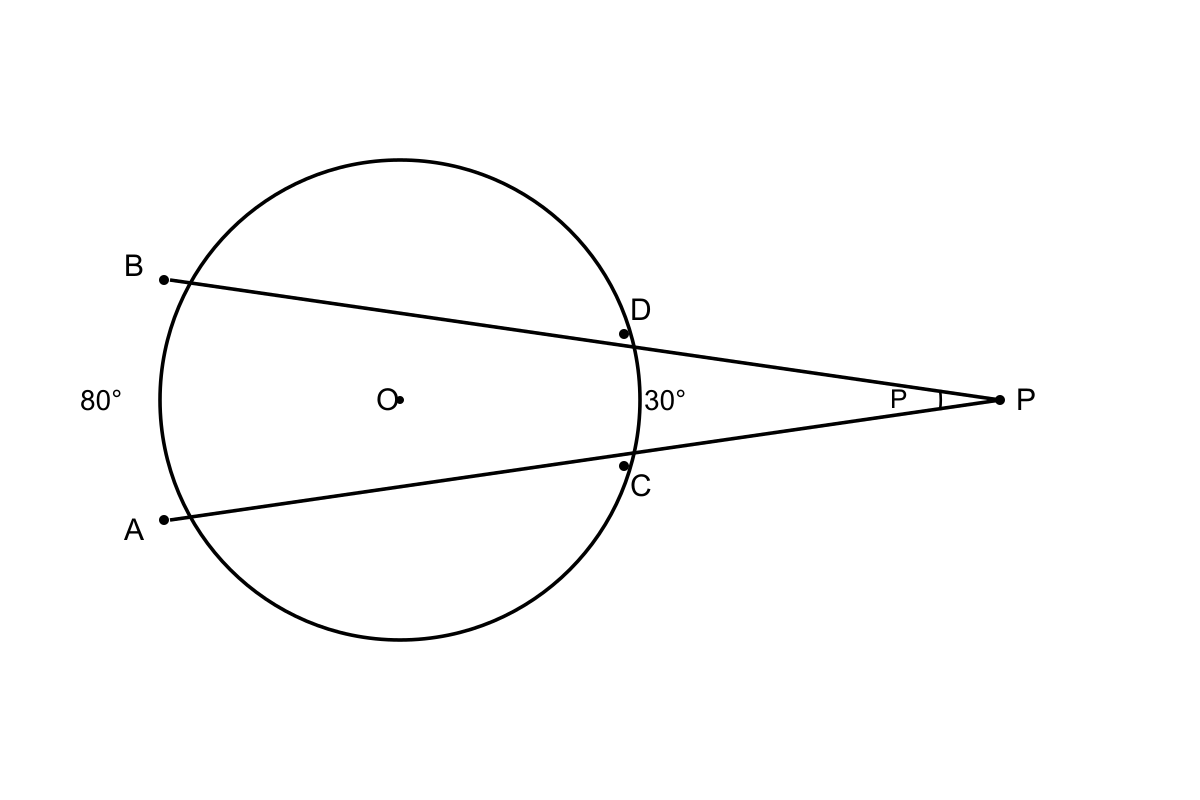
Refer to the figure. In circle O, arc AB=80° and arc CD=30°, where chords AC and BD extended meet at external point P. What is the measure of ∠APB?
20°
25° (correct answer)
55°
110°
Explanation: The angle formed by two secants meeting outside the circle equals half the positive difference of the intercepted arcs: ∠APB=21(80°−30°)=25°. Choice A comes from dividing incorrectly. Choice C adds and halves (110/2). Choice D is the sum of the arcs.
Question 2
In the figure shown, a circle is inscribed in a right triangle with legs of lengths 6 and 8. What is the radius of the inscribed circle?
1.5
2 (correct answer)
2.4
3
Explanation: For a right triangle with legs a, b and hypotenuse c, the inradius is r=2a+b−c. Here c=36+64=10, so r=26+8−10=2. Alternative: r=Area/s=24/12=2. Choice A comes from dividing by 4 instead of 2. Choice C is the altitude to the hypotenuse (6⋅8/10). Choice D is half a leg.
Question 3
The figure shows circle O with center at the origin and radius 13. Point P=(5,12) lies on the circle. The tangent line to the circle at P intersects the x-axis at point Q. What is the x-coordinate of Q?
5169 (correct answer)
1225
12169
13
Explanation: The radius OP has slope 12/5, so the tangent at P has slope −5/12. Tangent line: y−12=−125(x−5). Setting y=0: −12=−125(x−5), so x−5=5144, giving x=5144+25=5169. Choice B swaps numerator/denominator. Choice C uses wrong slope. Choice D is the radius.
Question 4
In the figure, circle O has radius 10. Two parallel chords AB and CD lie on opposite sides of center O, with AB=12 and CD=16. What is the distance between the two chords?
2
7
14 (correct answer)
8
Explanation: Distance from O to AB: 102−62=8. Distance from O to CD: 102−82=6. Since the chords are on opposite sides of O, the total distance is 8+6=14. Choice A (2) is the answer if the chords were on the same side. Choice B is the average. Choice D is only one of the distances.
Question 5
A line is tangent to a circle at point P. The circle has center O, and OP=13. If the distance from O to the tangent line is 13, what is the measure of the angle between OP and the tangent line at P?
0∘
45∘
90∘ (correct answer)
180∘
Explanation: This question involves a fundamental property of tangent lines to circles. A tangent line to a circle is always perpendicular to the radius drawn to the point of tangency. Since OP is the radius to point P where the line is tangent, the angle between OP and the tangent line must be 90°. The given information that the distance from O to the tangent line equals OP = 13 confirms this is the perpendicular distance. Remember this key property for any tangent line problem.
Question 6
A circle has radius 7 cm. What is the circumference of the circle, in centimeters?
14π cm (correct answer)
49π cm
7π cm
28π cm
Explanation: This question asks for the circumference of a circle given its radius. The formula for circumference is C = 2πr, where r is the radius. Substituting r = 7 cm into the formula: C = 2π(7) = 14π cm. A common error is using the area formula (πr²) instead of the circumference formula, which would give 49π. When you see radius given directly, remember to use 2πr for circumference.
Question 7
A circle is inscribed in a square of side length 10 inches (the circle is tangent to all four sides). What is the area of the region inside the square but outside the circle, in square inches? (Use π.)
100−25π (correct answer)
100−100π
25π−100
100−50π
Explanation: A circle inscribed in a square with side 10 inches has diameter equal to the side length, so diameter = 10 and radius = 5 inches. The area of the square is 10² = 100 square inches, and the area of the circle is πr² = π(5)² = 25π square inches. The area outside the circle but inside the square is 100 - 25π square inches. A common mistake is using diameter instead of radius in the area formula. Remember that an inscribed circle touches all four sides, making its diameter equal to the square's side length.
Question 8
In circle O, an inscribed angle ∠ACB intercepts arc AB. If the measure of arc AB is 110∘, what is the measure of ∠ACB?
55∘ (correct answer)
110∘
220∘
70∘
Explanation: This question asks for the measure of inscribed angle ACB that intercepts arc AB of 110 degrees in circle O. The key property is that an inscribed angle measures half the degree of the arc it intercepts. Thus, angle ACB = (1/2) * measure of arc AB = (1/2) * 110° = 55°. This follows directly from the inscribed angle theorem, which applies here since the angle is formed by chords from the circle's circumference. A common error is confusing inscribed angles with central angles, which would incorrectly use 110° directly. Another mistake is doubling instead of halving the arc measure. For test-taking, recall that inscribed angles are always half the intercepted arc to quickly eliminate choices like 110° or 220°.
Question 9
Two concentric circles share the same center. The larger circle has radius 9 in and the smaller circle has radius 6 in. What is the area of the region between the circles, in square inches?
15π in2
27π in2
45π in2 (correct answer)
81π in2
Explanation: This question asks for the area of the region between two concentric circles with radii 9 in and 6 in. The area is the difference in their areas: π(9)^2 - π(6)^2 = π(81 - 36) = 45π in², emphasizing radius squared in the formula. The larger radius is 9, smaller is 6, and subtraction gives the annular region. Ensure to use radii, not diameters. A key error is subtracting radii before squaring, which underestimates the area. For test-taking, calculate each area separately then subtract to avoid mistakes in combined expressions.
Question 10
A circle is graphed in the coordinate plane with center (−2,3). The circle passes through the point (4,3). Which equation represents the circle?
(x+2)2+(y−3)2=6
(x−2)2+(y+3)2=36
(x+2)2+(y−3)2=36 (correct answer)
(x−2)2+(y−3)2=36
Explanation: This question asks for the equation of a circle with center (-2, 3) that passes through the point (4, 3). The standard form is (x - h)^2 + (y - k)^2 = r^2, with h = -2 and k = 3. To find r, calculate the distance from center to (4, 3): √[(4 - (-2))^2 + (3 - 3)^2] = √[6^2 + 0^2] = 6, so r^2 = 36. The equation is (x + 2)^2 + (y - 3)^2 = 36, noting the signs reflect the center coordinates. Common errors include switching signs or miscalculating r by using diameter instead. In exams, verify by plugging in the point to confirm it satisfies the equation.
Question 11
In the coordinate plane, a circle has equation (x−4)2+(y+1)2=49. What are the center and radius of the circle?
Center (4,−1), radius 7 (correct answer)
Center (−4,1), radius 7
Center (4,1), radius 49
Center (4,−1), radius 49
Explanation: This question asks for the center and radius of a circle given its equation in the coordinate plane. The standard form of a circle's equation is (x - h)^2 + (y - k)^2 = r^2, where (h, k) is the center and r is the radius. Comparing the given equation (x - 4)^2 + (y + 1)^2 = 49, we identify h = 4 and k = -1 because y + 1 is equivalent to y - (-1), and r^2 = 49 so r = √49 = 7, emphasizing that the radius is the square root of the constant term. Be careful not to confuse the signs in the center coordinates, as (y + 1)^2 indicates a negative k value. A common error is mistaking the radius for the squared value 49 instead of taking the square root. When working with circle equations, always verify the radius by distinguishing it from the diameter, which would be twice the radius or 14 here.
Question 12
Refer to the figure. Two concentric circles have common center S. The radius of the larger circle is 10 cm and the radius of the smaller circle is 6 cm. What is the area, in square centimeters, of the shaded region between the circles?
16π
36π
64π (correct answer)
100π
Explanation: Area difference: π(10)2−π(6)2=100π−36π=64π (C). A subtracts radii before squaring, B gives inner area, D outer only.
Question 13
A line is tangent to a circle at point T. The circle has center O, and OT=13. If the tangent segment from T to point P on the tangent line has length 5, what is the length of OP?
8
194 (correct answer)
169
18
Explanation: This question asks for the length of OP, where a line is tangent to a circle at T, OT = 13 (radius), and TP = 5 along the tangent. The property is that the radius is perpendicular to the tangent at the point of contact, forming right triangle OTP with right angle at T. Using Pythagorean theorem, OP = √(OT2 + TP2) = √(132 + 52) = √(169 + 25) = √194. Visualize the right triangle with radius as one leg. A common mistake is adding instead of using Pythagoras or confusing radius with diameter. In tests, emphasize the perpendicular property and verify if the result matches a choice without simplifying further.
Question 14
A circle has circumference 18π meters. What is the area of the circle in square meters, in terms of π?
81π (correct answer)
162π
324π
9π
Explanation: This question asks for the area of a circle with a circumference of 18π meters. The circumference formula is C = 2πr, and the area formula is A = πr^2; solve for r first. From C = 18π, divide both sides by 2π to get r = 9 meters, noting radius is half of what diameter would be (diameter = C/π = 18). Substitute r = 9 into the area formula: A = π * 9^2 = 81π square meters. A key error is using diameter in the area formula, like π*(18)^2 = 324π, but area requires radius squared. Another mistake is confusing circumference with area formulas. For strategy, always derive radius from circumference using r = C/(2π) before finding area.
Question 15
In the figure shown, PA is tangent to circle O at point A, and PBC is a secant passing through the circle with B and C on the circle. If PB=4 and BC=12, what is the length of PA?
43
8 (correct answer)
45
12
Explanation: By the tangent-secant relationship, PA2=PB⋅PC. Here PC=PB+BC=4+12=16, so PA2=4⋅16=64, giving PA=8. Choice A comes from PA2=PB⋅BC=48. Choice C from PA2=4⋅20. Choice D incorrectly equates PA with BC.
Question 16
In circle O, the measure of inscribed angle ∠ACB is 35∘, where points A, B, and C lie on the circle. What is the measure of arc AB⌢ that does not include C?
35∘
70∘ (correct answer)
145∘
325∘
Explanation: This question asks for the measure of arc AB that does not include point C, given inscribed angle ∠ACB = 35° in circle O. The property is that an inscribed angle measures half the arc it subtends, so arc AB = 2 × 35° = 70°. The arc not including C is the one subtended by the angle, typically the minor arc. Confirm points A, B, C are on the circle with ∠ACB intercepting arc AB. A key error is confusing inscribed with central angles, which would equal the arc. For strategy, remember to double the inscribed angle for the arc and consider if it's minor or major based on context.
Question 17
A tangent line touches a circle at point T. The circle has center O. If OT=13 and a point P lies on the tangent line such that PT=5, what is the length of OP? (Use the relationship between a radius and a tangent.)
194 (correct answer)
18
144
69
Explanation: This question asks for the length of OP, where a tangent touches a circle at T, O is the center with OT = 13, and P is on the tangent with PT = 5. The key property is that a radius to the point of tangency is perpendicular to the tangent line, forming right triangle OTP at T. In this right triangle, OT is one leg (13, the radius), PT is the other leg (5), and OP is the hypotenuse. Apply the Pythagorean theorem: OP = sqrt(OT2 + PT2) = sqrt(132 + 52) = sqrt(169 + 25) = sqrt(194). A common error is confusing radius with diameter; using diameter 26 would incorrectly give sqrt(262 + 52). Another mistake is not recognizing the right angle at T. As a test-taking tip, recall that tangents are perpendicular to radii to quickly set up the right triangle.
Question 18
A circle has radius 12 cm. Point A and point B lie on the circle, and the central angle ∠AOB is 150∘ (with O as the center). What is the length of arc AB⌢, in terms of π?
5π cm
10π cm (correct answer)
12π cm
20π cm
Explanation: This question asks for the length of arc AB on a circle with radius 12 cm and a central angle of 150 degrees. The formula for arc length is (theta/360) * 2πr, where theta is the central angle in degrees and r is the radius. Substitute theta = 150 and r = 12 into the formula: (150/360) * 2π * 12 = (5/12) * 24π. Simplify by multiplying 5/12 by 24π to get 10π cm. A key error to avoid is using the diameter instead of the radius; here, diameter is 24 cm, but the formula requires radius. Another common mistake is forgetting to divide by 360 or using radians instead of degrees. For test-taking, convert the fraction theta/360 to its simplest form before multiplying to make calculations easier.
Question 19
A circular pizza has diameter 14 inches. If a person eats one slice that is a 45∘ sector of the pizza, what is the area of that slice in terms of π (in square inches)?
849π (correct answer)
449π
898π
8196π
Explanation: This question asks for the area of a 45-degree sector of a pizza with a diameter of 14 inches. The formula for the area of a sector is (theta/360) * πr^2, where theta is the angle and r is the radius. First, note the diameter is 14 inches, so radius r = 7 inches, emphasizing the distinction: radius is half the diameter. Substitute theta = 45 and r = 7: (45/360) * π * 49 = (1/8) * 49π = 49π/8 square inches. A common error is using diameter in the area formula instead of radius, which would give π*(14)^2/8 = 196π/8, incorrect because area uses r^2. Another mistake is confusing sector area with arc length, but here we need area. As a strategy, always halve the diameter to get radius before plugging into πr^2.
Question 20
In the coordinate plane, a circle has equation (x−3)2+(y+2)2=49. Which of the following gives the center and radius of the circle?
Center (3,−2), r=7 (correct answer)
Center (−3,2), r=7
Center (3,2), r=49
Center (−3,−2), r=49
Explanation: The question asks for the center and radius of a circle given its equation in the coordinate plane. The standard form of a circle's equation is (x−h)2+(y−k)2=r2, where (h,k) is the center and r is the radius. Comparing the given equation (x−3)2+(y+2)2=49 to the standard form shows that h=3, k=−2, and r2=49, so r=7. Note that y+2 is equivalent to y−(−2), confirming the center at (3,−2). A common error is misreading the signs inside the parentheses, such as incorrectly identifying the center as (−3,2) or confusing the radius with the squared value 49. Always emphasize using the radius, not the diameter, and verify by plugging values back into the equation if needed. As a test-taking strategy, rewrite the equation to match the standard form exactly before selecting the answer.