Triangles
Help Questions
Trigonometry › Triangles
While waiting for your sister to finish her bungee jump, you decide to figure out how tall the platform she is jumping off is. You are standing 


Explanation
You can draw the following right triangle using the information given by the question:
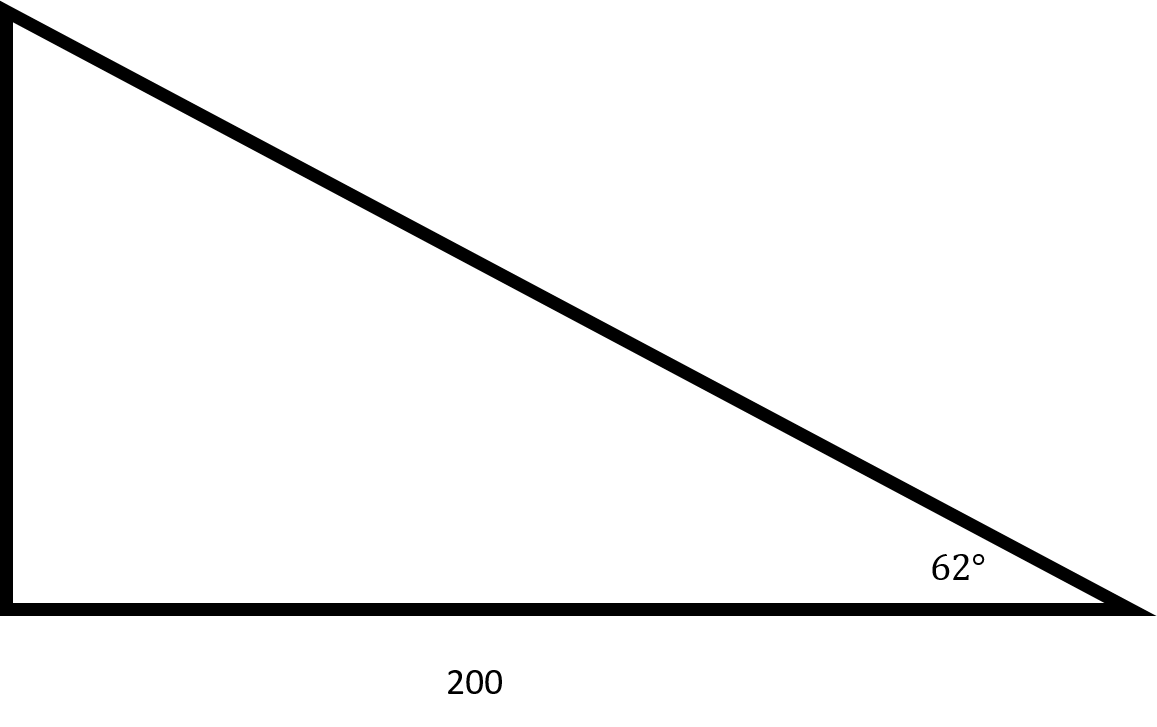
Since you want to find the height of the platform, you will need to use tangent.
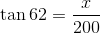

Make sure to round to 
You need to build a diagonal support for the bleachers at the local sportsfield. The support needs to reach from the ground to the top of the bleacher. How the support should look is highlighted in blue below. The bleacher wall is 10 feet high and perpendicular to the ground. The owner would like the support to only stick out 3 feet from the bleacher at the bottom. What is the length of the support you need to build?

20 ft
10.44 ft
109 ft
11.32 ft
Explanation
It is important to recognize that the bleacher, the ground, and the support form a right triangle with the right angle formed by the intersection of the bleacher wall and the ground. We know the bottom of the support should only be 3ft from the bleacher wall on the ground and the bleacher wall is 10ft high. We will use the Pythagorean Theorem to solve for the length of the support, which is the hypotenuse of this right triangle. Our base of the triangle is 3 feet and the leg is 10 feet.


And so we need a support of 10.44 feet long.
While waiting for your sister to finish her bungee jump, you decide to figure out how tall the platform she is jumping off is. You are standing
Explanation
You can draw the following right triangle using the information given by the question:
Since you want to find the height of the platform, you will need to use tangent.
Make sure to round to
You need to build a diagonal support for the bleachers at the local sportsfield. The support needs to reach from the ground to the top of the bleacher. How the support should look is highlighted in blue below. The bleacher wall is 10 feet high and perpendicular to the ground. The owner would like the support to only stick out 3 feet from the bleacher at the bottom. What is the length of the support you need to build?
20 ft
10.44 ft
109 ft
11.32 ft
Explanation
It is important to recognize that the bleacher, the ground, and the support form a right triangle with the right angle formed by the intersection of the bleacher wall and the ground. We know the bottom of the support should only be 3ft from the bleacher wall on the ground and the bleacher wall is 10ft high. We will use the Pythagorean Theorem to solve for the length of the support, which is the hypotenuse of this right triangle. Our base of the triangle is 3 feet and the leg is 10 feet.
And so we need a support of 10.44 feet long.
You need to build a diagonal support for the bleachers at the local sportsfield. The support needs to reach from the ground to the top of the bleacher. How the support should look is highlighted in blue below. The bleacher wall is 10 feet high and perpendicular to the ground. The owner would like the support to only stick out 3 feet from the bleacher at the bottom. What is the length of the support you need to build?
20 ft
10.44 ft
109 ft
11.32 ft
Explanation
It is important to recognize that the bleacher, the ground, and the support form a right triangle with the right angle formed by the intersection of the bleacher wall and the ground. We know the bottom of the support should only be 3ft from the bleacher wall on the ground and the bleacher wall is 10ft high. We will use the Pythagorean Theorem to solve for the length of the support, which is the hypotenuse of this right triangle. Our base of the triangle is 3 feet and the leg is 10 feet.
And so we need a support of 10.44 feet long.
If c=70, a=50, and 


no solution
Explanation
Notice that the given information is Angle-Side-Side, which is the ambiguous case. Therefore, we should test to see if there are no triangles that satisfy, one triangle that satisfies, or two triangles that satisfy this. From 


In this problem, 

While waiting for your sister to finish her bungee jump, you decide to figure out how tall the platform she is jumping off is. You are standing
Explanation
You can draw the following right triangle using the information given by the question:
Since you want to find the height of the platform, you will need to use tangent.
Make sure to round to
If c=70, a=50, and
no solution
Explanation
Notice that the given information is Angle-Side-Side, which is the ambiguous case. Therefore, we should test to see if there are no triangles that satisfy, one triangle that satisfies, or two triangles that satisfy this. From
In this problem,
In the figure below, 


Which of the following is a true statement?
The area of quadrilateral 

The area of quadrilateral 

The perimeter of quadrilateral 

The perimeter of quadrilateral 

Explanation
Since 


Therefore, 


If c=70, a=50, and
no solution
Explanation
Notice that the given information is Angle-Side-Side, which is the ambiguous case. Therefore, we should test to see if there are no triangles that satisfy, one triangle that satisfies, or two triangles that satisfy this. From
In this problem,