Trigonometry
Help Questions
Trigonometry › Trigonometry
You need to build a diagonal support for the bleachers at the local sportsfield. The support needs to reach from the ground to the top of the bleacher. How the support should look is highlighted in blue below. The bleacher wall is 10 feet high and perpendicular to the ground. The owner would like the support to only stick out 3 feet from the bleacher at the bottom. What is the length of the support you need to build?

20 ft
10.44 ft
109 ft
11.32 ft
Explanation
It is important to recognize that the bleacher, the ground, and the support form a right triangle with the right angle formed by the intersection of the bleacher wall and the ground. We know the bottom of the support should only be 3ft from the bleacher wall on the ground and the bleacher wall is 10ft high. We will use the Pythagorean Theorem to solve for the length of the support, which is the hypotenuse of this right triangle. Our base of the triangle is 3 feet and the leg is 10 feet.


And so we need a support of 10.44 feet long.
Solve the following equation by squaring both sides:


Explanation
We begin with our original equation:


Looking at the unit circle we see that 


Checking


Checking


And so our only solution is

Convert 


Explanation
To convert radians to degrees, we need to multiply the given radians by 

What is the domain of f(x) = sin x?
All positive numbers and 0
All negative numbers and 0
All real numbers except 0
All real numbers
Explanation
The domain of a function is the range of all possible inputs, or x-values, that yield a real value for f(x). Trigonometric functions are equal to 0, 1, -1 or undefined when the angle lies on an axis, meaning that the angle is equal to 0, 90, 180 or 270 degrees (0, (pi)/2, pi or 3(pi)/2 in radians.) Trigonometric functions are undefined when they represent fractions with denominators equal to zero. Sine is defined as the ratio between the side length opposite to the angle in question and the hypotenuse (SOH, or sin x = opposite/hypotenuse). In any triangle created by the angle x and the x-axis, the hypotenuse is a nonzero number. As a result, the denominator of the fraction created by the definition sin x = opposite/hypotenuse is not equal to zero for any angle value x. Therefore, the domain of f(x) = sin x is all real numbers.
Simplify


Explanation
The first step to simplifying is to remember an important trig identity.

If we rewrite it to look like the denominator, it is.

Now we can substitute this in the denominator.

Now write each term separately.

Remember the following identities.

Now simplify, and combine each term.

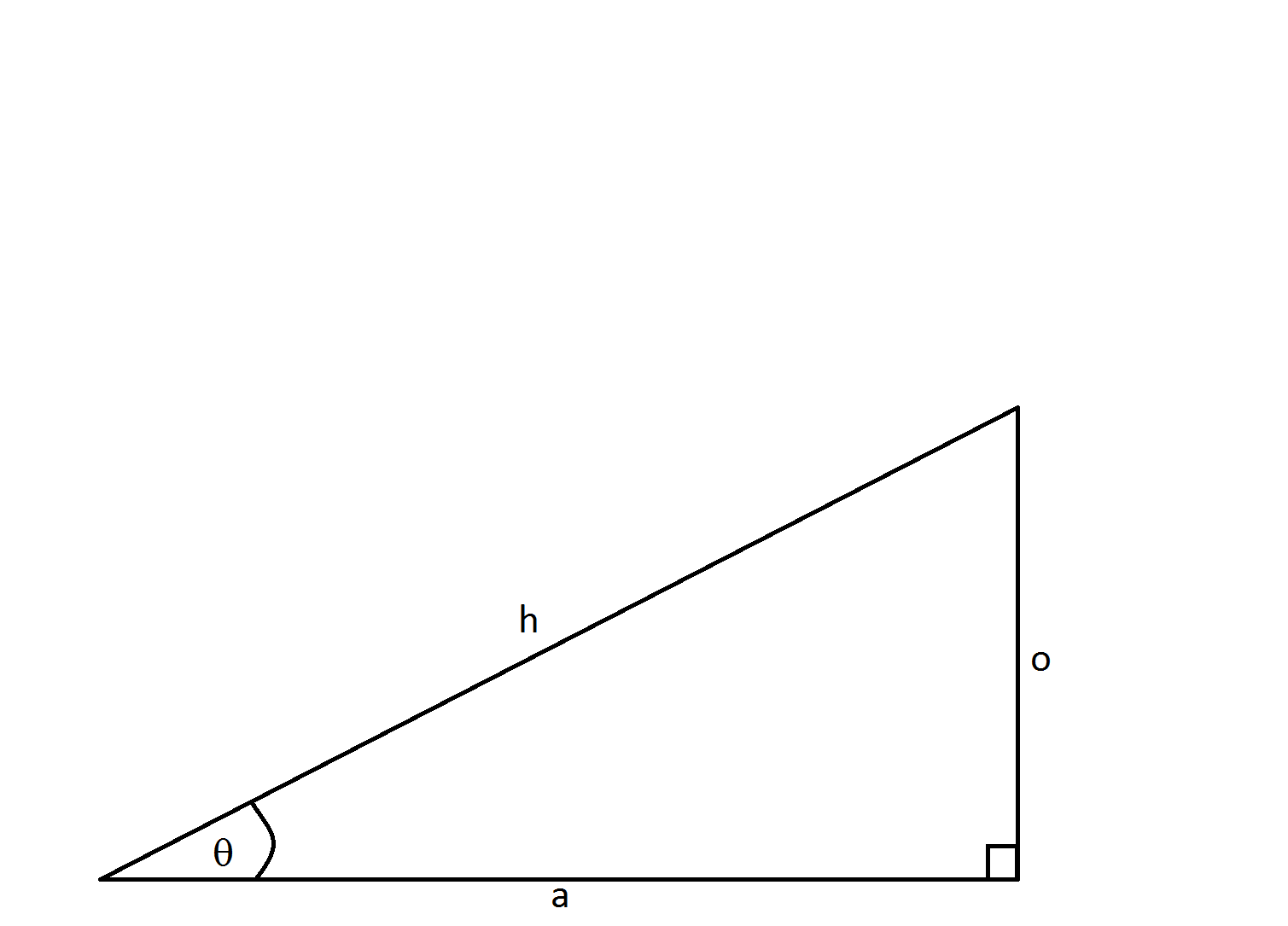
What is 


Explanation
In order to find 


Now to find the measure of the angle using the 


If you calculated the angle's measure to be 
If c=70, a=50, and 


no solution
Explanation
Notice that the given information is Angle-Side-Side, which is the ambiguous case. Therefore, we should test to see if there are no triangles that satisfy, one triangle that satisfies, or two triangles that satisfy this. From 


In this problem, 

Convert 


Explanation
Recall that there are 360 degrees in a circle which is equivalent to 

Therefore, in order to convert from radians to degrees you need to multiply by 

Convert
Explanation
To convert radians to degrees, we need to multiply the given radians by
You need to build a diagonal support for the bleachers at the local sportsfield. The support needs to reach from the ground to the top of the bleacher. How the support should look is highlighted in blue below. The bleacher wall is 10 feet high and perpendicular to the ground. The owner would like the support to only stick out 3 feet from the bleacher at the bottom. What is the length of the support you need to build?
20 ft
10.44 ft
109 ft
11.32 ft
Explanation
It is important to recognize that the bleacher, the ground, and the support form a right triangle with the right angle formed by the intersection of the bleacher wall and the ground. We know the bottom of the support should only be 3ft from the bleacher wall on the ground and the bleacher wall is 10ft high. We will use the Pythagorean Theorem to solve for the length of the support, which is the hypotenuse of this right triangle. Our base of the triangle is 3 feet and the leg is 10 feet.
And so we need a support of 10.44 feet long.