Measure Area by Counting Squares
Help Questions
3rd Grade Math › Measure Area by Counting Squares
Maria covers a rectangular table with square tiles. She uses 4 rows of tiles, with 6 tiles in each row. Then she removes 3 tiles from one corner to make space for a lamp. What is the area of the table that is still covered by tiles?
30 square units
24 square units
21 square units
27 square units
Explanation
First find the total area: 4 rows × 6 tiles = 24 square units. Then subtract the removed tiles: 24 - 3 = 21 square units. Choice B is the original total area before removing tiles. Choice C adds instead of subtracting (24 + 3). Choice D represents 5 × 6, miscounting the rows.
A rectangular classroom floor is being covered with square carpet tiles. The floor is 8 tiles long and 5 tiles wide. After installation, the teacher notices that 6 tiles in various spots are damaged and must be removed for replacement. What area of the floor currently has good carpet tiles?
36 square units
34 square units
38 square units
40 square units
Explanation
Total floor area = 8 × 5 = 40 square units. Good tiles remaining = 40 - 6 = 34 square units. Choice B subtracts only 4 damaged tiles. Choice C subtracts only 2 damaged tiles. Choice D gives the total floor area but doesn't account for the damaged tiles that were removed.
Two rectangular rugs are placed on a floor. The first rug is 3 units by 4 units. The second rug is 2 units by 5 units. The rugs overlap in a 2 unit by 2 unit square area. What is the total floor area covered by the rugs?
18 square units
22 square units
26 square units
20 square units
Explanation
First rug area = 3 × 4 = 12 square units. Second rug area = 2 × 5 = 10 square units. Overlap area = 2 × 2 = 4 square units. Total covered area = 12 + 10 - 4 = 18 square units (subtract overlap to avoid double-counting). Choice B forgets to subtract overlap. Choice C only subtracts 2 instead of 4. Choice D adds all three measurements.
Jamal’s garden uses $1$-meter squares. How many square meters (sq m) is it?
12 square meters (sq m)
10 square meters (sq m)
15 square meters (sq m)
14 square meters (sq m)
Explanation
This question tests 3rd grade area measurement: measuring areas by counting unit squares in square cm, square m, square in, square ft, and improvised units (CCSS.3.MD.6). To measure area, we count how many unit squares fit inside the shape. Different unit squares are used for different-sized objects: square centimeters for small things like paper, square meters for large things like floors, square inches and square feet in the customary system. The total count of unit squares gives us the area. Jamal’s garden is divided into square meter squares. Counting row by row, there are 2 rows with 5 squares each (10) plus 2 rows with 2 squares each (4), resulting in 14 unit squares total. Choice D is correct because counting all squares gives 14, and the unit type is square meters as specified. This shows understanding of measuring area by counting and using appropriate units. Choice A represents a miscount, such as missing some extension squares. This typically happens because students miscount squares in irregular shapes. To help students: Practice with real objects and appropriate units (graph paper for sq cm, floor tiles for sq ft, garden plot marked with meter sticks for sq m). Teach organized counting: number each square as you count, or count by rows ('2 rows of 5 make 10, plus 2 rows of 2 make 4, total 14'). Discuss unit appropriateness: Would you measure your desk in square meters? (Too big!) Would you measure the playground in square centimeters? (Too many!) Watch for: Students who miscount (go too fast or miss squares), students who use wrong unit type (especially confusing metric and customary), students who forget to say 'square' before the unit, and students who confuse area (inside space) with perimeter (distance around). Use different colored markers to track counting.
Study the quilt pattern below made of unit squares. The pattern will be extended by adding one more complete row at the bottom and one more complete column on the right side. What will be the area of the extended pattern?
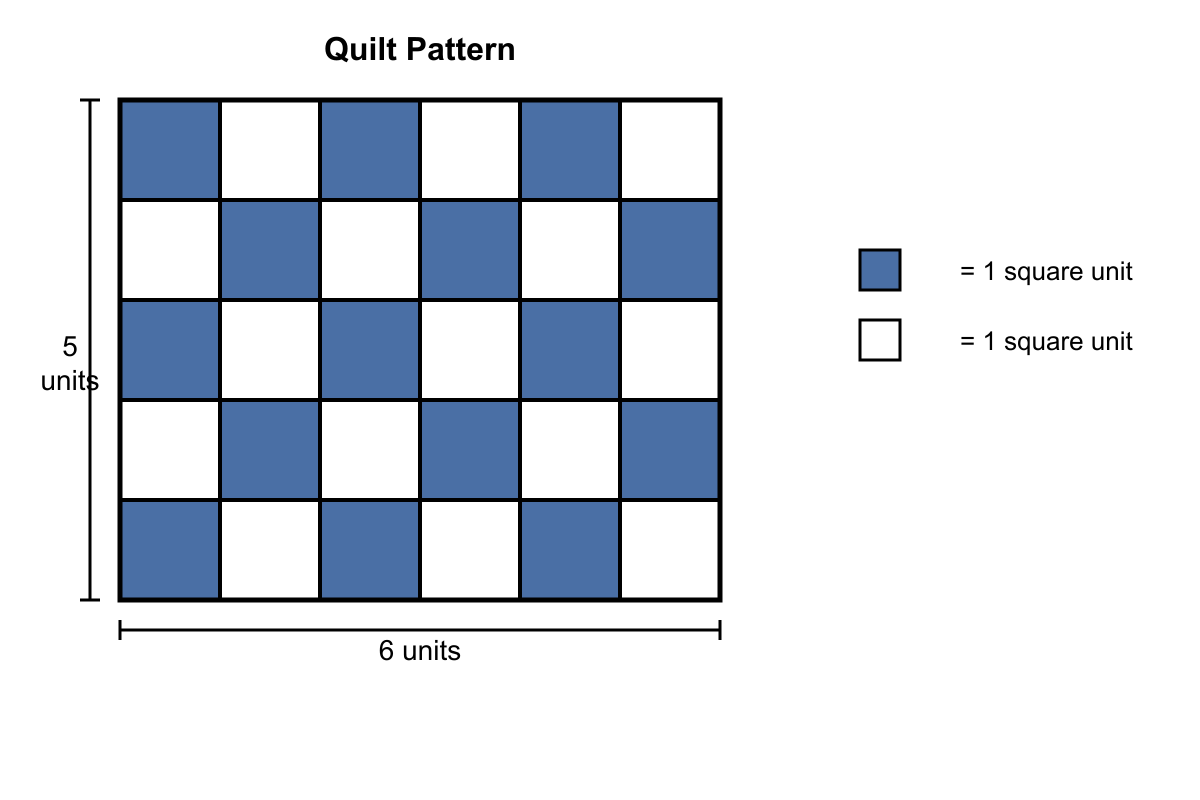
42 square units in the extended pattern
56 square units in the extended pattern
35 square units in the extended pattern
48 square units in the extended pattern
Explanation
Current pattern is 6×5 = 30 square units. Adding one row (6 squares) and one column (5 squares), but the corner square gets counted twice, so add 6 + 5 - 1 = 10 squares. New total = 30 + 10 = 40... Wait, let me recalculate: Original 6×5, new will be 7×6 = 42. Choice A miscalculates the addition. Choice C assumes 8×6. Choice D assumes 8×7.
Use the grid to find the area. Count the unit squares inside the shaded region, including any partial squares that are more than half covered.
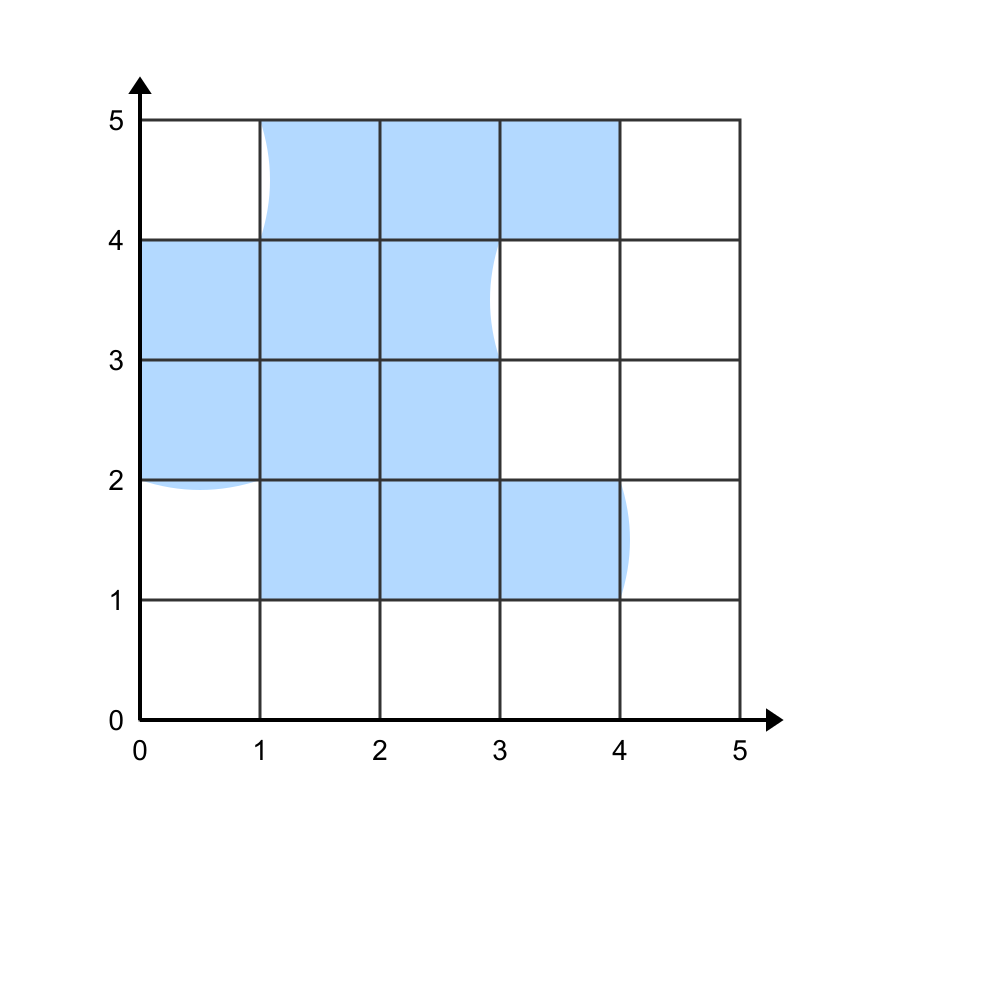
19 square units
15 square units
17 square units
13 square units
Explanation
Counting carefully: there are 11 complete unit squares fully inside the shaded region, plus 4 partial squares that are more than half covered (each counted as 1 unit). Total = 11 + 4 = 15 square units. Choice A counts only complete squares plus 2 partials. Choice C counts all partial squares regardless of coverage. Choice D includes partial squares that are less than half covered.