Construct and Interpret Linear Functions
Help Questions
8th Grade Math › Construct and Interpret Linear Functions
A water tank initially contains 150 gallons of water. Water is being drained at a constant rate of 8 gallons per minute. Which function best represents the amount of water $$W(t)$$ in the tank after $$t$$ minutes, and what does the slope represent in this context?
$$W(t) = 150 - 8t$$; the slope represents the rate at which water is drained from the tank
$$W(t) = 150 + 8t$$; the slope represents the rate at which water is added to the tank
$$W(t) = 8t - 150$$; the slope represents the initial amount of water in the tank
$$W(t) = 8 - 150t$$; the slope represents the time it takes to drain all the water
Explanation
The correct answer is B. Since water is being drained at 8 gallons per minute, the amount decreases over time, so we subtract 8t from the initial 150 gallons. The slope -8 represents the rate of change (drainage rate). Choice A incorrectly adds water instead of subtracting. Choice C has the wrong initial value and would give negative amounts initially. Choice D incorrectly places the time coefficient with the initial value.
Maria charges a flat fee plus an hourly rate for tutoring. After tutoring for 2 hours, she earns $45. After tutoring for 5 hours, she earns $75. What linear function represents her total earnings $$E(h)$$ after $$h$$ hours, and what is her flat fee?
$$E(h) = 10h + 25$$; flat fee is $25
$$E(h) = 15h + 15$$; flat fee is $15
$$E(h) = 25h + 10$$; flat fee is $10
$$E(h) = 30h - 15$$; flat fee is $30
Explanation
The correct answer is A. The rate of change is (75-45)/(5-2) = 30/3 = 10 dollars per hour. Using point (2,45): 45 = 10(2) + b, so b = 25. The function is E(h) = 10h + 25, where the flat fee is $25. Choice B has incorrect slope and y-intercept. Choice C reverses the hourly rate and flat fee. Choice D has an incorrect negative y-intercept.
A plant grows according to a linear pattern. The data shows that after 4 weeks, the plant is 15 cm tall, and after 9 weeks, it is 27.5 cm tall. What was the plant's height when it was first measured (at week 0), and what does the rate of change represent?
Initial height was 10 cm; rate of change of 2.5 cm/week represents weekly growth
Initial height was 5 cm; rate of change of 2.5 cm/week represents weekly growth
Initial height was 7 cm; rate of change of 3 cm/week represents weekly growth
Initial height was 5 cm; rate of change of 1.25 cm/week represents weekly growth
Explanation
The correct answer is A. The rate of change is (27.5-15)/(9-4) = 12.5/5 = 2.5 cm per week. Using point (4,15): 15 = 2.5(4) + b, so 15 = 10 + b, thus b = 5 cm. The initial height was 5 cm and the plant grows 2.5 cm per week. Choice B has incorrect rate and initial value. Choice C has incorrect initial height. Choice D has incorrect rate of change.
A temperature sensor records data showing a linear relationship. At 2 PM, the temperature was 68°F. At 6 PM, the temperature was 76°F. Assuming this trend continues, what function models temperature $$T(h)$$ where $$h$$ is hours after noon, and what was the temperature at noon?
$$T(h) = 4h + 60$$; temperature at noon was 60°F
$$T(h) = 2h + 64$$; temperature at noon was 64°F
$$T(h) = 2h + 68$$; temperature at noon was 68°F
$$T(h) = h + 66$$; temperature at noon was 66°F
Explanation
The correct answer is A. At 2 PM (h=2), T=68°F and at 6 PM (h=6), T=76°F. The rate of change is (76-68)/(6-2) = 8/4 = 2°F per hour. Using point (2,68): 68 = 2(2) + b, so b = 64. The function is T(h) = 2h + 64. At noon (h=0), T(0) = 64°F. Choice B has incorrect slope and y-intercept. Choice C incorrectly uses the 2 PM temperature as the y-intercept. Choice D has incorrect slope.
The temperature of a cup of soup decreases at a steady rate. The temperature is $160^\circ\text{F}$ at time $t=0$ minutes and $148^\circ\text{F}$ at time $t=4$ minutes.
Which function models the temperature $T$ (in $^\circ\text{F}$) as a function of time $t$ (minutes), and what do $m$ and $b$ represent?
$T=-3t+160$; $m=-3\ ^\circ\text{F}$/min, $b=160^\circ\text{F}$ starting temperature
$T=-4t+148$; $m=-4\ ^\circ\text{F}$/min, $b=148^\circ\text{F}$ starting temperature
$T=3t+160$; $m=3\ ^\circ\text{F}$/min, $b=160^\circ\text{F}$ starting temperature
$T=-12t+160$; $m=-12\ ^\circ\text{F}$/min, $b=160^\circ\text{F}$ starting temperature
Explanation
This question tests constructing the linear function T=mt+b from temperature data points over time (finding m as the cooling rate and b as the starting temperature) and interpreting m and b in the context of temperature decrease. Construction: from points (t=0, T=160) and (t=4, T=148), calculate m=(148-160)/(4-0)=-3, then b=160, forming T=-3t+160; from table, find ΔT/Δt and intercept. Interpretation: m is the rate of change with units (-3 °F/min), b is the initial value when t=0 (160 °F starting temperature). For example, in a taxi scenario giving y=2x+3, interpret m=2 as $2 per mile rate, b=3 as $3 initial fee, function gives total cost y for x miles driven. The correct construction shows slope from the rate (m=-3 °F per minute), intercept from initial (b=160 °F), and proper interpretation with units as cooling rate and starting temperature. A common error is forgetting the negative sign for decrease, or miscalculating m as -4 by wrong delta. Construction steps: (1) identify variables (t=minutes, T=temperature in °F), (2) find slope (from points: m=(148-160)/(4-0)=-3 °F/min), (3) find intercept (b=160 at t=0), (4) write function (T=-3t+160), (5) verify (at t=4: -3*4+160=148). Interpretation: state what m means (rate: -3 °F per minute decrease), what b means (initial: 160 °F at t=0), include units (critical for context understanding); errors include positive slope or omitting units.
A science lab cools a liquid. The temperature is 80°C at time 0 minutes and 68°C at time 4 minutes. Let $t$ be time (minutes) and let $T$ be temperature (°C).
Which linear function models the temperature, and how should you interpret the slope and intercept?
$T=80t-3$; temperature starts at -3°C and changes 80°C per minute
$T=-12t+4$; temperature decreases 12°C per minute and starts at 4°C
$T=-3t+80$; temperature decreases 3°C per minute and starts at 80°C
$T=3t+80$; temperature increases 3°C per minute and starts at 80°C
Explanation
This question tests constructing a linear function T=mt+b from two points and interpreting m as rate of temperature change (negative for decrease) and b as initial temperature. Construction: from (0,80) and (4,68), m=(68-80)/(4-0)=-12/4=-3 °C per minute, b=80, forming T=-3t+80. For example, in this cooling scenario, T=-3t+80 means starting at 80°C, decreasing by 3°C each minute. The correct construction captures the negative slope from data, intercept at t=0, with interpretation including units and direction like decreases 3°C/min, starts at 80°C. A common error is ignoring the negative sign or swapping points in slope calculation. Construction steps: (1) identify variables (t=minutes, T=°C), (2) calculate m=(68-80)/(4-0)=-3, (3) find b=80, (4) write T=-3t+80, (5) verify: -3*4+80=68. Interpretation: m=-3 means temperature decreases by 3°C per minute, b=80 means initial temperature of 80°C, units important.
A runner’s distance from the start increases at a constant rate. The runner is $0.5$ miles from the start at $t=0$ minutes and $2.0$ miles from the start at $t=30$ minutes. Let $t$ be time (minutes) and $d$ be distance (miles).
Which linear function models $d$ as a function of $t$, and what do $m$ and $b$ mean?
$d=0.05t+2.0$; $m=0.05$ miles/minute, $b=2.0$ miles at $t=0$
$d=0.5t+0.05$; $m=0.5$ miles/minute, $b=0.05$ miles at $t=0$
$d=\frac{30}{1.5}t+0.5$; $m=20$ miles/minute, $b=0.5$ miles at $t=0$
$d=0.05t+0.5$; $m=0.05$ miles/minute, $b=0.5$ miles at $t=0$
Explanation
This question tests constructing a linear function d=mt+b from two points of runner's distance over time, and interpreting m and b in context. Construction: from points (0,0.5) and (30,2.0), calculate m=(2.0-0.5)/(30-0)=0.05 miles/minute, b=0.5 miles, forming d=0.05t+0.5; interpretation: m is speed in miles/minute, b is starting distance in miles at t=0. For example, in a taxi scenario giving y=2x+3, interpret m=2 as $2 per mile rate, b=3 as $3 initial fee, function gives total cost y for x miles driven. The correct construction in choice A shows slope m=0.05 from change in distance over time, intercept b=0.5 from initial, with proper units and meanings. A common error is swapping m and b as in B, wrong b as in C, or incorrect slope calculation as in D. Construction steps: (1) identify variables (t=minutes, d=distance in miles), (2) find slope (m=(2.0-0.5)/(30-0)=0.05 miles/minute), (3) find intercept (b=0.5 using (0,0.5)), (4) write function (d=0.05t+0.5), (5) verify (at t=30, d=0.05*30+0.5=2.0). Interpretation: state what m means (rate: 0.05 miles per minute), what b means (initial: 0.5 miles at 0 minutes), include units; errors: inverting ratio, wrong calculation, omitting units.
A plant is $12$ cm tall at week $0$ and $27$ cm tall at week $3$. Let $t$ be the number of weeks and let $h$ be the height (in cm).
Which linear function models the plant’s height, and what do $m$ and $b$ represent?
$h=12t+5$; $m=12$ cm/week growth rate, $b=5$ cm starting height
$h=5t+27$; $m=5$ cm/week growth rate, $b=27$ cm starting height
$h=3t+12$; $m=3$ cm/week growth rate, $b=12$ cm starting height
$h=5t+12$; $m=5$ cm/week growth rate, $b=12$ cm starting height
Explanation
This question tests constructing a linear function y=mx+b from two points representing plant height over time, and interpreting m and b in the context of growth. Construction: from points (0,12) and (3,27), calculate m=(27-12)/(3-0)=5 cm/week, then b=12 - 50=12 cm, forming h=5t+12; interpretation: m is the growth rate in cm/week, b is the starting height in cm when t=0. For example, in a taxi scenario giving y=2x+3, interpret m=2 as $2 per mile rate, b=3 as $3 initial fee, function gives total cost y for x miles driven. The correct construction in choice A shows slope m=5 from change in height over weeks, intercept b=12 from initial height, and proper interpretation with units as cm/week and cm. A common error is miscalculating slope as 3 like in B, or swapping m and b as in C, or wrong b as in D. Construction steps: (1) identify variables (t=weeks, h=height in cm), (2) find slope (calculate from points: m=(27-12)/(3-0)=5 cm/week), (3) find intercept (b=12 using point (0,12)), (4) write function (h=5t+12), (5) verify (at t=3, h=53+12=27). Interpretation: state what m means (rate: 5 cm per week), what b means (initial: 12 cm at week 0), include units; errors: calculating slope as Δx/Δy, using wrong point for b, forgetting units.
A movie theater sells a refillable popcorn bucket. The bucket costs $\$10$ at first, and then each refill costs $$3$. Let $x$ be the number of refills and let $y$ be the total amount spent (in dollars). Which statement correctly interprets the slope and y-intercept of the function $y=3x+10$?
The slope $3$ means the total increases $\$3$ per refill, and the y-intercept $10$ means the starting cost is $$10$ when there are 0 refills.
The slope $10$ means the total increases $\$10$ per refill, and the y-intercept $3$ means the starting cost is $$3$.
The slope $3$ means the bucket costs $\$3$, and the y-intercept $10$ means each refill costs $$10$.
The slope $3$ means the total increases 3 refills per dollar, and the y-intercept $10$ means 10 refills are free.
Explanation
This question tests interpreting the slope m and y-intercept b in the linear function y=$3x+10$ from the context of popcorn costs (understanding m as the cost per refill and b as the initial bucket cost). Construction: from verbal description, extract rate of $3 per refill as m=$3$, initial $10 as b=$10$, giving y=$3x+10$; from points, calculate m and b similarly. Interpretation: m is the rate of change with units ($3 per refill), b is the initial value when x=0 ($10 starting cost). For example, in a taxi scenario giving y=$2x+3$, interpret m=$2$ as $2 per mile rate, b=$3$ as $3 initial fee, function gives total cost y for x miles driven. The correct interpretation states slope as the increase of $3 per refill and intercept as $10 when no refills, with proper units. A common error is swapping m and b meanings, like saying slope is $10 per refill, or interpreting slope as refills per dollar. Construction steps: (1) identify variables (x=refills, y=total spent in dollars), (2) find slope (rate given: m=$3$ dollars/refill), (3) find intercept (initial: b=$10$), (4) write function (y=$3x+10$), (5) verify (e.g., at x=0, y=$10$). Interpretation: state what m means (rate: total increases $3 per refill), what b means (initial: $10 for the bucket at 0 refills), include units (critical for context understanding); errors include reversing meanings or forgetting units.
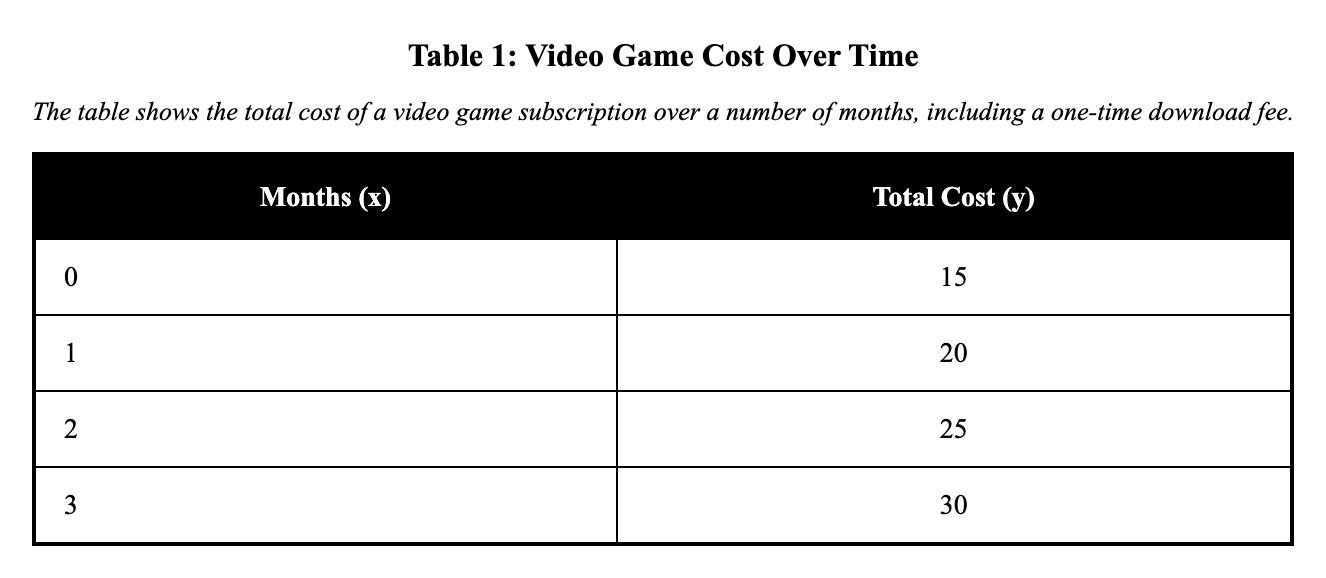
A video game charges a one-time download fee and then a monthly subscription. The total cost $y$ (in dollars) is shown in the table, where $x$ is the number of months.
Which equation fits the table, and what do $m$ and $b$ mean in this context?
$y=10x+5$; $m=10$ dollars per month, $b=5$ dollars download fee
$y=15x+5$; $m=15$ dollars per month, $b=5$ dollars download fee
$y=5x+10$; $m=5$ dollars per month, $b=10$ dollars download fee
$y=5x+15$; $m=5$ dollars per month, $b=15$ dollars download fee
Explanation
This question tests constructing the linear function y=mx+b from a table of video game costs over months (finding m as the monthly rate and b as the download fee by calculating slope and intercept) and interpreting m and b in the context of total cost. Construction: from a table, find slope Δy/Δx as the monthly increase which becomes m, and the y-value at x=0 as b; alternatively, from points calculate m=(y₂-y₁)/(x₂-x₁) and b=y-mx. Interpretation: m is the rate of change with units ($5 per month, for example), b is the initial value when x=0 ($15 download fee). For example, in a taxi scenario giving y=2x+3, interpret m=2 as $2 per mile rate, b=3 as $3 initial fee, function gives total cost y for x miles driven. The correct construction shows slope from the rate in the table (m=5 dollars per month), intercept from the initial cost (b=15 dollars), and proper interpretation with units as subscription rate and download fee. A common error is misreading the table to swap m and b values, or omitting units in interpretation like stating slope as '5' without dollars per month. Construction steps: (1) identify variables (x=months, y=total cost in dollars), (2) find slope (rate from table: Δy/Δx=5 dollars per month), (3) find intercept (value at x=0 from table or calculation: b=15), (4) write function (y=5x+15), (5) verify (check against table points). Interpretation: state what m means (rate: 5 dollars per month subscribed), what b means (initial: 15 dollars for download), include units (critical for context understanding); errors include calculating slope as Δx/Δy, or using a non-zero point for b without adjustment.