Definite integral of the rate of change of a quantity over an interval interpreted as the change of the quantity over the interval - AP Calculus AB
Card 1 of 253
If f(1) = 12, f' is continuous, and the integral from 1 to 4 of f'(x)dx = 16, what is the value of f(4)?
If f(1) = 12, f' is continuous, and the integral from 1 to 4 of f'(x)dx = 16, what is the value of f(4)?
Tap to reveal answer
You are provided f(1) and are told to find the value of f(4). By the FTC, the following follows:
(integral from 1 to 4 of f'(x)dx) + f(1) = f(4)
16 + 12 = 28
You are provided f(1) and are told to find the value of f(4). By the FTC, the following follows:
(integral from 1 to 4 of f'(x)dx) + f(1) = f(4)
16 + 12 = 28
← Didn't Know|Knew It →
Find the limit.
lim as n approaches infiniti of ((4n3) – 6n)/((n3) – 2n2 + 6)
Find the limit.
lim as n approaches infiniti of ((4n3) – 6n)/((n3) – 2n2 + 6)
Tap to reveal answer
lim as n approaches infiniti of ((4n3) – 6n)/((n3) – 2n2 + 6)
Use L'Hopitals rule to find the limit.
lim as n approaches infiniti of ((4n3) – 6n)/((n3) – 2n2 + 6)
lim as n approaches infiniti of ((12n2) – 6)/((3n2) – 4n + 6)
lim as n approaches infiniti of 24n/(6n – 4)
lim as n approaches infiniti of 24/6
The limit approaches 4.
lim as n approaches infiniti of ((4n3) – 6n)/((n3) – 2n2 + 6)
Use L'Hopitals rule to find the limit.
lim as n approaches infiniti of ((4n3) – 6n)/((n3) – 2n2 + 6)
lim as n approaches infiniti of ((12n2) – 6)/((3n2) – 4n + 6)
lim as n approaches infiniti of 24n/(6n – 4)
lim as n approaches infiniti of 24/6
The limit approaches 4.
← Didn't Know|Knew It →
If $y-6x-x^{2}$=4,
then at  , what is
  's instantaneous rate of change?
If $y-6x-x^{2}$=4,
then at
Tap to reveal answer
The answer is 8.
$y-6x-x^{2}$=4
$y=x^{2}$+6x+4
y'=2x+6

The answer is 8.
$y-6x-x^{2}$=4
$y=x^{2}$+6x+4
y'=2x+6
← Didn't Know|Knew It →
h(x)=\frac{g(x)}{(1+f(x))}$
If 
then find  .
.
h(x)=\frac{g(x)}{(1+f(x))}$
If
then find
Tap to reveal answer
We see the answer is 0 after we do the quotient rule.
h(x)=\frac{g(x)}{(1+f(x))}$
$h'(x)=\frac{g'(x)(1+f(x))-g(x)(f'(x))}{(1+f(x))^{2}$$}

We see the answer is 0 after we do the quotient rule.
h(x)=\frac{g(x)}{(1+f(x))}$
$h'(x)=\frac{g'(x)(1+f(x))-g(x)(f'(x))}{(1+f(x))^{2}$$}
← Didn't Know|Knew It →
If a particle's movement is represented by $p=3t^{2}$-t+16, then when is the velocity equal to zero?
If a particle's movement is represented by $p=3t^{2}$-t+16, then when is the velocity equal to zero?
Tap to reveal answer
The answer is  seconds.
$p=3t^{2}$-t+16
v=p'=6t-1
now set  because that is what the question is asking for.
v=0=6t-1
t=\frac{1}{6}$ seconds
The answer is
$p=3t^{2}$-t+16
v=p'=6t-1
now set
v=0=6t-1
t=\frac{1}{6}$ seconds
← Didn't Know|Knew It →
A particle's movement is represented by $p=-t^{2}$+12t+2
At what time is the velocity at it's greatest?
A particle's movement is represented by $p=-t^{2}$+12t+2
At what time is the velocity at it's greatest?
Tap to reveal answer
The answer is at 6 seconds.
$p=-t^{2}$+12t+2
We can see that this equation will look like a upside down parabola so we know there will be only one maximum.
v=p'=-2t+12
Now we set  to find the local maximum.
v=0=-2t+12
t=6 seconds
The answer is at 6 seconds.
$p=-t^{2}$+12t+2
We can see that this equation will look like a upside down parabola so we know there will be only one maximum.
v=p'=-2t+12
Now we set
v=0=-2t+12
t=6 seconds
← Didn't Know|Knew It →
If g(x)=int_${0}^{x^2}$f(t)dt, then which of the following is equal to g'(x)?
If g(x)=int_${0}^{x^2}$f(t)dt, then which of the following is equal to g'(x)?
Tap to reveal answer
According to the Fundamental Theorem of Calculus, if we take the derivative of the integral of a function, the result is the original function. This is because differentiation and integration are inverse operations.
For example, if h(x)=int_${a}^{x}$f(u)du, where  is a constant, then h'(x)=f(x).
We will apply the same principle to this problem. Because the integral is evaluated from 0 to $x^{2}$, we must apply the chain rule.
g'(x)=\frac{d}{dx}$int_${0}^{x^{2}$$}f(t)dt=f(x^{2}$)cdot $$\frac{d}{dx}$(x^{2}$)
$=2xf(x^{2}$)
The answer is $2xf(x^{2}$).
According to the Fundamental Theorem of Calculus, if we take the derivative of the integral of a function, the result is the original function. This is because differentiation and integration are inverse operations.
For example, if h(x)=int_${a}^{x}$f(u)du, where
We will apply the same principle to this problem. Because the integral is evaluated from 0 to $x^{2}$, we must apply the chain rule.
g'(x)=\frac{d}{dx}$int_${0}^{x^{2}$$}f(t)dt=f(x^{2}$)cdot $$\frac{d}{dx}$(x^{2}$)
$=2xf(x^{2}$)
The answer is $2xf(x^{2}$).
← Didn't Know|Knew It →
What is the domain of $f(x)=\frac{x+5}{sqrt{x^2$-9}$}?
What is the domain of $f(x)=\frac{x+5}{sqrt{x^2$-9}$}?
Tap to reveal answer
${$\sqrt{x^2$-9}$}>0 because the denominator cannot be zero and square roots cannot be taken of negative numbers
$x^2$-9>0
$x^2$>9
$$\sqrt{x^2$}$>$\sqrt{9}$
left | x right |>3
x>3: or, x<-3
${$\sqrt{x^2$-9}$}>0 because the denominator cannot be zero and square roots cannot be taken of negative numbers
$x^2$-9>0
$x^2$>9
$$\sqrt{x^2$}$>$\sqrt{9}$
left | x right |>3
x>3: or, x<-3
← Didn't Know|Knew It →
Which of the following represents the graph of the polar function  in Cartestian coordinates?
Which of the following represents the graph of the polar function
Tap to reveal answer

First, mulitply both sides by r.

Then, use the identities  and
and  .
.


The answer is  .
.
First, mulitply both sides by r.
Then, use the identities
The answer is
← Didn't Know|Knew It →
What is the average value of the function  from
from  to
to  ?
?
What is the average value of the function
Tap to reveal answer
The average function value is given by the following formula:

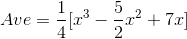 , evaluated from
  to
to  .
.

The average function value is given by the following formula:
← Didn't Know|Knew It →

Tap to reveal answer
← Didn't Know|Knew It →

Tap to reveal answer
← Didn't Know|Knew It →

Tap to reveal answer

← Didn't Know|Knew It →

Tap to reveal answer

← Didn't Know|Knew It →

Tap to reveal answer
← Didn't Know|Knew It →

Tap to reveal answer
← Didn't Know|Knew It →

Tap to reveal answer
← Didn't Know|Knew It →

Tap to reveal answer
← Didn't Know|Knew It →

Tap to reveal answer
← Didn't Know|Knew It →

Tap to reveal answer
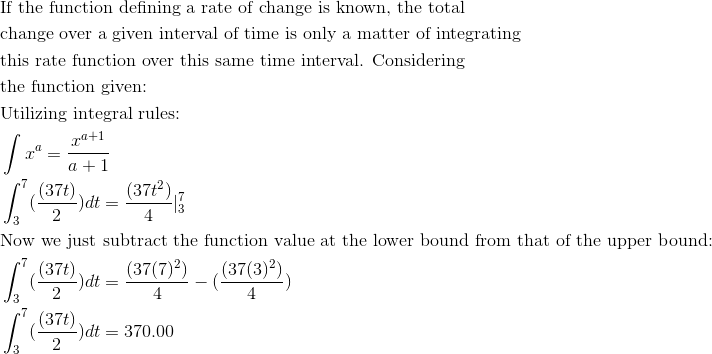
← Didn't Know|Knew It →