Solutions - AP Chemistry
Card 1 of 1196
What would be the best solvent would you choose to dissolve C31H64?
What would be the best solvent would you choose to dissolve C31H64?
Tap to reveal answer
C31H64 is a non-polar substance and would dissolve best in a non-polar solvent like Toluene.
C31H64 is a non-polar substance and would dissolve best in a non-polar solvent like Toluene.
← Didn't Know|Knew It →
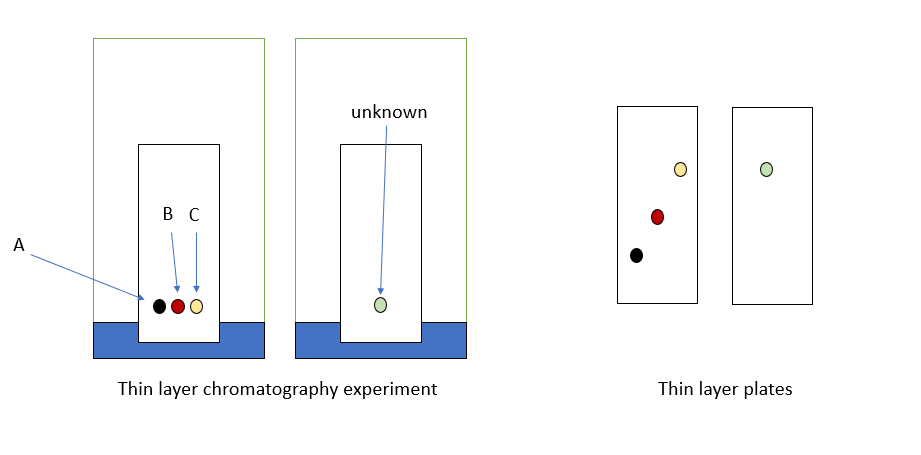
A student investigates a series of compounds in a thin layer chromatography experiment. The student has a sample of three organic compounds labeled A, B, and C as well as an unknown compound. The student performs the experiment as shown on the left above and gets the results shown on the right. What organic compound is in the unknown sample?
A student investigates a series of compounds in a thin layer chromatography experiment. The student has a sample of three organic compounds labeled A, B, and C as well as an unknown compound. The student performs the experiment as shown on the left above and gets the results shown on the right. What organic compound is in the unknown sample?
Tap to reveal answer
The unknown sample gives a single spot that has migrated to the same amount as Sample C.
The unknown sample gives a single spot that has migrated to the same amount as Sample C.
← Didn't Know|Knew It →
If 50g of NaCl are dissolved in 5 L of water what is the solute and what is the solvent?
If 50g of NaCl are dissolved in 5 L of water what is the solute and what is the solvent?
Tap to reveal answer
The solvent is what you the most off. In this case water is the solvent and sodium chloride is the solute.
The solvent is what you the most off. In this case water is the solvent and sodium chloride is the solute.
← Didn't Know|Knew It →
Which of these solutions can be separated via chromatography?
Which of these solutions can be separated via chromatography?
Tap to reveal answer
Chromatography is the physical separation of components of a mixture. Answers b and c can be separated by chromatography due to their homogeneous nature. The soil and water example would be separated by filtration.
Chromatography is the physical separation of components of a mixture. Answers b and c can be separated by chromatography due to their homogeneous nature. The soil and water example would be separated by filtration.
← Didn't Know|Knew It →
Which of the following would most likely form a homogeneous solution?
Which of the following would most likely form a homogeneous solution?
Tap to reveal answer
Like dissolves like. The NH4Cl and water mixture involves an ionic solid and a polar solvent. Examples a and b involve mixing polar/non-polar solvents and ionic and non-polar solvents.
Like dissolves like. The NH4Cl and water mixture involves an ionic solid and a polar solvent. Examples a and b involve mixing polar/non-polar solvents and ionic and non-polar solvents.
← Didn't Know|Knew It →
What is the energy of a photon that has a wavelength of 540 nm?
What is the energy of a photon that has a wavelength of 540 nm?
Tap to reveal answer
 ;
;  ;
; 

← Didn't Know|Knew It →
What transition would emit the longest wavelength of light?
What transition would emit the longest wavelength of light?
Tap to reveal answer
Wavelength is inversely proportional to energy. Since the transition from n=4 to n=3 is the lowest energy transition, it would have the longest wavelength.
Wavelength is inversely proportional to energy. Since the transition from n=4 to n=3 is the lowest energy transition, it would have the longest wavelength.
← Didn't Know|Knew It →
What photon wavelength can promote a transition from the n = 1 (ground state) to the n = 3 (excited state)?
What photon wavelength can promote a transition from the n = 1 (ground state) to the n = 3 (excited state)?
Tap to reveal answer

 ;
; 

← Didn't Know|Knew It →
A 3.0 eV light is shined on Gold ( Փ = 5.1 eV), silver (Փ =4.26 eV), Cesium (Փ = 2.1 eV), and Platinum (Փ = 6.35). If Փ is the work function of the metal, what metal would have electrons ejected?
A 3.0 eV light is shined on Gold ( Փ = 5.1 eV), silver (Փ =4.26 eV), Cesium (Փ = 2.1 eV), and Platinum (Փ = 6.35). If Փ is the work function of the metal, what metal would have electrons ejected?
Tap to reveal answer
The work function is the energy required to remove an electron from a metal. Only Cs metal has a work function less than the energy of the light.
The work function is the energy required to remove an electron from a metal. Only Cs metal has a work function less than the energy of the light.
← Didn't Know|Knew It →
A student has a Blue #1 dye with a molar absorptivity of 1.30 x 10⁵ M-1 cm-1 at 631 nm. If the student runs this sample through a spectrophotometer and finds it has an absorption of 0.500 what is the dye’s molarity? Assume a path length of 1.0 cm.
A student has a Blue #1 dye with a molar absorptivity of 1.30 x 10⁵ M-1 cm-1 at 631 nm. If the student runs this sample through a spectrophotometer and finds it has an absorption of 0.500 what is the dye’s molarity? Assume a path length of 1.0 cm.
Tap to reveal answer
 ;
; 

← Didn't Know|Knew It →
A student investigates a series of compounds in a thin layer chromatography experiment. The student has a sample of three organic compounds labeled A, B, and C as well as an unknown compound. The student performs the experiment as shown on the left above and gets the results shown on the right. What organic compound is in the unknown sample?
A student investigates a series of compounds in a thin layer chromatography experiment. The student has a sample of three organic compounds labeled A, B, and C as well as an unknown compound. The student performs the experiment as shown on the left above and gets the results shown on the right. What organic compound is in the unknown sample?
Tap to reveal answer
The unknown sample gives a single spot that has migrated to the same amount as Sample C.
The unknown sample gives a single spot that has migrated to the same amount as Sample C.
← Didn't Know|Knew It →
Which of these solutions can be separated via chromatography?
Which of these solutions can be separated via chromatography?
Tap to reveal answer
Chromatography is the physical separation of components of a mixture. Answers b and c can be separated by chromatography due to their homogeneous nature. The soil and water example would be separated by filtration.
Chromatography is the physical separation of components of a mixture. Answers b and c can be separated by chromatography due to their homogeneous nature. The soil and water example would be separated by filtration.
← Didn't Know|Knew It →
Which of the following would most likely form a homogeneous solution?
Which of the following would most likely form a homogeneous solution?
Tap to reveal answer
Like dissolves like. The NH4Cl and water mixture involves an ionic solid and a polar solvent. Examples a and b involve mixing polar/non-polar solvents and ionic and non-polar solvents.
Like dissolves like. The NH4Cl and water mixture involves an ionic solid and a polar solvent. Examples a and b involve mixing polar/non-polar solvents and ionic and non-polar solvents.
← Didn't Know|Knew It →
If 50g of NaCl are dissolved in 5 L of water what is the solute and what is the solvent?
If 50g of NaCl are dissolved in 5 L of water what is the solute and what is the solvent?
Tap to reveal answer
The solvent is what you the most off. In this case water is the solvent and sodium chloride is the solute.
The solvent is what you the most off. In this case water is the solvent and sodium chloride is the solute.
← Didn't Know|Knew It →
What would be the best solvent would you choose to dissolve C31H64?
What would be the best solvent would you choose to dissolve C31H64?
Tap to reveal answer
C31H64 is a non-polar substance and would dissolve best in a non-polar solvent like Toluene.
C31H64 is a non-polar substance and would dissolve best in a non-polar solvent like Toluene.
← Didn't Know|Knew It →
What would be the best solvent would you choose to dissolve C31H64?
What would be the best solvent would you choose to dissolve C31H64?
Tap to reveal answer
C31H64 is a non-polar substance and would dissolve best in a non-polar solvent like Toluene.
C31H64 is a non-polar substance and would dissolve best in a non-polar solvent like Toluene.
← Didn't Know|Knew It →
A student investigates a series of compounds in a thin layer chromatography experiment. The student has a sample of three organic compounds labeled A, B, and C as well as an unknown compound. The student performs the experiment as shown on the left above and gets the results shown on the right. What organic compound is in the unknown sample?
A student investigates a series of compounds in a thin layer chromatography experiment. The student has a sample of three organic compounds labeled A, B, and C as well as an unknown compound. The student performs the experiment as shown on the left above and gets the results shown on the right. What organic compound is in the unknown sample?
Tap to reveal answer
The unknown sample gives a single spot that has migrated to the same amount as Sample C.
The unknown sample gives a single spot that has migrated to the same amount as Sample C.
← Didn't Know|Knew It →
If 50g of NaCl are dissolved in 5 L of water what is the solute and what is the solvent?
If 50g of NaCl are dissolved in 5 L of water what is the solute and what is the solvent?
Tap to reveal answer
The solvent is what you the most off. In this case water is the solvent and sodium chloride is the solute.
The solvent is what you the most off. In this case water is the solvent and sodium chloride is the solute.
← Didn't Know|Knew It →
Which of these solutions can be separated via chromatography?
Which of these solutions can be separated via chromatography?
Tap to reveal answer
Chromatography is the physical separation of components of a mixture. Answers b and c can be separated by chromatography due to their homogeneous nature. The soil and water example would be separated by filtration.
Chromatography is the physical separation of components of a mixture. Answers b and c can be separated by chromatography due to their homogeneous nature. The soil and water example would be separated by filtration.
← Didn't Know|Knew It →
Which of the following would most likely form a homogeneous solution?
Which of the following would most likely form a homogeneous solution?
Tap to reveal answer
Like dissolves like. The NH4Cl and water mixture involves an ionic solid and a polar solvent. Examples a and b involve mixing polar/non-polar solvents and ionic and non-polar solvents.
Like dissolves like. The NH4Cl and water mixture involves an ionic solid and a polar solvent. Examples a and b involve mixing polar/non-polar solvents and ionic and non-polar solvents.
← Didn't Know|Knew It →