What this deck covers
This deck focuses on Monopsonistic Markets, giving you a quick way to review the definitions, rules, and examples that matter most for AP Microeconomics.
Study Monopsonistic Markets in AP Microeconomics with focused flashcards that help you recognize the idea, recall the key rule, and apply it in practice-style prompts.
0% Complete
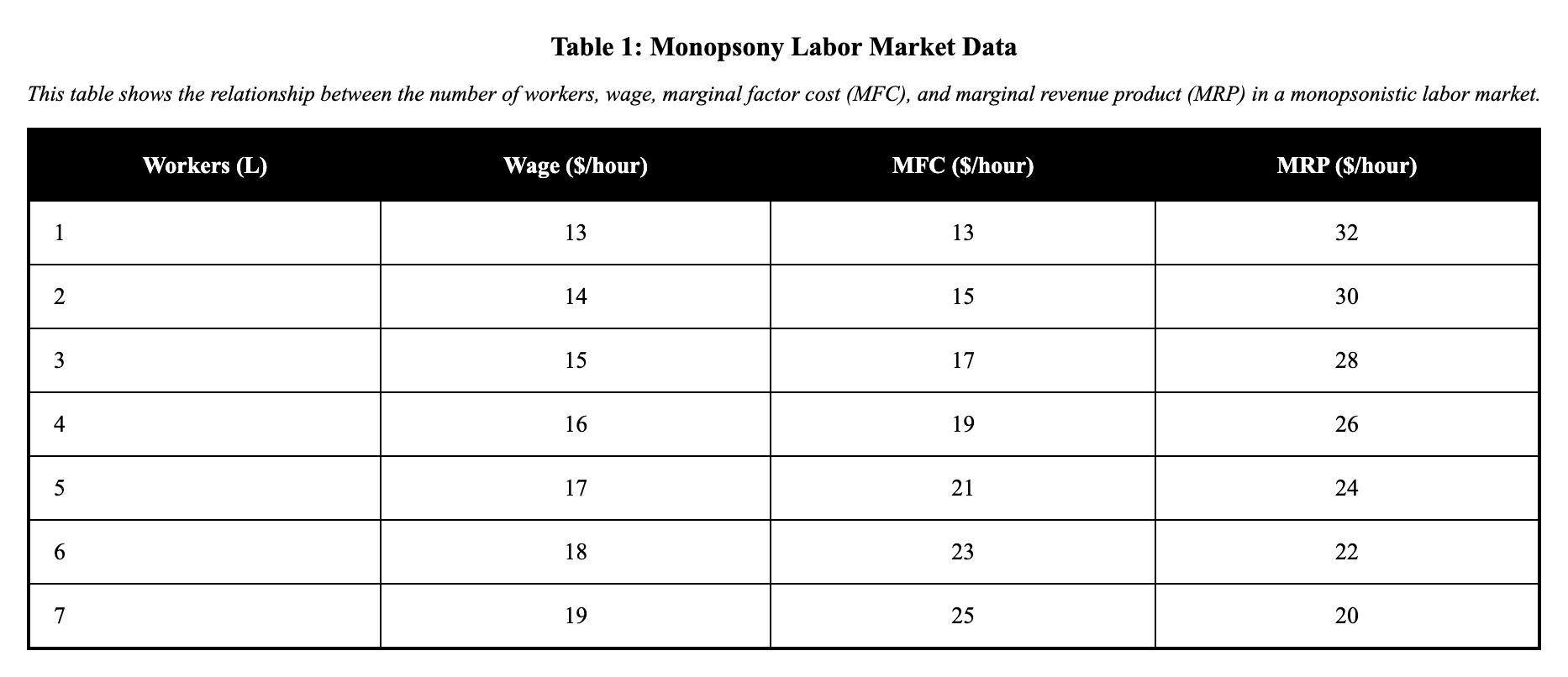
In a monopsony, how does MFC compare to AFC (labor supply) above the first worker?
Tap card or press Space to flip
MFC>AFC for additional labor units. Must raise wages for all workers to attract more, so marginal exceeds average.
How well did you know it?
Card 1 / 37
Space to flip · ← / → to move · once flipped, → Got it · ← Still learning
This deck focuses on Monopsonistic Markets, giving you a quick way to review the definitions, rules, and examples that matter most for AP Microeconomics.
Work through these flashcards in short sessions. Try to answer each prompt before flipping the card, then revisit any cards you miss until the explanation feels automatic.
Answer: MFC>AFC for additional labor units. Must raise wages for all workers to attract more, so marginal exceeds average.
Answer: MFC becomes horizontal at the minimum wage up to the supply limit. Fixed minimum wage removes need to raise all wages when hiring more.
Answer: It can increase employment up to the competitive level. Eliminates monopsony power partially, making hiring less costly.
Answer: MRP=MP×P. Revenue from last worker equals their output times product price.
Answer: Hire where MRP=MFC. Equates marginal benefit and marginal cost of hiring.
Answer: MRPL=MPL×MR. With market power in output, use MR not P to value marginal product.
Answer: Minimum wage set above the monopsony wage. Effective when set higher than what monopsonist would pay.
Answer: w=6. Substitute L=8 into supply: w=2+0.5(8).
Answer: Wage below MRPL at the chosen employment level. Workers paid less than their marginal contribution to revenue.
Answer: It must raise the wage to attract additional workers. Higher wages needed since it's the only employer competing for workers.
Answer: Hire where MRPL=MFC. Profit maximizes where marginal benefit equals marginal cost of labor.
Answer: w∗=20. Substitute optimal employment into supply function.
Answer: A market with a single buyer of an input, facing the market supply. Single buyer has market power over input price, unlike competitive markets with many buyers.
Answer: Employment where labor demand (MRP) equals labor supply. Competitive wage where demand and supply intersect.
Answer: From the labor supply (AFC) curve at L∗. Read wage from supply curve at optimal employment level.
Answer: MRPL=SL (wage equals both). Supply and demand intersect where marginal social benefit equals cost.
Answer: MFC=a+2bL. For linear supply, MFC has same intercept but double the slope.
Answer: The additional cost of hiring one more unit of labor. Includes wage increase for all workers when hiring one more.
Answer: Higher wage and higher employment (up to competitive level). Forces monopsonist to act more like competitive employer.
Answer: LC is larger. Monopsony restricts employment below competitive level.
Answer: Lower wage and lower employment. Monopsony power restricts hiring and depresses wages.
Answer: The loss from LM<LC where MRPL>SL for missed hires. Triangle between MRPL and SL curves from LM to LC.
Answer: MRPL=MPL×P. Marginal product times output price gives revenue from last worker.
Answer: The monopsonist's average factor cost (AFC) curve. AFC shows the average cost per worker, which equals the supply curve price.
Answer: The extra cost of hiring one more unit of labor. Includes wage increase for all workers when hiring one more.
Answer: MRPL and MFC intersect at the chosen L. Profit-maximizing condition where marginal benefit equals marginal cost.
Answer: MRP>w at the monopsony quantity of labor. Workers produce more value than their wage cost.
Answer: MFC lies above the labor supply (AFC) curve. Must pay all workers the higher wage, so MFC exceeds supply price.
Answer: MRP=MP×MR. With market power in output, use MR not price.
Answer: L=8. Set 20−L=4+L, so 2L=16.
Answer: The MRP curve. Shows willingness to pay for each additional worker.
Answer: A single buyer of a factor of production (usually labor). Has market power as the sole employer in the labor market.
Answer: Pay the wage on the labor supply (AFC) at that L. Read wage from supply curve at optimal L, not from MFC curve.
Answer: Underemployment: Lm<Lc where MRP>w for missing workers. Some workers willing to work for less than their MRP aren't hired.
Answer: The average factor cost (AFC) of labor at each quantity. Shows the wage needed to hire each quantity of workers.
Answer: Lower wage and lower employment than competitive equilibrium. Market power reduces both wage and employment below competitive levels.
Answer: MFC=w (constant and equal to AFC). Horizontal supply means constant wage regardless of quantity hired.