Other Fluid Dynamics - AP Physics 2
Card 1 of 12
Viscosity is defined loosely as internal friction in a fluid. Which of the following fluids would you expect to have the highest viscosity?
Viscosity is defined loosely as internal friction in a fluid. Which of the following fluids would you expect to have the highest viscosity?
Tap to reveal answer
The correct answer is molasses. Since this liquid is notably thicker and more difficult to move, it is intuitively sensed that is has the highest viscosity of this group of fluids.
The correct answer is molasses. Since this liquid is notably thicker and more difficult to move, it is intuitively sensed that is has the highest viscosity of this group of fluids.
← Didn't Know|Knew It →
A spherical ball of mass  and radius
  is sinking in water. What is the terminal velocity of the ball?


A spherical ball of mass
Tap to reveal answer
We will start with Newton's second law for this problem:

When the ball reaches terminal velocity, we know that the net force on the ball is equal to 0:

There are three forces acting on the ball: gravitational, buoyant, and drag. If we designate any downward force as positive, we get:
 (1)
(1)
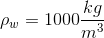
Where:
 (2)
(2)

Where:

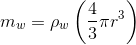
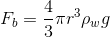 (3)
(3)
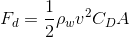
 (4)
(4)
Substituting expressions (2), (3), and (4) into (1), we get:

Now we just need to rearranging for velocity.

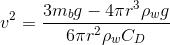
We have all of these values, so time to plug and chug:


We will start with Newton's second law for this problem:
When the ball reaches terminal velocity, we know that the net force on the ball is equal to 0:
There are three forces acting on the ball: gravitational, buoyant, and drag. If we designate any downward force as positive, we get:
Where:
Where:
Substituting expressions (2), (3), and (4) into (1), we get:
Now we just need to rearranging for velocity.
We have all of these values, so time to plug and chug:
← Didn't Know|Knew It →
An object with mass  and volume
  and reference area of
  is sinking in water with a constant velocity of
  . What is the drag coefficient of the object?

An object with mass
Tap to reveal answer
We will start with Newton's second law:

Since the block is sinking at a constant velocity, we know that the net force is 0:

There are three forces acting on the ball: gravitational, buoyant, and drag. If we designate any downward force as positive, we get:
 (1)
(1)
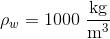
Where:
 (2)
(2)

Where:

 (3)
(3)
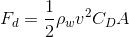 (4)
(4)
Plugging expressions 2, 3, and 4 into 1, we get:

Now we need to rearranging for the drag coefficient:

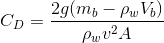
Plugging in our values, we get:


We will start with Newton's second law:
Since the block is sinking at a constant velocity, we know that the net force is 0:
There are three forces acting on the ball: gravitational, buoyant, and drag. If we designate any downward force as positive, we get:
Where:
Where:
Plugging expressions 2, 3, and 4 into 1, we get:
Now we need to rearranging for the drag coefficient:
Plugging in our values, we get:
← Didn't Know|Knew It →
Viscosity is defined loosely as internal friction in a fluid. Which of the following fluids would you expect to have the highest viscosity?
Viscosity is defined loosely as internal friction in a fluid. Which of the following fluids would you expect to have the highest viscosity?
Tap to reveal answer
The correct answer is molasses. Since this liquid is notably thicker and more difficult to move, it is intuitively sensed that is has the highest viscosity of this group of fluids.
The correct answer is molasses. Since this liquid is notably thicker and more difficult to move, it is intuitively sensed that is has the highest viscosity of this group of fluids.
← Didn't Know|Knew It →
A spherical ball of mass and radius is sinking in water. What is the terminal velocity of the ball?
A spherical ball of mass
Tap to reveal answer
We will start with Newton's second law for this problem:
When the ball reaches terminal velocity, we know that the net force on the ball is equal to 0:
There are three forces acting on the ball: gravitational, buoyant, and drag. If we designate any downward force as positive, we get:
(1)
Where:
(2)
Where:
(3)
(4)
Substituting expressions (2), (3), and (4) into (1), we get:
Now we just need to rearranging for velocity.
We have all of these values, so time to plug and chug:
We will start with Newton's second law for this problem:
When the ball reaches terminal velocity, we know that the net force on the ball is equal to 0:
There are three forces acting on the ball: gravitational, buoyant, and drag. If we designate any downward force as positive, we get:
Where:
Where:
Substituting expressions (2), (3), and (4) into (1), we get:
Now we just need to rearranging for velocity.
We have all of these values, so time to plug and chug:
← Didn't Know|Knew It →
An object with mass and volume and reference area of is sinking in water with a constant velocity of . What is the drag coefficient of the object?
An object with mass
Tap to reveal answer
We will start with Newton's second law:
Since the block is sinking at a constant velocity, we know that the net force is 0:
There are three forces acting on the ball: gravitational, buoyant, and drag. If we designate any downward force as positive, we get:
(1)
Where:
(2)
Where:
(3)
(4)
Plugging expressions 2, 3, and 4 into 1, we get:
Now we need to rearranging for the drag coefficient:
Plugging in our values, we get:
We will start with Newton's second law:
Since the block is sinking at a constant velocity, we know that the net force is 0:
There are three forces acting on the ball: gravitational, buoyant, and drag. If we designate any downward force as positive, we get:
Where:
Where:
Plugging expressions 2, 3, and 4 into 1, we get:
Now we need to rearranging for the drag coefficient:
Plugging in our values, we get:
← Didn't Know|Knew It →
Viscosity is defined loosely as internal friction in a fluid. Which of the following fluids would you expect to have the highest viscosity?
Viscosity is defined loosely as internal friction in a fluid. Which of the following fluids would you expect to have the highest viscosity?
Tap to reveal answer
The correct answer is molasses. Since this liquid is notably thicker and more difficult to move, it is intuitively sensed that is has the highest viscosity of this group of fluids.
The correct answer is molasses. Since this liquid is notably thicker and more difficult to move, it is intuitively sensed that is has the highest viscosity of this group of fluids.
← Didn't Know|Knew It →
A spherical ball of mass and radius is sinking in water. What is the terminal velocity of the ball?
A spherical ball of mass
Tap to reveal answer
We will start with Newton's second law for this problem:
When the ball reaches terminal velocity, we know that the net force on the ball is equal to 0:
There are three forces acting on the ball: gravitational, buoyant, and drag. If we designate any downward force as positive, we get:
(1)
Where:
(2)
Where:
(3)
(4)
Substituting expressions (2), (3), and (4) into (1), we get:
Now we just need to rearranging for velocity.
We have all of these values, so time to plug and chug:
We will start with Newton's second law for this problem:
When the ball reaches terminal velocity, we know that the net force on the ball is equal to 0:
There are three forces acting on the ball: gravitational, buoyant, and drag. If we designate any downward force as positive, we get:
Where:
Where:
Substituting expressions (2), (3), and (4) into (1), we get:
Now we just need to rearranging for velocity.
We have all of these values, so time to plug and chug:
← Didn't Know|Knew It →
An object with mass and volume and reference area of is sinking in water with a constant velocity of . What is the drag coefficient of the object?
An object with mass
Tap to reveal answer
We will start with Newton's second law:
Since the block is sinking at a constant velocity, we know that the net force is 0:
There are three forces acting on the ball: gravitational, buoyant, and drag. If we designate any downward force as positive, we get:
(1)
Where:
(2)
Where:
(3)
(4)
Plugging expressions 2, 3, and 4 into 1, we get:
Now we need to rearranging for the drag coefficient:
Plugging in our values, we get:
We will start with Newton's second law:
Since the block is sinking at a constant velocity, we know that the net force is 0:
There are three forces acting on the ball: gravitational, buoyant, and drag. If we designate any downward force as positive, we get:
Where:
Where:
Plugging expressions 2, 3, and 4 into 1, we get:
Now we need to rearranging for the drag coefficient:
Plugging in our values, we get:
← Didn't Know|Knew It →
Viscosity is defined loosely as internal friction in a fluid. Which of the following fluids would you expect to have the highest viscosity?
Viscosity is defined loosely as internal friction in a fluid. Which of the following fluids would you expect to have the highest viscosity?
Tap to reveal answer
The correct answer is molasses. Since this liquid is notably thicker and more difficult to move, it is intuitively sensed that is has the highest viscosity of this group of fluids.
The correct answer is molasses. Since this liquid is notably thicker and more difficult to move, it is intuitively sensed that is has the highest viscosity of this group of fluids.
← Didn't Know|Knew It →
A spherical ball of mass and radius is sinking in water. What is the terminal velocity of the ball?
A spherical ball of mass
Tap to reveal answer
We will start with Newton's second law for this problem:
When the ball reaches terminal velocity, we know that the net force on the ball is equal to 0:
There are three forces acting on the ball: gravitational, buoyant, and drag. If we designate any downward force as positive, we get:
(1)
Where:
(2)
Where:
(3)
(4)
Substituting expressions (2), (3), and (4) into (1), we get:
Now we just need to rearranging for velocity.
We have all of these values, so time to plug and chug:
We will start with Newton's second law for this problem:
When the ball reaches terminal velocity, we know that the net force on the ball is equal to 0:
There are three forces acting on the ball: gravitational, buoyant, and drag. If we designate any downward force as positive, we get:
Where:
Where:
Substituting expressions (2), (3), and (4) into (1), we get:
Now we just need to rearranging for velocity.
We have all of these values, so time to plug and chug:
← Didn't Know|Knew It →
An object with mass and volume and reference area of is sinking in water with a constant velocity of . What is the drag coefficient of the object?
An object with mass
Tap to reveal answer
We will start with Newton's second law:
Since the block is sinking at a constant velocity, we know that the net force is 0:
There are three forces acting on the ball: gravitational, buoyant, and drag. If we designate any downward force as positive, we get:
(1)
Where:
(2)
Where:
(3)
(4)
Plugging expressions 2, 3, and 4 into 1, we get:
Now we need to rearranging for the drag coefficient:
Plugging in our values, we get:
We will start with Newton's second law:
Since the block is sinking at a constant velocity, we know that the net force is 0:
There are three forces acting on the ball: gravitational, buoyant, and drag. If we designate any downward force as positive, we get:
Where:
Where:
Plugging expressions 2, 3, and 4 into 1, we get:
Now we need to rearranging for the drag coefficient:
Plugging in our values, we get:
← Didn't Know|Knew It →