Electricity - AP Physics C: Electricity and Magnetism
Card 1 of 385
Consider a spherical shell with radius  and charge
  . What is the magnitude of the electric field at the center of this spherical shell?
Consider a spherical shell with radius
Tap to reveal answer
According to the shell theorem, the total electric field at the center point of a charged spherical shell is always zero. At this point, any electric field lines will result in symmetry, canceling each other out and creating a net field of zero at that point.
According to the shell theorem, the total electric field at the center point of a charged spherical shell is always zero. At this point, any electric field lines will result in symmetry, canceling each other out and creating a net field of zero at that point.
← Didn't Know|Knew It →
Consider a spherical shell with radius and charge . What is the magnitude of the electric field at the center of this spherical shell?
Consider a spherical shell with radius
Tap to reveal answer
According to the shell theorem, the total electric field at the center point of a charged spherical shell is always zero. At this point, any electric field lines will result in symmetry, canceling each other out and creating a net field of zero at that point.
According to the shell theorem, the total electric field at the center point of a charged spherical shell is always zero. At this point, any electric field lines will result in symmetry, canceling each other out and creating a net field of zero at that point.
← Didn't Know|Knew It →
A charge,  , is enclosed by two spherical surfaces of radii
  and
and  , with
  . The cross-sectional side view is shown.
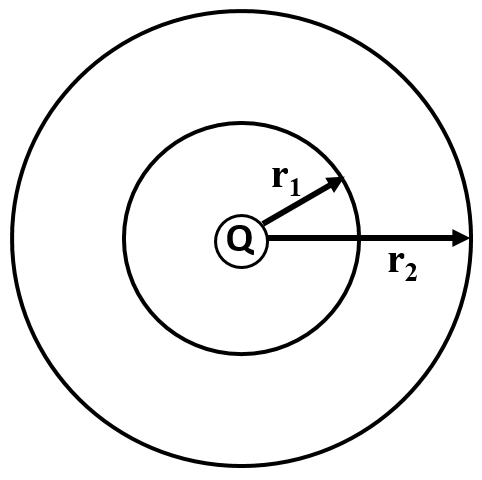
Which is the correct relationship between the electric flux passing through the two spherical surfaces around the point charge?
A charge,
Which is the correct relationship between the electric flux passing through the two spherical surfaces around the point charge?
Tap to reveal answer
Electric flux is given by either side of the equation of Gauss's Law:
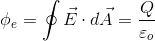
Since the charge is the same for both spherical surfaces, even though these surfaces are of different radii, the amounts of electric flux passing through each surface is the same.
Electric flux is given by either side of the equation of Gauss's Law:
Since the charge is the same for both spherical surfaces, even though these surfaces are of different radii, the amounts of electric flux passing through each surface is the same.
← Didn't Know|Knew It →
A charge of unknown value is held in place far from other charges. Its electric field lines and some lines of electric equipotential (V1 and V2) are shown in the diagram.
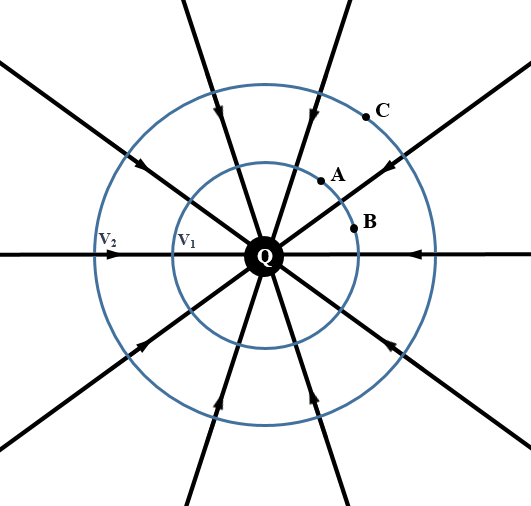
A second point charge, known to be negative, is placed at point A in the diagram. In which direction will the second, negative charge freely move?
A charge of unknown value is held in place far from other charges. Its electric field lines and some lines of electric equipotential (V1 and V2) are shown in the diagram.
A second point charge, known to be negative, is placed at point A in the diagram. In which direction will the second, negative charge freely move?
Tap to reveal answer
The original charge Q is negative, as indicated by the direction of the electric field lines in the diagram. A negative point charge of any value placed at point A will cause both charges to feel a mutually repelling force on each other. Therefore, the second charge will be repelled by the original negative charge with a force pointing radially along a line connecting the center of Q and the point A, resulting in free movement toward C. Additionally, point B is on a line of equipotential to point A; negative point charges will move from regions of lower electric potential to higher electric potential (against the direction of the electric field lines), so point B is not a viable answer.
The original charge Q is negative, as indicated by the direction of the electric field lines in the diagram. A negative point charge of any value placed at point A will cause both charges to feel a mutually repelling force on each other. Therefore, the second charge will be repelled by the original negative charge with a force pointing radially along a line connecting the center of Q and the point A, resulting in free movement toward C. Additionally, point B is on a line of equipotential to point A; negative point charges will move from regions of lower electric potential to higher electric potential (against the direction of the electric field lines), so point B is not a viable answer.
← Didn't Know|Knew It →
A point charge of  exerts a force of
  on another charge with
  . How far apart are the two charges?

A point charge of
Tap to reveal answer
To find the distance between the two charges, use Coulomb's Law.

Since we want to find distance,  , we solve for
  .
.

We know the values of the force and the two charges.


We can plug in these values and solve for the distance.


To find the distance between the two charges, use Coulomb's Law.
Since we want to find distance,
We know the values of the force and the two charges.
We can plug in these values and solve for the distance.
← Didn't Know|Knew It →
We have a point charge of  . Determine the electric field at a distance of
  away from that charge.

We have a point charge of
Tap to reveal answer
Coulomb's law for the electric field from point charges is  , where we know the values of the following variables.


Using these values, we can solve for the electric field.


Coulomb's law for the electric field from point charges is
Using these values, we can solve for the electric field.
← Didn't Know|Knew It →
Two positive point charges of  and
and  are place at a distance
  away from each other, as shown below. If a positive test charge,
  , is placed in between, at what distance away from
  will this test charge experience zero net force?

Two positive point charges of
Tap to reveal answer
To find the location at which the test charge experience zero net force, write the net force equation as  , where
  is the force on the test charge from
  , and
, and  is the force on the same test charge from
  . Using Coulomb's law, we can rewrite the force equation and set it equal to zero.


In this equation, the distance,  , is how far away the test charge is from
  , while
  represents how far away the test charge is from
  . Now, we simplify and solve for
  .
.
Cross-multiply.
%5E2=kq_2qr%5E2 "kq_$1q(d-r)^2$=kq_$2qr^2$")
We can cancel  and
and  . We do not need to know these values in order to solve the question.


Now that we have isolated  , we can plug in the values given in the question and solve.


To find the location at which the test charge experience zero net force, write the net force equation as
In this equation, the distance,
Cross-multiply.
We can cancel
Now that we have isolated
← Didn't Know|Knew It →
You are standing on top of a very large positively charged metal plate with a surface charge of  .
.
Assuming that the plate is infinitely large and your mass is  , how much charge does your body need to have in order for you to float?

You are standing on top of a very large positively charged metal plate with a surface charge of
Assuming that the plate is infinitely large and your mass is
Tap to reveal answer
Consider the forces that are acting on you. There is the downward (negative direction) force of gravity,  . In order for you to float, there has to be an upward (positive direction) force, and that upward force is coming from the metal plate,
  . To show that you would float, the net force equation is written as
  , where
  is the charge on you.
For plates that are charged, know that  .
.
Knowing this, the force equation becomes  .
.
Solve for  .
.

Now we can plug in our given values, and solve for the charge.


Consider the forces that are acting on you. There is the downward (negative direction) force of gravity,
For plates that are charged, know that
Knowing this, the force equation becomes
Solve for
Now we can plug in our given values, and solve for the charge.
← Didn't Know|Knew It →
What is the electric force between two charges,  and
and  , located
  apart?

What is the electric force between two charges,
Tap to reveal answer
The equation for finding the electric force between two charges is  , where
  . Using this, we can rewrite the force equation.

Now, we can use the values given in the question to solve for the electric force between the two particles.


The equation for finding the electric force between two charges is
Now, we can use the values given in the question to solve for the electric force between the two particles.
← Didn't Know|Knew It →
What is the magnitude of the electric field at a field point  from a point charge of
  ?
?

What is the magnitude of the electric field at a field point
Tap to reveal answer
The equation to find the strength of an electric field is  .
.
We can use the given values to solve for the strength of the field at a distance of  .
.


The equation to find the strength of an electric field is
We can use the given values to solve for the strength of the field at a distance of
← Didn't Know|Knew It →
Two capacitors are in parallel, with capacitance values of  and
and  . What is their equivalent capacitance?
Two capacitors are in parallel, with capacitance values of
Tap to reveal answer
The equivalent capacitance for capacitors in parallel is the sum of the individual capacitance values.

Using the values given in the question, we can find the equivalent capacitance.

The equivalent capacitance for capacitors in parallel is the sum of the individual capacitance values.
Using the values given in the question, we can find the equivalent capacitance.
← Didn't Know|Knew It →
A proton moves in a straight line for a distance of  . Along this path, the electric field is uniform with a value of
  . Find the force on the proton.
The charge of a proton is  .
.
A proton moves in a straight line for a distance of
The charge of a proton is
Tap to reveal answer
The force of an electric field is given by the equation  , where
  is the charge of the particle and
  is the electric field strength. We can use the given values from the question to solve for the force.

The force of an electric field is given by the equation
← Didn't Know|Knew It →
Two point charges,  and
and  are separated by a distance
  .
.

The values of the charges are:


The distance is 4.0cm. The point  lies 1.5cm away from
  on a line connecting the centers of the two charges.
What is the magnitude and direction of the net electric field at point  due to the two charges?

Two point charges,
The values of the charges are:
The distance is 4.0cm. The point
What is the magnitude and direction of the net electric field at point
Tap to reveal answer
At point  , the electric field due to
  points toward
  with a magnitude given by:

At point P, the electric field due to Q2 points away from Q2 with a magnitude given by

The addition of these two vectors, both pointing in the same direction, results in a net electric field vector of magnitude 152000 volts per meter, pointing toward  .
.

At point
At point P, the electric field due to Q2 points away from Q2 with a magnitude given by
The addition of these two vectors, both pointing in the same direction, results in a net electric field vector of magnitude 152000 volts per meter, pointing toward
← Didn't Know|Knew It →
Three identical point charges with  are placed so that they form an equilateral triangle as shown in the figure. Find the electric potential at the center point (black dot) of that equilateral triangle, where this point is at a equal distance,
  , away from the three charges.


Three identical point charges with
Tap to reveal answer
The electric potential from point charges is  .
.
Knowing that all three charges are identical, and knowing that the center point at which we are calculating the electric potential is equal distance from the charges, we can multiply the electric potential equation by three.

Plug in the given values and solve for  .
.


The electric potential from point charges is
Knowing that all three charges are identical, and knowing that the center point at which we are calculating the electric potential is equal distance from the charges, we can multiply the electric potential equation by three.
Plug in the given values and solve for
← Didn't Know|Knew It →
A proton moves in a straight line for a distance of  . Along this path, the electric field is uniform with a value of
  . Find the work done on the proton by the electric field.
The charge of a proton is  .
.
A proton moves in a straight line for a distance of
The charge of a proton is
Tap to reveal answer
Work done by an electric field is given by the product of the charge of the particle, the electric field strength, and the distance travelled.

We are given the charge ( ), the distance (
 ), and the field strength (
 ), allowing us to calculate the work.


Work done by an electric field is given by the product of the charge of the particle, the electric field strength, and the distance travelled.
We are given the charge (
← Didn't Know|Knew It →
A proton moves in a straight line for a distance of  . Along this path, the electric field is uniform with a value of
  . Find the potential difference created by the movement.
The charge of a proton is  .
.
A proton moves in a straight line for a distance of
The charge of a proton is
Tap to reveal answer
Potential difference is given by the change in voltage

Work done by an electric field is equal to the product of the electric force and the distance travelled. Electric force is equal to the product of the charge and the electric field strength.

The charges cancel, and we are able to solve for the potential difference.

Potential difference is given by the change in voltage
Work done by an electric field is equal to the product of the electric force and the distance travelled. Electric force is equal to the product of the charge and the electric field strength.
The charges cancel, and we are able to solve for the potential difference.
← Didn't Know|Knew It →
The potential outside of a charged conducting cylinder with radius  and charge per unit length
  is given by the below equation.

What is the electric field at a point located at a distance  from the surface of the cylinder?
The potential outside of a charged conducting cylinder with radius
What is the electric field at a point located at a distance
Tap to reveal answer
The radial electric field outside the cylinder can be found using the equation  .
.
Using the formula given in the question, we can expand this equation.

Now, we can take the derivative and simplify.


The radial electric field outside the cylinder can be found using the equation
Using the formula given in the question, we can expand this equation.
Now, we can take the derivative and simplify.
← Didn't Know|Knew It →
For a ring of charge with radius  and total charge
  , the potential is given by
  .
.
Find the expression for electric field produced by the ring.
For a ring of charge with radius
Find the expression for electric field produced by the ring.
Tap to reveal answer
We know that  .
.
Using the given formula, we can find the electric potential expression for the ring.

Take the derivative and simplify.

We know that
Using the given formula, we can find the electric potential expression for the ring.
Take the derivative and simplify.
← Didn't Know|Knew It →
A negative charge of magnitude  is placed in a uniform electric field of
  , directed upwards. If the charge is moved
  upwards, how much work is done on the charge by the electric field in this process?
A negative charge of magnitude
Tap to reveal answer
Relevant equations:


Given:


First, find the potential difference between the initial and final positions:

2. Plug this potential difference into the work equation to solve for W:


Relevant equations:
Given:
First, find the potential difference between the initial and final positions:
2. Plug this potential difference into the work equation to solve for W:
← Didn't Know|Knew It →
Three point charges are arranged around the origin, as shown.


Calculate the total electric potential at the origin due to the three point charges.

Three point charges are arranged around the origin, as shown.
Calculate the total electric potential at the origin due to the three point charges.
Tap to reveal answer
Electric potential is a scalar quantity given by the equation:

To find the total potential at the origin due to the three charges, add the potentials of each charge.


Electric potential is a scalar quantity given by the equation:
To find the total potential at the origin due to the three charges, add the potentials of each charge.
← Didn't Know|Knew It →