Normal Distribution - AP Statistics
Card 1 of 72
Alex took a test in physics and scored a 35. The class average was 27 and the standard deviation was 5.
Noah took a chemistry test and scored an 82. The class average was 70 and the standard deviation was 8.
Show that Alex had the better performance by calculating -
-
Alex's standard normal percentile and
-
Noah's standard normal percentile
Alex took a test in physics and scored a 35. The class average was 27 and the standard deviation was 5.
Noah took a chemistry test and scored an 82. The class average was 70 and the standard deviation was 8.
Show that Alex had the better performance by calculating -
-
Alex's standard normal percentile and
-
Noah's standard normal percentile
Tap to reveal answer
Alex -
 on the z-table
Noah -
 on the z-table
Alex -
Noah -
← Didn't Know|Knew It →
Find the area under the standard normal curve between Z=1.5 and Z=2.4.
Find the area under the standard normal curve between Z=1.5 and Z=2.4.
Tap to reveal answer



← Didn't Know|Knew It →
When

and

Find
 .
.
When
and
Find
Tap to reveal answer





← Didn't Know|Knew It →
Arrivals to a bed and breakfast follow a Poisson process. The expected number of arrivals each week is 4. What is the probability that there are exactly 3 arrivals over the course of one week?
Arrivals to a bed and breakfast follow a Poisson process. The expected number of arrivals each week is 4. What is the probability that there are exactly 3 arrivals over the course of one week?
Tap to reveal answer

← Didn't Know|Knew It →
The masses of tomatoes are normally distributed with a mean of  grams and a standard deviation of
  grams. What mass of tomatoes would be the
  percentile of the masses of all the tomatoes?
The masses of tomatoes are normally distributed with a mean of
Tap to reveal answer
The Z score for a normal distribution at the  percentile is
  So
So  , which can be found on the normal distribution table. The mass of tomatoes in the
  percentile of all tomatoes is
  standard deviations below the mean, so the mass is
  .
.
The Z score for a normal distribution at the
← Didn't Know|Knew It →
Find
 .
.
Find
Tap to reveal answer
First, we use our normal distribution table to find a p-value for a z-score greater than 0.50.
Our table tells us the probability is approximately,
 .
.
Next we use our normal distribution table to find a p-value for a z-score greater than 1.23.
Our table tells us the probability is approximately,
 .
.
We then subtract the probability of z being greater than 0.50 from the probability of z being less than 1.23 to give us our answer of,
 .
.
First, we use our normal distribution table to find a p-value for a z-score greater than 0.50.
Our table tells us the probability is approximately,
Next we use our normal distribution table to find a p-value for a z-score greater than 1.23.
Our table tells us the probability is approximately,
We then subtract the probability of z being greater than 0.50 from the probability of z being less than 1.23 to give us our answer of,
← Didn't Know|Knew It →
Find
 .
.
Find
Tap to reveal answer
First, we use the table to look up a p-value for z > -1.22.
This gives us a p-value of,
 .
.
Next, we use the table to look up a p-value for z > 1.59.
This gives us a p-value of,
 .
.
Finally we subtract the probability of z being greater than -1.22 from the probability of z being less than 1.59 to arrive at our answer of,
 .
.
First, we use the table to look up a p-value for z > -1.22.
This gives us a p-value of,
Next, we use the table to look up a p-value for z > 1.59.
This gives us a p-value of,
Finally we subtract the probability of z being greater than -1.22 from the probability of z being less than 1.59 to arrive at our answer of,
← Didn't Know|Knew It →
Gabbie earned a score of 940 on a national achievement test. The mean test score was 850 with a sample standard deviation of 100. What proportion of students had a higher score than Gabbie? (Assume that test scores are normally distributed.)
Gabbie earned a score of 940 on a national achievement test. The mean test score was 850 with a sample standard deviation of 100. What proportion of students had a higher score than Gabbie? (Assume that test scores are normally distributed.)
Tap to reveal answer
When we get this type of problem, first we need to calculate a z-score that we can use in our table.
To do that, we use our z-score formula:
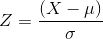
where,
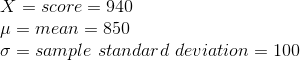
Plugging into the equation we get:

We then use our table to look up a p-value for z > 0.9. Since we want to calculate the probability of students who earned a higher score than Gabbie we need to subtract the P(z<0.9) to get our answer.
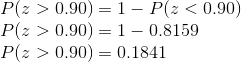
When we get this type of problem, first we need to calculate a z-score that we can use in our table.
To do that, we use our z-score formula:
where,
Plugging into the equation we get:
We then use our table to look up a p-value for z > 0.9. Since we want to calculate the probability of students who earned a higher score than Gabbie we need to subtract the P(z<0.9) to get our answer.
← Didn't Know|Knew It →
Alex took a test in physics and scored a 35. The class average was 27 and the standard deviation was 5.
Noah took a chemistry test and scored an 82. The class average was 70 and the standard deviation was 8.
Show that Alex had the better performance by calculating -
-
Alex's standard normal percentile and
-
Noah's standard normal percentile
Alex took a test in physics and scored a 35. The class average was 27 and the standard deviation was 5.
Noah took a chemistry test and scored an 82. The class average was 70 and the standard deviation was 8.
Show that Alex had the better performance by calculating -
-
Alex's standard normal percentile and
-
Noah's standard normal percentile
Tap to reveal answer
Alex -
on the z-table
Noah -
on the z-table
Alex -
Noah -
← Didn't Know|Knew It →
Find the area under the standard normal curve between Z=1.5 and Z=2.4.
Find the area under the standard normal curve between Z=1.5 and Z=2.4.
Tap to reveal answer
← Didn't Know|Knew It →
When
and
Find
.
When
and
Find
Tap to reveal answer
← Didn't Know|Knew It →
Arrivals to a bed and breakfast follow a Poisson process. The expected number of arrivals each week is 4. What is the probability that there are exactly 3 arrivals over the course of one week?
Arrivals to a bed and breakfast follow a Poisson process. The expected number of arrivals each week is 4. What is the probability that there are exactly 3 arrivals over the course of one week?
Tap to reveal answer
← Didn't Know|Knew It →
The masses of tomatoes are normally distributed with a mean of grams and a standard deviation of grams. What mass of tomatoes would be the percentile of the masses of all the tomatoes?
The masses of tomatoes are normally distributed with a mean of
Tap to reveal answer
The Z score for a normal distribution at the percentile is So , which can be found on the normal distribution table. The mass of tomatoes in the percentile of all tomatoes is standard deviations below the mean, so the mass is .
The Z score for a normal distribution at the
← Didn't Know|Knew It →
Find
.
Find
Tap to reveal answer
First, we use our normal distribution table to find a p-value for a z-score greater than 0.50.
Our table tells us the probability is approximately,
.
Next we use our normal distribution table to find a p-value for a z-score greater than 1.23.
Our table tells us the probability is approximately,
.
We then subtract the probability of z being greater than 0.50 from the probability of z being less than 1.23 to give us our answer of,
.
First, we use our normal distribution table to find a p-value for a z-score greater than 0.50.
Our table tells us the probability is approximately,
Next we use our normal distribution table to find a p-value for a z-score greater than 1.23.
Our table tells us the probability is approximately,
We then subtract the probability of z being greater than 0.50 from the probability of z being less than 1.23 to give us our answer of,
← Didn't Know|Knew It →
Find
.
Find
Tap to reveal answer
First, we use the table to look up a p-value for z > -1.22.
This gives us a p-value of,
.
Next, we use the table to look up a p-value for z > 1.59.
This gives us a p-value of,
.
Finally we subtract the probability of z being greater than -1.22 from the probability of z being less than 1.59 to arrive at our answer of,
.
First, we use the table to look up a p-value for z > -1.22.
This gives us a p-value of,
Next, we use the table to look up a p-value for z > 1.59.
This gives us a p-value of,
Finally we subtract the probability of z being greater than -1.22 from the probability of z being less than 1.59 to arrive at our answer of,
← Didn't Know|Knew It →
Gabbie earned a score of 940 on a national achievement test. The mean test score was 850 with a sample standard deviation of 100. What proportion of students had a higher score than Gabbie? (Assume that test scores are normally distributed.)
Gabbie earned a score of 940 on a national achievement test. The mean test score was 850 with a sample standard deviation of 100. What proportion of students had a higher score than Gabbie? (Assume that test scores are normally distributed.)
Tap to reveal answer
When we get this type of problem, first we need to calculate a z-score that we can use in our table.
To do that, we use our z-score formula:
where,
Plugging into the equation we get:
We then use our table to look up a p-value for z > 0.9. Since we want to calculate the probability of students who earned a higher score than Gabbie we need to subtract the P(z<0.9) to get our answer.
When we get this type of problem, first we need to calculate a z-score that we can use in our table.
To do that, we use our z-score formula:
where,
Plugging into the equation we get:
We then use our table to look up a p-value for z > 0.9. Since we want to calculate the probability of students who earned a higher score than Gabbie we need to subtract the P(z<0.9) to get our answer.
← Didn't Know|Knew It →
Which of the following populations has a precisely normal distribution?
Which of the following populations has a precisely normal distribution?
Tap to reveal answer
A normal distribution is one in which the values are evenly distributed both above and below the mean. A population has a precisely normal distribution if the mean, mode, and median are all equal. For the population of 3,4,5,5,5,6,7, the mean, mode, and median are all 5.
A normal distribution is one in which the values are evenly distributed both above and below the mean. A population has a precisely normal distribution if the mean, mode, and median are all equal. For the population of 3,4,5,5,5,6,7, the mean, mode, and median are all 5.
← Didn't Know|Knew It →
If a population has a normal distribution, the number of values within one positive standard deviation of the mean will be . . .
If a population has a normal distribution, the number of values within one positive standard deviation of the mean will be . . .
Tap to reveal answer
In a normal distribution, the number of values within one positive standard deviation of the mean is equal to the number of values within one negative standard deviation of the mean. The reason for this is that the values below the population mean exactly parallel the values above the mean.
In a normal distribution, the number of values within one positive standard deviation of the mean is equal to the number of values within one negative standard deviation of the mean. The reason for this is that the values below the population mean exactly parallel the values above the mean.
← Didn't Know|Knew It →
Which parameters define the normal distribution?
Which parameters define the normal distribution?
Tap to reveal answer
The two main parameters of the normal distribution are  and
and  .
.  is a location parameter which determines the location of the peak of the normal distribution on the real number line.
  is a scale parameter which determines the concentration of the density around the mean. Larger
  's lead the normal to spread out more than smaller
  's.
's.
The two main parameters of the normal distribution are
← Didn't Know|Knew It →
In order to be considered a normal distribution, a data set (when graphed) must follow a bell-shaped symmetrical curve centered around the mean.
It must also adhere to the empirical rule that indicates the percentage of the data set that falls within (plus or minus) 1, 2 and 3 standard deviations of the mean.
In order to be a normal distribution, what percentage of the data set must fall within:
-

-

-

In order to be considered a normal distribution, a data set (when graphed) must follow a bell-shaped symmetrical curve centered around the mean.
It must also adhere to the empirical rule that indicates the percentage of the data set that falls within (plus or minus) 1, 2 and 3 standard deviations of the mean.
In order to be a normal distribution, what percentage of the data set must fall within:
Tap to reveal answer
- Percentile for Z=1 is .8413 - or - .1587 in one tail - or - .3174 in both tails -
1 - .3174=.6826
- Percentile for Z=2 is .9772 - or - .0228 in one tail - or - .0456 in both tails -
1 - .0456=.9544
- Percentile for Z=3 is .9987 - or - .0013 in one tail - or - .0026 in both tails -
1 - .0026=.9974
- Percentile for Z=1 is .8413 - or - .1587 in one tail - or - .3174 in both tails -
1 - .3174=.6826
- Percentile for Z=2 is .9772 - or - .0228 in one tail - or - .0456 in both tails -
1 - .0456=.9544
- Percentile for Z=3 is .9987 - or - .0013 in one tail - or - .0026 in both tails -
1 - .0026=.9974
← Didn't Know|Knew It →