Manipulation of Fractions - Basic Math
Card 1 of 68
What is the reciprocal of  ?
?
What is the reciprocal of
Tap to reveal answer
To get the reciprocal of a fraction, you simply switch the numerator and the denominator.
In our case our numerator is  and our denominator is
  .
.
So  becomes
  .
.
To get the reciprocal of a fraction, you simply switch the numerator and the denominator.
In our case our numerator is
So
← Didn't Know|Knew It →
What is the reciprocal of  multiplied by the reciprocal of
  ?
?
What is the reciprocal of
Tap to reveal answer
To find the reciprocal of a fraction, we simply need to switch the numerator and the denominator: for example, the reciprocal of a fraction  is
is  .
.
With integers, it helps to remember that all integers are really fractions with a denominator of  :
:
 ,
,  , and
, and 
The reciprocals of these numbers are  and
and  respectively.
Therefore, to solve the problem, we first need to find the reciprocals of  and
and  . If we keep in mind that
  , we can determine that the reciprocals are
  and
and  , respectively. The product of these two numbers is:

 is our final answer.
To find the reciprocal of a fraction, we simply need to switch the numerator and the denominator: for example, the reciprocal of a fraction
With integers, it helps to remember that all integers are really fractions with a denominator of
The reciprocals of these numbers are
Therefore, to solve the problem, we first need to find the reciprocals of
← Didn't Know|Knew It →
What is the sum of the reciprocal of  and
and  ?
?
What is the sum of the reciprocal of
Tap to reveal answer
To find the reciprocal of a fraction, flip the numerator and the denominator.
Thus, the reciprocal of  is
is  .
.
Then we need to find the sum of 4 and 7, which is 11.
To find the reciprocal of a fraction, flip the numerator and the denominator.
Thus, the reciprocal of
Then we need to find the sum of 4 and 7, which is 11.
← Didn't Know|Knew It →
Compute: 
Compute:
Tap to reveal answer
We will need to rewrite this in order to eliminate the negative exponent in the problem.
Because the denominator has a negative exponent, that is the same as having a positive exponent in the numerator. Therefore we can rewrite the problem as follows and then multiply.

We will need to rewrite this in order to eliminate the negative exponent in the problem.
Because the denominator has a negative exponent, that is the same as having a positive exponent in the numerator. Therefore we can rewrite the problem as follows and then multiply.
← Didn't Know|Knew It →
Evaluate:

Evaluate:
Tap to reveal answer
To divide a term by a fraction, take the reciprocal of the fraction.
Then mutiply both terms.
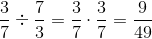
To divide a term by a fraction, take the reciprocal of the fraction.
Then mutiply both terms.
← Didn't Know|Knew It →
What is  in fraction form?
What is
Tap to reveal answer
To rewrite the mixed fractions as improper fractions we multiply the whole number by the denominator and add the numerator to get our new numerator. Our denominator stays the same. With this in mind we get the following:
 and
and
 .
.
Adding them gives us
 .
.
To rewrite the mixed fractions as improper fractions we multiply the whole number by the denominator and add the numerator to get our new numerator. Our denominator stays the same. With this in mind we get the following:
Adding them gives us
← Didn't Know|Knew It →
Convert this mixed number  to an improper fraction.
Convert this mixed number
Tap to reveal answer
The correct answer is  .
.
The mixed number can be broken down as follows: 3 is the whole number, 1 is the numerator, and 4 is the denominator.
In order to convert the mixed number to an improper fraction, you must first multiply the denominator with the whole number and then add the numerator to it.
This answer is the numerator of the improper fraction:
 .
.
The denominator of the fraction remains the same and the final answer is  .
.
The correct answer is
The mixed number can be broken down as follows: 3 is the whole number, 1 is the numerator, and 4 is the denominator.
In order to convert the mixed number to an improper fraction, you must first multiply the denominator with the whole number and then add the numerator to it.
This answer is the numerator of the improper fraction:
The denominator of the fraction remains the same and the final answer is
← Didn't Know|Knew It →
Find the sum.

Find the sum.
Tap to reveal answer
To add mixed numbers, you need to first change both of them into improper fractions.


Then, add the two improper fractions like you would any other fraction.
We need both fractions to have the same denominator before we can add them. Since 27 is a multiple of 3, we only need to change 1 fraction.
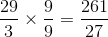
Now, we can add these fractions.
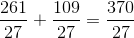
Finally, change the improper fraction back into a mixed number.

To add mixed numbers, you need to first change both of them into improper fractions.
Then, add the two improper fractions like you would any other fraction.
We need both fractions to have the same denominator before we can add them. Since 27 is a multiple of 3, we only need to change 1 fraction.
Now, we can add these fractions.
Finally, change the improper fraction back into a mixed number.
← Didn't Know|Knew It →
What is  equivalent to?
What is
Tap to reveal answer
This question is asking you to change an improper fraction into a mixed number. To do that we will need to divide 75 by 6.

Now, we place the remainder as the numerator of a fraction with a denominator that is 6 because we just divided by six.
So then, 12 remainder 3 becomes  .
.
Simplify this mixed fraction.

This question is asking you to change an improper fraction into a mixed number. To do that we will need to divide 75 by 6.
Now, we place the remainder as the numerator of a fraction with a denominator that is 6 because we just divided by six.
So then, 12 remainder 3 becomes
Simplify this mixed fraction.
← Didn't Know|Knew It →
What is the decimal equivalent to  ?
?
What is the decimal equivalent to
Tap to reveal answer
The correct answer is 
 is greater than half so you can eliminate
  and
and  right away.
You should memorize common fractions:


The correct answer is
You should memorize common fractions:
← Didn't Know|Knew It →
Express the following fraction as a decimal:

Express the following fraction as a decimal:
Tap to reveal answer
To easily express a fraction as a decimal, we need to convert the denominator into a power of  . We can do this by dividing both the top and the bottom of the given fraction by
  to express it in tenths.

 , or six tenths, can be expressed as
  .
.
To easily express a fraction as a decimal, we need to convert the denominator into a power of
← Didn't Know|Knew It →
Which fraction is less than  ?
?
Which fraction is less than
Tap to reveal answer
The best way to answer this question is to find the smallest fraction among the answer choices.
Comparing fractions can be done easily when they are converted to decimals.
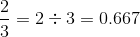
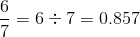
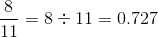
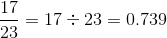
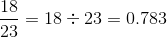
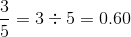
Of these options, only  , or 0.60, is less than
  .
.
The best way to answer this question is to find the smallest fraction among the answer choices.
Comparing fractions can be done easily when they are converted to decimals.
Of these options, only
← Didn't Know|Knew It →

What is the result of the above equation?
What is the result of the above equation?
Tap to reveal answer
So we first multiply the numerators:

We then multiply the denominators

Our resulting fraction is:

We reduce by dividing by 2 from the numerator and denominator.
For the numerator:

For the denominator:

The resulting fraction is:

So we first multiply the numerators:
We then multiply the denominators
Our resulting fraction is:
We reduce by dividing by 2 from the numerator and denominator.
For the numerator:
For the denominator:
The resulting fraction is:
← Didn't Know|Knew It →

What is the result of the above equation?
What is the result of the above equation?
Tap to reveal answer
We first multiply the numerators:

Then we multiply the denominators:

The resulting fraction is:

We divide the numerator and denominator by 12.
The numerator is:

The denominator results in:

Our resulting fraction is:

We first multiply the numerators:
Then we multiply the denominators:
The resulting fraction is:
We divide the numerator and denominator by 12.
The numerator is:
The denominator results in:
Our resulting fraction is:
← Didn't Know|Knew It →
What is the result of the below equation?

What is the result of the below equation?
Tap to reveal answer
First, multiply the terms in the numerators:

Then multiply the terms in the denominators:

This results in the fraction  .
.
Notice that both the numerator and denominator have a common factor of 6. Dividing both the numerator and denominator by 6 results in the simplest form fraction  .
.
First, multiply the terms in the numerators:
Then multiply the terms in the denominators:
This results in the fraction
Notice that both the numerator and denominator have a common factor of 6. Dividing both the numerator and denominator by 6 results in the simplest form fraction
← Didn't Know|Knew It →
What is the result of the below equation?

What is the result of the below equation?
Tap to reveal answer
First, multiply the numerators of the terms:

Then, multiply the denominators of the terms:

The resulting fraction is  . Note that the numerator and denominator both have a common factor of 6. Dividing both parts of the fraction by 6, we get the simplest form fraction
  .
.
First, multiply the numerators of the terms:
Then, multiply the denominators of the terms:
The resulting fraction is
← Didn't Know|Knew It →
What is the result of the below equation?

What is the result of the below equation?
Tap to reveal answer
First, multiply the numerators of each term:

Then, multiply the denominators:

This results in a fraction of  . Since the numerator and denominator both have a common factor of 4, reduce both the numerator and denominator by dividing by 4 to get the simplest form fraction
  .
.
First, multiply the numerators of each term:
Then, multiply the denominators:
This results in a fraction of
← Didn't Know|Knew It →
What is the decimal equivalent to ?
What is the decimal equivalent to
Tap to reveal answer
The correct answer is
is greater than half so you can eliminate and right away.
You should memorize common fractions:
The correct answer is
You should memorize common fractions:
← Didn't Know|Knew It →
Express the following fraction as a decimal:
Express the following fraction as a decimal:
Tap to reveal answer
To easily express a fraction as a decimal, we need to convert the denominator into a power of . We can do this by dividing both the top and the bottom of the given fraction by to express it in tenths.
, or six tenths, can be expressed as .
To easily express a fraction as a decimal, we need to convert the denominator into a power of
← Didn't Know|Knew It →
Which fraction is less than ?
Which fraction is less than
Tap to reveal answer
The best way to answer this question is to find the smallest fraction among the answer choices.
Comparing fractions can be done easily when they are converted to decimals.
Of these options, only , or 0.60, is less than .
The best way to answer this question is to find the smallest fraction among the answer choices.
Comparing fractions can be done easily when they are converted to decimals.
Of these options, only
← Didn't Know|Knew It →