Percents and Decimals - Basic Math
Card 1 of 176
Convert  to a percent.
Convert
Tap to reveal answer
To convert a decimal into percent, multiply the decimal by 100 and then add a "%" sign.

Add a % sign.

To convert a decimal into percent, multiply the decimal by 100 and then add a "%" sign.
Add a % sign.
← Didn't Know|Knew It →
What is  expressed as a percentage rounded to the nearest tenth?
What is
Tap to reveal answer
Percents are numbers expressing parts of  :
:  means
means  part of
  , or
, or  .
.
The simplest way to convert a decimal to a percentage is to move the decimal place over two places to the right. We move the decimal point to after the hundredths place because we are rewriting the decimal as a portion of  . Therefore:

Now, we need to round the percentage to the nearest tenth. The number after the tenths place is a five, so we need to round up:

 is therefore our final answer.
Percents are numbers expressing parts of
The simplest way to convert a decimal to a percentage is to move the decimal place over two places to the right. We move the decimal point to after the hundredths place because we are rewriting the decimal as a portion of
Now, we need to round the percentage to the nearest tenth. The number after the tenths place is a five, so we need to round up:
← Didn't Know|Knew It →
What is  expressed as a percentage rounded to the nearest hundredth?
What is
Tap to reveal answer
Percents are numbers expressing parts of  :
:  is the same thing as saying
  parts of
  or
or 
The simplest way to convert a decimal to a percentage is to move the decimal place over two places to the right. We move the decimal point to after the hundredths place because we are rewriting the decimal as a portion of  . Therefore:

In everyday usage, percents usually are between  and
and  . However, when a number is greater than
  , it's corresponding percentage is going to be greater than
  . The next step of this problem is to round the percentage we have to the nearest hundredth. The number in the thousandths place is
  , therefore, we're going to round up:

 is therefore our final answer.
Percents are numbers expressing parts of
The simplest way to convert a decimal to a percentage is to move the decimal place over two places to the right. We move the decimal point to after the hundredths place because we are rewriting the decimal as a portion of
In everyday usage, percents usually are between
← Didn't Know|Knew It →
What is  as a percent?
What is
Tap to reveal answer
To change a demical to a percent, multiply the decimal by 100 and then add the percent sign.

Add the percent sign.

To change a demical to a percent, multiply the decimal by 100 and then add the percent sign.
Add the percent sign.
← Didn't Know|Knew It →
What is  as a percent?
What is
Tap to reveal answer
To change a decimal into a percent, start by multiplying the decimal by 100.

Then, add a percent sign to the end of that number.

To change a decimal into a percent, start by multiplying the decimal by 100.
Then, add a percent sign to the end of that number.
← Didn't Know|Knew It →
What is  as a percent?
What is
Tap to reveal answer
To change a decimal into a percent, start by multiplying the decimal by 100.

Then add a percent sign to the end of the number.

To change a decimal into a percent, start by multiplying the decimal by 100.
Then add a percent sign to the end of the number.
← Didn't Know|Knew It →
What is  as a percent?
What is
Tap to reveal answer
To change a decimal into a percent, multiply the decimal by 100 then add the percent sign.


To change a decimal into a percent, multiply the decimal by 100 then add the percent sign.
← Didn't Know|Knew It →
Change  into a percent.
Change
Tap to reveal answer
To change a decimal into a percent, multiply the decimal by  then add a percent sign at the end of that number.


To change a decimal into a percent, multiply the decimal by
← Didn't Know|Knew It →
If  of an unknown number is
  , what is the unknown number?
If
Tap to reveal answer
First, we will need to convert  to a decimal.

Now, the word "of" means we will need to multiply 0.05 by our unknown number,  . Set that equation to 18, since that is what the problem tells us.

Now, divide both sides by 0.05

First, we will need to convert
Now, the word "of" means we will need to multiply 0.05 by our unknown number,
Now, divide both sides by 0.05
← Didn't Know|Knew It →
Jimmy is a salesman who is paid a base salary of  per month. He also receives a
  commission on all his sales. If Jimmy sold
  worth of goods one month, how much was he paid for that month?
Jimmy is a salesman who is paid a base salary of
Tap to reveal answer
We can write the following equation to represet Jimmy's salary:

Because we know Jimmy sold $1920 this month, we can plug it into the above equation.

Now, convert the percent into a decimal to find how much Jimmy made this month.

We can write the following equation to represet Jimmy's salary:
Because we know Jimmy sold $1920 this month, we can plug it into the above equation.
Now, convert the percent into a decimal to find how much Jimmy made this month.
← Didn't Know|Knew It →
If  of
of  is
is  , what is the value of
If
Tap to reveal answer
To be able to write the question as an equation, we need to first convert  into a decimal.

Now, we can write the following equation and solve.


To be able to write the question as an equation, we need to first convert
Now, we can write the following equation and solve.
← Didn't Know|Knew It →
If  of an unknown number is
  , what is the unknown number?
If
Tap to reveal answer
First, we need to convert  into a decimal.

Then, we can write the following equation using the information given in the question:
 ,
,
where  is our unknown number.
Now, solve for 

First, we need to convert
Then, we can write the following equation using the information given in the question:
where
Now, solve for
← Didn't Know|Knew It →
When an unknown number is increased by  , it becomes the number
  . What is the unknown number?
When an unknown number is increased by
Tap to reveal answer
First, convert the percent into a decimal.

Now, increasing an unknown number by  can be written by the following expression:

Next, set that equal to 88, since that is what the question tells us to do.

Now solve.


First, convert the percent into a decimal.
Now, increasing an unknown number by
Next, set that equal to 88, since that is what the question tells us to do.
Now solve.
← Didn't Know|Knew It →
 of an unknown number is
  . What is the unknown number?
Tap to reveal answer
Before we can write an equation, we need to turn the percent into a decimal.

Now, we can write the following equation:

Divide both sides by  .
.

Before we can write an equation, we need to turn the percent into a decimal.
Now, we can write the following equation:
Divide both sides by
← Didn't Know|Knew It →
If  of an unknown number is
  , what is the unknown number?
If
Tap to reveal answer
First, let  stand for the unknown number.
Then, let's convert the percentage  into an equivalent decimal
Translating the question above into an equation, we have:

Dividing both sides by  , we see that
  .
.
First, let
Then, let's convert the percentage
Translating the question above into an equation, we have:
Dividing both sides by
← Didn't Know|Knew It →
If  of a number
  is
is  , what is the value of
  ?
?
If
Tap to reveal answer
First, let's convert the percentage  into its equivalent decimal
  .
.
Then, translate the above question into an equation:

Dividing by  :
:

First, let's convert the percentage
Then, translate the above question into an equation:
Dividing by
← Didn't Know|Knew It →
A school board plans to renovate one of its schools in order to make room for more people. After the renovation, the school's maximum capacity will increase by 20%. If the school's current maximum capacity is 1020 people, what will its maximum capacity be after the renovation?
A school board plans to renovate one of its schools in order to make room for more people. After the renovation, the school's maximum capacity will increase by 20%. If the school's current maximum capacity is 1020 people, what will its maximum capacity be after the renovation?
Tap to reveal answer
A 20% increase is equal to 120% of the original value. To figure out how much more space the building will have if expanded 20%, you must multiply the existing maximum capacity (1020) by 120%. To do this, first divide 120 by 100.

Then, multiply the result times the existing maximum capacity.

The result is your answer.
A 20% increase is equal to 120% of the original value. To figure out how much more space the building will have if expanded 20%, you must multiply the existing maximum capacity (1020) by 120%. To do this, first divide 120 by 100.
Then, multiply the result times the existing maximum capacity.
The result is your answer.
← Didn't Know|Knew It →
What is  of
of  ?
?
What is
Tap to reveal answer
Before multiplying, it's necessary to convert 0.25% to a decimal, which is 0.0025.
Multiply this 0.0025, with 100.
The correct answer is 0.25.
Before multiplying, it's necessary to convert 0.25% to a decimal, which is 0.0025.
Multiply this 0.0025, with 100.
The correct answer is 0.25.
← Didn't Know|Knew It →
What is the perimeter of a semicircle with an area of  ?
?
What is the perimeter of a semicircle with an area of
Tap to reveal answer
This is a multi-step problem. The perimeter of a semicircle is the sum of the circumference and diameter. First, since we are given the area, we will need to find the radius.
For the area of a semicircle:

Since the area is  , substitute this into A to find radius r.


Since the radius is 2, the diameter is 4.

The circumference for a semicircle is:

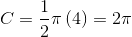
The perimeter is the sum of the circumference and diameter:

This is a multi-step problem. The perimeter of a semicircle is the sum of the circumference and diameter. First, since we are given the area, we will need to find the radius.
For the area of a semicircle:
Since the area is
Since the radius is 2, the diameter is 4.
The circumference for a semicircle is:
The perimeter is the sum of the circumference and diameter:
← Didn't Know|Knew It →
Lucy is a real estate agent who is paid a  commission on the value of each house she sells every month. She is also paid a base monthly rate of
  as part of her salary. If
  represents the value of the houses she sells per month, which of the following equations would accurately predict how much money she makes per month?
Lucy is a real estate agent who is paid a
Tap to reveal answer
To start, we need to convert the percent into a decimal.

Now, we know that Lucy receives 17% of the value of the homes she sells as her commission. Her commission can then be written as the expression  .
.
Lucy is also paid $1000 regardless of if she sells any houses or not that month. In a linear equation, this would be our y-intercept.
Putting the pieces of the salary together, we get the following equation:

To start, we need to convert the percent into a decimal.
Now, we know that Lucy receives 17% of the value of the homes she sells as her commission. Her commission can then be written as the expression
Lucy is also paid $1000 regardless of if she sells any houses or not that month. In a linear equation, this would be our y-intercept.
Putting the pieces of the salary together, we get the following equation:
← Didn't Know|Knew It →