Complex Numbers - College Algebra
Card 1 of 108
Add:

Add:
Tap to reveal answer
When adding complex numbers, add the real parts and the imaginary parts separately to get another complex number in standard form.
Adding the real parts gives  , and adding the imaginary parts gives
  .
.
When adding complex numbers, add the real parts and the imaginary parts separately to get another complex number in standard form.
Adding the real parts gives
← Didn't Know|Knew It →
Divide: 
The answer must be in standard form.
Divide:
The answer must be in standard form.
Tap to reveal answer
Multiply both the numerator and the denominator by the conjugate of the denominator which is  which results in
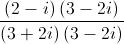
The numerator after simplification give us 
The denominator is equal to 
Hence, the final answer in standard form =

Multiply both the numerator and the denominator by the conjugate of the denominator which is
The numerator after simplification give us
The denominator is equal to
Hence, the final answer in standard form =

← Didn't Know|Knew It →
Divide: 
Answer must be in standard form.
Divide:
Answer must be in standard form.
Tap to reveal answer
Multiply both the numerator and the denominator by the conjugate of the denominator which is  resulting in

This is equal to 
Since  you can make that substitution of
  in place of
  in both numerator and denominator, leaving:

When you then cancel the negatives in both numerator and denominator (remember that  , simplifying each term), you're left with a denominator of
  and a numerator of
  , which equals
  .
.
Multiply both the numerator and the denominator by the conjugate of the denominator which is
This is equal to

Since 


When you then cancel the negatives in both numerator and denominator (remember that 


← Didn't Know|Knew It →
Consider the following definitions of imaginary numbers:


Then, 
Consider the following definitions of imaginary numbers:
Then,
Tap to reveal answer

← Didn't Know|Knew It →
What is the value of  ?
?
What is the value of
Tap to reveal answer
Recall that the definition of imaginary numbers gives that  and thus that
  . Therefore, we can use Exponent Rules to write
Recall that the definition of imaginary numbers gives that
← Didn't Know|Knew It →
What is the value of  ?
?
What is the value of
Tap to reveal answer
When dealing with imaginary numbers, we multiply by foiling as we do with binomials. When we do this we get the expression below:

Since we know that  we get
  which gives us
  .
.
When dealing with imaginary numbers, we multiply by foiling as we do with binomials. When we do this we get the expression below:
Since we know that
← Didn't Know|Knew It →
Evaluate: 
Evaluate:
Tap to reveal answer
Use the FOIL method to simplify. FOIL means to mulitply the first terms together, then multiply the outer terms together, then multiply the inner terms togethers, and lastly, mulitply the last terms together.


The imaginary  is equal to:

Write the terms for  .
.


Replace  with the appropiate values and simplify.

Use the FOIL method to simplify. FOIL means to mulitply the first terms together, then multiply the outer terms together, then multiply the inner terms togethers, and lastly, mulitply the last terms together.
The imaginary
Write the terms for
Replace
← Didn't Know|Knew It →

Tap to reveal answer

Combine like terms:

Distribute:

Combine like terms:


Combine like terms:
Distribute:
Combine like terms:
← Didn't Know|Knew It →
Multiply: 
Multiply:
Tap to reveal answer
Use FOIL to multiply the two binomials.
Recall that FOIL stands for Firsts, Outers, Inners, and Lasts.


Remember that 


Use FOIL to multiply the two binomials.
Recall that FOIL stands for Firsts, Outers, Inners, and Lasts.
Remember that
← Didn't Know|Knew It →
Rationalize the complex fraction: 
Rationalize the complex fraction:
Tap to reveal answer
To rationalize a complex fraction, multiply numerator and denominator by the conjugate of the denominator.


To rationalize a complex fraction, multiply numerator and denominator by the conjugate of the denominator.
← Didn't Know|Knew It →
Simplify the following:

Simplify the following:
Tap to reveal answer
To solve, you must remember the basic rules for i exponents.


Given the prior, simply plug into the given expression and combine like terms.


To solve, you must remember the basic rules for i exponents.
Given the prior, simply plug into the given expression and combine like terms.
← Didn't Know|Knew It →
Given the following quadratic, which values of  will produce a set of complex valued solutions for


Given the following quadratic, which values of
Tap to reveal answer
In order to determine if a quadratic equation  will have real-valued or complex-valued solutions compute the discriminate:

If the discriminate is negative, we will have complex-valued solutions. If the discriminate is positive, we will have real-valued solutions.
This arises from the fact that the quadratic equation has the square-root term,

Evaluate the discriminate for 

-79<0 so the quadratic has complex roots for  .
.
Evaluate the discriminate for 

The discriminate is positive, therefor the quadratic has real roots for 
In order to determine if a quadratic equation
If the discriminate is negative, we will have complex-valued solutions. If the discriminate is positive, we will have real-valued solutions.
This arises from the fact that the quadratic equation has the square-root term,
Evaluate the discriminate for
-79<0 so the quadratic has complex roots for
Evaluate the discriminate for
The discriminate is positive, therefor the quadratic has real roots for
← Didn't Know|Knew It →
Evaluate: 
Evaluate:
Tap to reveal answer
Recall that  ,
,  , and
, and  .
.
Each imaginary term can then be factored by using  .
.

Replace the numerical values for each term.

The answer is: 
Recall that
Each imaginary term can then be factored by using
Replace the numerical values for each term.
The answer is:
← Didn't Know|Knew It →
Simplify:

Simplify:
Tap to reveal answer
When simplifying expressions with complex numbers, use the same techniques and procedures as normal.
Distribute the negative:

Combine like terms- combine the real numbers together and the imaginary numbers together:


This gives a final answer of 2+4i
When simplifying expressions with complex numbers, use the same techniques and procedures as normal.
Distribute the negative:
Combine like terms- combine the real numbers together and the imaginary numbers together:
This gives a final answer of 2+4i
← Didn't Know|Knew It →
Simplify:

Simplify:
Tap to reveal answer
When simplifying expressions with complex numbers, use the same techniques and procedures as normal.
Distribute the sign to the terms in parentheses:

Combine like terms- combine the real numbers together and the imaginary numbers together:


This gives a final answer of 10-4i
When simplifying expressions with complex numbers, use the same techniques and procedures as normal.
Distribute the sign to the terms in parentheses:
Combine like terms- combine the real numbers together and the imaginary numbers together:
This gives a final answer of 10-4i
← Didn't Know|Knew It →
Simplify:

Simplify:
Tap to reveal answer
When simplifying expressions with complex numbers, use the same techniques and procedures as normal.
Distribute the sign to the terms in parentheses:

Combine like terms- combine the real numbers together and the imaginary numbers together:


This gives a final answer of 10+2i
When simplifying expressions with complex numbers, use the same techniques and procedures as normal.
Distribute the sign to the terms in parentheses:
Combine like terms- combine the real numbers together and the imaginary numbers together:
This gives a final answer of 10+2i
← Didn't Know|Knew It →
Simplify:

Simplify:
Tap to reveal answer
When simplifying expressions with complex numbers, use the same techniques and procedures as normal.
Distribute the sign to the terms in parentheses:

Combine like terms- combine the real numbers together and the imaginary numbers together:


This gives a final answer of 7+18i
When simplifying expressions with complex numbers, use the same techniques and procedures as normal.
Distribute the sign to the terms in parentheses:
Combine like terms- combine the real numbers together and the imaginary numbers together:
This gives a final answer of 7+18i
← Didn't Know|Knew It →
Simplify:

Simplify:
Tap to reveal answer
When simplifying expressions with complex numbers, use the same techniques and procedures as normal.
Distribute the sign to the terms in parentheses:

Combine like terms- combine the real numbers together and the imaginary numbers together:


This gives a final answer of 9+2i
When simplifying expressions with complex numbers, use the same techniques and procedures as normal.
Distribute the sign to the terms in parentheses:
Combine like terms- combine the real numbers together and the imaginary numbers together:
This gives a final answer of 9+2i
← Didn't Know|Knew It →
Simplify:

Simplify:
Tap to reveal answer
When simplifying expressions with complex numbers, use the same techniques and procedures as normal.
Distribute the sign to the terms in parentheses:

Combine like terms- combine the real numbers together and the imaginary numbers together:


This gives a final answer of -1+9i
When simplifying expressions with complex numbers, use the same techniques and procedures as normal.
Distribute the sign to the terms in parentheses:
Combine like terms- combine the real numbers together and the imaginary numbers together:
This gives a final answer of -1+9i
← Didn't Know|Knew It →
Simplify:

Simplify:
Tap to reveal answer
When simplifying expressions with complex numbers, use the same techniques and procedures as normal.
Distribute the sign to the terms in parentheses:

Combine like terms- combine the real numbers together and the imaginary numbers together:


This gives a final answer of 10-4i
When simplifying expressions with complex numbers, use the same techniques and procedures as normal.
Distribute the sign to the terms in parentheses:
Combine like terms- combine the real numbers together and the imaginary numbers together:
This gives a final answer of 10-4i
← Didn't Know|Knew It →