Symmetry - College Algebra
Card 1 of 48
Determine the symmetry of the following equation.

Determine the symmetry of the following equation.
Tap to reveal answer
To check for symmetry, we are going to do three tests, which involve substitution. First one will be to check symmetry along the x-axis, replace  .
.

This isn't equivilant to the first equation, so it's not symmetric along the x-axis.
Next is to substitute  .
.


This is not the same, so it is not symmetric along the y-axis.
For the last test we will substitute  , and
, and 


This isn't the same as the orginal equation, so it is not symmetric along the origin.
The answer is it is not symmetric along any axis.
To check for symmetry, we are going to do three tests, which involve substitution. First one will be to check symmetry along the x-axis, replace
This isn't equivilant to the first equation, so it's not symmetric along the x-axis.
Next is to substitute
This is not the same, so it is not symmetric along the y-axis.
For the last test we will substitute
This isn't the same as the orginal equation, so it is not symmetric along the origin.
The answer is it is not symmetric along any axis.
← Didn't Know|Knew It →

Which of the following is true of the relation graphed above?
Which of the following is true of the relation graphed above?
Tap to reveal answer
The relation graphed is a function, as it passes the vertical line test - no vertical line can pass through it more than once, as is demonstrated below:

Also, it can be seen to be symmetrical about the origin. Consequently, for each  in the domain,
  - the function is odd.
The relation graphed is a function, as it passes the vertical line test - no vertical line can pass through it more than once, as is demonstrated below:
Also, it can be seen to be symmetrical about the origin. Consequently, for each
← Didn't Know|Knew It →

The above table refers to a function  with domain
  .
.
Is this function even, odd, or neither?
The above table refers to a function
Is this function even, odd, or neither?
Tap to reveal answer
A function  is odd if and only if, for every
  in its domain,
  ; it is even if and only if, for every
  in its domain,
  .
.
We see that  and
and  . Therefore,
  , so is false for at least one
  . cannot be even.
For a function to be odd, since  , it follows that
  ; since
  is its own opposite,
  must be 0. However,
  ; cannot be odd.
The correct choice is neither.
A function
We see that
For a function to be odd, since
The correct choice is neither.
← Didn't Know|Knew It →

Which of the following is true of the relation graphed above?
Which of the following is true of the relation graphed above?
Tap to reveal answer
The relation graphed is a function, as it passes the vertical line test - no vertical line can pass through it more than once, as is demonstrated below:

Also, it is seen to be symmetric about the origin. Consequently, for each in the domain,  - the function is odd.
The relation graphed is a function, as it passes the vertical line test - no vertical line can pass through it more than once, as is demonstrated below:
Also, it is seen to be symmetric about the origin. Consequently, for each
← Didn't Know|Knew It →
Define  .
.
Is this function even, odd, or neither?
Define
Is this function even, odd, or neither?
Tap to reveal answer
A function is odd if and only if, for all  ,
,  ; it is even if and only if, for all
  ,
,  . Therefore, to answer this question, determine
  by substituting
  for
for  , and compare it to both
  and
and  .
.


 , so
, so  is not even.

 , so
, so  is not odd.
A function
← Didn't Know|Knew It →
 is an even function;
  .
.
True or false: It follows that  .
.
True or false: It follows that
Tap to reveal answer
A function is even if and only if, for all  in its domain,
  . It follows that if
  , then
 .
.
No restriction is placed on any other value as a result of this information, so the answer is false.
A function
No restriction is placed on any other value as a result of this information, so the answer is false.
← Didn't Know|Knew It →

Consider the relation graphed above. Which is true of this relation?
Consider the relation graphed above. Which is true of this relation?
Tap to reveal answer
The relation passes the Vertical Line test, as seen in the diagram below, in that no vertical line can be drawn that intersects the graph than once:
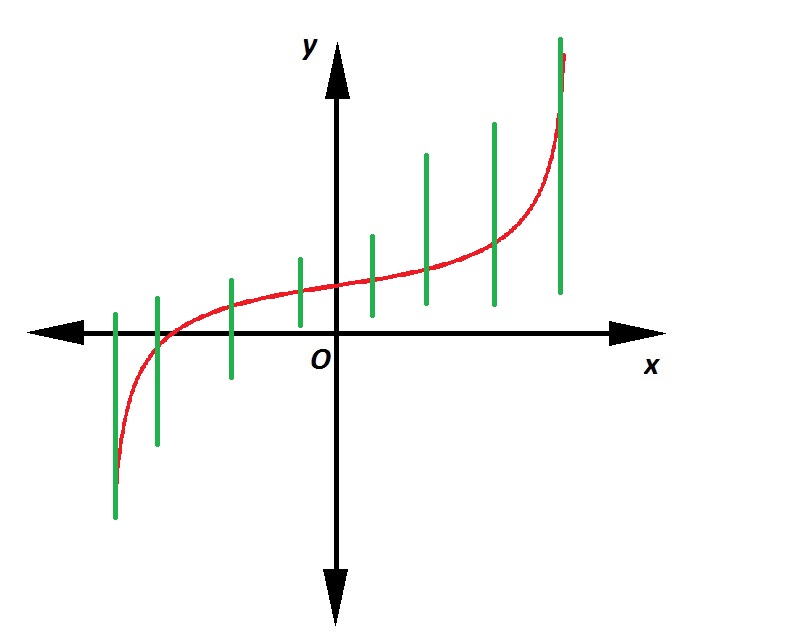
An function is odd if and only if its graph is symmetric about the origin, and even if and only if its graph is symmetric about the  -axis. From the diagram, we see neither is the case.
The relation passes the Vertical Line test, as seen in the diagram below, in that no vertical line can be drawn that intersects the graph than once:
An function is odd if and only if its graph is symmetric about the origin, and even if and only if its graph is symmetric about the
← Didn't Know|Knew It →
Which of the following is symmetrical to  across the origin?
Which of the following is symmetrical to
Tap to reveal answer
Symmetry across the origin is symmetry across  .
.
Determine the inverse of the function. Swap the x and y variables, and solve for y.

Subtract 3 on both sides.


Divide by negative two on both sides.

The answer is: 
Symmetry across the origin is symmetry across
Determine the inverse of the function. Swap the x and y variables, and solve for y.
Subtract 3 on both sides.
Divide by negative two on both sides.
The answer is:
← Didn't Know|Knew It →
Consider the function  .
.
Is  an even function, an odd function, or neither?
Consider the function
Is
Tap to reveal answer
A function  is even if, for each
  in its domain,
 .
.
It is odd if, for each  in its domain,
 .
.
Substitute  for
for  in the definition:


Since  ,
,  is an even function.
A function
It is odd if, for each
Substitute
Since
← Didn't Know|Knew It →
 is an even function. Let
  .
.
Is  an even function, an odd function, or neither?
Is
Tap to reveal answer
A function is even if, for each in its domain,
.
It is odd if, for each in its domain,
.
Substitute  for
for  in the definition of
  :
:

Since is even,  , so
, so

This makes  an odd function.
A function
It is odd if, for each
Substitute
Since
This makes
← Didn't Know|Knew It →
 is a piecewise-defined function. Its definition is partially given below:

How can  be defined for negative values of
  so that
  is an odd function?
How can
Tap to reveal answer
 , by definition, is an odd function if, for all
  in its domain,
 , or, equivalently
One implication of this is that for  to be odd, it must hold that
  . Since
  is explicitly defined to be equal to 0 here, this condition is satisfied.
Now, if  is negative,
  is positive. it must hold that
 ,
,
so for all 


This is the correct choice.
One implication of this is that for
Now, if
so for all
This is the correct choice.
← Didn't Know|Knew It →
is a piecewise-defined function. Its definition is partially given below:

How can be defined for negative values of so that is an odd function?
How can
Tap to reveal answer
, by definition, is an odd function if, for all in its domain,
, or, equivalently
One implication of this is that for to be odd, it must hold that . If  , then, since

for nonnegative values, then, by substitution,

This condition is satisfied.
Now, if is negative, is positive. it must hold that
,
so for all


 ,
,
the correct response.
One implication of this is that for
for nonnegative values, then, by substitution,
This condition is satisfied.
Now, if
so for all
the correct response.
← Didn't Know|Knew It →
Which of the following is true of the relation graphed above?
Which of the following is true of the relation graphed above?
Tap to reveal answer
The relation graphed is a function, as it passes the vertical line test - no vertical line can pass through it more than once, as is demonstrated below:
Also, it is seen to be symmetric about the origin. Consequently, for each in the domain, - the function is odd.
The relation graphed is a function, as it passes the vertical line test - no vertical line can pass through it more than once, as is demonstrated below:
Also, it is seen to be symmetric about the origin. Consequently, for each
← Didn't Know|Knew It →
Define .
Is this function even, odd, or neither?
Define
Is this function even, odd, or neither?
Tap to reveal answer
A function is odd if and only if, for all , ; it is even if and only if, for all , . Therefore, to answer this question, determine by substituting for , and compare it to both and .
, so is not even.
, so is not odd.
A function
← Didn't Know|Knew It →
is an even function; .
True or false: It follows that .
True or false: It follows that
Tap to reveal answer
A function is even if and only if, for all in its domain, . It follows that if , then
.
No restriction is placed on any other value as a result of this information, so the answer is false.
A function
No restriction is placed on any other value as a result of this information, so the answer is false.
← Didn't Know|Knew It →
is an even function. Let .
Is an even function, an odd function, or neither?
Is
Tap to reveal answer
A function is even if, for each in its domain,
.
It is odd if, for each in its domain,
.
Substitute for in the definition of :
Since is even, , so
This makes an odd function.
A function
It is odd if, for each
Substitute
Since
This makes
← Didn't Know|Knew It →
Determine the symmetry of the following equation.
Determine the symmetry of the following equation.
Tap to reveal answer
To check for symmetry, we are going to do three tests, which involve substitution. First one will be to check symmetry along the x-axis, replace .
This isn't equivilant to the first equation, so it's not symmetric along the x-axis.
Next is to substitute .
This is not the same, so it is not symmetric along the y-axis.
For the last test we will substitute , and
This isn't the same as the orginal equation, so it is not symmetric along the origin.
The answer is it is not symmetric along any axis.
To check for symmetry, we are going to do three tests, which involve substitution. First one will be to check symmetry along the x-axis, replace
This isn't equivilant to the first equation, so it's not symmetric along the x-axis.
Next is to substitute
This is not the same, so it is not symmetric along the y-axis.
For the last test we will substitute
This isn't the same as the orginal equation, so it is not symmetric along the origin.
The answer is it is not symmetric along any axis.
← Didn't Know|Knew It →
Which of the following is true of the relation graphed above?
Which of the following is true of the relation graphed above?
Tap to reveal answer
The relation graphed is a function, as it passes the vertical line test - no vertical line can pass through it more than once, as is demonstrated below:
Also, it can be seen to be symmetrical about the origin. Consequently, for each in the domain, - the function is odd.
The relation graphed is a function, as it passes the vertical line test - no vertical line can pass through it more than once, as is demonstrated below:
Also, it can be seen to be symmetrical about the origin. Consequently, for each
← Didn't Know|Knew It →
Consider the relation graphed above. Which is true of this relation?
Consider the relation graphed above. Which is true of this relation?
Tap to reveal answer
The relation passes the Vertical Line test, as seen in the diagram below, in that no vertical line can be drawn that intersects the graph than once:
An function is odd if and only if its graph is symmetric about the origin, and even if and only if its graph is symmetric about the -axis. From the diagram, we see neither is the case.
The relation passes the Vertical Line test, as seen in the diagram below, in that no vertical line can be drawn that intersects the graph than once:
An function is odd if and only if its graph is symmetric about the origin, and even if and only if its graph is symmetric about the
← Didn't Know|Knew It →
Which of the following is symmetrical to across the origin?
Which of the following is symmetrical to
Tap to reveal answer
Symmetry across the origin is symmetry across .
Determine the inverse of the function. Swap the x and y variables, and solve for y.
Subtract 3 on both sides.
Divide by negative two on both sides.
The answer is:
Symmetry across the origin is symmetry across
Determine the inverse of the function. Swap the x and y variables, and solve for y.
Subtract 3 on both sides.
Divide by negative two on both sides.
The answer is:
← Didn't Know|Knew It →