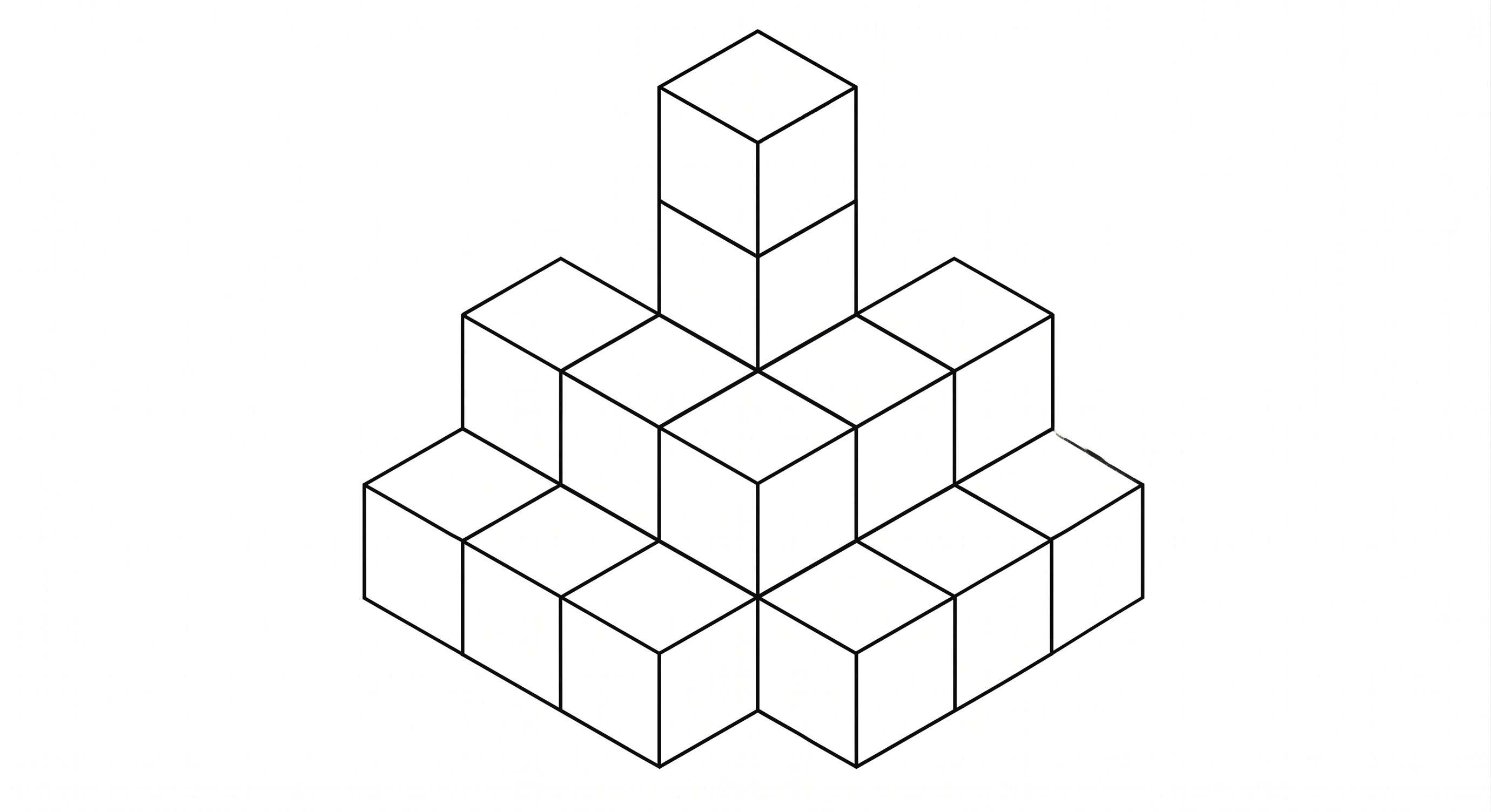
This figure has been made by cementing together cubes of the same size. After being cemented, the structure was painted on all sides EXCEPT FOR THE BOTTOM ON WHICH IT IS RESTING. The only hidden cubes are those required to support other cubes. You are to examine the figure closely to determine how many cubes have: only one of their sides painted only two of their sides painted only three of their sides painted only four of their sides painted all five of their sides painted
The figure shown is comprised of 20 cubes: the 13 explicitly pictured and the cubes necessary to support them. Of those 20 cubes, how many have exactly three sides painted?
- 3 cubes
- 4 cubes
- 5 cubes (correct answer)
- 6 cubes
- 7 cubes
Explanation: This structure contains exactly 20 identical cubes arranged in a tiered V-shape with a four-story central tower. The analysis determines the number of painted sides for each cube by calculating its exposed surfaces, excluding the bottom surface resting on the ground. 0 Sides Painted (3 Cubes):These are the three "landlocked" support cubes at the base of the inner V. They are blocked on all six faces: ground (bottom), the Level 2 cubes above (top), and neighbors on all four lateral sides. 1 Side Painted (0 Cubes):In this specific structure, no cube has exactly one face exposed. Every cube either has zero exposure (if landlocked) or at least two faces peering out. 2 Sides Painted (8 Cubes)The Four-Story Tower Base: The bottom two cubes of the central tower are blocked on the top/bottom and two side neighbors. This leaves exactly two vertical faces exposed per cube .Middle Arm Supports (L1): The two cubes at the base of the Level 2 "middle arms" are blocked by ground, the cube above, and two lateral neighbors.Middle Arm Visible Blocks (L2): These two visible blocks are blocked on the bottom and two sides. With the top exposed, they have two faces painted (Top and Front).End Arm Supports (L1): The two cubes hidden beneath the Level 2 wingtips are blocked on the top, bottom, and two sides. This leaves the front and back faces exposed. 3 Sides Painted (5 Cubes)Bottom Row End Pieces: The four single-story cubes at the very ends of the base V have their top and two outer vertical faces exposed .Second Row Vertex: The cube at the vertex of the Level 2 V is blocked on the bottom and two lateral sides. This leaves the top, front, and back faces exposed. 4 Sides Painted (3 Cubes)Level 2 Wingtips: The two cubes at the far ends of the Level 2 V are blocked only on the bottom and one lateral side. This leaves the top and three vertical faces exposed.Third Level Tower Block: This cube is blocked on the top and bottom by other tower segments. All four of its vertical sides are exposed . 5 Sides Painted (1 Cube)The Topmost Cube: The cube at the very peak (Level 4) is blocked only on its bottom surface where it sits on Level 3. All five other faces are painted .