Tables, Graphs, and Charts
Help Questions
DAT Quantitative Reasoning › Tables, Graphs, and Charts
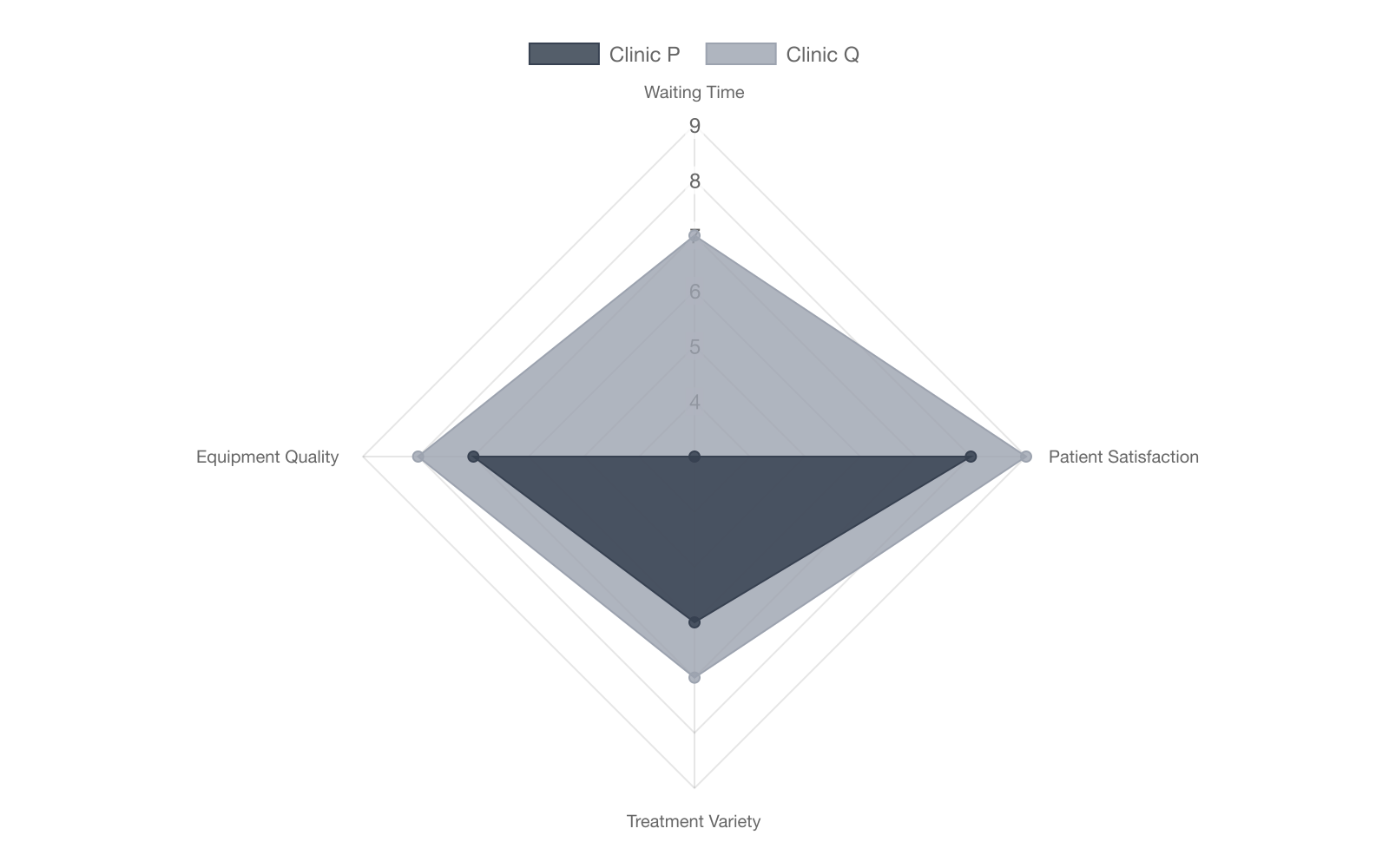
Refer to the radar chart to answer the question. Which category shows the greatest difference between Clinic P and Clinic Q?
Equipment Quality
Patient Satisfaction
Treatment Variety
Waiting Time
Explanation
In the radar chart, Waiting Time spokes differ by 4 units (P = 3, Q = 7) while other spokes differ by at most 2. Therefore Waiting Time shows the greatest gap.
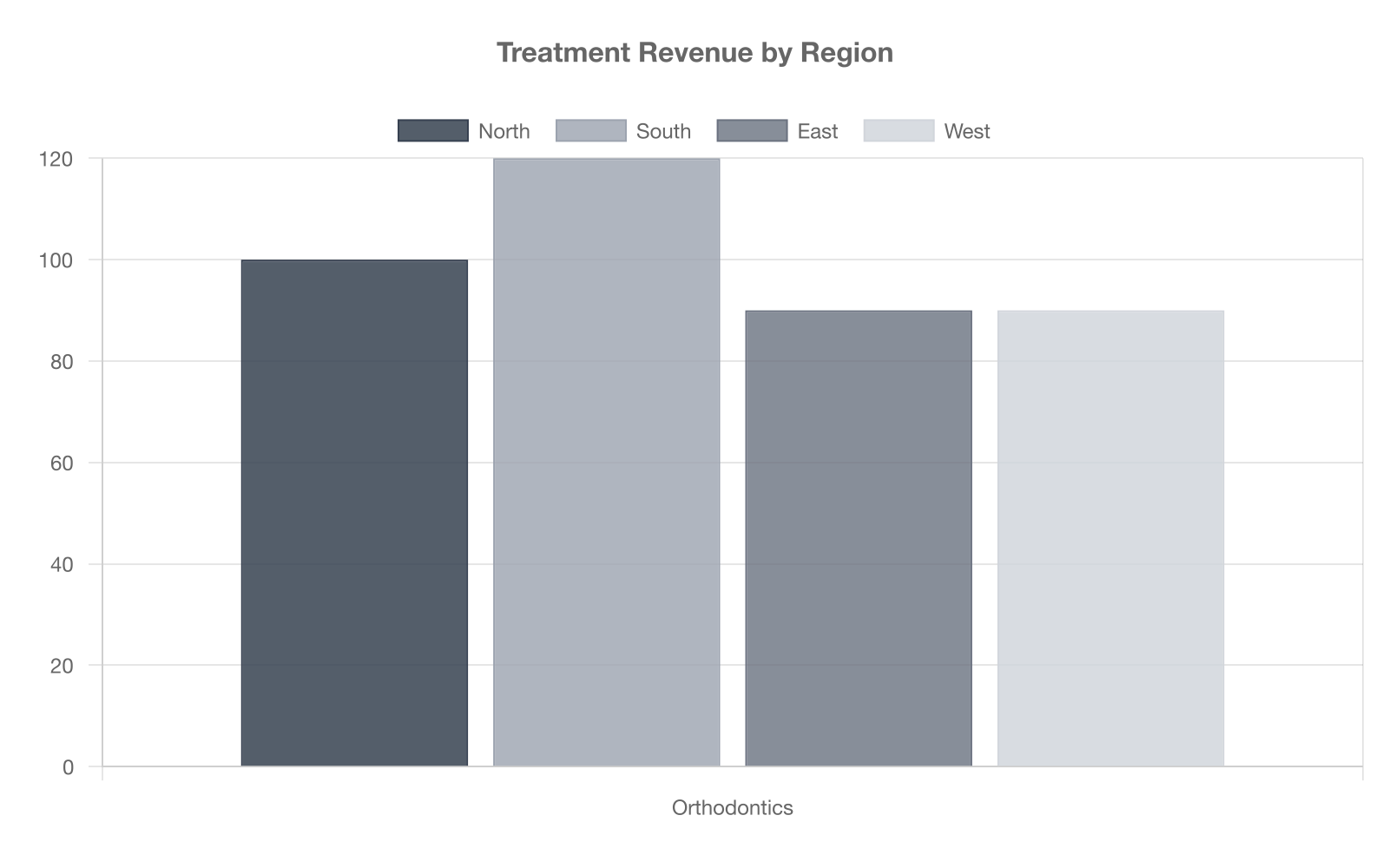
Use the bar chart to answer the question. What fraction of Orthodontics revenue came from the North region?
$$\dfrac{1}{2}$$
$$\dfrac{1}{3}$$
$$\dfrac{3}{8}$$
$$\dfrac{1}{4}$$
Explanation
Orthodontics bar totals $400 k: North 100 k, South 120 k, East 90 k, West 90 k. North share = 100/400 = 1/4. Other fractions use wrong component or wrong total.
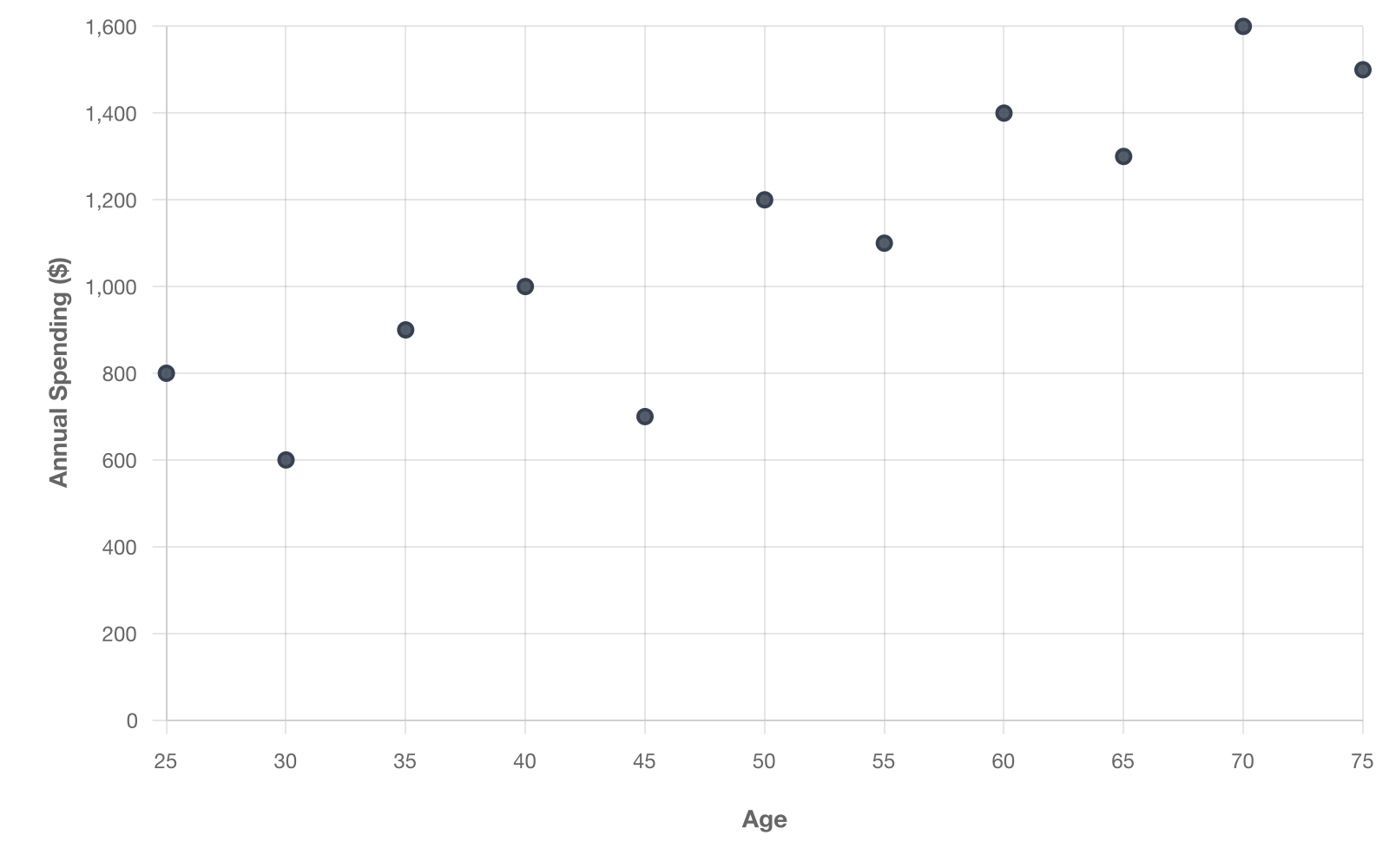
Based on the trend line in the scatter plot below, which of the following best describes the correlation between age and amount spent on dental care?
Strong positive correlation
Weak positive correlation
Strong negative correlation
No correlation
Explanation
The plotted points consistently rise with only a handful of outliers--and even those furoutliers that do not fit the overall trend increase relative to one another. This shows a strong positive correlation. No or negative correlation do not fit the upward slope.
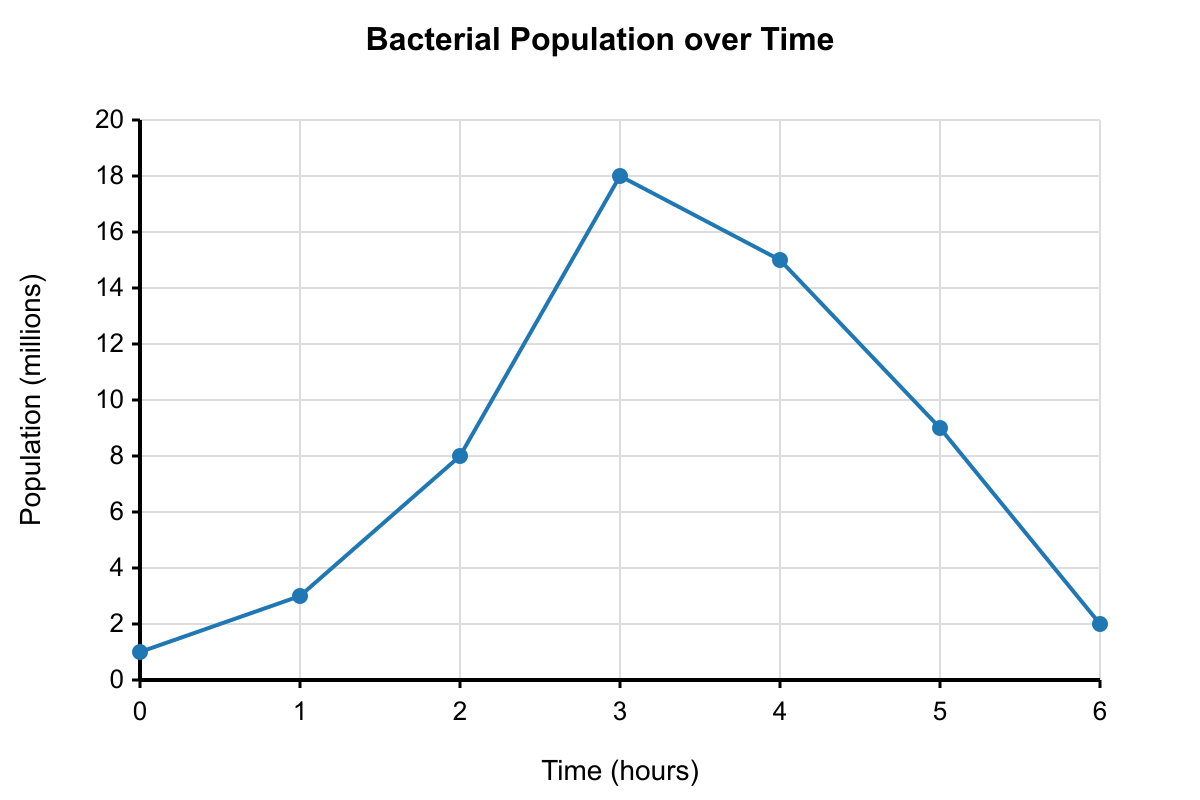
The line graph shows the population of bacteria (in millions) in a culture over 6 hours. Based on the line graph shown, during which one-hour interval was the average rate of change in population greatest in magnitude?
Hour 1 to Hour 2
Hour 5 to Hour 6
Hour 2 to Hour 3
Hour 3 to Hour 4
Explanation
Rates of change: Hour 1→2: 8−3 = +5. Hour 2→3: 18−8 = +10. Hour 3→4: 15−18 = −3. Hour 4→5: 9−15 = −6. Hour 5→6: 2−9 = −7. Greatest magnitude is |−7| = 7, during Hour 5 to Hour 6.
Distractor A: +5, smaller magnitude. Distractor B: +10 is the greatest positive change; students ignoring 'magnitude' will pick this. Distractor C: −3, smaller magnitude than Hour 5→6.
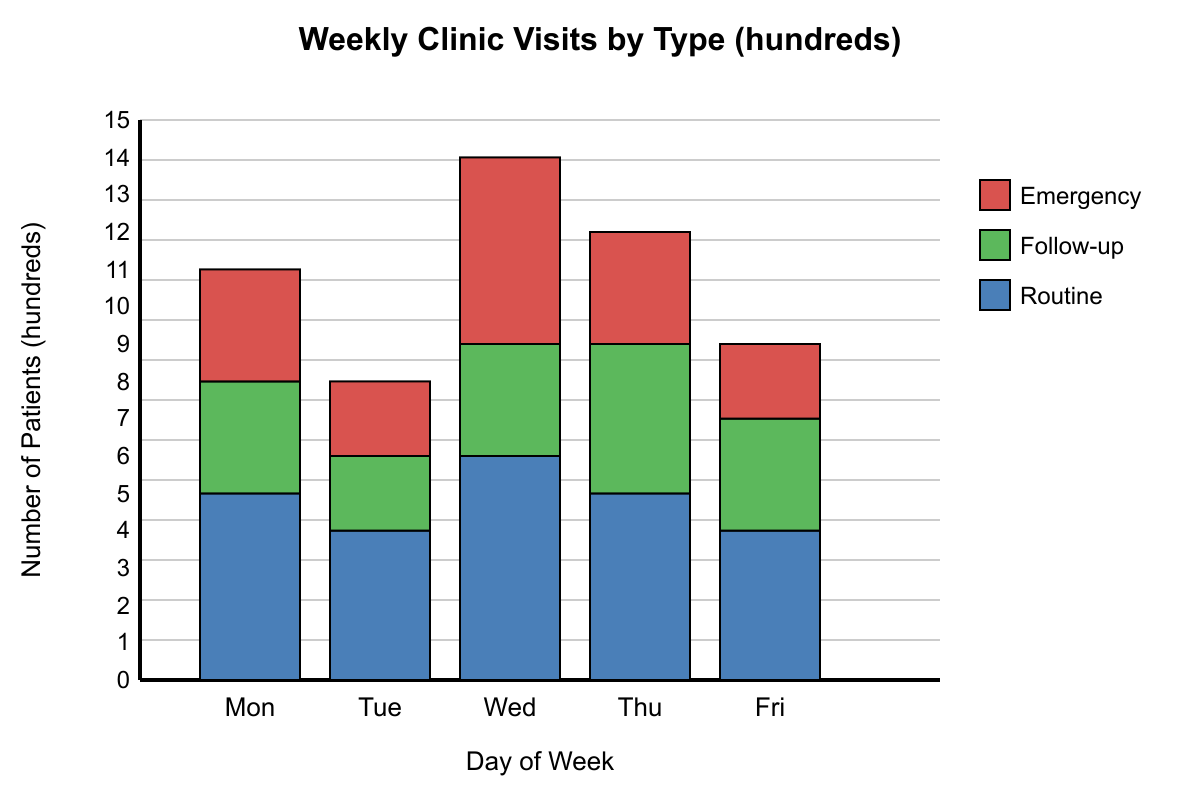
The stacked bar chart below shows the number of patients (in hundreds) seen at a clinic each weekday, broken down by type of visit. Refer to the chart. What percentage of all Emergency visits for the week occurred on Wednesday and Thursday combined?
33.30%
40.00%
46.70%
53.30%
Explanation
Emergency visits per day: Mon 3, Tue 2, Wed 5, Thu 3, Fri 2. Total = 15. Wed + Thu = 5 + 3 = 8. Percentage = 8/15 ≈ 53.3%.
Distractor A: 5/15 = 33.3%, using only Wednesday.
Distractor B: 6/15 = 40%, miscounting Thursday's emergency segment as 1.
Distractor C: 7/15 ≈ 46.7%, using Wed=5, Thu=2 (misread).
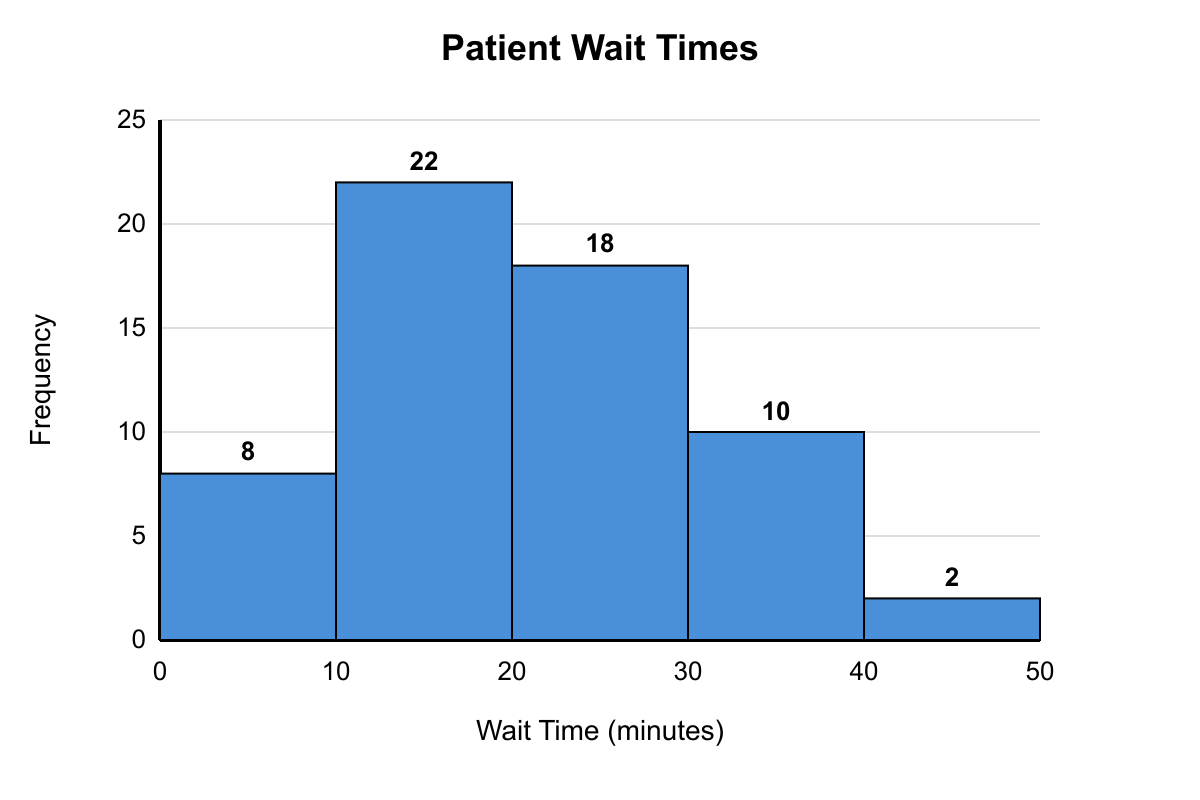
The histogram shows the frequency distribution of patient wait times (in minutes) at a dental office. Based on the histogram, which of the following best approximates the median wait time?
27.5 minutes
22.5 minutes
12.5 minutes
17.5 minutes
Explanation
Frequencies: 0–10: 8, 10–20: 22, 20–30: 18, 30–40: 10, 40–50: 2. Total = 60. Median is the average of the 30th and 31st values. Cumulative: after 0–10 → 8; after 10–20 → 30; after 20–30 → 48. The 30th value is the last in the 10–20 bin; the 31st is the first in the 20–30 bin. Using linear interpolation in the median class (10–20): median ≈ 10 + ((30−8)/22)×10 = 10 + 10 = 20. The 30th and 31st values straddle this; 17.5 (midpoint of the median bin) is the best choice of the options.
Distractor A: Midpoint of first large bin, but only 8 values lie in 0–10.
Distractor C: Midpoint of 20–30 bin; student who miscounts cumulative frequency.
Distractor D: Midpoint of 30–40 bin; would require median in upper tail.
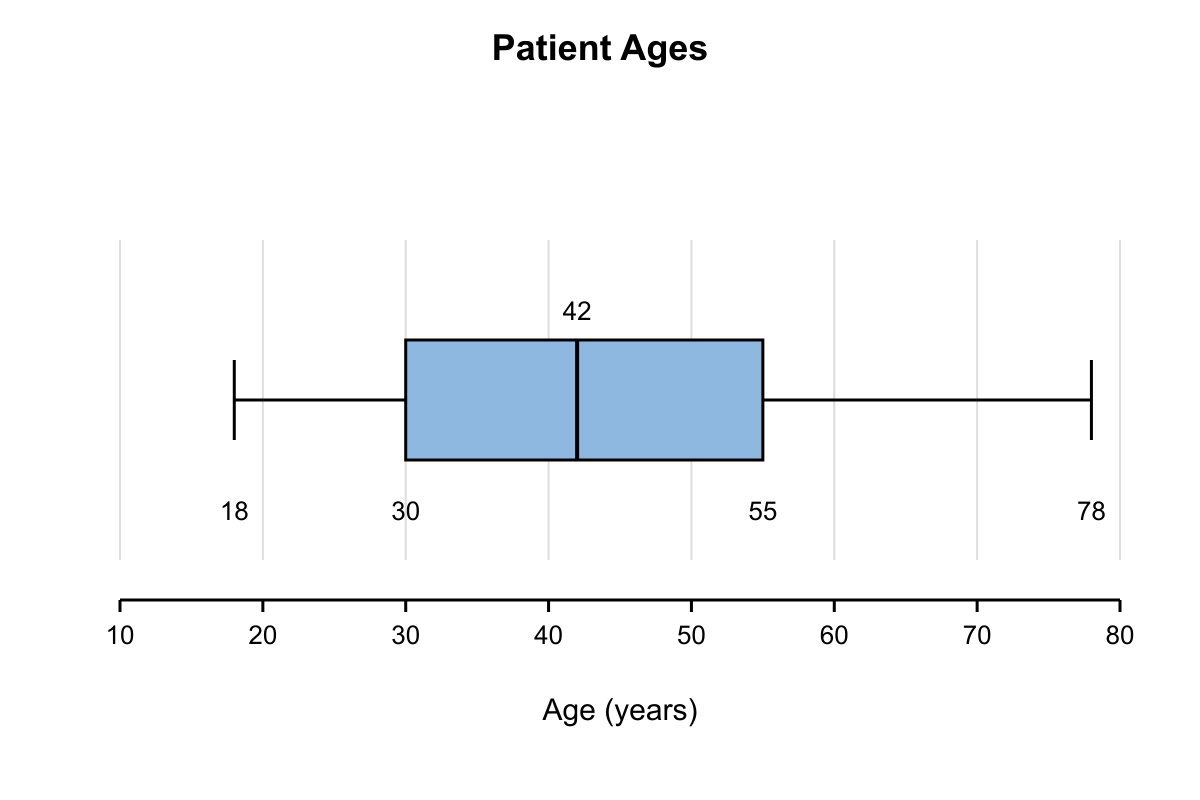
The box plot summarizes the distribution of ages of patients at a dental clinic. Based on the box plot shown, which of the following statements must be true?
Exactly 25% of patients are between 30 and 42 years old.
The interquartile range is 25.
More than 75% of patients are younger than 50.
The mean age is 42.
Explanation
From the box plot: Q1 = 30 and Q3 = 55. The interquartile range (IQR) = Q3 − Q1 = 55 − 30 = 25. Choice A is incorrect because box plots show the median (42), not the mean. Choice B is incorrect because while approximately 25% fall between Q1 and the median, the exact percentage depends on ties at boundaries. Choice D is incorrect because we cannot determine what percentage falls below 50 from the given information.
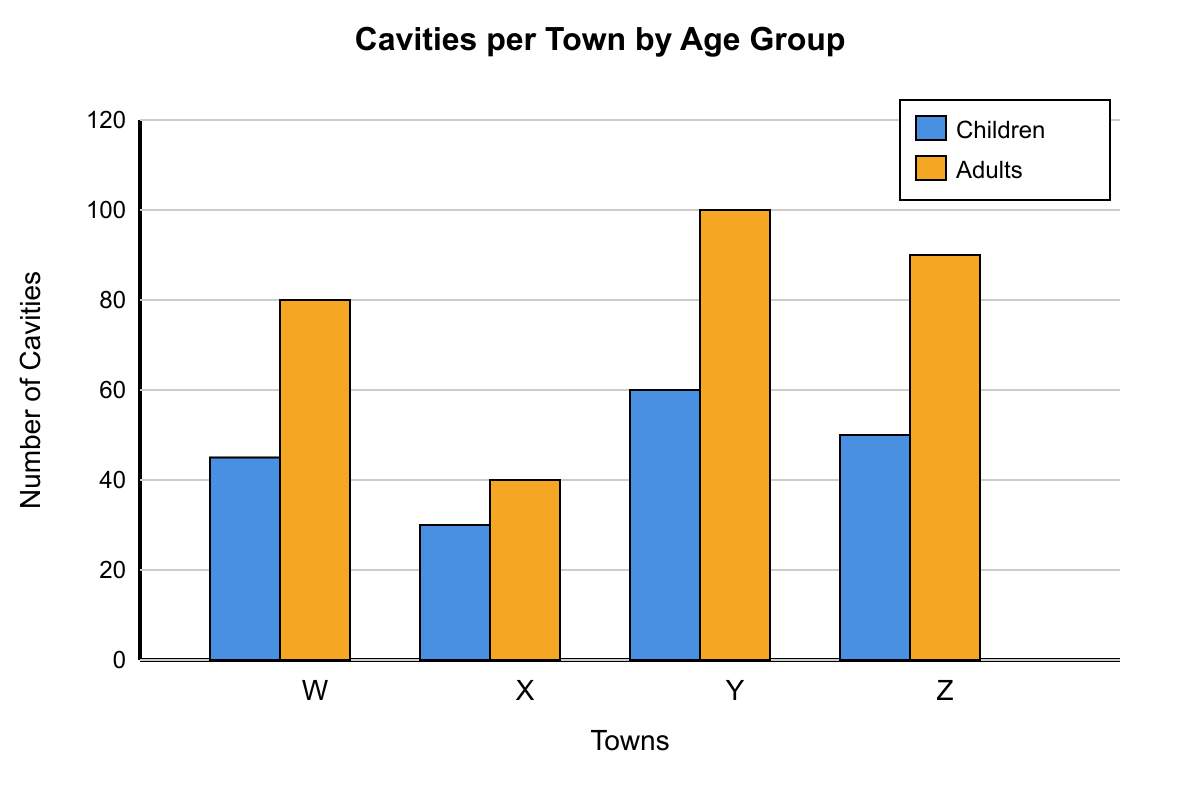
The double bar graph compares the number of cavities found in two age groups across four different towns. Based on the graph, in which town is the ratio of Children's cavities to Adults' cavities closest to 3:5?
Town X
Town Z
Town W
Town Y
Explanation
Target ratio 3:5 = 0.60. Town W: 45/80 = 0.5625. Town X: 30/40 = 0.75. Town Y: 60/100 = 0.60. Town Z: 50/90 ≈ 0.556. Town Y matches exactly.
Distractor A: 0.5625, close to 0.6 but not the closest.
Distractor B: 0.75, matches 3:4, a common confusion.
Distractor D: 0.556, close but farther from 0.60 than Town Y.
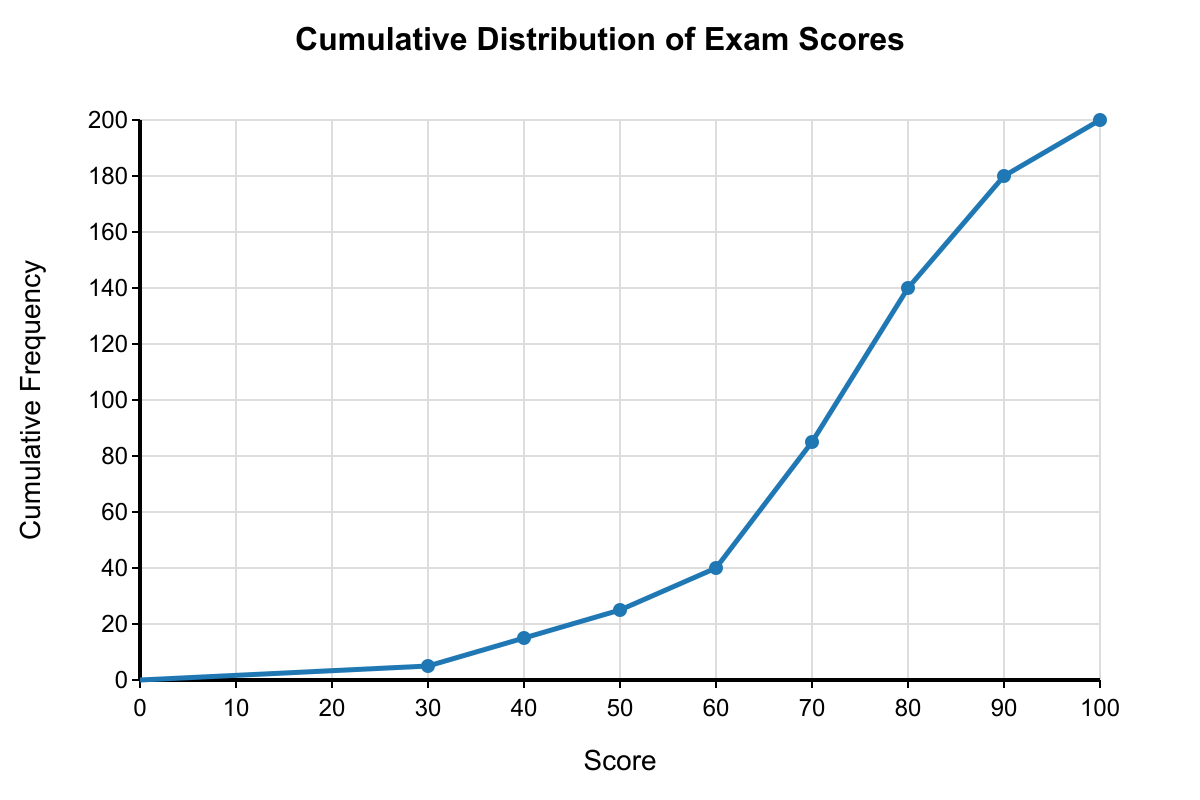
The cumulative frequency graph shows the distribution of exam scores for 200 students. Based on the cumulative frequency graph, approximately how many students scored between 60 and 80?
120 students
80 students
60 students
100 students
Explanation
From the cumulative graph: at score = 60, cumulative frequency ≈ 40; at score = 80, cumulative frequency ≈ 140. Students scoring between 60 and 80 = 140 − 40 = 100.
Distractor A: Confusing cumulative with a single bin value (e.g., just reading 60 mark).
Distractor B: Slight misreading of the cumulative values (e.g., 130−50).
Distractor D: Including students who scored above 80 up to 90, or misreading 160−40.
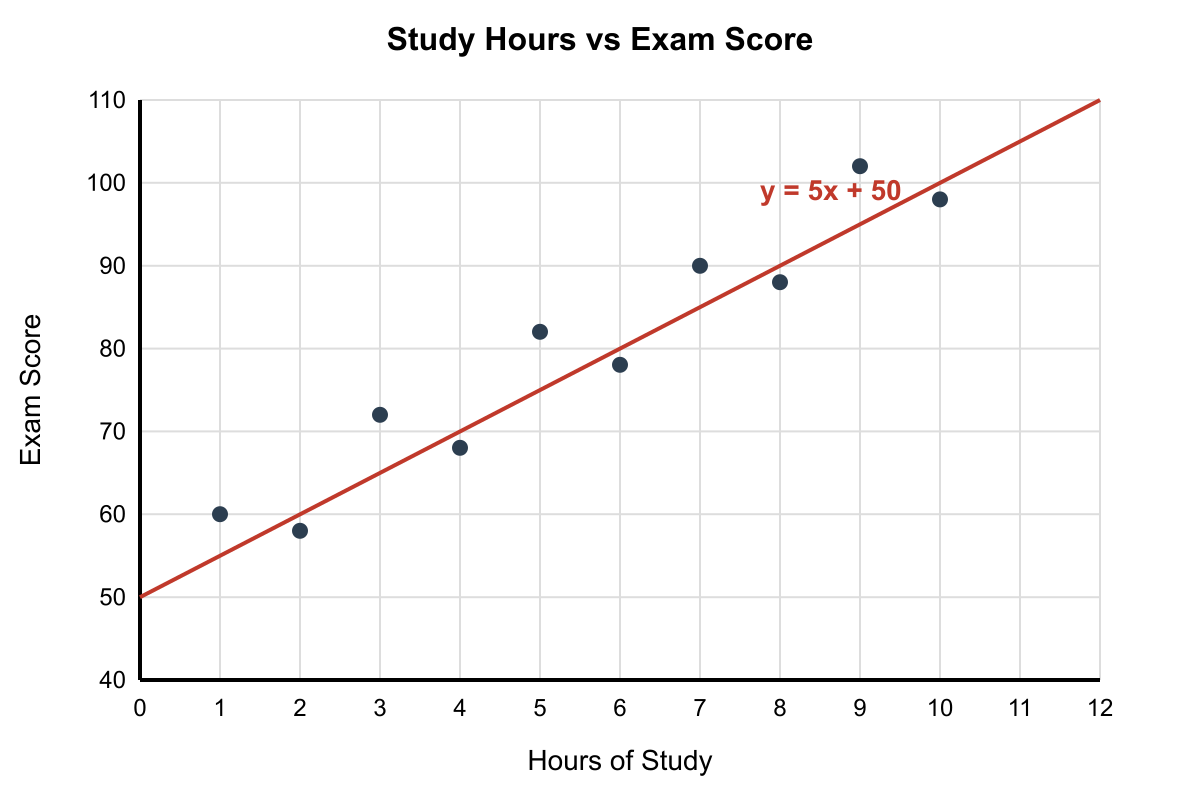
The scatter plot shows the relationship between hours of study (x) and exam scores (y) for 10 students, along with the line of best fit. Based on the scatter plot, how many data points lie strictly above the line of best fit by more than 5 points on the y-axis?
2
3
4
5
Explanation
Line of best fit: y = 5x + 50. For each data point, compare actual y to predicted y = 5x+50 and check if residual > 5. Points: (1,60): pred 55, residual +5 (NOT strictly >5). (2,58): pred 60, res −2. (3,72): pred 65, res +7 ✓. (4,68): pred 70, res −2. (5,82): pred 75, res +7 ✓. (6,78): pred 80, res −2. (7,90): pred 85, res +5 (not strictly). (8,88): pred 90, res −2. (9,102): pred 95, res +7 ✓. (10,98): pred 100, res −2. Three points satisfy: (3,72), (5,82), (9,102).
Distractor A: Missing one of the three qualifying points.
Distractor C: Including a point with residual exactly +5 (not strictly greater).
Distractor D: Counting all points above the line regardless of distance.