Angles and Quadrilaterals - GED Math
Card 1 of 25
In Rhombus  ,
,  . If
. If  is constructed, which of the following is true about
  ?
?
In Rhombus
Tap to reveal answer
The figure referenced is below.
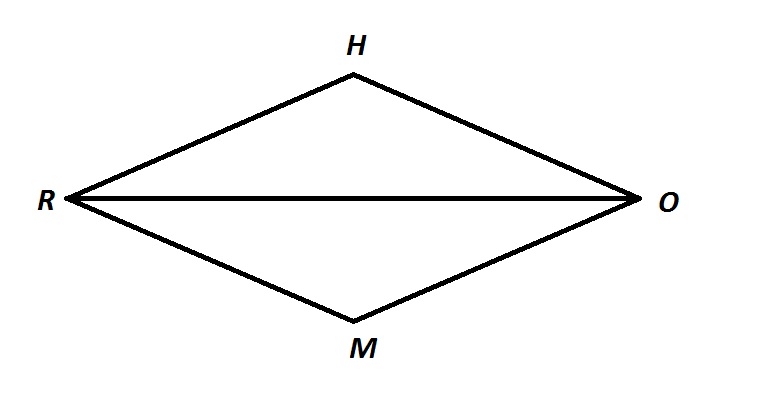
The sides of a rhombus are congruent by definition, so  , making
  isosceles (and possibly equilateral).
Also, consecutive angles of a rhombus are supplementary, as they are with all parallelograms, so
 .
.
 , having measure greater than
  , is obtuse, making
  an obtuse triangle. Also, the triangle is not equilateral, since such a triangle must have three
  angles.
The correct response is that  is obtuse and isosceles, but not equilateral.
The figure referenced is below.
The sides of a rhombus are congruent by definition, so
Also, consecutive angles of a rhombus are supplementary, as they are with all parallelograms, so
The correct response is that
← Didn't Know|Knew It →
Given Quadrilateral  , which of these statements would prove that it is a parallelogram?
I)  and
and 
II)  and
and 
III)  and
and  are supplementary and
  and
and  are supplementary
Given Quadrilateral
I)
II)
III)
Tap to reveal answer
Statement I asserts that two pairs of consecutive angles are congruent. This does not prove that the figure is a parallelogram. For example, an isosceles trapezoid has two pairs of congruent base angles, which are consecutive.
Statement II asserts that both pairs of opposite angles are congruent. By a theorem of geometry, this proves the quadrilateral to be a parallelogram.
Statement III asserts that two pairs of consecutive angles are supplementary. While all parallelograms have this characteristic, trapezoids do as well, so this does not prove the figure a parallelogram.
The correct response is Statement II only.
Statement I asserts that two pairs of consecutive angles are congruent. This does not prove that the figure is a parallelogram. For example, an isosceles trapezoid has two pairs of congruent base angles, which are consecutive.
Statement II asserts that both pairs of opposite angles are congruent. By a theorem of geometry, this proves the quadrilateral to be a parallelogram.
Statement III asserts that two pairs of consecutive angles are supplementary. While all parallelograms have this characteristic, trapezoids do as well, so this does not prove the figure a parallelogram.
The correct response is Statement II only.
← Didn't Know|Knew It →
You are given Parallelogram  with
with  . Which of the following statements, along with what you are given, would be enough to prove that Parallelogram
  is a rectangle?
I) 
II) 
III) 
You are given Parallelogram
I)
II)
III)
Tap to reveal answer
A rectangle is defined as a parallelogram with four right, or  , angles.
Since opposite angles of a paralellogram are congruent, if one angle measures  , so does its opposite. Since consecutive angles of a paralellogram are supplementary - that is, their degree measures total
  - if one angle measures
  , then both of the neighboring angles measure
  .
.
In short, in a parallelogram, if one angle is right, all are right and the parallelogram is a rectangle. All three statements assert that one angle is right, so from any one, it follows that the figure is a rectangle. The correct response is Statements I, II, or III.
Note that the sidelengths are irrelevant.
A rectangle is defined as a parallelogram with four right, or
Since opposite angles of a paralellogram are congruent, if one angle measures
In short, in a parallelogram, if one angle is right, all are right and the parallelogram is a rectangle. All three statements assert that one angle is right, so from any one, it follows that the figure is a rectangle. The correct response is Statements I, II, or III.
Note that the sidelengths are irrelevant.
← Didn't Know|Knew It →
If the rectangle has a width of 5 and a length of 10, what is the area of the rectangle?
If the rectangle has a width of 5 and a length of 10, what is the area of the rectangle?
Tap to reveal answer
Write the area for a rectangle.

Substitute the given dimensions.

The answer is: 
Write the area for a rectangle.
Substitute the given dimensions.
The answer is:
← Didn't Know|Knew It →
In the figure below, find the measure of the largest angle.
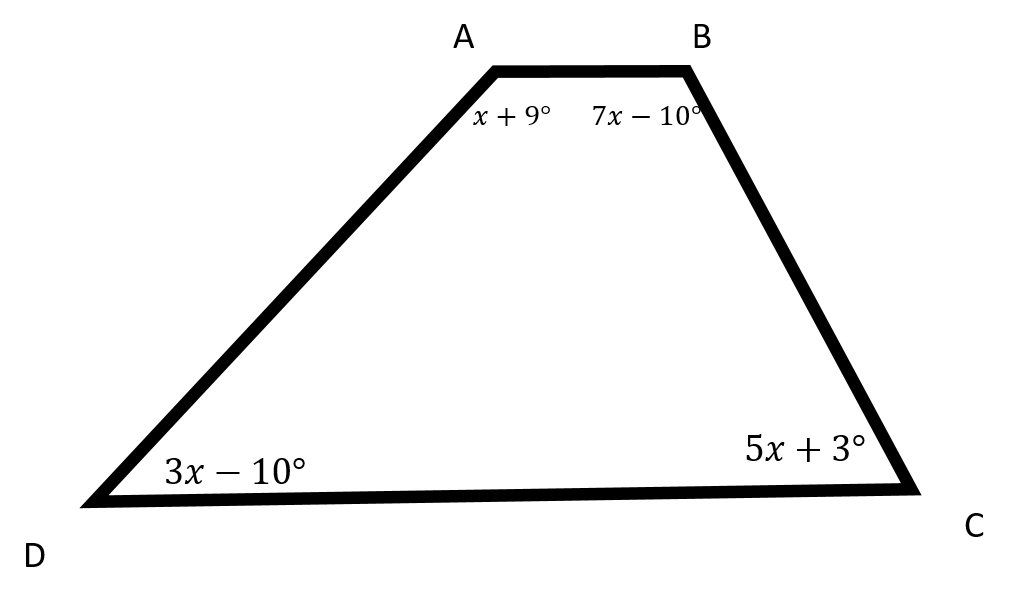
In the figure below, find the measure of the largest angle.
Tap to reveal answer
Recall that in a quadrilateral, the interior angles must add up to  .
.
Thus, we can solve for  :
:




Now, to find the largest angle, plug in the value of  into each expression for each angle.




The largest angle is  .
.
Recall that in a quadrilateral, the interior angles must add up to
Thus, we can solve for
Now, to find the largest angle, plug in the value of
The largest angle is
← Didn't Know|Knew It →
In Rhombus , . If is constructed, which of the following is true about ?
In Rhombus
Tap to reveal answer
The figure referenced is below.
The sides of a rhombus are congruent by definition, so , making isosceles (and possibly equilateral).
Also, consecutive angles of a rhombus are supplementary, as they are with all parallelograms, so
.
, having measure greater than , is obtuse, making an obtuse triangle. Also, the triangle is not equilateral, since such a triangle must have three angles.
The correct response is that is obtuse and isosceles, but not equilateral.
The figure referenced is below.
The sides of a rhombus are congruent by definition, so
Also, consecutive angles of a rhombus are supplementary, as they are with all parallelograms, so
The correct response is that
← Didn't Know|Knew It →
Given Quadrilateral , which of these statements would prove that it is a parallelogram?
I) and
II) and
III) and are supplementary and and are supplementary
Given Quadrilateral
I)
II)
III)
Tap to reveal answer
Statement I asserts that two pairs of consecutive angles are congruent. This does not prove that the figure is a parallelogram. For example, an isosceles trapezoid has two pairs of congruent base angles, which are consecutive.
Statement II asserts that both pairs of opposite angles are congruent. By a theorem of geometry, this proves the quadrilateral to be a parallelogram.
Statement III asserts that two pairs of consecutive angles are supplementary. While all parallelograms have this characteristic, trapezoids do as well, so this does not prove the figure a parallelogram.
The correct response is Statement II only.
Statement I asserts that two pairs of consecutive angles are congruent. This does not prove that the figure is a parallelogram. For example, an isosceles trapezoid has two pairs of congruent base angles, which are consecutive.
Statement II asserts that both pairs of opposite angles are congruent. By a theorem of geometry, this proves the quadrilateral to be a parallelogram.
Statement III asserts that two pairs of consecutive angles are supplementary. While all parallelograms have this characteristic, trapezoids do as well, so this does not prove the figure a parallelogram.
The correct response is Statement II only.
← Didn't Know|Knew It →
You are given Parallelogram with . Which of the following statements, along with what you are given, would be enough to prove that Parallelogram is a rectangle?
I)
II)
III)
You are given Parallelogram
I)
II)
III)
Tap to reveal answer
A rectangle is defined as a parallelogram with four right, or , angles.
Since opposite angles of a paralellogram are congruent, if one angle measures , so does its opposite. Since consecutive angles of a paralellogram are supplementary - that is, their degree measures total - if one angle measures , then both of the neighboring angles measure .
In short, in a parallelogram, if one angle is right, all are right and the parallelogram is a rectangle. All three statements assert that one angle is right, so from any one, it follows that the figure is a rectangle. The correct response is Statements I, II, or III.
Note that the sidelengths are irrelevant.
A rectangle is defined as a parallelogram with four right, or
Since opposite angles of a paralellogram are congruent, if one angle measures
In short, in a parallelogram, if one angle is right, all are right and the parallelogram is a rectangle. All three statements assert that one angle is right, so from any one, it follows that the figure is a rectangle. The correct response is Statements I, II, or III.
Note that the sidelengths are irrelevant.
← Didn't Know|Knew It →
If the rectangle has a width of 5 and a length of 10, what is the area of the rectangle?
If the rectangle has a width of 5 and a length of 10, what is the area of the rectangle?
Tap to reveal answer
Write the area for a rectangle.
Substitute the given dimensions.
The answer is:
Write the area for a rectangle.
Substitute the given dimensions.
The answer is:
← Didn't Know|Knew It →
In the figure below, find the measure of the largest angle.
In the figure below, find the measure of the largest angle.
Tap to reveal answer
Recall that in a quadrilateral, the interior angles must add up to .
Thus, we can solve for :
Now, to find the largest angle, plug in the value of into each expression for each angle.
The largest angle is .
Recall that in a quadrilateral, the interior angles must add up to
Thus, we can solve for
Now, to find the largest angle, plug in the value of
The largest angle is
← Didn't Know|Knew It →
In Rhombus , . If is constructed, which of the following is true about ?
In Rhombus
Tap to reveal answer
The figure referenced is below.
The sides of a rhombus are congruent by definition, so , making isosceles (and possibly equilateral).
Also, consecutive angles of a rhombus are supplementary, as they are with all parallelograms, so
.
, having measure greater than , is obtuse, making an obtuse triangle. Also, the triangle is not equilateral, since such a triangle must have three angles.
The correct response is that is obtuse and isosceles, but not equilateral.
The figure referenced is below.
The sides of a rhombus are congruent by definition, so
Also, consecutive angles of a rhombus are supplementary, as they are with all parallelograms, so
The correct response is that
← Didn't Know|Knew It →
Given Quadrilateral , which of these statements would prove that it is a parallelogram?
I) and
II) and
III) and are supplementary and and are supplementary
Given Quadrilateral
I)
II)
III)
Tap to reveal answer
Statement I asserts that two pairs of consecutive angles are congruent. This does not prove that the figure is a parallelogram. For example, an isosceles trapezoid has two pairs of congruent base angles, which are consecutive.
Statement II asserts that both pairs of opposite angles are congruent. By a theorem of geometry, this proves the quadrilateral to be a parallelogram.
Statement III asserts that two pairs of consecutive angles are supplementary. While all parallelograms have this characteristic, trapezoids do as well, so this does not prove the figure a parallelogram.
The correct response is Statement II only.
Statement I asserts that two pairs of consecutive angles are congruent. This does not prove that the figure is a parallelogram. For example, an isosceles trapezoid has two pairs of congruent base angles, which are consecutive.
Statement II asserts that both pairs of opposite angles are congruent. By a theorem of geometry, this proves the quadrilateral to be a parallelogram.
Statement III asserts that two pairs of consecutive angles are supplementary. While all parallelograms have this characteristic, trapezoids do as well, so this does not prove the figure a parallelogram.
The correct response is Statement II only.
← Didn't Know|Knew It →
You are given Parallelogram with . Which of the following statements, along with what you are given, would be enough to prove that Parallelogram is a rectangle?
I)
II)
III)
You are given Parallelogram
I)
II)
III)
Tap to reveal answer
A rectangle is defined as a parallelogram with four right, or , angles.
Since opposite angles of a paralellogram are congruent, if one angle measures , so does its opposite. Since consecutive angles of a paralellogram are supplementary - that is, their degree measures total - if one angle measures , then both of the neighboring angles measure .
In short, in a parallelogram, if one angle is right, all are right and the parallelogram is a rectangle. All three statements assert that one angle is right, so from any one, it follows that the figure is a rectangle. The correct response is Statements I, II, or III.
Note that the sidelengths are irrelevant.
A rectangle is defined as a parallelogram with four right, or
Since opposite angles of a paralellogram are congruent, if one angle measures
In short, in a parallelogram, if one angle is right, all are right and the parallelogram is a rectangle. All three statements assert that one angle is right, so from any one, it follows that the figure is a rectangle. The correct response is Statements I, II, or III.
Note that the sidelengths are irrelevant.
← Didn't Know|Knew It →
If the rectangle has a width of 5 and a length of 10, what is the area of the rectangle?
If the rectangle has a width of 5 and a length of 10, what is the area of the rectangle?
Tap to reveal answer
Write the area for a rectangle.
Substitute the given dimensions.
The answer is:
Write the area for a rectangle.
Substitute the given dimensions.
The answer is:
← Didn't Know|Knew It →
In the figure below, find the measure of the largest angle.
In the figure below, find the measure of the largest angle.
Tap to reveal answer
Recall that in a quadrilateral, the interior angles must add up to .
Thus, we can solve for :
Now, to find the largest angle, plug in the value of into each expression for each angle.
The largest angle is .
Recall that in a quadrilateral, the interior angles must add up to
Thus, we can solve for
Now, to find the largest angle, plug in the value of
The largest angle is
← Didn't Know|Knew It →
In Rhombus , . If is constructed, which of the following is true about ?
In Rhombus
Tap to reveal answer
The figure referenced is below.
The sides of a rhombus are congruent by definition, so , making isosceles (and possibly equilateral).
Also, consecutive angles of a rhombus are supplementary, as they are with all parallelograms, so
.
, having measure greater than , is obtuse, making an obtuse triangle. Also, the triangle is not equilateral, since such a triangle must have three angles.
The correct response is that is obtuse and isosceles, but not equilateral.
The figure referenced is below.
The sides of a rhombus are congruent by definition, so
Also, consecutive angles of a rhombus are supplementary, as they are with all parallelograms, so
The correct response is that
← Didn't Know|Knew It →
Given Quadrilateral , which of these statements would prove that it is a parallelogram?
I) and
II) and
III) and are supplementary and and are supplementary
Given Quadrilateral
I)
II)
III)
Tap to reveal answer
Statement I asserts that two pairs of consecutive angles are congruent. This does not prove that the figure is a parallelogram. For example, an isosceles trapezoid has two pairs of congruent base angles, which are consecutive.
Statement II asserts that both pairs of opposite angles are congruent. By a theorem of geometry, this proves the quadrilateral to be a parallelogram.
Statement III asserts that two pairs of consecutive angles are supplementary. While all parallelograms have this characteristic, trapezoids do as well, so this does not prove the figure a parallelogram.
The correct response is Statement II only.
Statement I asserts that two pairs of consecutive angles are congruent. This does not prove that the figure is a parallelogram. For example, an isosceles trapezoid has two pairs of congruent base angles, which are consecutive.
Statement II asserts that both pairs of opposite angles are congruent. By a theorem of geometry, this proves the quadrilateral to be a parallelogram.
Statement III asserts that two pairs of consecutive angles are supplementary. While all parallelograms have this characteristic, trapezoids do as well, so this does not prove the figure a parallelogram.
The correct response is Statement II only.
← Didn't Know|Knew It →
You are given Parallelogram with . Which of the following statements, along with what you are given, would be enough to prove that Parallelogram is a rectangle?
I)
II)
III)
You are given Parallelogram
I)
II)
III)
Tap to reveal answer
A rectangle is defined as a parallelogram with four right, or , angles.
Since opposite angles of a paralellogram are congruent, if one angle measures , so does its opposite. Since consecutive angles of a paralellogram are supplementary - that is, their degree measures total - if one angle measures , then both of the neighboring angles measure .
In short, in a parallelogram, if one angle is right, all are right and the parallelogram is a rectangle. All three statements assert that one angle is right, so from any one, it follows that the figure is a rectangle. The correct response is Statements I, II, or III.
Note that the sidelengths are irrelevant.
A rectangle is defined as a parallelogram with four right, or
Since opposite angles of a paralellogram are congruent, if one angle measures
In short, in a parallelogram, if one angle is right, all are right and the parallelogram is a rectangle. All three statements assert that one angle is right, so from any one, it follows that the figure is a rectangle. The correct response is Statements I, II, or III.
Note that the sidelengths are irrelevant.
← Didn't Know|Knew It →
If the rectangle has a width of 5 and a length of 10, what is the area of the rectangle?
If the rectangle has a width of 5 and a length of 10, what is the area of the rectangle?
Tap to reveal answer
Write the area for a rectangle.
Substitute the given dimensions.
The answer is:
Write the area for a rectangle.
Substitute the given dimensions.
The answer is:
← Didn't Know|Knew It →
In the figure below, find the measure of the largest angle.
In the figure below, find the measure of the largest angle.
Tap to reveal answer
Recall that in a quadrilateral, the interior angles must add up to .
Thus, we can solve for :
Now, to find the largest angle, plug in the value of into each expression for each angle.
The largest angle is .
Recall that in a quadrilateral, the interior angles must add up to
Thus, we can solve for
Now, to find the largest angle, plug in the value of
The largest angle is
← Didn't Know|Knew It →