Proving Angle Addition/Subtraction Formulas
Help Questions
Geometry › Proving Angle Addition/Subtraction Formulas
Given that $$\cos(\alpha - \beta) = \cos \alpha \cos \beta + \sin \alpha \sin \beta$$, which of the following correctly represents $$\cos(60° - 45°)$$ using this formula?
$$\cos(60°)\cos(45°) + \sin(60°)\sin(45°)$$
$$\sin(60°)\cos(45°) - \cos(60°)\sin(45°)$$
$$\sin(60°)\cos(45°) + \cos(60°)\sin(45°)$$
$$\cos(60°)\cos(45°) - \sin(60°)\sin(45°)$$
Explanation
The correct answer is B. Using the given cosine subtraction formula with $$\alpha = 60°$$ and $$\beta = 45°$$, we get $$\cos(60° - 45°) = \cos(60°)\cos(45°) + \sin(60°)\sin(45°)$$. Choice A uses the cosine addition formula incorrectly. Choices C and D incorrectly use sine terms in the first position, which would be sine formulas.
Which of the following is equivalent to the expression $$\cos(x)\cos(y) - \sin(x)\sin(y)$$?
$$\sin(x - y)$$
$$\cos(x + y)$$
$$\sin(x + y)$$
$$\cos(x - y)$$
Explanation
The correct answer is B. The expression $$\cos(x)\cos(y) - \sin(x)\sin(y)$$ matches the cosine addition formula: $$\cos(x + y) = \cos x \cos y - \sin x \sin y$$. Choice A would be the cosine subtraction formula with a plus sign instead of minus. Choices C and D are sine formulas, which have different structures involving sine and cosine terms in different positions.
Given the identity $$\sin(A - B) = \sin A \cos B - \cos A \sin B$$, which statement about this formula is correct?
The formula is only valid when both $$A$$ and $$B$$ are acute angles
The formula can be derived by substituting $$-B$$ for $$B$$ in the sine addition formula
The formula requires that $$A > B$$ for the result to be positive
The formula produces the same result as $$\cos(A + B)$$ when $$A = 90°$$
Explanation
The correct answer is A. The sine subtraction formula can be derived from the sine addition formula $$\sin(A + B) = \sin A \cos B + \cos A \sin B$$ by replacing $$B$$ with $$-B$$ and using the facts that $$\sin(-B) = -\sin B$$ and $$\cos(-B) = \cos B$$. Choice B is incorrect because the formula works for all real angles. Choice C is incorrect because $$\sin(90° - B) = \cos B$$ while $$\cos(90° + B) = -\sin B$$. Choice D is incorrect because the sign of the result depends on the quadrant of $$A - B$$, not just whether $$A > B$$.
A student attempts to find $$\tan(15°)$$ by using $$\tan(45° - 30°)$$ and the formula $$\tan(A - B) = \frac{\tan A - \tan B}{1 + \tan A \tan B}$$. Given that $$\tan(45°) = 1$$ and $$\tan(30°) = \frac{\sqrt{3}}{3}$$, which calculation should the student perform?
$$\frac{1 + \frac{\sqrt{3}}{3}}{1 - 1 \cdot \frac{\sqrt{3}}{3}}$$
$$\frac{1 - \frac{\sqrt{3}}{3}}{1 + 1 \cdot \frac{\sqrt{3}}{3}}$$
$$\frac{1 - \frac{\sqrt{3}}{3}}{1 - 1 \cdot \frac{\sqrt{3}}{3}}$$
$$\frac{1 \cdot \frac{\sqrt{3}}{3} - 1}{1 + 1 + \frac{\sqrt{3}}{3}}$$
Explanation
When you encounter trigonometric expressions involving angle differences, the tangent difference formula is your key tool: $$\tan(A - B) = \frac{\tan A - \tan B}{1 + \tan A \tan B}$$.
To find $$\tan(15°)$$, you need to apply this formula to $$\tan(45° - 30°)$$. Here, $$A = 45°$$ and $$B = 30°$$, so you substitute directly: $$\tan(45° - 30°) = \frac{\tan(45°) - \tan(30°)}{1 + \tan(45°) \cdot \tan(30°)}$$.
Plugging in the given values $$\tan(45°) = 1$$ and $$\tan(30°) = \frac{\sqrt{3}}{3}$$, you get: $$\frac{1 - \frac{\sqrt{3}}{3}}{1 + 1 \cdot \frac{\sqrt{3}}{3}}$$, which matches answer choice D.
Let's examine the mistakes in other options: Choice A uses $$1 - 1 \cdot \frac{\sqrt{3}}{3}$$ in the denominator, incorrectly applying subtraction instead of addition in the formula's denominator. Choice B has the wrong sign in the numerator, using $$1 + \frac{\sqrt{3}}{3}$$ instead of $$1 - \frac{\sqrt{3}}{3}$$—this would be the tangent addition formula, not subtraction. Choice C completely scrambles the formula structure, placing the product term first in the numerator and adding an extra 1 in the denominator.
Study tip: Always write out the difference formula completely before substituting values. The pattern is: numerator uses subtraction ($$\tan A - \tan B$$), denominator uses addition ($$1 + \tan A \tan B$$). Double-check that your signs match the formula exactly.
A student claims that $$\sin(x + y) + \sin(x - y) = 2\sin x \cos y$$. To verify this identity, which approach would be most direct?
Apply the Pythagorean identity to both sides before expanding the angle formulas
Convert the right side to exponential form and compare with the left side
Use the product-to-sum formulas to simplify the right side first
Expand both $$\sin(x + y)$$ and $$\sin(x - y)$$ using their respective formulas, then add the results
Explanation
When you encounter trigonometric identities involving angle addition and subtraction, the most straightforward verification approach is to expand the complex expressions using fundamental formulas and see if they simplify to match.
To verify this identity, you should expand the left side using the angle addition and subtraction formulas: $$\sin(x + y) = \sin x \cos y + \cos x \sin y$$ and $$\sin(x - y) = \sin x \cos y - \cos x \sin y$$. Adding these expressions gives you:
$$\sin(x + y) + \sin(x - y) = (\sin x \cos y + \cos x \sin y) + (\sin x \cos y - \cos x \sin y)$$
The $$\cos x \sin y$$ terms cancel out, leaving $$2\sin x \cos y$$, which matches the right side exactly.
Answer C is correct because it takes the most direct path to verification. Answer A is backwards—product-to-sum formulas would complicate rather than simplify $$2\sin x \cos y$$. Answer B introduces unnecessary complexity; while exponential forms work, they're far more elaborate than needed for this straightforward identity. Answer D makes no sense because the Pythagorean identity ($$\sin^2 θ + \cos^2 θ = 1$$) doesn't apply to sums of different angles.
Remember: when verifying trigonometric identities, always choose the path that directly applies the most relevant formulas. For expressions involving $$\sin(x ± y)$$, immediately think of the angle addition and subtraction formulas—they're usually your fastest route to a solution.
A student claims that $$\sin(75°)$$ can be found using the angle addition formula by writing $$75° = 45° + 30°$$. If the student correctly applies $$\sin(A + B) = \sin A \cos B + \cos A \sin B$$, which expression represents the correct calculation?
$$\cos(45°)\cos(30°) - \sin(45°)\sin(30°)$$
$$\sin(45°)\cos(30°) - \cos(45°)\sin(30°)$$
$$\sin(45°)\cos(30°) + \cos(45°)\sin(30°)$$
$$\sin(45°)\sin(30°) + \cos(45°)\cos(30°)$$
Explanation
The correct answer is A. Using the sine addition formula $$\sin(A + B) = \sin A \cos B + \cos A \sin B$$ with $$A = 45°$$ and $$B = 30°$$, we get $$\sin(75°) = \sin(45°)\cos(30°) + \cos(45°)\sin(30°)$$. Choice B uses the cosine addition formula incorrectly. Choice C uses the sine subtraction formula. Choice D uses the cosine addition formula.
Which reasoning supports the angle addition formula?
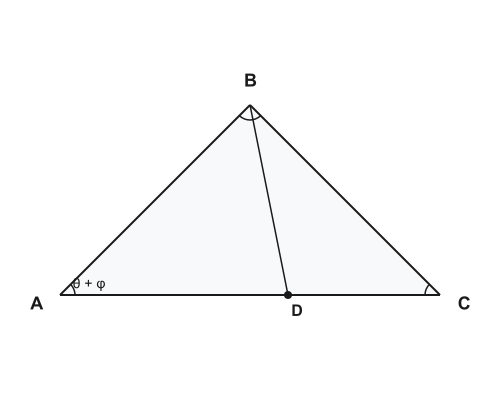
In the diagram, triangle $ABC$ has point $D$ on segment $AC$. At vertex $A$, ray $AD$ splits $\angle BAC$ into two angles labeled $\theta$ (between $AB$ and $AD$) and $\varphi$ (between $AD$ and $AC$), so $\angle BAC=\theta+\varphi$. Segment $BD$ is drawn. A right-angle marker indicates $BD\perp AC$ at $D$.
Which statement proves an identity for $\sin(\theta+\varphi)$ using this construction?
Because $D$ lies on $AC$, triangles $ABD$ and $ABC$ are similar, so $\sin(\theta+\varphi)=\sin\theta\cos\varphi$.
Since $BD\perp AC$, angles at $D$ are complementary, so $\sin(\theta+\varphi)=\sin\theta\cos\varphi-\cos\theta\sin\varphi$.
Decompose lengths using right triangles $\triangle ABD$ and $\triangle CBD$ to express the altitude $BD$ two ways, leading to $\sin(\theta+\varphi)=\sin\theta\cos\varphi+\cos\theta\sin\varphi$.
Because $\angle BAC=\theta+\varphi$, we can write $\sin(\theta+\varphi)=\sin\theta+\sin\varphi$ directly from the diagram.
Explanation
The skill focuses on proving the sine addition formula using triangle decompositions. The geometric setup features triangle ABC with point D on AC, ray AD splitting angle BAC into θ and φ, and BD perpendicular to AC. Angle BAC decomposes into θ between AB and AD plus φ between AD and AC, summing to θ + φ. Side relationships are tracked through right triangles ABD and CBD, expressing altitude BD in terms of opposite sides and angles. This justifies sin(θ + φ) = sinθ cosφ + cosθ sinφ by equating expressions for the height relative to the hypotenuse. A distractor misconception involves subtracting terms due to complementary angles, leading to an incorrect sign. Transfer strategy: think geometry before algebra by decomposing angles in triangles to build trig identities from basic definitions.
A student is asked to prove that $$\tan(A + B) = \frac{\tan A + \tan B}{1 - \tan A \tan B}$$. The student begins by writing $$\tan(A + B) = \frac{\sin(A + B)}{\cos(A + B)}$$. What should be the student's next step?
Substitute the angle addition formulas for both sine and cosine in the numerator and denominator
Apply the Pythagorean identity to simplify the expression before substitution
Convert the tangent function directly to the quotient form without using sine and cosine
Factor out common terms from the numerator and denominator before applying formulas
Explanation
When proving trigonometric identities involving tangent addition formulas, you're working with the fundamental relationship that tangent equals sine divided by cosine. The student correctly started with $$\tan(A + B) = \frac{\sin(A + B)}{\cos(A + B)}$$, which sets up the perfect foundation for using angle addition formulas.
The next logical step is to substitute the angle addition formulas for both sine and cosine. You need to replace $$\sin(A + B)$$ with $$\sin A \cos B + \cos A \sin B$$ and $$\cos(A + B)$$ with $$\cos A \cos B - \sin A \sin B$$. This gives you $$\tan(A + B) = \frac{\sin A \cos B + \cos A \sin B}{\cos A \cos B - \sin A \sin B}$$. From here, you can divide both numerator and denominator by $$\cos A \cos B$$ to eventually reach the desired form with individual tangent terms.
Option A is incorrect because there are no common factors to extract before applying the formulas—you need the expanded forms first. Option B misses the point entirely since the student already chose the sine/cosine approach, which is perfectly valid and systematic. Option C is wrong because the Pythagorean identity $$\sin^2 θ + \cos^2 θ = 1$$ doesn't directly help with angle addition—you need the specific addition formulas.
Remember: when proving tangent addition formulas, always apply the sine and cosine addition formulas first, then manipulate algebraically to isolate the tangent terms. This systematic approach works reliably for all angle addition proofs.
To prove that $$\cos(2\theta) = \cos^2 \theta - \sin^2 \theta$$, a student decides to use the angle addition formula for cosine. Which substitution should the student make?
Let $$A = \theta$$ and $$B = \theta$$ in $$\cos(A + B) = \cos A \cos B - \sin A \sin B$$
Let $$A = \theta$$ and $$B = -\theta$$ in $$\cos(A - B) = \cos A \cos B + \sin A \sin B$$
Let $$A = \frac{\theta}{2}$$ and $$B = \frac{3\theta}{2}$$ in $$\cos(A + B) = \cos A \cos B - \sin A \sin B$$
Let $$A = 2\theta$$ and $$B = 0$$ in $$\cos(A + B) = \cos A \cos B - \sin A \sin B$$
Explanation
When you encounter double angle formulas like $$\cos(2\theta)$$, the most direct approach is recognizing that $$2\theta = \theta + \theta$$. This allows you to apply the angle addition formula by setting both angles equal to $$\theta$$.
Using the angle addition formula $$\cos(A + B) = \cos A \cos B - \sin A \sin B$$ with $$A = \theta$$ and $$B = \theta$$, you get:
$$\cos(\theta + \theta) = \cos \theta \cos \theta - \sin \theta \sin \theta = \cos^2 \theta - \sin^2 \theta$$
This directly proves the desired formula, making choice C correct.
Let's examine why the other options don't work:
Choice A uses subtraction ($$A - B$$) instead of addition, and with $$A = \theta$$ and $$B = -\theta$$, you'd get $$\cos(\theta - (-\theta)) = \cos(2\theta)$$, but the subtraction formula gives $$\cos \theta \cos(-\theta) + \sin \theta \sin(-\theta)$$, which simplifies to $$\cos^2 \theta + \sin^2 \theta = 1$$, not the target formula.
Choice B substitutes $$A = 2\theta$$ and $$B = 0$$, giving $$\cos(2\theta + 0) = \cos(2\theta)$$. While this equals $$\cos(2\theta)$$, it doesn't help prove the formula since you're starting with what you're trying to prove.
Choice D creates $$\cos(\frac{\theta}{2} + \frac{3\theta}{2}) = \cos(2\theta)$$, but the resulting expression involves $$\cos(\frac{\theta}{2})$$ and $$\cos(\frac{3\theta}{2})$$, which won't simplify to the desired form.
Study tip: For double angle proofs, always think "double = single + single" and use the appropriate addition formula with both angles equal to the single angle.
Which explanation correctly uses the geometry?
In triangle $ABC$, $\angle A$ is labeled $\theta$ and $\angle B$ is labeled $\varphi$. A segment from $C$ to $AB$ meets $AB$ at $D$ and is marked perpendicular to $AB$ (right-angle box at $D$). Thus $CD$ is an altitude.
Which statement gives a valid geometric justification path toward an identity involving $\sin(\theta+\varphi)$ (using that $\angle C = 180^\circ-(\theta+\varphi)$), without plugging in numbers or assuming the identity?
Use right triangles $\triangle ACD$ and $\triangle BCD$ to express $CD$ two ways with sines/cosines, then relate those expressions to an angle-sum through $\angle C$.
Because $CD$ is an altitude, $\sin(\theta+\varphi)=\sin\theta+\sin\varphi$.
Because $\angle C=180^\circ-(\theta+\varphi)$, conclude $\sin(\theta+\varphi)=\sin\theta\sin\varphi$.
Because the triangle is not to scale, the altitude cannot be used to form right triangles.
Explanation
The skill is proving the sine angle addition formula using an altitude in a triangle. The geometric setup involves triangle ABC with angles theta at A and phi at B, and altitude CD perpendicular to AB at D. This decomposes the supplementary angle at C as 180 degrees minus (theta + phi). Side relationships are tracked via CD expressed in right triangles ACD and BCD using sines and cosines of theta and phi. Relating these expressions through sin(180 - (theta + phi)) = sin(theta + phi) justifies the addition formula. A distractor misconception is adding sines directly due to the altitude, as in choice B, without considering the angle relations. To transfer this strategy, focus on geometric altitudes and right triangles before algebraic substitutions.