Proving the Pythagorean Identity
Help Questions
Geometry › Proving the Pythagorean Identity
A right triangle has legs of length $$a$$ and $$b$$, and hypotenuse of length $$c$$. If $$\theta$$ is the acute angle opposite the leg of length $$a$$, which equation demonstrates how the Pythagorean identity relates to the Pythagorean theorem?
$$\left(\frac{c}{a}\right)^2 + \left(\frac{c}{b}\right)^2 = 1$$ follows from $$a^2 + b^2 = c^2$$ by dividing both sides by $$c^2$$
$$\left(\frac{a}{c}\right)^2 + \left(\frac{b}{c}\right)^2 = 1$$ follows from $$a^2 + b^2 = c^2$$ by dividing both sides by $$c^2$$
$$\left(\frac{a}{c}\right)^2 + \left(\frac{c}{b}\right)^2 = 1$$ follows from $$a^2 + b^2 = c^2$$ by cross-multiplying the ratios
$$\left(\frac{a}{b}\right)^2 + \left(\frac{b}{a}\right)^2 = 1$$ follows from $$a^2 + b^2 = c^2$$ by dividing both sides by $$ab$$
Explanation
Starting with $$a^2 + b^2 = c^2$$ and dividing by $$c^2$$ gives $$\frac{a^2}{c^2} + \frac{b^2}{c^2} = 1$$, which is $$\left(\frac{a}{c}\right)^2 + \left(\frac{b}{c}\right)^2 = 1$$. Since $$\sin(\theta) = \frac{a}{c}$$ and $$\cos(\theta) = \frac{b}{c}$$, this becomes $$\sin^2(\theta) + \cos^2(\theta) = 1$$. Choice B incorrectly uses ratios of legs only. Choice C inverts the ratios incorrectly. Choice D mixes different types of ratios and mentions cross-multiplication inappropriately.
A right triangle has angle $\theta$ and side lengths: opposite $=a$, adjacent $=b$, hypotenuse $=c$. Which statement justifies the identity using the correct side ratios and the Pythagorean Theorem?
Since $a^2+b^2=c$, dividing by $c^2$ gives $\sin^2\theta+\cos^2\theta=1$.
Since $\sin\theta=\frac{a}{c}$ and $\cos\theta=\frac{b}{c}$, then $\sin^2\theta+\cos^2\theta=\frac{a^2+b^2}{c^2}=1$.
Since $\sin\theta=\frac{a}{b}$ and $\cos\theta=\frac{b}{c}$, then $\sin^2\theta+\cos^2\theta=1$.
Since $\sin\theta=\frac{c}{a}$ and $\cos\theta=\frac{c}{b}$, then $\sin^2\theta+\cos^2\theta=1$.
Explanation
This question verifies the Pythagorean identity using general triangle notation where a is opposite, b is adjacent, and c is the hypotenuse. Sine equals opposite/hypotenuse = a/c, and cosine equals adjacent/hypotenuse = b/c. Squaring these gives sin²θ = a²/c² and cos²θ = b²/c². Adding: sin²θ + cos²θ = a²/c² + b²/c² = (a² + b²)/c². By the Pythagorean Theorem, a² + b² = c², so (a² + b²)/c² = c²/c² = 1. Choice B incorrectly defines sine and cosine as c/a and c/b (reciprocals of the correct ratios). Choice C mixes up the ratios entirely. Choice D incorrectly states the Pythagorean Theorem as a² + b² = c rather than c². Careful attention to both trigonometric definitions and algebraic accuracy is essential.
A right triangle $\triangle ABC$ has right angle at $C$ and angle $\theta$ at $A$. The diagram labels $\sin\theta=\dfrac{BC}{AB}$ and $\cos\theta=\dfrac{AC}{AB}$. Which argument uses the Pythagorean Theorem correctly?
Image description (not drawn to scale): A right triangle with vertices $A$ (left), $B$ (upper-right), $C$ (lower-right). A right-angle box marks $\angle C=90^\circ$. The hypotenuse is $AB$. The legs are $AC$ (adjacent to $\theta$ at $A$) and $BC$ (opposite to $\theta$). An angle arc at $A$ labels $\theta$. No numerical lengths are given; only segment names are shown.
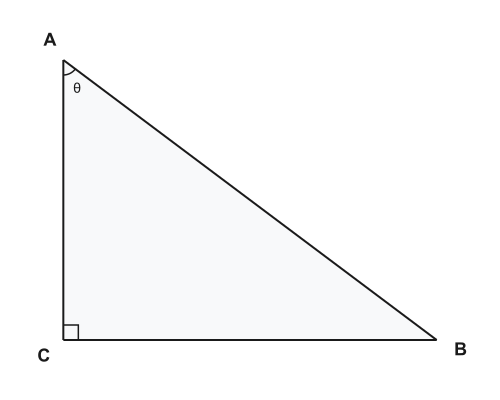
Square the ratios and add: $\left(\dfrac{BC}{AB}\right)^2+\left(\dfrac{AC}{AB}\right)^2=\dfrac{BC^2+AC^2}{AB^2}=\dfrac{AB^2}{AB^2}=1$.
Square the ratios and add: $\left(\dfrac{BC}{AB}\right)^2+\left(\dfrac{AC}{AB}\right)^2=\dfrac{BC^2+AC^2}{AB}=1$.
Since the triangle is right, $\sin\theta=\cos\theta$, so $\sin^2\theta+\cos^2\theta=1$.
Use $AB^2+AC^2=BC^2$ to get $\sin^2\theta+\cos^2\theta=1$.
Explanation
The Pythagorean identity states that sin²θ + cos²θ = 1 for any angle θ. In a right triangle, sine of θ is opposite over hypotenuse, and cosine is adjacent over hypotenuse. Squaring the ratios yields sin²θ = (opposite / hypotenuse)² and cos²θ = (adjacent / hypotenuse)². Applying the Pythagorean theorem, opposite² + adjacent² = hypotenuse². Dividing by hypotenuse² gives sin²θ + cos²θ = 1. A common distractor is dividing by hypotenuse instead of its square, leading to incorrect equality. To reinforce, always consult the right triangle geometry for accurate ratio application.
A student claims: “Because $\sin^2\theta+\cos^2\theta=1$ is true, it must come from the Pythagorean Theorem on a right triangle with hypotenuse $1$.” Which statement justifies the identity using geometric reasoning rather than memorization?
Assume $\sin^2\theta+\cos^2\theta=1$ is a known formula, so it holds for all $\theta$.
Since $\sin\theta=\frac{1}{\cos\theta}$, squaring gives $\sin^2\theta+\cos^2\theta=1$.
If $\theta=30^\circ$, then $\sin^2\theta+\cos^2\theta=1$, so it is always true.
In a right triangle with hypotenuse $1$, the legs are $\sin\theta$ and $\cos\theta$, so $\sin^2\theta+\cos^2\theta=1$ by Pythagorean Theorem.
Explanation
This question asks which statement provides geometric justification rather than memorization for the Pythagorean identity. The identity sin²θ + cos²θ = 1 fundamentally comes from applying the Pythagorean Theorem to a right triangle. When the hypotenuse equals 1, the legs have lengths sin θ (opposite) and cos θ (adjacent). The Pythagorean Theorem states that (leg₁)² + (leg₂)² = (hypotenuse)², so (sin θ)² + (cos θ)² = 1². Choice A assumes the formula without proving it, Choice C only verifies one specific angle, and Choice D incorrectly claims sin θ = 1/cos θ. The geometric reasoning in Choice B directly connects the identity to the fundamental theorem about right triangles, making it the only valid justification.
A right triangle is normalized so its hypotenuse has length $1$, and $\angle A=\theta$. Which conclusion follows from the diagram?
Image description: A right triangle $\triangle ABC$ with right angle at $C$ (right-angle box at $C$). Point $A$ is at the left, point $B$ is at the right, and point $C$ is below segment $\overline{AB}$. Segment $\overline{AB}$ is the hypotenuse and is labeled $1$. An angle arc at $A$ labels $\angle A=\theta$. The leg $\overline{AC}$ is labeled $\cos\theta$ and the leg $\overline{BC}$ is labeled $\sin\theta$. No other markings are shown; diagram not to scale.
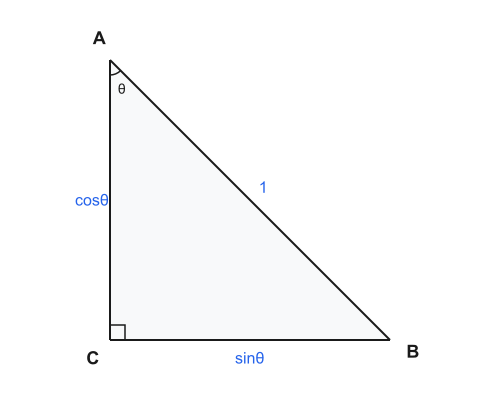
Because the hypotenuse is $1$, $\cos\theta+\sin\theta=1$.
Since $\angle C$ is right, $\cos\theta=\sin\theta$ for all $\theta$.
Because the diagram is not to scale, $\cos^2\theta+\sin^2\theta$ cannot equal a constant.
By the Pythagorean Theorem, $\cos^2\theta+\sin^2\theta=1$.
Explanation
The Pythagorean identity states that for any angle θ, sin²θ + cos²θ = 1. In a right triangle, sine of θ is the ratio of the opposite side labeled sinθ to the hypotenuse of length 1, and cosine is the ratio of the adjacent side labeled cosθ to 1. Squaring these ratios gives sin²θ = (sinθ)² / 1² and cos²θ = (cosθ)² / 1². Applying the Pythagorean Theorem to the sides, (cosθ)² + (sinθ)² = 1². Therefore, sin²θ + cos²θ = 1, deriving the identity. A common distractor misconception is claiming sinθ + cosθ = 1 because the hypotenuse is 1, as in choice B, confusing addition with squaring. To transfer this strategy, always return to the triangle geometry by identifying opposite, adjacent, and hypotenuse sides and applying the theorem step by step.
A student tries to prove $\sin^2\theta+\cos^2\theta=1$ from a right triangle but makes an error. Which reasoning proves $\sin^2\theta+\cos^2\theta=1$?
Start with $\sin\theta=\frac{\text{opposite}}{\text{hypotenuse}}$ and $\cos\theta=\frac{\text{adjacent}}{\text{hypotenuse}}$, then add to get $\frac{\text{opposite}+\text{adjacent}}{\text{hypotenuse}}=1$.
Start with $\sin\theta=\frac{\text{opposite}}{\text{hypotenuse}}$ and $\cos\theta=\frac{\text{adjacent}}{\text{hypotenuse}}$, then square and use $\text{opposite}^2+\text{adjacent}^2=\text{hypotenuse}^2$.
Start with $\sin\theta=\frac{\text{hypotenuse}}{\text{opposite}}$ and $\cos\theta=\frac{\text{hypotenuse}}{\text{adjacent}}$, then square and add to get $1$.
Because $\theta$ is acute, $\sin^2\theta+\cos^2\theta=2\sin\theta\cos\theta$ and this equals $1$.
Explanation
To correctly prove the Pythagorean identity sin²θ + cos²θ = 1, we must start with the proper definitions: sin θ = opposite/hypotenuse and cos θ = adjacent/hypotenuse. When we square these ratios, we get sin²θ = opposite²/hypotenuse² and cos²θ = adjacent²/hypotenuse². The Pythagorean Theorem tells us that opposite² + adjacent² = hypotenuse² in any right triangle. Adding our squared trigonometric ratios: sin²θ + cos²θ = opposite²/hypotenuse² + adjacent²/hypotenuse² = (opposite² + adjacent²)/hypotenuse² = hypotenuse²/hypotenuse² = 1. Choice A incorrectly tries to add the unsquared ratios, claiming that opposite + adjacent = hypotenuse, which is false. The key insight is that the Pythagorean Theorem applies to squared lengths, matching perfectly with the squared trigonometric ratios in the identity.
In the right triangle shown, the right angle is at $B$ and the acute angle at $A$ is $\theta$. The hypotenuse $AC$ is labeled $1$. The leg $AB$ is labeled $\cos\theta$ and the leg $BC$ is labeled $\sin\theta$. Which argument uses the Pythagorean Theorem correctly?
Because $AB^2-BC^2=AC^2$, $(\cos\theta)^2-(\sin\theta)^2=1$, so $\sin^2\theta+\cos^2\theta=1$.
Because $AB+BC=AC$, $\cos\theta+\sin\theta=1$, so squaring gives $\sin^2\theta+\cos^2\theta=1$.
Because $AB^2+BC^2=AC^2$, $(\cos\theta)^2+(\sin\theta)^2=1^2$, so $\sin^2\theta+\cos^2\theta=1$.
Because $AC$ is a leg, $\sin\theta=\frac{\cos\theta}{1}$ and $\cos\theta=\frac{\sin\theta}{1}$, so the identity holds.
Explanation
This question tests applying the Pythagorean Theorem when the right angle is at B and angle θ is at A. With hypotenuse AC = 1, leg AB = cos θ (adjacent to θ), and leg BC = sin θ (opposite to θ), the Pythagorean Theorem states AB² + BC² = AC². Substituting the given labels: (cos θ)² + (sin θ)² = 1², which simplifies to cos²θ + sin²θ = 1 or sin²θ + cos²θ = 1. Choice A incorrectly assumes AB + BC = AC, confusing the Pythagorean Theorem with perimeter. Choice C uses subtraction instead of addition. Choice D makes nonsensical claims about AC being a leg when it's clearly the hypotenuse. The Pythagorean Theorem always involves squaring and adding the legs to equal the square of the hypotenuse.
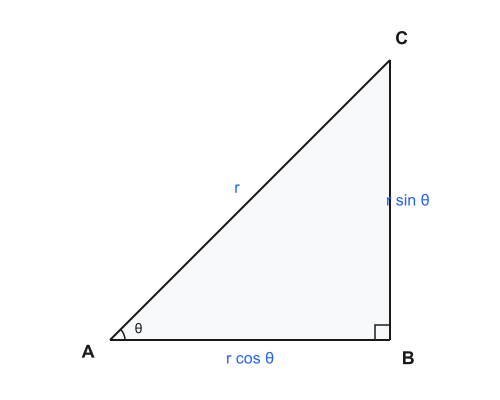
Use the diagram of right triangle $\triangle ABC$ (not drawn to scale). Angle $\theta$ is $\angle A$. Which reasoning proves $\sin^2\theta+\cos^2\theta=1$?
Image description: A right triangle $\triangle ABC$ with $A$ at the left, $B$ at the right, and $C$ above segment $\overline{AB}$. Segment $\overline{AB}$ is horizontal. Segment $\overline{AC}$ slopes upward from $A$ to $C$. Segment $\overline{BC}$ slopes upward from $B$ to $C$. A right-angle box marks $\angle B$ (so $\overline{AB}\perp\overline{BC}$). An angle arc at $A$ labels $\angle A=\theta$. The hypotenuse is $\overline{AC}$ and is labeled $r$ (with $r>0$). The leg $\overline{AB}$ is labeled $r\cos\theta$. The leg $\overline{BC}$ is labeled $r\sin\theta$. No other equalities or measures are marked.
Because $\overline{AB}$ is the hypotenuse, $\sin\theta=\dfrac{r\cos\theta}{r\cos\theta}=1$ and $\cos\theta=\dfrac{r\sin\theta}{r\cos\theta}$, so $\sin^2\theta+\cos^2\theta=1$.
Using $\angle A=\theta$, $\sin\theta=\dfrac{r\sin\theta}{r}$ and $\cos\theta=\dfrac{r\cos\theta}{r}$; by the Pythagorean Theorem, $(r\sin\theta)^2+(r\cos\theta)^2=r^2$, so $\sin^2\theta+\cos^2\theta=1$.
Since the triangle is right, the identity holds only when $\theta=45^\circ$, so $\sin^2\theta+\cos^2\theta=1$.
Since $\sin\theta=\dfrac{r\sin\theta}{r}$ and $\cos\theta=\dfrac{r\cos\theta}{r}$, then $\sin\theta+\cos\theta=1$.
Explanation
The Pythagorean identity states that for any angle θ, sin²θ + cos²θ = 1. In a right triangle, sine of θ is the ratio of the opposite side to the hypotenuse r, and cosine is the ratio of the adjacent side to r. Squaring these ratios gives sin²θ = (r sinθ)² / r² and cos²θ = (r cosθ)² / r², using the labeled sides. Applying the Pythagorean Theorem to the sides, (r sinθ)² + (r cosθ)² = r². Therefore, sin²θ + cos²θ = [(r sinθ)² + (r cosθ)²] / r² = r² / r² = 1, deriving the identity. A common distractor misconception is adding sine and cosine instead of squaring them, as in choice A, which incorrectly claims sinθ + cosθ = 1. To transfer this strategy, always return to the triangle geometry by identifying opposite, adjacent, and hypotenuse sides and applying the theorem step by step.
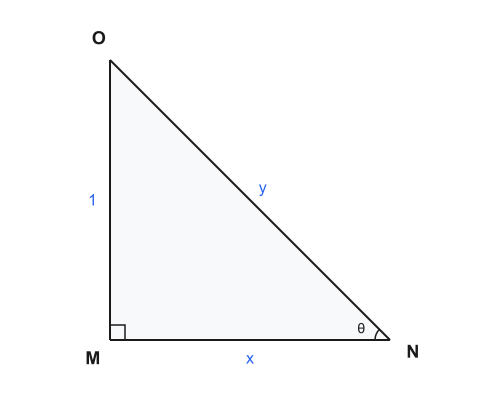
A right triangle is normalized so that its hypotenuse is $1$. In the diagram, $\angle M=\theta$, the adjacent leg to $\theta$ is labeled $x$, and the opposite leg is labeled $y$. The diagram indicates the right angle at the vertex between the legs. Which statement justifies the identity?
Since $\theta$ is acute, $\sin\theta=\cos\theta$, so $\sin^2\theta+\cos^2\theta=1$.
Since $x=\sin\theta$ and $y=\cos\theta$, then $x^2+y^2=1$ by definition.
Since $x=\cos\theta$ and $y=\sin\theta$, then $x+y=1$ and so $\sin^2\theta+\cos^2\theta=1$.
Since $x=\cos\theta$ and $y=\sin\theta$, then $x^2+y^2=1$ by the Pythagorean Theorem.
Explanation
The Pythagorean identity states that for any angle θ, sin²θ + cos²θ = 1. In a right triangle with angle θ at M, sine of θ is defined as the ratio of the opposite leg y to the hypotenuse 1, and cosine is the ratio of the adjacent leg x to the hypotenuse 1. Squaring these ratios gives sin²θ = y²/1² and cos²θ = x²/1². Adding them results in sin²θ + cos²θ = (y² + x²)/1², and by the Pythagorean theorem, y² + x² = 1². Therefore, sin²θ + cos²θ = 1/1 = 1, deriving the identity. A common misconception, as in choice A, is assuming x + y = 1 and then squaring, but the legs add differently and the identity requires squaring first. To remember this, always return to the geometry of the right triangle and apply the definitions and the theorem step by step.
Which of the following correctly explains why $$\sin^2(\theta) + \cos^2(\theta) = 1$$ is true for any angle $$\theta$$, including angles greater than $$90°$$?
The identity is valid because sine and cosine functions are periodic, so their values repeat every $$360°$$ in a predictable pattern
The identity extends beyond right triangles because sine and cosine are defined as coordinates on the unit circle, where $$x^2 + y^2 = 1$$
The identity holds because the Pythagorean theorem applies to all triangles, not just right triangles, when extended properly
The identity works because the definitions of sine and cosine as opposite over hypotenuse and adjacent over hypotenuse remain consistent
Explanation
The Pythagorean identity $$\sin^2(\theta) + \cos^2(\theta) = 1$$ holds for all angles because $$\sin(\theta)$$ and $$\cos(\theta)$$ are defined as the $$y$$ and $$x$$ coordinates respectively of a point on the unit circle. Since any point $$(x,y)$$ on the unit circle satisfies $$x^2 + y^2 = 1$$, we have $$\cos^2(\theta) + \sin^2(\theta) = 1$$. Choice B is incorrect because the Pythagorean theorem doesn't apply to non-right triangles. Choice C mentions periodicity but doesn't explain why the identity holds. Choice D is incorrect because the opposite/hypotenuse definitions only work for acute angles in right triangles.