Decimals - GMAT Quantitative
Card 1 of 80
Subtract nine hundred six ten-thousandths from four tenths.
Subtract nine hundred six ten-thousandths from four tenths.
Tap to reveal answer
Nine hundred six ten-thousandths = 0.0906
Four tenths = 0.4, or 0.4000
The difference:

This is three thousand ninety-four ten-thousandths.
Nine hundred six ten-thousandths = 0.0906
Four tenths = 0.4, or 0.4000
The difference:
This is three thousand ninety-four ten-thousandths.
← Didn't Know|Knew It →
If  and
and  are positive integers such that
  = 4.46, which of the following numbers could be the remainder when
  is divided by
  ?
?
If
Tap to reveal answer
Given that

it follows that  .
.
We don't need to know  or
or  , the only important information is that:

Where the remainder is any one of the answer choices. This is because the remainder for any divisor/dividend pair is the product of the decimal portion of the quotient and the divisor.
Since we don't know y, our answer choice for the remainder is any answer that satisfies the above equation for a positive interger, since  is specified as such in the problem.
The only answer choice that satisfies the constraints on  is 184:
 ==>
==>  ==>
==> 
Given that
it follows that
We don't need to know
Where the remainder is any one of the answer choices. This is because the remainder for any divisor/dividend pair is the product of the decimal portion of the quotient and the divisor.
Since we don't know y, our answer choice for the remainder is any answer that satisfies the above equation for a positive interger, since
The only answer choice that satisfies the constraints on
← Didn't Know|Knew It →
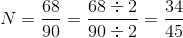
Rewrite as a fraction in lowest terms: 
Rewrite as a fraction in lowest terms:
Tap to reveal answer




← Didn't Know|Knew It →
Add one hundred seven ten-thousandths to seventeeen one-hundredths.
Add one hundred seven ten-thousandths to seventeeen one-hundredths.
Tap to reveal answer
One hundred seven ten-thousandths = 0.0107
Seventeeen one-hundredths = 0.17, or 0.1700
The sum:

This is one thousand eight hundred seven ten-thousandths.
One hundred seven ten-thousandths = 0.0107
Seventeeen one-hundredths = 0.17, or 0.1700
The sum:
This is one thousand eight hundred seven ten-thousandths.
← Didn't Know|Knew It →
Multiply seventy-seven one-hundredths by sixty-six one-thousandths.
Multiply seventy-seven one-hundredths by sixty-six one-thousandths.
Tap to reveal answer
Seventy-seven one-hundredths = 0.77
Sixty-six one-thousandths = 0.066
The product:


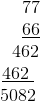
0.77 and 0.066 have a total of five digits to the right of their decimal points, so position the decimal point in the answer so that there are five digits to its right.

This is five thousand eighty-two hundred-thousandths.
Seventy-seven one-hundredths = 0.77
Sixty-six one-thousandths = 0.066
The product:
0.77 and 0.066 have a total of five digits to the right of their decimal points, so position the decimal point in the answer so that there are five digits to its right.
This is five thousand eighty-two hundred-thousandths.
← Didn't Know|Knew It →
Divide eight hundred eighty-eight thousandths by sixty-four ten-thousandths.
Divide eight hundred eighty-eight thousandths by sixty-four ten-thousandths.
Tap to reveal answer
Eight hundred eighty-eight thousandths = 0.888
Sixty-four ten-thousandths = 0.0064
Set up a long division:
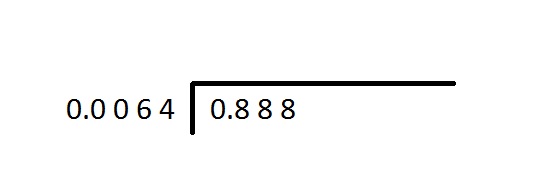
Move the decimal point four places right in both numbers so that the divisor will be a whole number. Note that this will require the use of placeholder zeroes in the dividend.
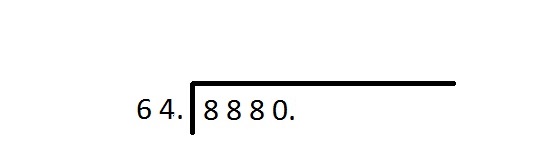
(Note that leading zeroes have been removed.)
Carry out the long division, making sure you align the decimals:
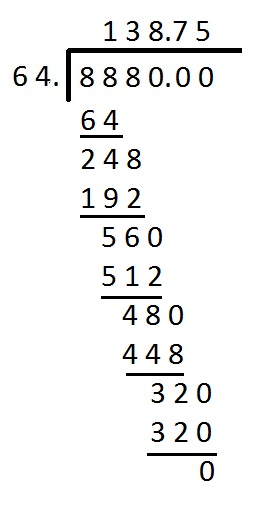
The quotient of this division is that of the original problem, so the correct choice is 138.75.
Eight hundred eighty-eight thousandths = 0.888
Sixty-four ten-thousandths = 0.0064
Set up a long division:
Move the decimal point four places right in both numbers so that the divisor will be a whole number. Note that this will require the use of placeholder zeroes in the dividend.
(Note that leading zeroes have been removed.)
Carry out the long division, making sure you align the decimals:
The quotient of this division is that of the original problem, so the correct choice is 138.75.
← Didn't Know|Knew It →
Which of the following is the square of twenty seven one-thousandths?
Which of the following is the square of twenty seven one-thousandths?
Tap to reveal answer
Twenty-seven one-thousandths = 0.027
Its square is

Multiply without regard to the decimals first:

0.027 and 0.027 have a total of six digits to the right of their decimal points, so position the decimal point in the answer so that there are six digits to its right.

This is seven hundred twenty-nine one-millionths.
Twenty-seven one-thousandths = 0.027
Its square is
Multiply without regard to the decimals first:
0.027 and 0.027 have a total of six digits to the right of their decimal points, so position the decimal point in the answer so that there are six digits to its right.
This is seven hundred twenty-nine one-millionths.
← Didn't Know|Knew It →
Which of the following is the cube of fifteen one-hundredths?
Which of the following is the cube of fifteen one-hundredths?
Tap to reveal answer
Fifteen one-hundredths = 0.15
Its cube is 
Multiply without regard to the decimals first:

0.15, 0.15, and 0.15 have a total of six digits to the right of their decimal points, so position the decimal point in the answer so that there are six digits to its right.

This is three thousand three hundred seventy-five one-millionths.
Fifteen one-hundredths = 0.15
Its cube is
Multiply without regard to the decimals first:
0.15, 0.15, and 0.15 have a total of six digits to the right of their decimal points, so position the decimal point in the answer so that there are six digits to its right.
This is three thousand three hundred seventy-five one-millionths.
← Didn't Know|Knew It →
Which of these equations is not correct?
Which of these equations is not correct?
Tap to reveal answer
Although tempting, a calculator is not required to spot the correct answer.
 is equal to
  as it is
  parts of
  . And therefore
  must be slightly different. (It's it actually
  )
)
Although tempting, a calculator is not required to spot the correct answer.
← Didn't Know|Knew It →
If we divide 10 by 3, what is the 10th digit after the decimal point of the quotient?
If we divide 10 by 3, what is the 10th digit after the decimal point of the quotient?
Tap to reveal answer
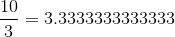
The tenth digit after the decimal point is 3.
When dividing 1 by 3 or 10 by 3, we get repeating 3s. So, there must be a 3 in the tenths digit.
The tenth digit after the decimal point is 3.
When dividing 1 by 3 or 10 by 3, we get repeating 3s. So, there must be a 3 in the tenths digit.
← Didn't Know|Knew It →
If and are positive integers such that = 4.46, which of the following numbers could be the remainder when is divided by ?
If
Tap to reveal answer
Given that
it follows that .
We don't need to know or , the only important information is that:
Where the remainder is any one of the answer choices. This is because the remainder for any divisor/dividend pair is the product of the decimal portion of the quotient and the divisor.
Since we don't know y, our answer choice for the remainder is any answer that satisfies the above equation for a positive interger, since is specified as such in the problem.
The only answer choice that satisfies the constraints on is 184:
==> ==>
Given that
it follows that
We don't need to know
Where the remainder is any one of the answer choices. This is because the remainder for any divisor/dividend pair is the product of the decimal portion of the quotient and the divisor.
Since we don't know y, our answer choice for the remainder is any answer that satisfies the above equation for a positive interger, since
The only answer choice that satisfies the constraints on
← Didn't Know|Knew It →
Rewrite as a fraction in lowest terms:
Rewrite as a fraction in lowest terms:
Tap to reveal answer
← Didn't Know|Knew It →
Add one hundred seven ten-thousandths to seventeeen one-hundredths.
Add one hundred seven ten-thousandths to seventeeen one-hundredths.
Tap to reveal answer
One hundred seven ten-thousandths = 0.0107
Seventeeen one-hundredths = 0.17, or 0.1700
The sum:
This is one thousand eight hundred seven ten-thousandths.
One hundred seven ten-thousandths = 0.0107
Seventeeen one-hundredths = 0.17, or 0.1700
The sum:
This is one thousand eight hundred seven ten-thousandths.
← Didn't Know|Knew It →
Subtract nine hundred six ten-thousandths from four tenths.
Subtract nine hundred six ten-thousandths from four tenths.
Tap to reveal answer
Nine hundred six ten-thousandths = 0.0906
Four tenths = 0.4, or 0.4000
The difference:
This is three thousand ninety-four ten-thousandths.
Nine hundred six ten-thousandths = 0.0906
Four tenths = 0.4, or 0.4000
The difference:
This is three thousand ninety-four ten-thousandths.
← Didn't Know|Knew It →
Multiply seventy-seven one-hundredths by sixty-six one-thousandths.
Multiply seventy-seven one-hundredths by sixty-six one-thousandths.
Tap to reveal answer
Seventy-seven one-hundredths = 0.77
Sixty-six one-thousandths = 0.066
The product:
0.77 and 0.066 have a total of five digits to the right of their decimal points, so position the decimal point in the answer so that there are five digits to its right.
This is five thousand eighty-two hundred-thousandths.
Seventy-seven one-hundredths = 0.77
Sixty-six one-thousandths = 0.066
The product:
0.77 and 0.066 have a total of five digits to the right of their decimal points, so position the decimal point in the answer so that there are five digits to its right.
This is five thousand eighty-two hundred-thousandths.
← Didn't Know|Knew It →
Divide eight hundred eighty-eight thousandths by sixty-four ten-thousandths.
Divide eight hundred eighty-eight thousandths by sixty-four ten-thousandths.
Tap to reveal answer
Eight hundred eighty-eight thousandths = 0.888
Sixty-four ten-thousandths = 0.0064
Set up a long division:
Move the decimal point four places right in both numbers so that the divisor will be a whole number. Note that this will require the use of placeholder zeroes in the dividend.
(Note that leading zeroes have been removed.)
Carry out the long division, making sure you align the decimals:
The quotient of this division is that of the original problem, so the correct choice is 138.75.
Eight hundred eighty-eight thousandths = 0.888
Sixty-four ten-thousandths = 0.0064
Set up a long division:
Move the decimal point four places right in both numbers so that the divisor will be a whole number. Note that this will require the use of placeholder zeroes in the dividend.
(Note that leading zeroes have been removed.)
Carry out the long division, making sure you align the decimals:
The quotient of this division is that of the original problem, so the correct choice is 138.75.
← Didn't Know|Knew It →
Which of the following is the square of twenty seven one-thousandths?
Which of the following is the square of twenty seven one-thousandths?
Tap to reveal answer
Twenty-seven one-thousandths = 0.027
Its square is
Multiply without regard to the decimals first:
0.027 and 0.027 have a total of six digits to the right of their decimal points, so position the decimal point in the answer so that there are six digits to its right.
This is seven hundred twenty-nine one-millionths.
Twenty-seven one-thousandths = 0.027
Its square is
Multiply without regard to the decimals first:
0.027 and 0.027 have a total of six digits to the right of their decimal points, so position the decimal point in the answer so that there are six digits to its right.
This is seven hundred twenty-nine one-millionths.
← Didn't Know|Knew It →
Which of the following is the cube of fifteen one-hundredths?
Which of the following is the cube of fifteen one-hundredths?
Tap to reveal answer
Fifteen one-hundredths = 0.15
Its cube is
Multiply without regard to the decimals first:
0.15, 0.15, and 0.15 have a total of six digits to the right of their decimal points, so position the decimal point in the answer so that there are six digits to its right.
This is three thousand three hundred seventy-five one-millionths.
Fifteen one-hundredths = 0.15
Its cube is
Multiply without regard to the decimals first:
0.15, 0.15, and 0.15 have a total of six digits to the right of their decimal points, so position the decimal point in the answer so that there are six digits to its right.
This is three thousand three hundred seventy-five one-millionths.
← Didn't Know|Knew It →
Which of these equations is not correct?
Which of these equations is not correct?
Tap to reveal answer
Although tempting, a calculator is not required to spot the correct answer.
is equal to as it is parts of . And therefore must be slightly different. (It's it actually )
Although tempting, a calculator is not required to spot the correct answer.
← Didn't Know|Knew It →
If we divide 10 by 3, what is the 10th digit after the decimal point of the quotient?
If we divide 10 by 3, what is the 10th digit after the decimal point of the quotient?
Tap to reveal answer
The tenth digit after the decimal point is 3.
When dividing 1 by 3 or 10 by 3, we get repeating 3s. So, there must be a 3 in the tenths digit.
The tenth digit after the decimal point is 3.
When dividing 1 by 3 or 10 by 3, we get repeating 3s. So, there must be a 3 in the tenths digit.
← Didn't Know|Knew It →