Calculating the area of a right triangle - GMAT Quantitative
Card 1 of 56
If a right triangle has a hypotenuse that is 10, and one side is 6, find the area of the triangle.
If a right triangle has a hypotenuse that is 10, and one side is 6, find the area of the triangle.
Tap to reveal answer
Becaue this is a right triangle and since the hypotenuse is 10 and one side is 6, the other side will be 8. This can be found using the Pythagorean Theorem, or multiplying a 3-4-5 triangle by 2 to get a 6-8-10 triangle. Since the area of a right triangle is half of the product of the two sides, we have

Becaue this is a right triangle and since the hypotenuse is 10 and one side is 6, the other side will be 8. This can be found using the Pythagorean Theorem, or multiplying a 3-4-5 triangle by 2 to get a 6-8-10 triangle. Since the area of a right triangle is half of the product of the two sides, we have
← Didn't Know|Knew It →
A triangle on the coordinate plane has vertices .
.
Which of the following expressions is equal to the area of the triangle?
A triangle on the coordinate plane has vertices
Which of the following expressions is equal to the area of the triangle?
Tap to reveal answer
This is a right triangle with legs along the  - and
- and  -axes, so the area of each can be calculated by taking one-half the product of the two legs.
The vertical leg has length  ; the horizontal leg has length
  .
.
Now calculate the area:

This is a right triangle with legs along the
The vertical leg has length
Now calculate the area:
← Didn't Know|Knew It →
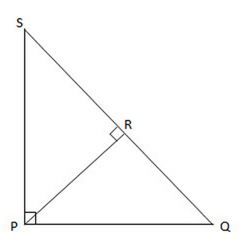
In the above figure, triangle SPQ, SPR and PRQ are right triangles. Given the lengths of SP and PQ are 2cm. What is the area of triangle SPR?
In the above figure, triangle SPQ, SPR and PRQ are right triangles. Given the lengths of SP and PQ are 2cm. What is the area of triangle SPR?
Tap to reveal answer
Since  are right triangles, we know that
  is an isosceles right triangle. So we know that the lengths of
  and
and  are 2 cm, so we can get the length of
  by using the Pythagorean Theorem:

 is the midpoint of
  , so the length of
  is
is  .
.
Now we can use the Pythagorean Theorem again to solve for  :
: 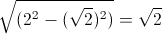 .
.
Finally, we have all the elements needed to solve for the area of  :
:

Since
Now we can use the Pythagorean Theorem again to solve for
Finally, we have all the elements needed to solve for the area of
← Didn't Know|Knew It →
The hypotenuse of a  triangle is equal to the sidelength of a square. Give the ratio of the area of the square to that of the triangle.
The hypotenuse of a
Tap to reveal answer
Let  be the sidelength of the square. Then its area is
  .
.
If the hypotenuse of a  triangle is
  , its shorter leg is half that, or
  ; its longer leg is
  times the shorter leg, or
  . The area of the triangle is half the product of the legs, or
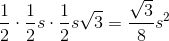
The ratio of the area of the square to that of the triangle is
 or
or 
or 
Let
If the hypotenuse of a
The ratio of the area of the square to that of the triangle is
or
← Didn't Know|Knew It →
Calculate the area of the following right triangle, leave in terms of  .
.
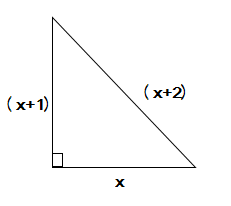
(Not drawn to scale.)
Calculate the area of the following right triangle, leave in terms of
(Not drawn to scale.)
Tap to reveal answer
The equation for the area of a right triangle is:

In this case, our values are: 
Plugging this into the equation leaves us with:
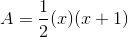
which can be rewritten as 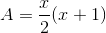
The equation for the area of a right triangle is:
In this case, our values are:
Plugging this into the equation leaves us with:
which can be rewritten as
← Didn't Know|Knew It →
A right triangle has a hypotenuse of 13 and a base of 12. Calculate the area of the triangle.
A right triangle has a hypotenuse of 13 and a base of 12. Calculate the area of the triangle.
Tap to reveal answer
In order to calculate the area of a right triangle, we need to know the height and the base. We are only given the length of the base, so we first need to use the Pythagorean theorem with the given hypotenuse to find the length of the height:



Now that we have the height and the base, we can plug these values into the formula for the area of a right triangle:

In order to calculate the area of a right triangle, we need to know the height and the base. We are only given the length of the base, so we first need to use the Pythagorean theorem with the given hypotenuse to find the length of the height:
Now that we have the height and the base, we can plug these values into the formula for the area of a right triangle:
← Didn't Know|Knew It →
Find the area of a triangle whose base is  and height is
  .
.
Find the area of a triangle whose base is
Tap to reveal answer
To find the area, use the following formula:

To find the area, use the following formula:
← Didn't Know|Knew It →
In the above figure, triangle SPQ, SPR and PRQ are right triangles. Given the lengths of SP and PQ are 2cm. What is the area of triangle SPR?
In the above figure, triangle SPQ, SPR and PRQ are right triangles. Given the lengths of SP and PQ are 2cm. What is the area of triangle SPR?
Tap to reveal answer
Since are right triangles, we know that is an isosceles right triangle. So we know that the lengths of and are 2 cm, so we can get the length of by using the Pythagorean Theorem:
is the midpoint of , so the length of is .
Now we can use the Pythagorean Theorem again to solve for : .
Finally, we have all the elements needed to solve for the area of :
Since
Now we can use the Pythagorean Theorem again to solve for
Finally, we have all the elements needed to solve for the area of
← Didn't Know|Knew It →
If a right triangle has a hypotenuse that is 10, and one side is 6, find the area of the triangle.
If a right triangle has a hypotenuse that is 10, and one side is 6, find the area of the triangle.
Tap to reveal answer
Becaue this is a right triangle and since the hypotenuse is 10 and one side is 6, the other side will be 8. This can be found using the Pythagorean Theorem, or multiplying a 3-4-5 triangle by 2 to get a 6-8-10 triangle. Since the area of a right triangle is half of the product of the two sides, we have
Becaue this is a right triangle and since the hypotenuse is 10 and one side is 6, the other side will be 8. This can be found using the Pythagorean Theorem, or multiplying a 3-4-5 triangle by 2 to get a 6-8-10 triangle. Since the area of a right triangle is half of the product of the two sides, we have
← Didn't Know|Knew It →
A triangle on the coordinate plane has vertices.
Which of the following expressions is equal to the area of the triangle?
A triangle on the coordinate plane has vertices
Which of the following expressions is equal to the area of the triangle?
Tap to reveal answer
This is a right triangle with legs along the - and -axes, so the area of each can be calculated by taking one-half the product of the two legs.
The vertical leg has length ; the horizontal leg has length .
Now calculate the area:
This is a right triangle with legs along the
The vertical leg has length
Now calculate the area:
← Didn't Know|Knew It →
The hypotenuse of a triangle is equal to the sidelength of a square. Give the ratio of the area of the square to that of the triangle.
The hypotenuse of a
Tap to reveal answer
Let be the sidelength of the square. Then its area is .
If the hypotenuse of a triangle is , its shorter leg is half that, or ; its longer leg is times the shorter leg, or . The area of the triangle is half the product of the legs, or
The ratio of the area of the square to that of the triangle is
or
or
Let
If the hypotenuse of a
The ratio of the area of the square to that of the triangle is
or
← Didn't Know|Knew It →
Calculate the area of the following right triangle, leave in terms of .
(Not drawn to scale.)
Calculate the area of the following right triangle, leave in terms of
(Not drawn to scale.)
Tap to reveal answer
The equation for the area of a right triangle is:
In this case, our values are:
Plugging this into the equation leaves us with:
which can be rewritten as
The equation for the area of a right triangle is:
In this case, our values are:
Plugging this into the equation leaves us with:
which can be rewritten as
← Didn't Know|Knew It →
A right triangle has a hypotenuse of 13 and a base of 12. Calculate the area of the triangle.
A right triangle has a hypotenuse of 13 and a base of 12. Calculate the area of the triangle.
Tap to reveal answer
In order to calculate the area of a right triangle, we need to know the height and the base. We are only given the length of the base, so we first need to use the Pythagorean theorem with the given hypotenuse to find the length of the height:
Now that we have the height and the base, we can plug these values into the formula for the area of a right triangle:
In order to calculate the area of a right triangle, we need to know the height and the base. We are only given the length of the base, so we first need to use the Pythagorean theorem with the given hypotenuse to find the length of the height:
Now that we have the height and the base, we can plug these values into the formula for the area of a right triangle:
← Didn't Know|Knew It →
Find the area of a triangle whose base is and height is .
Find the area of a triangle whose base is
Tap to reveal answer
To find the area, use the following formula:
To find the area, use the following formula:
← Didn't Know|Knew It →
If a right triangle has a hypotenuse that is 10, and one side is 6, find the area of the triangle.
If a right triangle has a hypotenuse that is 10, and one side is 6, find the area of the triangle.
Tap to reveal answer
Becaue this is a right triangle and since the hypotenuse is 10 and one side is 6, the other side will be 8. This can be found using the Pythagorean Theorem, or multiplying a 3-4-5 triangle by 2 to get a 6-8-10 triangle. Since the area of a right triangle is half of the product of the two sides, we have
Becaue this is a right triangle and since the hypotenuse is 10 and one side is 6, the other side will be 8. This can be found using the Pythagorean Theorem, or multiplying a 3-4-5 triangle by 2 to get a 6-8-10 triangle. Since the area of a right triangle is half of the product of the two sides, we have
← Didn't Know|Knew It →
A triangle on the coordinate plane has vertices.
Which of the following expressions is equal to the area of the triangle?
A triangle on the coordinate plane has vertices
Which of the following expressions is equal to the area of the triangle?
Tap to reveal answer
This is a right triangle with legs along the - and -axes, so the area of each can be calculated by taking one-half the product of the two legs.
The vertical leg has length ; the horizontal leg has length .
Now calculate the area:
This is a right triangle with legs along the
The vertical leg has length
Now calculate the area:
← Didn't Know|Knew It →
In the above figure, triangle SPQ, SPR and PRQ are right triangles. Given the lengths of SP and PQ are 2cm. What is the area of triangle SPR?
In the above figure, triangle SPQ, SPR and PRQ are right triangles. Given the lengths of SP and PQ are 2cm. What is the area of triangle SPR?
Tap to reveal answer
Since are right triangles, we know that is an isosceles right triangle. So we know that the lengths of and are 2 cm, so we can get the length of by using the Pythagorean Theorem:
is the midpoint of , so the length of is .
Now we can use the Pythagorean Theorem again to solve for : .
Finally, we have all the elements needed to solve for the area of :
Since
Now we can use the Pythagorean Theorem again to solve for
Finally, we have all the elements needed to solve for the area of
← Didn't Know|Knew It →
The hypotenuse of a triangle is equal to the sidelength of a square. Give the ratio of the area of the square to that of the triangle.
The hypotenuse of a
Tap to reveal answer
Let be the sidelength of the square. Then its area is .
If the hypotenuse of a triangle is , its shorter leg is half that, or ; its longer leg is times the shorter leg, or . The area of the triangle is half the product of the legs, or
The ratio of the area of the square to that of the triangle is
or
or
Let
If the hypotenuse of a
The ratio of the area of the square to that of the triangle is
or
← Didn't Know|Knew It →
Calculate the area of the following right triangle, leave in terms of .
(Not drawn to scale.)
Calculate the area of the following right triangle, leave in terms of
(Not drawn to scale.)
Tap to reveal answer
The equation for the area of a right triangle is:
In this case, our values are:
Plugging this into the equation leaves us with:
which can be rewritten as
The equation for the area of a right triangle is:
In this case, our values are:
Plugging this into the equation leaves us with:
which can be rewritten as
← Didn't Know|Knew It →
A right triangle has a hypotenuse of 13 and a base of 12. Calculate the area of the triangle.
A right triangle has a hypotenuse of 13 and a base of 12. Calculate the area of the triangle.
Tap to reveal answer
In order to calculate the area of a right triangle, we need to know the height and the base. We are only given the length of the base, so we first need to use the Pythagorean theorem with the given hypotenuse to find the length of the height:
Now that we have the height and the base, we can plug these values into the formula for the area of a right triangle:
In order to calculate the area of a right triangle, we need to know the height and the base. We are only given the length of the base, so we first need to use the Pythagorean theorem with the given hypotenuse to find the length of the height:
Now that we have the height and the base, we can plug these values into the formula for the area of a right triangle:
← Didn't Know|Knew It →