Calculating the perimeter of a square - GMAT Quantitative
Card 1 of 72
A square plot of land has area 256 square yards. Give its perimeter in inches.
A square plot of land has area 256 square yards. Give its perimeter in inches.
Tap to reveal answer
The sidelength of a square is the square root of its area - in this case,  yards. Its perimeter is therefore four times that, or
  yards. Multiply by 36 to convert to inches:
 inches.
The sidelength of a square is the square root of its area - in this case,
← Didn't Know|Knew It →
Five squares have sidelengths 3, 4, 5, 6, and 7 meters. What is the mean of their perimeters?
Five squares have sidelengths 3, 4, 5, 6, and 7 meters. What is the mean of their perimeters?
Tap to reveal answer
Multiply each sidelength by four to get the perimeters - they will be 12, 16, 20, 24, and 28 meters, respectively. The mean will be
 meters
Multiply each sidelength by four to get the perimeters - they will be 12, 16, 20, 24, and 28 meters, respectively. The mean will be
← Didn't Know|Knew It →
Given Square  , answer the following questions.
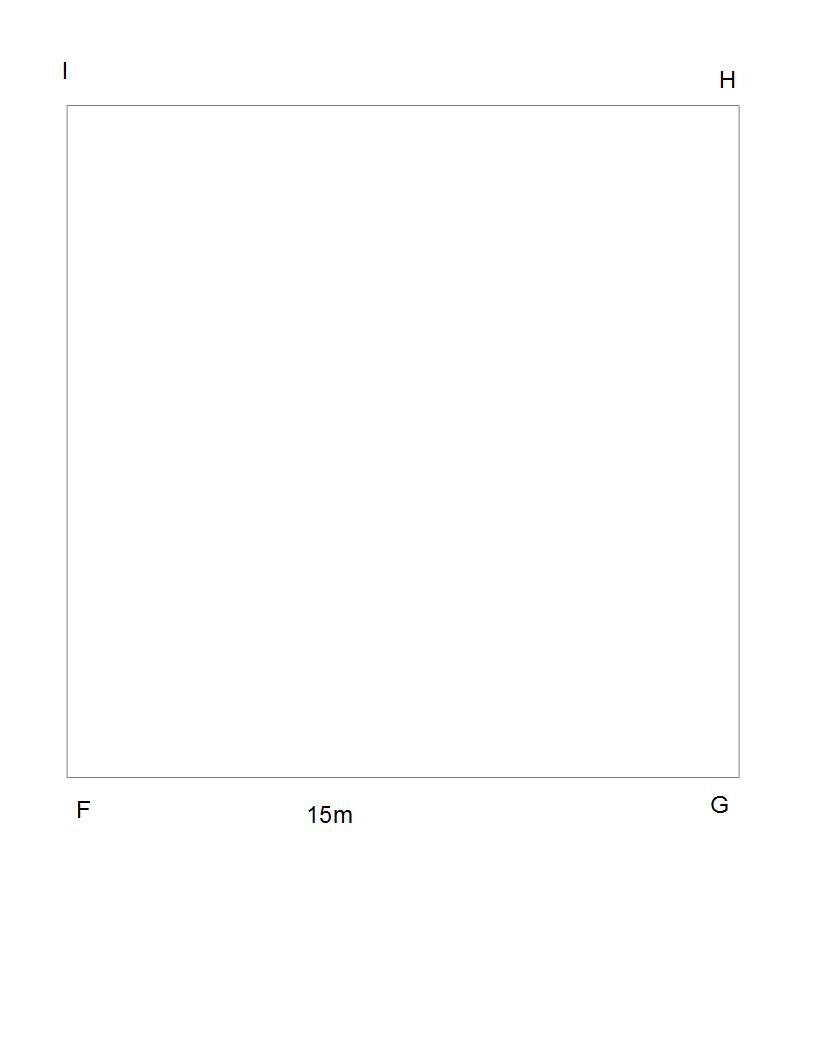
Square  represents a small field for a farmer's sheep. How many meters of fence will the farmer require to completely enclose the field?
Given Square
Square
Tap to reveal answer
This question is a thinly veiled perimeter of a square question. To find the total amount of fencing needed, use the following formula:

Where  is the perimeter of a square, and
  is the length of one side.

This question is a thinly veiled perimeter of a square question. To find the total amount of fencing needed, use the following formula:
Where
← Didn't Know|Knew It →
A given square has a side length of  . What is its perimeter?
A given square has a side length of
Tap to reveal answer
In order to find the perimeter  of a given square with side length
  , we use the equation
  . Given
  , we can therefore conclude that
  .
.
In order to find the perimeter
← Didn't Know|Knew It →
A given square has an area of  . What is its perimeter?
A given square has an area of
Tap to reveal answer
We are told that the area  of the square is
  . We know the area of a square is defined as
  , where
  is the length of the side of the square. We can therefore deduce that
  and that
  .
.
In order to find the perimeter  of a given square with side length
  , we use the equation
  . Given
  , we can therefore conclude that
  .
.
We are told that the area
In order to find the perimeter
← Didn't Know|Knew It →
A given square has a side of length  . What is the perimeter of the square?
A given square has a side of length
Tap to reveal answer
In order to find the perimeter  of a given square with side length
  , we use the equation
  . Given
  , we can therefore conclude that
  .
.
In order to find the perimeter
← Didn't Know|Knew It →
The area of a square is  . Give its perimeter.
The area of a square is
Tap to reveal answer
The length of one side of a square is the square root of the area - or, equivalently, the area raised to the power of  . Here, this is
 .
.
Multiply this by 4 to get the perimeter:

The length of one side of a square is the square root of the area - or, equivalently, the area raised to the power of
Multiply this by 4 to get the perimeter:
← Didn't Know|Knew It →
A square courtyard will have paths running diagonally across it (the paths will form an x). If the length of one of the paths will be  long, what will the perimeter of the courtyard be?
A square courtyard will have paths running diagonally across it (the paths will form an x). If the length of one of the paths will be
Tap to reveal answer
A square courtyard will have paths running diagonally across it (the paths will form an x). If the length of one of the paths will be  long, what will the perimeter of the courtyard be?
To find the perimeter of a square, we need to find the side lengths. We can find the side lengths from the diagonal by recalling that the diagonal of a square creates two 45/45/90 triangles.
A 45/45/90 triangle has the following side-length ratios: 
This means that if our hypotenuse is  long, our other two sides will be 14 meters long
So our side-length is 14 meters, find the perimeter via the following

A square courtyard will have paths running diagonally across it (the paths will form an x). If the length of one of the paths will be
To find the perimeter of a square, we need to find the side lengths. We can find the side lengths from the diagonal by recalling that the diagonal of a square creates two 45/45/90 triangles.
A 45/45/90 triangle has the following side-length ratios:
This means that if our hypotenuse is
So our side-length is 14 meters, find the perimeter via the following
← Didn't Know|Knew It →
A square is created from joining two equilateral triangles of side length =  What is the perimeter of the square?
A square is created from joining two equilateral triangles of side length =
Tap to reveal answer
Draw yourself a picture for this problem. If you create a square out of two triangles, they meet at the diagonal of the square. Since, we know the triangles are equilateral, then all of the side lengths of the triangle and square are equal. Therefore, we just take the side length and add that four times.

Draw yourself a picture for this problem. If you create a square out of two triangles, they meet at the diagonal of the square. Since, we know the triangles are equilateral, then all of the side lengths of the triangle and square are equal. Therefore, we just take the side length and add that four times.
← Didn't Know|Knew It →
Five squares have sidelengths 3, 4, 5, 6, and 7 meters. What is the mean of their perimeters?
Five squares have sidelengths 3, 4, 5, 6, and 7 meters. What is the mean of their perimeters?
Tap to reveal answer
Multiply each sidelength by four to get the perimeters - they will be 12, 16, 20, 24, and 28 meters, respectively. The mean will be
meters
Multiply each sidelength by four to get the perimeters - they will be 12, 16, 20, 24, and 28 meters, respectively. The mean will be
← Didn't Know|Knew It →
Given Square , answer the following questions.
Square represents a small field for a farmer's sheep. How many meters of fence will the farmer require to completely enclose the field?
Given Square
Square
Tap to reveal answer
This question is a thinly veiled perimeter of a square question. To find the total amount of fencing needed, use the following formula:
Where is the perimeter of a square, and is the length of one side.
This question is a thinly veiled perimeter of a square question. To find the total amount of fencing needed, use the following formula:
Where
← Didn't Know|Knew It →
A square plot of land has area 256 square yards. Give its perimeter in inches.
A square plot of land has area 256 square yards. Give its perimeter in inches.
Tap to reveal answer
The sidelength of a square is the square root of its area - in this case, yards. Its perimeter is therefore four times that, or yards. Multiply by 36 to convert to inches:
inches.
The sidelength of a square is the square root of its area - in this case,
← Didn't Know|Knew It →
A given square has a side length of . What is its perimeter?
A given square has a side length of
Tap to reveal answer
In order to find the perimeter of a given square with side length , we use the equation . Given , we can therefore conclude that .
In order to find the perimeter
← Didn't Know|Knew It →
A given square has an area of . What is its perimeter?
A given square has an area of
Tap to reveal answer
We are told that the area of the square is . We know the area of a square is defined as , where is the length of the side of the square. We can therefore deduce that and that .
In order to find the perimeter of a given square with side length , we use the equation . Given , we can therefore conclude that .
We are told that the area
In order to find the perimeter
← Didn't Know|Knew It →
A given square has a side of length . What is the perimeter of the square?
A given square has a side of length
Tap to reveal answer
In order to find the perimeter of a given square with side length , we use the equation . Given , we can therefore conclude that .
In order to find the perimeter
← Didn't Know|Knew It →
The area of a square is . Give its perimeter.
The area of a square is
Tap to reveal answer
The length of one side of a square is the square root of the area - or, equivalently, the area raised to the power of . Here, this is
.
Multiply this by 4 to get the perimeter:
The length of one side of a square is the square root of the area - or, equivalently, the area raised to the power of
Multiply this by 4 to get the perimeter:
← Didn't Know|Knew It →
A square courtyard will have paths running diagonally across it (the paths will form an x). If the length of one of the paths will be long, what will the perimeter of the courtyard be?
A square courtyard will have paths running diagonally across it (the paths will form an x). If the length of one of the paths will be
Tap to reveal answer
A square courtyard will have paths running diagonally across it (the paths will form an x). If the length of one of the paths will be long, what will the perimeter of the courtyard be?
To find the perimeter of a square, we need to find the side lengths. We can find the side lengths from the diagonal by recalling that the diagonal of a square creates two 45/45/90 triangles.
A 45/45/90 triangle has the following side-length ratios:
This means that if our hypotenuse is long, our other two sides will be 14 meters long
So our side-length is 14 meters, find the perimeter via the following
A square courtyard will have paths running diagonally across it (the paths will form an x). If the length of one of the paths will be
To find the perimeter of a square, we need to find the side lengths. We can find the side lengths from the diagonal by recalling that the diagonal of a square creates two 45/45/90 triangles.
A 45/45/90 triangle has the following side-length ratios:
This means that if our hypotenuse is
So our side-length is 14 meters, find the perimeter via the following
← Didn't Know|Knew It →
A square is created from joining two equilateral triangles of side length = What is the perimeter of the square?
A square is created from joining two equilateral triangles of side length =
Tap to reveal answer
Draw yourself a picture for this problem. If you create a square out of two triangles, they meet at the diagonal of the square. Since, we know the triangles are equilateral, then all of the side lengths of the triangle and square are equal. Therefore, we just take the side length and add that four times.
Draw yourself a picture for this problem. If you create a square out of two triangles, they meet at the diagonal of the square. Since, we know the triangles are equilateral, then all of the side lengths of the triangle and square are equal. Therefore, we just take the side length and add that four times.
← Didn't Know|Knew It →
A square plot of land has area 256 square yards. Give its perimeter in inches.
A square plot of land has area 256 square yards. Give its perimeter in inches.
Tap to reveal answer
The sidelength of a square is the square root of its area - in this case, yards. Its perimeter is therefore four times that, or yards. Multiply by 36 to convert to inches:
inches.
The sidelength of a square is the square root of its area - in this case,
← Didn't Know|Knew It →
Five squares have sidelengths 3, 4, 5, 6, and 7 meters. What is the mean of their perimeters?
Five squares have sidelengths 3, 4, 5, 6, and 7 meters. What is the mean of their perimeters?
Tap to reveal answer
Multiply each sidelength by four to get the perimeters - they will be 12, 16, 20, 24, and 28 meters, respectively. The mean will be
meters
Multiply each sidelength by four to get the perimeters - they will be 12, 16, 20, 24, and 28 meters, respectively. The mean will be
← Didn't Know|Knew It →