Graphing - GMAT Quantitative
Card 1 of 816
Give the  -intercept of the graph of the equation
  .
.
Give the
Tap to reveal answer
Set  in the equation:

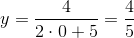
The  -intercept is
  .
.
Set
The
← Didn't Know|Knew It →
Give the  -intercept(s), if any, of the graph of the equation

Give the
Tap to reveal answer
Set  in the equation and solve for
  .
.




This is impossible, so the equation has no solution. Therefore, the graph has no  -intercept.
Set
This is impossible, so the equation has no solution. Therefore, the graph has no
← Didn't Know|Knew It →
Give the vertical asymptote of the graph of the equation

Give the vertical asymptote of the graph of the equation
Tap to reveal answer
The vertical asymptote is  , where
  is found by setting the denominator equal to 0 and solving for
  :
:





This is the equation of the vertical asymptote.
The vertical asymptote is
This is the equation of the vertical asymptote.
← Didn't Know|Knew It →
Give the -intercept(s), if any, of the graph of the equation

Give the
Tap to reveal answer
Set in the equation and solve for .


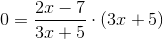





The  -intercept is
Set
The
← Didn't Know|Knew It →
Give the horizontal asymptote, if there is one, of the graph of the equation

Give the horizontal asymptote, if there is one, of the graph of the equation
Tap to reveal answer
To find the horizontal asymptote, we can divide both numerator and denominator in the right expression by  :
:


As  approaches positive or negative infinity,
  and
and  both approach 0. Therefore,
  approaches
  , making the horizontal asymptote the line of the equation
  .
.
To find the horizontal asymptote, we can divide both numerator and denominator in the right expression by
As
← Didn't Know|Knew It →
Give the -intercept of the graph of the equation .
Give the
Tap to reveal answer
Set in the equation:
The -intercept is .
Set
The
← Didn't Know|Knew It →
Give the -intercept(s), if any, of the graph of the equation
Give the
Tap to reveal answer
Set in the equation and solve for .
This is impossible, so the equation has no solution. Therefore, the graph has no -intercept.
Set
This is impossible, so the equation has no solution. Therefore, the graph has no
← Didn't Know|Knew It →
Give the vertical asymptote of the graph of the equation
Give the vertical asymptote of the graph of the equation
Tap to reveal answer
The vertical asymptote is , where is found by setting the denominator equal to 0 and solving for :
This is the equation of the vertical asymptote.
The vertical asymptote is
This is the equation of the vertical asymptote.
← Didn't Know|Knew It →
Give the -intercept(s), if any, of the graph of the equation
Give the
Tap to reveal answer
Set in the equation and solve for .
The -intercept is
Set
The
← Didn't Know|Knew It →
Give the horizontal asymptote, if there is one, of the graph of the equation
Give the horizontal asymptote, if there is one, of the graph of the equation
Tap to reveal answer
To find the horizontal asymptote, we can divide both numerator and denominator in the right expression by :
As approaches positive or negative infinity, and both approach 0. Therefore, approaches , making the horizontal asymptote the line of the equation .
To find the horizontal asymptote, we can divide both numerator and denominator in the right expression by
As
← Didn't Know|Knew It →
Give the  -intercept(s) of the parabola with equation
  . Round to the nearest tenth, if applicable.
Give the
Tap to reveal answer
The  -coordinate(s) of the
  -intercept(s) are the real solution(s) to the equation
  . We can use the quadratic formula to find any solutions, setting
  - the coefficients of the expression.
An examination of the discriminant  , however, proves this unnecessary.

The discriminant being negative, there are no real solutions, so the parabola has no  -intercepts.
The
An examination of the discriminant
The discriminant being negative, there are no real solutions, so the parabola has no
← Didn't Know|Knew It →
In which quadrant does the complex number  lie?
lie?
In which quadrant does the complex number
Tap to reveal answer
When plotting a complex number, we use a set of real-imaginary axes in which the x-axis is represented by the real component of the complex number, and the y-axis is represented by the imaginary component of the complex number. The real component is  and the imaginary component is
  , so this is the equivalent of plotting the point
  on a set of Cartesian axes. Plotting the complex number on a set of real-imaginary axes, we move
  to the left in the x-direction and
  up in the y-direction, which puts us in the second quadrant, or in terms of Roman numerals:

When plotting a complex number, we use a set of real-imaginary axes in which the x-axis is represented by the real component of the complex number, and the y-axis is represented by the imaginary component of the complex number. The real component is
← Didn't Know|Knew It →
In which quadrant does the complex number  lie?
lie?
In which quadrant does the complex number
Tap to reveal answer
If we graphed the given complex number on a set of real-imaginary axes, we would plot the real value of the complex number as the x coordinate, and the imaginary value of the complex number as the y coordinate. Because the given complex number is as follows:

We are essentially doing the same as plotting the point  on a set of Cartesian axes. We move
  units right in the x direction, and
  units down in the y direction, which puts us in the fourth quadrant, or in terms of Roman numerals:

If we graphed the given complex number on a set of real-imaginary axes, we would plot the real value of the complex number as the x coordinate, and the imaginary value of the complex number as the y coordinate. Because the given complex number is as follows:
We are essentially doing the same as plotting the point
← Didn't Know|Knew It →
In which quadrant does the complex number  lie?
lie?
In which quadrant does the complex number
Tap to reveal answer
If we graphed the given complex number on a set of real-imaginary axes, we would plot the real value of the complex number as the x coordinate, and the imaginary value of the complex number as the y coordinate. Because the given complex number is as follows:

We are essentially doing the same as plotting the point  on a set of Cartesian axes. We move
  units left of the origin in the x direction, and
  units down from the origin in the y direction, which puts us in the third quadrant, or in terms of Roman numerals:

If we graphed the given complex number on a set of real-imaginary axes, we would plot the real value of the complex number as the x coordinate, and the imaginary value of the complex number as the y coordinate. Because the given complex number is as follows:
We are essentially doing the same as plotting the point
← Didn't Know|Knew It →
In which quadrant does the complex number  lie?
lie?
In which quadrant does the complex number
Tap to reveal answer
If we graphed the given complex number on a set of real-imaginary axes, we would plot the real value of the complex number as the x coordinate, and the imaginary value of the complex number as the y coordinate. Because the given complex number is as follows:

We are essentially doing the same as plotting the point  on a set of Cartesian axes. We move
  units right of the origin in the x direction, and
  units up from the origin in the y direction, which puts us in the first quadrant, or in terms of Roman numerals:

If we graphed the given complex number on a set of real-imaginary axes, we would plot the real value of the complex number as the x coordinate, and the imaginary value of the complex number as the y coordinate. Because the given complex number is as follows:
We are essentially doing the same as plotting the point
← Didn't Know|Knew It →
Raise  to the power of four.
Raise
Tap to reveal answer
Squaring an expression, then squaring the result, amounts to taking the original expression to the fourth power. Therefore, we can first square  :
:



Now square this result:





Squaring an expression, then squaring the result, amounts to taking the original expression to the fourth power. Therefore, we can first square
Now square this result:
← Didn't Know|Knew It →
Raise  to the power of eight.
Raise
Tap to reveal answer
For any expression  ,
,  . That is, we can raise an expression to the power of eight by squaring it, then squaring the result, then squaring that result.
First, we square:



Square this result to obtain the fourth power:

Square this result to obtain the eighth power:

For any expression
First, we square:
Square this result to obtain the fourth power:
Square this result to obtain the eighth power:
← Didn't Know|Knew It →
The point  lies on a line with slope
  that passes through the point
  .
.
What is  ?
?
The point
What is
Tap to reveal answer
We first need to find an equation of the line with a slope of  that passes through the point (2, 5).


Now, plug in the point  and solve for
  .
.

We first need to find an equation of the line with a slope of
Now, plug in the point
← Didn't Know|Knew It →
A line goes through points  . What is
  ?
?
A line goes through points
Tap to reveal answer
The slope of the line through  and
and  can be found using the slope formula:

Set  :
:

We can use this slope and the slope formula; set  :
:


The slope of the line through
Set
We can use this slope and the slope formula; set
← Didn't Know|Knew It →
The point  lies on a line with a slope
  that passes through
  . What is the value of
  ?
?
The point
Tap to reveal answer
In order to find the value of  , we first need to find the equation for the line with slope
  that passes through the point
  .
.


Plugging in  and solving for
  :
:


In order to find the value of
Plugging in
← Didn't Know|Knew It →