Lines - GMAT Quantitative
Card 1 of 912
Two perpendicular lines intersect at point  . One line passes through
  ; the other, through
  . What is the value of
  ?
?
Two perpendicular lines intersect at point
Tap to reveal answer
The slope of the first line, in terms of  , is
, is

The slope of the second line is

The slopes of two perpendicular lines have product  , so we set up this equation and solve for
  :
:


or

The slope of the first line, in terms of
The slope of the second line is
The slopes of two perpendicular lines have product
or
← Didn't Know|Knew It →
Which of the following choices give the slopes of two perpendicular lines?
Which of the following choices give the slopes of two perpendicular lines?
Tap to reveal answer
We can eliminate the choice  immediately since the slopes of two perpendicular lines cannot have the same sign. We can also eliminate
  and undefined,
  , since a line with slope 0 and a line with undefined slope are perpendicular to each other, not a line of slope -1 or 1.
Of the two remaining choices, we check for the choice that includes two numbers whose product is -1.
 and
and 
so  is the correct choice.
We can eliminate the choice
Of the two remaining choices, we check for the choice that includes two numbers whose product is -1.
so
← Didn't Know|Knew It →
Which of the following is perpendicular to the line given by the equation:

Which of the following is perpendicular to the line given by the equation:
Tap to reveal answer
In order for one line to be perpendicular to another, its slope must be the negative reciprocal of that line's slope. That is, the slope of any perpendicular line must be opposite in sign and the inverse of the slope of the line to which it is perpendicular:

In the given line we can see that  , so the slope of any line perpendicular to it will be:

There is only one answer choice with this slope, so we know the following line is perpendicular to the line given in the problem:

In order for one line to be perpendicular to another, its slope must be the negative reciprocal of that line's slope. That is, the slope of any perpendicular line must be opposite in sign and the inverse of the slope of the line to which it is perpendicular:
In the given line we can see that
There is only one answer choice with this slope, so we know the following line is perpendicular to the line given in the problem:
← Didn't Know|Knew It →
What is the slope of any line that is perpendicular to  ?
?
What is the slope of any line that is perpendicular to
Tap to reveal answer
For a given line  defined by the equation
  with slope
  , any line perpendicular to
  has a slope of
  , or the negative reciprocal of
  . Since the slope of the provided line
  in this instance is
  , then the slope of any line perpendicular to
  is
is  .
.
For a given line
← Didn't Know|Knew It →
What is the slope of any line that is perpendicular to  ?
?
What is the slope of any line that is perpendicular to
Tap to reveal answer
For a given line  defined by the equation
  with slope
  , any line perpendicular to
  has a slope of
  , or the negative reciprocal of
  . Since the slope of the provided line
  in this instance is
  , then the slope of any line perpendicular to
  is
is  .
.
For a given line
← Didn't Know|Knew It →
What is the slope of any line that is perpendicular to  ?
?
What is the slope of any line that is perpendicular to
Tap to reveal answer
For a given line defined by the equation with slope , any line perpendicular to has a slope of , or the negative reciprocal of . Since the slope of the provided line in this instance is  , then the slope of any line perpendicular to is
  .
.
For a given line
← Didn't Know|Knew It →
Find the midpoint of the points  and
and  .
.
Find the midpoint of the points
Tap to reveal answer
Add the corresponding points together and divide both values by 2:
($\frac{2+4}{2}$,$\frac{9+3}{2}$) = (3, 6)
Add the corresponding points together and divide both values by 2:
($\frac{2+4}{2}$,$\frac{9+3}{2}$) = (3, 6)
← Didn't Know|Knew It →
What is the midpoint of  and
and  ?
?
What is the midpoint of
Tap to reveal answer
Add the x-values and divide by 2, and then add the y-values and divide by 2. Be careful of the negatives!

Add the x-values and divide by 2, and then add the y-values and divide by 2. Be careful of the negatives!
← Didn't Know|Knew It →
Which of the following quadrants can contain the midpoint of a line segment with endpoints  and
and  for some nonzero value of
  ?
?
Which of the following quadrants can contain the midpoint of a line segment with endpoints
Tap to reveal answer
The midpoint of the line segment with endpoints  and
and  is
is 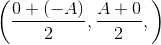 , or
, or 
If  , then the
  -coordinate is negative and the
  -coordinate is positive, so the midpoint is in Quadrant II. If
  , the reverse is true, so the midpoint is in Quadrant IV.
The midpoint of the line segment with endpoints
If
← Didn't Know|Knew It →
The midpoint of a line segment with endpoints  and
and  is
is  . Sove for
  .
.
The midpoint of a line segment with endpoints
Tap to reveal answer
The midpoint of a line segment with endpoints  is
is
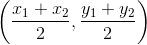 .
.
Substitute the coordinates of the endpoints, then set each equation to the appropriate midpoint coordinate.
 -coordinate: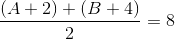
 -coordinate:
Simplify each, then solve the system of linear equations in two variables:
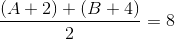
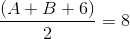



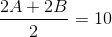

The two linear equations turn out to be equivalent, meaning that there are infinitely many solutions to the system. Therefore, insufficient information is given to answer the question.
The midpoint of a line segment with endpoints
Substitute the coordinates of the endpoints, then set each equation to the appropriate midpoint coordinate.
Simplify each, then solve the system of linear equations in two variables:
The two linear equations turn out to be equivalent, meaning that there are infinitely many solutions to the system. Therefore, insufficient information is given to answer the question.
← Didn't Know|Knew It →
Consider segment  which passes through the points
  and
and  .
.
What are the correct coordinates for the midpoint of  ?
?
Consider segment
What are the correct coordinates for the midpoint of
Tap to reveal answer
Midpoint formula is as follows:
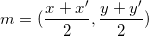
Plug in and calculate:

Midpoint formula is as follows:
Plug in and calculate:
← Didn't Know|Knew It →
Segment  has endpoints of
  and
and  . If the midpoint of
  is given by point
  , what are the coordinates of point
  ?
?
Segment
Tap to reveal answer
Midpoints can be found using the following:

Plug in our points (-6,8) and (4,26) to find the midpoint.

Midpoints can be found using the following:
Plug in our points (-6,8) and (4,26) to find the midpoint.
← Didn't Know|Knew It →
What are the coordinates of the mipdpoint of the line segment  if
if  and
and 
What are the coordinates of the mipdpoint of the line segment
Tap to reveal answer
The midpoint formula is 
The midpoint formula is
← Didn't Know|Knew It →
What is the slope of the line perpendicular to  ?
?
What is the slope of the line perpendicular to
Tap to reveal answer
Perpendicular lines have slopes that are negative reciprocals of each other. Therefore, rewrite the equation in slope intercept form  :
:



Slope of given line: 
Negative reciprocal: 
Perpendicular lines have slopes that are negative reciprocals of each other. Therefore, rewrite the equation in slope intercept form
Slope of given line:
Negative reciprocal:
← Didn't Know|Knew It →
What is the slope of a line perpendicular to the line of the equation  ?
?
What is the slope of a line perpendicular to the line of the equation
Tap to reveal answer
The graph of  for any real number
  is a horizontal line. A line parallel to it is a vertical line, which has a slope that is undefined.
The graph of
← Didn't Know|Knew It →
Line 1 is the line of the equation  . Line 2 is perpendicular to this line. What is the slope of Line 2?
Line 1 is the line of the equation
Tap to reveal answer
Rewrite in slope-intercept form:




The slope of the line is the coefficient of  , which is
  . A line perpendicular to this has as its slope the opposite of the reciprocal of
  :
:
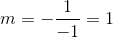
Rewrite in slope-intercept form:
The slope of the line is the coefficient of
← Didn't Know|Knew It →
Given:
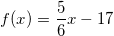
Calculate the slope of  , a line perpendicular to
  .
.
Given:
Calculate the slope of
Tap to reveal answer
To find the slope of a line perpendicular to a given line, simply take the opposite reciprocal of the slope of the given line.
Since f(x) is given in slope intercept form,
 .
.
Therefore our original slope is

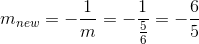
So our new slope becomes:
To find the slope of a line perpendicular to a given line, simply take the opposite reciprocal of the slope of the given line.
Since f(x) is given in slope intercept form,
Therefore our original slope is
So our new slope becomes:
← Didn't Know|Knew It →
What would be the slope of a line perpendicular to the following line?

What would be the slope of a line perpendicular to the following line?
Tap to reveal answer
The equation for a line in standard form is written as follows:

Where  is the slope of the line and
  is the y intercept. By definition, the slope of a line is the negative reciprocal of the slope of the line to which it is perpendicular. So if the given line has a slope of
  , the slope of any line perpendicular to it will have the negative reciprocal of that slope. This gives us:


The equation for a line in standard form is written as follows:
Where
← Didn't Know|Knew It →
Give the slope of a line on the coordinate plane.
Statement 1: The line shares an  -intercept and its
  -intercept with the line of the equation
  .
.
Statement 2: The line is perpendicular to the line of the equation  .
.
Give the slope of a line on the coordinate plane.
Statement 1: The line shares an
Statement 2: The line is perpendicular to the line of the equation
Tap to reveal answer
Assume Statement 1 alone. In order to determine the slope of a line on the coordinate plane, the coordinates of two of its points are needed. The  -intercept of the line of the equation can be found by substituting
  and solving for
  :
:




The  -intercept of the line is at the origin,
  . It follows that the
  -intercept is also at the origin. Therefore, Statement 1 only gives one point on the line, and its slope cannot be determined.
Assume Statement 2 alone. The slope of the line of the equation  can be calculated by putting it in slope-intercept form
  :
:





The slope of this line is the coefficient of  , which is
  . A line perpendicular to this one has as its slope the opposite of the reciprocal of
  , which is
 .
.
The question is answered.
Assume Statement 1 alone. In order to determine the slope of a line on the coordinate plane, the coordinates of two of its points are needed. The
The
Assume Statement 2 alone. The slope of the line of the equation
The slope of this line is the coefficient of
The question is answered.
← Didn't Know|Knew It →
What is the distance between the points  and
and  ?
?
What is the distance between the points
Tap to reveal answer
Let's plug our coordinates into the distance formula.
$$\sqrt{(2-7)^{2}$$$+(5-17)^{2}$}= $$\sqrt{(-5)^{2}$$$+(-12)^{2}$} = $\sqrt{25+144}$= $\sqrt{169}$ = 13
Let's plug our coordinates into the distance formula.
$$\sqrt{(2-7)^{2}$$$+(5-17)^{2}$}= $$\sqrt{(-5)^{2}$$$+(-12)^{2}$} = $\sqrt{25+144}$= $\sqrt{169}$ = 13
← Didn't Know|Knew It →