Range - GMAT Quantitative
Card 1 of 120
Consider the following set of numbers:
85, 87, 87, 82, 89
What is the range?
Consider the following set of numbers:
85, 87, 87, 82, 89
What is the range?
Tap to reveal answer
The range is the difference between the maximum and minimum value.

The range is the difference between the maximum and minimum value.
← Didn't Know|Knew It →
A large group of students is given a standardized test. The following information is given about the scores:
Mean: 73.8
Standard deviation: 6.3
Median: 71
25th percentile: 61
75th percentile: 86
Highest score: 100
Lowest score: 12
What is the interquartile range of the tests?
A large group of students is given a standardized test. The following information is given about the scores:
Mean: 73.8
Standard deviation: 6.3
Median: 71
25th percentile: 61
75th percentile: 86
Highest score: 100
Lowest score: 12
What is the interquartile range of the tests?
Tap to reveal answer
The interquartile range of a data set is the difference between the 75th and 25th percentiles:

All other given information is extraneous to the problem.
The interquartile range of a data set is the difference between the 75th and 25th percentiles:
All other given information is extraneous to the problem.
← Didn't Know|Knew It →
What is the range for the following data set:

What is the range for the following data set:
Tap to reveal answer
The range is the highest value number minus the lowest value number in a sorted data set:

We need to sort the data set:


The range is the highest value number minus the lowest value number in a sorted data set:
We need to sort the data set:
← Didn't Know|Knew It →
What is the range for the following set:

What is the range for the following set:
Tap to reveal answer
The range is the difference between the highest and lowest number.
First sort the set:


The range is the difference between the highest and lowest number.
First sort the set:
← Didn't Know|Knew It →
Below is the stem-and-leaf display of a set of test scores.
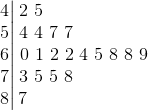
What is the range of this set of scores?
Below is the stem-and-leaf display of a set of test scores.
What is the range of this set of scores?
Tap to reveal answer
The range of a data set is the difference of the highest and lowest scores,
The numbers in the "stem" of this display represent tens digits of the test scores, and the numbers in the "leaves" represent the units digits. The highest and lowest scores represented are 87 and 42, so the range is their difference:  .
.
The range of a data set is the difference of the highest and lowest scores,
The numbers in the "stem" of this display represent tens digits of the test scores, and the numbers in the "leaves" represent the units digits. The highest and lowest scores represented are 87 and 42, so the range is their difference:
← Didn't Know|Knew It →
Below is the stem-and-leaf display of a set of test scores.
What is the interquartile range of these test scores?
Below is the stem-and-leaf display of a set of test scores.
What is the interquartile range of these test scores?
Tap to reveal answer
The numbers in the "stem" of this display represent tens digits of the test scores, and the numbers in the "leaves" represent the units digits. This stem-and-leaf display represents twenty scores.
The interquartile range is the difference of the third and first quartiles.
The third quartile is the median of the upper half, or the upper ten scores. This is the arithmetic mean of the fifth- and sixth-highest scores. These scores are 73 and 69, so the mean is  .
.
The first quartile is the median of the lower half, or the lower ten scores. This is the arithmetic mean of the fifth- and sixth-lowest scores. Both of these scores are the same, however - 57.
The interquartile range is therefore the difference of these numbers: 
The numbers in the "stem" of this display represent tens digits of the test scores, and the numbers in the "leaves" represent the units digits. This stem-and-leaf display represents twenty scores.
The interquartile range is the difference of the third and first quartiles.
The third quartile is the median of the upper half, or the upper ten scores. This is the arithmetic mean of the fifth- and sixth-highest scores. These scores are 73 and 69, so the mean is
The first quartile is the median of the lower half, or the lower ten scores. This is the arithmetic mean of the fifth- and sixth-lowest scores. Both of these scores are the same, however - 57.
The interquartile range is therefore the difference of these numbers:
← Didn't Know|Knew It →
Set 1: 5, 13, -2, -1, 19, 27
Set 2: 6, -3, 23, 15, m, 1
What should the value of  be if we want the ranges of both sets of number to be equal?
Set 1: 5, 13, -2, -1, 19, 27
Set 2: 6, -3, 23, 15, m, 1
What should the value of
Tap to reveal answer
The range of a set of numbers is the difference between the highest number and the lowest number in the set.
The range of set 1 is:

The range of the second set, ignoring the value of m is:

We need to either subtract 3 from the lowest number in set Set 2 or add 3 to the highest number in Set 2 to get the value of m such that the range of both sets are equal.

or

The range of a set of numbers is the difference between the highest number and the lowest number in the set.
The range of set 1 is:
The range of the second set, ignoring the value of m is:
We need to either subtract 3 from the lowest number in set Set 2 or add 3 to the highest number in Set 2 to get the value of m such that the range of both sets are equal.
or
← Didn't Know|Knew It →
Calculate the range of the following set of data:

Calculate the range of the following set of data:
Tap to reveal answer
The range of a set of data is the difference between its highest value and its lowest value, as this describes the range of values spanned by the set. A quick way to calculate the range is to locate the lowest value in the set and subtract it from the highest value, but let's arrange the set in increasing order to visualize the problem first:

Now we can see that the lowest value in the set is 9, and the highest value in the set is 27, so the range of the set is:

The range of a set of data is the difference between its highest value and its lowest value, as this describes the range of values spanned by the set. A quick way to calculate the range is to locate the lowest value in the set and subtract it from the highest value, but let's arrange the set in increasing order to visualize the problem first:
Now we can see that the lowest value in the set is 9, and the highest value in the set is 27, so the range of the set is:
← Didn't Know|Knew It →
Calculate the range of the following set of data:

Calculate the range of the following set of data:
Tap to reveal answer
The range of a set of data is the difference between its smallest and greatest values. We can first look through the set for the greatest value, which we can see is 53. We then look through the set for the smallest value, which we can see is 28. The range of the set is then:

The range of a set of data is the difference between its smallest and greatest values. We can first look through the set for the greatest value, which we can see is 53. We then look through the set for the smallest value, which we can see is 28. The range of the set is then:
← Didn't Know|Knew It →
Determine the mean for the following set of numbers.

Determine the mean for the following set of numbers.
Tap to reveal answer
To find the range, simply subract the smallest number from the largest. Therefore:

To find the range, simply subract the smallest number from the largest. Therefore:
← Didn't Know|Knew It →
Find the range of the following set of numbers:

Find the range of the following set of numbers:
Tap to reveal answer
To find range, subtract the smallest number from the largest number. Thus,

To find range, subtract the smallest number from the largest number. Thus,
← Didn't Know|Knew It →
Find the range of the following set of numbers.
1,1,2,7,8,10,11
Find the range of the following set of numbers.
1,1,2,7,8,10,11
Tap to reveal answer
To find the range, you m ust subtract the smallest number from the largest. Thus,

To find the range, you m ust subtract the smallest number from the largest. Thus,
← Didn't Know|Knew It →
Find the range of the following data set:

Find the range of the following data set:
Tap to reveal answer
Find the range of the following data set:

Range is as simple as finding the diffference between the largest and smallest terms in a set. So, let's find our largest and smallest terms.
Largest: 989
Smallest: 2
Next, let's calculate the range:

So our answer should be 987
Find the range of the following data set:
Range is as simple as finding the diffference between the largest and smallest terms in a set. So, let's find our largest and smallest terms.
Largest: 989
Smallest: 2
Next, let's calculate the range:
So our answer should be 987
← Didn't Know|Knew It →
Consider the data set  .
.
What is its midrange?
Consider the data set
What is its midrange?
Tap to reveal answer
The midrange of a data set is the arithmetic mean of its greatest element and least element. Here, those elements are  and
and  , so we can find the midrange as follows:

The midrange of a data set is the arithmetic mean of its greatest element and least element. Here, those elements are
← Didn't Know|Knew It →
 .
.
Give the midrange of the set  .
.
Give the midrange of the set
Tap to reveal answer
The midrange of a set is the arithmetic mean of the greatest and least values, which here are  and
and  . This makes the midrange
  .
.
The midrange of a set is the arithmetic mean of the greatest and least values, which here are
← Didn't Know|Knew It →
Consider the following set of numbers:
85, 87, 87, 82, 89
What is the range?
Consider the following set of numbers:
85, 87, 87, 82, 89
What is the range?
Tap to reveal answer
The range is the difference between the maximum and minimum value.
The range is the difference between the maximum and minimum value.
← Didn't Know|Knew It →
A large group of students is given a standardized test. The following information is given about the scores:
Mean: 73.8
Standard deviation: 6.3
Median: 71
25th percentile: 61
75th percentile: 86
Highest score: 100
Lowest score: 12
What is the interquartile range of the tests?
A large group of students is given a standardized test. The following information is given about the scores:
Mean: 73.8
Standard deviation: 6.3
Median: 71
25th percentile: 61
75th percentile: 86
Highest score: 100
Lowest score: 12
What is the interquartile range of the tests?
Tap to reveal answer
The interquartile range of a data set is the difference between the 75th and 25th percentiles:
All other given information is extraneous to the problem.
The interquartile range of a data set is the difference between the 75th and 25th percentiles:
All other given information is extraneous to the problem.
← Didn't Know|Knew It →
What is the range for the following data set:
What is the range for the following data set:
Tap to reveal answer
The range is the highest value number minus the lowest value number in a sorted data set:
We need to sort the data set:
The range is the highest value number minus the lowest value number in a sorted data set:
We need to sort the data set:
← Didn't Know|Knew It →
What is the range for the following set:
What is the range for the following set:
Tap to reveal answer
The range is the difference between the highest and lowest number.
First sort the set:
The range is the difference between the highest and lowest number.
First sort the set:
← Didn't Know|Knew It →
Below is the stem-and-leaf display of a set of test scores.
What is the range of this set of scores?
Below is the stem-and-leaf display of a set of test scores.
What is the range of this set of scores?
Tap to reveal answer
The range of a data set is the difference of the highest and lowest scores,
The numbers in the "stem" of this display represent tens digits of the test scores, and the numbers in the "leaves" represent the units digits. The highest and lowest scores represented are 87 and 42, so the range is their difference: .
The range of a data set is the difference of the highest and lowest scores,
The numbers in the "stem" of this display represent tens digits of the test scores, and the numbers in the "leaves" represent the units digits. The highest and lowest scores represented are 87 and 42, so the range is their difference:
← Didn't Know|Knew It →