DSQ: Calculating the length of the diagonal of a rectangle - GMAT Quantitative
Card 1 of 40
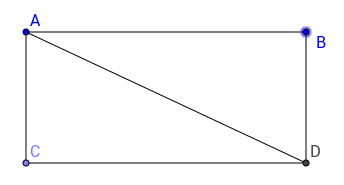
What is the length of the diagonal of rectangle  ?
?
(1) 
(2)  and
and 
What is the length of the diagonal of rectangle
(1)
(2)
Tap to reveal answer
In order to find the diagonal, we must know the sides of the rectangle or know whether the triangles ADC or ABD have special angles.
Statement 1 alone doesn't let us calculate the hypothenuse of the triangles, because we only know one side.
Statement 2 alone is sufficient because it allows us to find all angles of the triangles inside of the rectangle. We can see that they are special triangles with angles 30-60-90. Any triangle with these angles will have its sides in ratio  , where
  is a constant. Here,
  , knowing this, we can calculate the length of the hypothenuse, also the diagonal, which will be
  .
.
Hence, statement 2 is sufficient.
In order to find the diagonal, we must know the sides of the rectangle or know whether the triangles ADC or ABD have special angles.
Statement 1 alone doesn't let us calculate the hypothenuse of the triangles, because we only know one side.
Statement 2 alone is sufficient because it allows us to find all angles of the triangles inside of the rectangle. We can see that they are special triangles with angles 30-60-90. Any triangle with these angles will have its sides in ratio
Hence, statement 2 is sufficient.
← Didn't Know|Knew It →
Rectangle  has a perimeter of
  , what is its area?
I) The diagonal of  is
is  inches.
II) The length of one side is  inches.
Rectangle
I) The diagonal of
II) The length of one side is
Tap to reveal answer
I) Gives us the length of ASOF's diagonal. This by itself does not give us any way of finding the other sides.
II) Gives us one side length. From there we can use the perimeter to find the other side length and then the area.
Therefore, Statement II is sufficient to answer the question.
I) Gives us the length of ASOF's diagonal. This by itself does not give us any way of finding the other sides.
II) Gives us one side length. From there we can use the perimeter to find the other side length and then the area.
Therefore, Statement II is sufficient to answer the question.
← Didn't Know|Knew It →
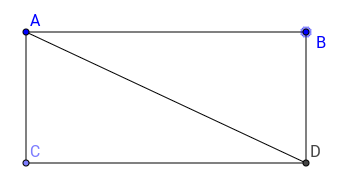
Rectangle  , has diagonal
  . What is the length of
  ?
?
(1) Angle  .
.
(2)  .
.
Rectangle
(1) Angle
(2)
Tap to reveal answer
The length of a diagonal of a rectangle can be calculated like a hypotenuse using the Pythagorean Theorem provided we have information about the lengths of the rectangle.
Statement 1 tells us that both triangles ADC and ABD have their angles in ratio  , which means that their sides will have length in ratio
  , where
  is a constant. We can't tell however what length the diagonal will be.
Statment 2 tells us that side AC is 1. From there we can't conclude anything. Indeed, rectangle ABCD might as well be a square or a very thin rectangle, we don't know.
Both statements together however, allow us to tell that  and therefore that the diagonal will be 2.
Hence, both statements together are sufficient.
The length of a diagonal of a rectangle can be calculated like a hypotenuse using the Pythagorean Theorem provided we have information about the lengths of the rectangle.
Statement 1 tells us that both triangles ADC and ABD have their angles in ratio
Statment 2 tells us that side AC is 1. From there we can't conclude anything. Indeed, rectangle ABCD might as well be a square or a very thin rectangle, we don't know.
Both statements together however, allow us to tell that
Hence, both statements together are sufficient.
← Didn't Know|Knew It →
 is a rectangle. What is the ratio
  ?
?
(1)  .
.
(2)  .
.
(1)
(2)
Tap to reveal answer
To solve this, we need information about the lengths of the sides or to whether triangles ADB and ACD are special triangles.
Statement 1 tells us that CDA has length 3. This is not enough and we still don't know whether the rectangle is of a special type of rectangle.
Statement 2 tells us that triangles ADB and ACD are special triangles, indeed, they have their angles in ratio  . That means that their sides will be in ratio
  . Now we don't need to know what is constant
  , since it will cancel out in the ratio.
Therefore, statement 2 alone is sufficient.
To solve this, we need information about the lengths of the sides or to whether triangles ADB and ACD are special triangles.
Statement 1 tells us that CDA has length 3. This is not enough and we still don't know whether the rectangle is of a special type of rectangle.
Statement 2 tells us that triangles ADB and ACD are special triangles, indeed, they have their angles in ratio
Therefore, statement 2 alone is sufficient.
← Didn't Know|Knew It →
Find the diagonal of rectangle  .
.
I) The area of  is
is  .
.
II) The perimeter of  is
is  .
.
Find the diagonal of rectangle
I) The area of
II) The perimeter of
Tap to reveal answer
In order to find the diagonal of a rectangle we need the length of both sides.
We can't find the lengths with just the area or just the perimeter, but by using them both together we can make a small system of equations with two unknowns and two equations.
Then we can solve for each side and use the Pythagorean Theorem to find our diagonal.
In order to find the diagonal of a rectangle we need the length of both sides.
We can't find the lengths with just the area or just the perimeter, but by using them both together we can make a small system of equations with two unknowns and two equations.
Then we can solve for each side and use the Pythagorean Theorem to find our diagonal.
← Didn't Know|Knew It →
What is the length of the diagonal of rectangle ?
(1)
(2) and
What is the length of the diagonal of rectangle
(1)
(2)
Tap to reveal answer
In order to find the diagonal, we must know the sides of the rectangle or know whether the triangles ADC or ABD have special angles.
Statement 1 alone doesn't let us calculate the hypothenuse of the triangles, because we only know one side.
Statement 2 alone is sufficient because it allows us to find all angles of the triangles inside of the rectangle. We can see that they are special triangles with angles 30-60-90. Any triangle with these angles will have its sides in ratio , where is a constant. Here, , knowing this, we can calculate the length of the hypothenuse, also the diagonal, which will be .
Hence, statement 2 is sufficient.
In order to find the diagonal, we must know the sides of the rectangle or know whether the triangles ADC or ABD have special angles.
Statement 1 alone doesn't let us calculate the hypothenuse of the triangles, because we only know one side.
Statement 2 alone is sufficient because it allows us to find all angles of the triangles inside of the rectangle. We can see that they are special triangles with angles 30-60-90. Any triangle with these angles will have its sides in ratio
Hence, statement 2 is sufficient.
← Didn't Know|Knew It →
Rectangle has a perimeter of , what is its area?
I) The diagonal of is inches.
II) The length of one side is inches.
Rectangle
I) The diagonal of
II) The length of one side is
Tap to reveal answer
I) Gives us the length of ASOF's diagonal. This by itself does not give us any way of finding the other sides.
II) Gives us one side length. From there we can use the perimeter to find the other side length and then the area.
Therefore, Statement II is sufficient to answer the question.
I) Gives us the length of ASOF's diagonal. This by itself does not give us any way of finding the other sides.
II) Gives us one side length. From there we can use the perimeter to find the other side length and then the area.
Therefore, Statement II is sufficient to answer the question.
← Didn't Know|Knew It →
Rectangle , has diagonal . What is the length of ?
(1) Angle .
(2) .
Rectangle
(1) Angle
(2)
Tap to reveal answer
The length of a diagonal of a rectangle can be calculated like a hypotenuse using the Pythagorean Theorem provided we have information about the lengths of the rectangle.
Statement 1 tells us that both triangles ADC and ABD have their angles in ratio , which means that their sides will have length in ratio , where is a constant. We can't tell however what length the diagonal will be.
Statment 2 tells us that side AC is 1. From there we can't conclude anything. Indeed, rectangle ABCD might as well be a square or a very thin rectangle, we don't know.
Both statements together however, allow us to tell that and therefore that the diagonal will be 2.
Hence, both statements together are sufficient.
The length of a diagonal of a rectangle can be calculated like a hypotenuse using the Pythagorean Theorem provided we have information about the lengths of the rectangle.
Statement 1 tells us that both triangles ADC and ABD have their angles in ratio
Statment 2 tells us that side AC is 1. From there we can't conclude anything. Indeed, rectangle ABCD might as well be a square or a very thin rectangle, we don't know.
Both statements together however, allow us to tell that
Hence, both statements together are sufficient.
← Didn't Know|Knew It →
is a rectangle. What is the ratio ?
(1) .
(2) .
(1)
(2)
Tap to reveal answer
To solve this, we need information about the lengths of the sides or to whether triangles ADB and ACD are special triangles.
Statement 1 tells us that CDA has length 3. This is not enough and we still don't know whether the rectangle is of a special type of rectangle.
Statement 2 tells us that triangles ADB and ACD are special triangles, indeed, they have their angles in ratio . That means that their sides will be in ratio . Now we don't need to know what is constant , since it will cancel out in the ratio.
Therefore, statement 2 alone is sufficient.
To solve this, we need information about the lengths of the sides or to whether triangles ADB and ACD are special triangles.
Statement 1 tells us that CDA has length 3. This is not enough and we still don't know whether the rectangle is of a special type of rectangle.
Statement 2 tells us that triangles ADB and ACD are special triangles, indeed, they have their angles in ratio
Therefore, statement 2 alone is sufficient.
← Didn't Know|Knew It →
Find the diagonal of rectangle .
I) The area of is .
II) The perimeter of is .
Find the diagonal of rectangle
I) The area of
II) The perimeter of
Tap to reveal answer
In order to find the diagonal of a rectangle we need the length of both sides.
We can't find the lengths with just the area or just the perimeter, but by using them both together we can make a small system of equations with two unknowns and two equations.
Then we can solve for each side and use the Pythagorean Theorem to find our diagonal.
In order to find the diagonal of a rectangle we need the length of both sides.
We can't find the lengths with just the area or just the perimeter, but by using them both together we can make a small system of equations with two unknowns and two equations.
Then we can solve for each side and use the Pythagorean Theorem to find our diagonal.
← Didn't Know|Knew It →
What is the length of the diagonal of rectangle ?
(1)
(2) and
What is the length of the diagonal of rectangle
(1)
(2)
Tap to reveal answer
In order to find the diagonal, we must know the sides of the rectangle or know whether the triangles ADC or ABD have special angles.
Statement 1 alone doesn't let us calculate the hypothenuse of the triangles, because we only know one side.
Statement 2 alone is sufficient because it allows us to find all angles of the triangles inside of the rectangle. We can see that they are special triangles with angles 30-60-90. Any triangle with these angles will have its sides in ratio , where is a constant. Here, , knowing this, we can calculate the length of the hypothenuse, also the diagonal, which will be .
Hence, statement 2 is sufficient.
In order to find the diagonal, we must know the sides of the rectangle or know whether the triangles ADC or ABD have special angles.
Statement 1 alone doesn't let us calculate the hypothenuse of the triangles, because we only know one side.
Statement 2 alone is sufficient because it allows us to find all angles of the triangles inside of the rectangle. We can see that they are special triangles with angles 30-60-90. Any triangle with these angles will have its sides in ratio
Hence, statement 2 is sufficient.
← Didn't Know|Knew It →
Rectangle has a perimeter of , what is its area?
I) The diagonal of is inches.
II) The length of one side is inches.
Rectangle
I) The diagonal of
II) The length of one side is
Tap to reveal answer
I) Gives us the length of ASOF's diagonal. This by itself does not give us any way of finding the other sides.
II) Gives us one side length. From there we can use the perimeter to find the other side length and then the area.
Therefore, Statement II is sufficient to answer the question.
I) Gives us the length of ASOF's diagonal. This by itself does not give us any way of finding the other sides.
II) Gives us one side length. From there we can use the perimeter to find the other side length and then the area.
Therefore, Statement II is sufficient to answer the question.
← Didn't Know|Knew It →
Rectangle , has diagonal . What is the length of ?
(1) Angle .
(2) .
Rectangle
(1) Angle
(2)
Tap to reveal answer
The length of a diagonal of a rectangle can be calculated like a hypotenuse using the Pythagorean Theorem provided we have information about the lengths of the rectangle.
Statement 1 tells us that both triangles ADC and ABD have their angles in ratio , which means that their sides will have length in ratio , where is a constant. We can't tell however what length the diagonal will be.
Statment 2 tells us that side AC is 1. From there we can't conclude anything. Indeed, rectangle ABCD might as well be a square or a very thin rectangle, we don't know.
Both statements together however, allow us to tell that and therefore that the diagonal will be 2.
Hence, both statements together are sufficient.
The length of a diagonal of a rectangle can be calculated like a hypotenuse using the Pythagorean Theorem provided we have information about the lengths of the rectangle.
Statement 1 tells us that both triangles ADC and ABD have their angles in ratio
Statment 2 tells us that side AC is 1. From there we can't conclude anything. Indeed, rectangle ABCD might as well be a square or a very thin rectangle, we don't know.
Both statements together however, allow us to tell that
Hence, both statements together are sufficient.
← Didn't Know|Knew It →
is a rectangle. What is the ratio ?
(1) .
(2) .
(1)
(2)
Tap to reveal answer
To solve this, we need information about the lengths of the sides or to whether triangles ADB and ACD are special triangles.
Statement 1 tells us that CDA has length 3. This is not enough and we still don't know whether the rectangle is of a special type of rectangle.
Statement 2 tells us that triangles ADB and ACD are special triangles, indeed, they have their angles in ratio . That means that their sides will be in ratio . Now we don't need to know what is constant , since it will cancel out in the ratio.
Therefore, statement 2 alone is sufficient.
To solve this, we need information about the lengths of the sides or to whether triangles ADB and ACD are special triangles.
Statement 1 tells us that CDA has length 3. This is not enough and we still don't know whether the rectangle is of a special type of rectangle.
Statement 2 tells us that triangles ADB and ACD are special triangles, indeed, they have their angles in ratio
Therefore, statement 2 alone is sufficient.
← Didn't Know|Knew It →
Find the diagonal of rectangle .
I) The area of is .
II) The perimeter of is .
Find the diagonal of rectangle
I) The area of
II) The perimeter of
Tap to reveal answer
In order to find the diagonal of a rectangle we need the length of both sides.
We can't find the lengths with just the area or just the perimeter, but by using them both together we can make a small system of equations with two unknowns and two equations.
Then we can solve for each side and use the Pythagorean Theorem to find our diagonal.
In order to find the diagonal of a rectangle we need the length of both sides.
We can't find the lengths with just the area or just the perimeter, but by using them both together we can make a small system of equations with two unknowns and two equations.
Then we can solve for each side and use the Pythagorean Theorem to find our diagonal.
← Didn't Know|Knew It →
What is the length of the diagonal of rectangle ?
(1)
(2) and
What is the length of the diagonal of rectangle
(1)
(2)
Tap to reveal answer
In order to find the diagonal, we must know the sides of the rectangle or know whether the triangles ADC or ABD have special angles.
Statement 1 alone doesn't let us calculate the hypothenuse of the triangles, because we only know one side.
Statement 2 alone is sufficient because it allows us to find all angles of the triangles inside of the rectangle. We can see that they are special triangles with angles 30-60-90. Any triangle with these angles will have its sides in ratio , where is a constant. Here, , knowing this, we can calculate the length of the hypothenuse, also the diagonal, which will be .
Hence, statement 2 is sufficient.
In order to find the diagonal, we must know the sides of the rectangle or know whether the triangles ADC or ABD have special angles.
Statement 1 alone doesn't let us calculate the hypothenuse of the triangles, because we only know one side.
Statement 2 alone is sufficient because it allows us to find all angles of the triangles inside of the rectangle. We can see that they are special triangles with angles 30-60-90. Any triangle with these angles will have its sides in ratio
Hence, statement 2 is sufficient.
← Didn't Know|Knew It →
Rectangle has a perimeter of , what is its area?
I) The diagonal of is inches.
II) The length of one side is inches.
Rectangle
I) The diagonal of
II) The length of one side is
Tap to reveal answer
I) Gives us the length of ASOF's diagonal. This by itself does not give us any way of finding the other sides.
II) Gives us one side length. From there we can use the perimeter to find the other side length and then the area.
Therefore, Statement II is sufficient to answer the question.
I) Gives us the length of ASOF's diagonal. This by itself does not give us any way of finding the other sides.
II) Gives us one side length. From there we can use the perimeter to find the other side length and then the area.
Therefore, Statement II is sufficient to answer the question.
← Didn't Know|Knew It →
Rectangle , has diagonal . What is the length of ?
(1) Angle .
(2) .
Rectangle
(1) Angle
(2)
Tap to reveal answer
The length of a diagonal of a rectangle can be calculated like a hypotenuse using the Pythagorean Theorem provided we have information about the lengths of the rectangle.
Statement 1 tells us that both triangles ADC and ABD have their angles in ratio , which means that their sides will have length in ratio , where is a constant. We can't tell however what length the diagonal will be.
Statment 2 tells us that side AC is 1. From there we can't conclude anything. Indeed, rectangle ABCD might as well be a square or a very thin rectangle, we don't know.
Both statements together however, allow us to tell that and therefore that the diagonal will be 2.
Hence, both statements together are sufficient.
The length of a diagonal of a rectangle can be calculated like a hypotenuse using the Pythagorean Theorem provided we have information about the lengths of the rectangle.
Statement 1 tells us that both triangles ADC and ABD have their angles in ratio
Statment 2 tells us that side AC is 1. From there we can't conclude anything. Indeed, rectangle ABCD might as well be a square or a very thin rectangle, we don't know.
Both statements together however, allow us to tell that
Hence, both statements together are sufficient.
← Didn't Know|Knew It →
is a rectangle. What is the ratio ?
(1) .
(2) .
(1)
(2)
Tap to reveal answer
To solve this, we need information about the lengths of the sides or to whether triangles ADB and ACD are special triangles.
Statement 1 tells us that CDA has length 3. This is not enough and we still don't know whether the rectangle is of a special type of rectangle.
Statement 2 tells us that triangles ADB and ACD are special triangles, indeed, they have their angles in ratio . That means that their sides will be in ratio . Now we don't need to know what is constant , since it will cancel out in the ratio.
Therefore, statement 2 alone is sufficient.
To solve this, we need information about the lengths of the sides or to whether triangles ADB and ACD are special triangles.
Statement 1 tells us that CDA has length 3. This is not enough and we still don't know whether the rectangle is of a special type of rectangle.
Statement 2 tells us that triangles ADB and ACD are special triangles, indeed, they have their angles in ratio
Therefore, statement 2 alone is sufficient.
← Didn't Know|Knew It →
Find the diagonal of rectangle .
I) The area of is .
II) The perimeter of is .
Find the diagonal of rectangle
I) The area of
II) The perimeter of
Tap to reveal answer
In order to find the diagonal of a rectangle we need the length of both sides.
We can't find the lengths with just the area or just the perimeter, but by using them both together we can make a small system of equations with two unknowns and two equations.
Then we can solve for each side and use the Pythagorean Theorem to find our diagonal.
In order to find the diagonal of a rectangle we need the length of both sides.
We can't find the lengths with just the area or just the perimeter, but by using them both together we can make a small system of equations with two unknowns and two equations.
Then we can solve for each side and use the Pythagorean Theorem to find our diagonal.
← Didn't Know|Knew It →