DSQ: Calculating the length of the side of a square - GMAT Quantitative
Card 1 of 48
Is Rectangle  a square?
Statement 1: 
Statement 2: 
Is Rectangle
Statement 1:
Statement 2:
Tap to reveal answer
A rectangle, by definition, is a parallelogram. Statement 1 asserts that the diagonals of this parallelogram are perpendicular. Statement 2 asserts that adjacent sides of the parallelogram are congruent, so, since opposite sides are also congruent, this makes all four sides congruent. From either statement alone, it can be deduced that Rectangle  is a rhombus. A figure that is a rectangle and a rhombus is by definition a square.
A rectangle, by definition, is a parallelogram. Statement 1 asserts that the diagonals of this parallelogram are perpendicular. Statement 2 asserts that adjacent sides of the parallelogram are congruent, so, since opposite sides are also congruent, this makes all four sides congruent. From either statement alone, it can be deduced that Rectangle
← Didn't Know|Knew It →
Find the side length of square R.
I) The area of square R is  .
.
II) The perimeter of square R is  .
.
Find the side length of square R.
I) The area of square R is
II) The perimeter of square R is
Tap to reveal answer
Consider the following equations:


Where a is area, p is perimeter, and s is side length
We can find the side length with either our area or our perimeter.
Thus, we only need one statment or the other.
Consider the following equations:
Where a is area, p is perimeter, and s is side length
We can find the side length with either our area or our perimeter.
Thus, we only need one statment or the other.
← Didn't Know|Knew It →
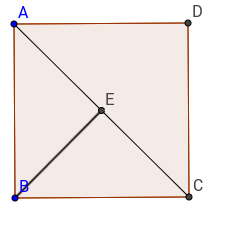
What is the length of the side of square  , knowing that
  is the midpoint of diagonal
  ?
?
(1) 
(2) 
What is the length of the side of square
(1)
(2)
Tap to reveal answer
Since ABCD is a square, we just need to know the length of the diagonale to find the length of the side. BE is half the diagonal, therefore knowing its length would help us find the length of the sides.
Statement 1 tells us the length of BE, therefore, with the formula  where
where  is the diagonal and
  the length of side, we can find the length of the side.
Statement 2 tells us that triangle AEB is isoceles, but it is something we could already have known from the beginning since we are told that E is the midpoint of the diagonal.
Therefore, statement 1 alone is sufficient.
Since ABCD is a square, we just need to know the length of the diagonale to find the length of the side. BE is half the diagonal, therefore knowing its length would help us find the length of the sides.
Statement 1 tells us the length of BE, therefore, with the formula
Statement 2 tells us that triangle AEB is isoceles, but it is something we could already have known from the beginning since we are told that E is the midpoint of the diagonal.
Therefore, statement 1 alone is sufficient.
← Didn't Know|Knew It →
Find the area of square  .
.
I)  has a diagonal of
  inches.
II)  has a perimeter of
  inches.
Find the area of square
I)
II)
Tap to reveal answer
To find the area of a square we need to find its side length.
In a square, the diagonal allows us to find the other two sides. The diagonal of a square creates two 45/45/90 triangles with special side length ratios.
I) Gives us the diagonal, which we can use to find the side length, which will then help us find the area.
II) Perimeter of a square allows us to find side length, which in turn lets us find area.
So, either statement is sufficient.
To find the area of a square we need to find its side length.
In a square, the diagonal allows us to find the other two sides. The diagonal of a square creates two 45/45/90 triangles with special side length ratios.
I) Gives us the diagonal, which we can use to find the side length, which will then help us find the area.
II) Perimeter of a square allows us to find side length, which in turn lets us find area.
So, either statement is sufficient.
← Didn't Know|Knew It →
Find the length of the quadrilateral.
Statement 1.) The area of a quadrilateral is  .
.
Statement 2.) All interior angles of a quadrilateral are right angles.
Find the length of the quadrilateral.
Statement 1.) The area of a quadrilateral is
Statement 2.) All interior angles of a quadrilateral are right angles.
Tap to reveal answer
Statement 1) mentions that the area of a quadrilateral is 4. This statement is insufficient to solve for the length of the square because the family of quadrilaterals include any 4-sided shape with 4 interior angles. Examples of quadrilaterals are squares, rectangles, rhombus, and trapezoids, but the quadrilateral is not necessarily a square.
Statement 2) mentions that all four interior angles of a quadrilateral are right angles. This narrows down the shape to either a square or a rectangle. Both shapes have 4 right angles, but there is not enough information to determine if the shape is a square or a rectangle.
Therefore, neither statement is sufficient to solve for the length of a quadrilateral.
Statement 1) mentions that the area of a quadrilateral is 4. This statement is insufficient to solve for the length of the square because the family of quadrilaterals include any 4-sided shape with 4 interior angles. Examples of quadrilaterals are squares, rectangles, rhombus, and trapezoids, but the quadrilateral is not necessarily a square.
Statement 2) mentions that all four interior angles of a quadrilateral are right angles. This narrows down the shape to either a square or a rectangle. Both shapes have 4 right angles, but there is not enough information to determine if the shape is a square or a rectangle.
Therefore, neither statement is sufficient to solve for the length of a quadrilateral.
← Didn't Know|Knew It →
Calculate the length of the square.
Statement 1): The area is  .
.
Statement 2): The diagonal is  .
.
Calculate the length of the square.
Statement 1): The area is
Statement 2): The diagonal is
Tap to reveal answer
Statement 1) gives the area of the square. For all positive real numbers, the formula,  , or
, or  , can be used to find either area or side length interchangeably.
Statement 2) mentions that the diagonal is 1, which is a positive real number. The formula  , can be used to also find the side length.
Either statement alone is sufficient to solve for the length of the square.
Statement 1) gives the area of the square. For all positive real numbers, the formula,
Statement 2) mentions that the diagonal is 1, which is a positive real number. The formula
Either statement alone is sufficient to solve for the length of the square.
← Didn't Know|Knew It →
Is Rectangle a square?
Statement 1:
Statement 2:
Is Rectangle
Statement 1:
Statement 2:
Tap to reveal answer
A rectangle, by definition, is a parallelogram. Statement 1 asserts that the diagonals of this parallelogram are perpendicular. Statement 2 asserts that adjacent sides of the parallelogram are congruent, so, since opposite sides are also congruent, this makes all four sides congruent. From either statement alone, it can be deduced that Rectangle is a rhombus. A figure that is a rectangle and a rhombus is by definition a square.
A rectangle, by definition, is a parallelogram. Statement 1 asserts that the diagonals of this parallelogram are perpendicular. Statement 2 asserts that adjacent sides of the parallelogram are congruent, so, since opposite sides are also congruent, this makes all four sides congruent. From either statement alone, it can be deduced that Rectangle
← Didn't Know|Knew It →
Find the side length of square R.
I) The area of square R is .
II) The perimeter of square R is .
Find the side length of square R.
I) The area of square R is
II) The perimeter of square R is
Tap to reveal answer
Consider the following equations:
Where a is area, p is perimeter, and s is side length
We can find the side length with either our area or our perimeter.
Thus, we only need one statment or the other.
Consider the following equations:
Where a is area, p is perimeter, and s is side length
We can find the side length with either our area or our perimeter.
Thus, we only need one statment or the other.
← Didn't Know|Knew It →
What is the length of the side of square , knowing that is the midpoint of diagonal ?
(1)
(2)
What is the length of the side of square
(1)
(2)
Tap to reveal answer
Since ABCD is a square, we just need to know the length of the diagonale to find the length of the side. BE is half the diagonal, therefore knowing its length would help us find the length of the sides.
Statement 1 tells us the length of BE, therefore, with the formula where is the diagonal and the length of side, we can find the length of the side.
Statement 2 tells us that triangle AEB is isoceles, but it is something we could already have known from the beginning since we are told that E is the midpoint of the diagonal.
Therefore, statement 1 alone is sufficient.
Since ABCD is a square, we just need to know the length of the diagonale to find the length of the side. BE is half the diagonal, therefore knowing its length would help us find the length of the sides.
Statement 1 tells us the length of BE, therefore, with the formula
Statement 2 tells us that triangle AEB is isoceles, but it is something we could already have known from the beginning since we are told that E is the midpoint of the diagonal.
Therefore, statement 1 alone is sufficient.
← Didn't Know|Knew It →
Find the area of square .
I) has a diagonal of inches.
II) has a perimeter of inches.
Find the area of square
I)
II)
Tap to reveal answer
To find the area of a square we need to find its side length.
In a square, the diagonal allows us to find the other two sides. The diagonal of a square creates two 45/45/90 triangles with special side length ratios.
I) Gives us the diagonal, which we can use to find the side length, which will then help us find the area.
II) Perimeter of a square allows us to find side length, which in turn lets us find area.
So, either statement is sufficient.
To find the area of a square we need to find its side length.
In a square, the diagonal allows us to find the other two sides. The diagonal of a square creates two 45/45/90 triangles with special side length ratios.
I) Gives us the diagonal, which we can use to find the side length, which will then help us find the area.
II) Perimeter of a square allows us to find side length, which in turn lets us find area.
So, either statement is sufficient.
← Didn't Know|Knew It →
Find the length of the quadrilateral.
Statement 1.) The area of a quadrilateral is .
Statement 2.) All interior angles of a quadrilateral are right angles.
Find the length of the quadrilateral.
Statement 1.) The area of a quadrilateral is
Statement 2.) All interior angles of a quadrilateral are right angles.
Tap to reveal answer
Statement 1) mentions that the area of a quadrilateral is 4. This statement is insufficient to solve for the length of the square because the family of quadrilaterals include any 4-sided shape with 4 interior angles. Examples of quadrilaterals are squares, rectangles, rhombus, and trapezoids, but the quadrilateral is not necessarily a square.
Statement 2) mentions that all four interior angles of a quadrilateral are right angles. This narrows down the shape to either a square or a rectangle. Both shapes have 4 right angles, but there is not enough information to determine if the shape is a square or a rectangle.
Therefore, neither statement is sufficient to solve for the length of a quadrilateral.
Statement 1) mentions that the area of a quadrilateral is 4. This statement is insufficient to solve for the length of the square because the family of quadrilaterals include any 4-sided shape with 4 interior angles. Examples of quadrilaterals are squares, rectangles, rhombus, and trapezoids, but the quadrilateral is not necessarily a square.
Statement 2) mentions that all four interior angles of a quadrilateral are right angles. This narrows down the shape to either a square or a rectangle. Both shapes have 4 right angles, but there is not enough information to determine if the shape is a square or a rectangle.
Therefore, neither statement is sufficient to solve for the length of a quadrilateral.
← Didn't Know|Knew It →
Calculate the length of the square.
Statement 1): The area is .
Statement 2): The diagonal is .
Calculate the length of the square.
Statement 1): The area is
Statement 2): The diagonal is
Tap to reveal answer
Statement 1) gives the area of the square. For all positive real numbers, the formula, , or , can be used to find either area or side length interchangeably.
Statement 2) mentions that the diagonal is 1, which is a positive real number. The formula , can be used to also find the side length.
Either statement alone is sufficient to solve for the length of the square.
Statement 1) gives the area of the square. For all positive real numbers, the formula,
Statement 2) mentions that the diagonal is 1, which is a positive real number. The formula
Either statement alone is sufficient to solve for the length of the square.
← Didn't Know|Knew It →
Is Rectangle a square?
Statement 1:
Statement 2:
Is Rectangle
Statement 1:
Statement 2:
Tap to reveal answer
A rectangle, by definition, is a parallelogram. Statement 1 asserts that the diagonals of this parallelogram are perpendicular. Statement 2 asserts that adjacent sides of the parallelogram are congruent, so, since opposite sides are also congruent, this makes all four sides congruent. From either statement alone, it can be deduced that Rectangle is a rhombus. A figure that is a rectangle and a rhombus is by definition a square.
A rectangle, by definition, is a parallelogram. Statement 1 asserts that the diagonals of this parallelogram are perpendicular. Statement 2 asserts that adjacent sides of the parallelogram are congruent, so, since opposite sides are also congruent, this makes all four sides congruent. From either statement alone, it can be deduced that Rectangle
← Didn't Know|Knew It →
Find the side length of square R.
I) The area of square R is .
II) The perimeter of square R is .
Find the side length of square R.
I) The area of square R is
II) The perimeter of square R is
Tap to reveal answer
Consider the following equations:
Where a is area, p is perimeter, and s is side length
We can find the side length with either our area or our perimeter.
Thus, we only need one statment or the other.
Consider the following equations:
Where a is area, p is perimeter, and s is side length
We can find the side length with either our area or our perimeter.
Thus, we only need one statment or the other.
← Didn't Know|Knew It →
What is the length of the side of square , knowing that is the midpoint of diagonal ?
(1)
(2)
What is the length of the side of square
(1)
(2)
Tap to reveal answer
Since ABCD is a square, we just need to know the length of the diagonale to find the length of the side. BE is half the diagonal, therefore knowing its length would help us find the length of the sides.
Statement 1 tells us the length of BE, therefore, with the formula where is the diagonal and the length of side, we can find the length of the side.
Statement 2 tells us that triangle AEB is isoceles, but it is something we could already have known from the beginning since we are told that E is the midpoint of the diagonal.
Therefore, statement 1 alone is sufficient.
Since ABCD is a square, we just need to know the length of the diagonale to find the length of the side. BE is half the diagonal, therefore knowing its length would help us find the length of the sides.
Statement 1 tells us the length of BE, therefore, with the formula
Statement 2 tells us that triangle AEB is isoceles, but it is something we could already have known from the beginning since we are told that E is the midpoint of the diagonal.
Therefore, statement 1 alone is sufficient.
← Didn't Know|Knew It →
Find the area of square .
I) has a diagonal of inches.
II) has a perimeter of inches.
Find the area of square
I)
II)
Tap to reveal answer
To find the area of a square we need to find its side length.
In a square, the diagonal allows us to find the other two sides. The diagonal of a square creates two 45/45/90 triangles with special side length ratios.
I) Gives us the diagonal, which we can use to find the side length, which will then help us find the area.
II) Perimeter of a square allows us to find side length, which in turn lets us find area.
So, either statement is sufficient.
To find the area of a square we need to find its side length.
In a square, the diagonal allows us to find the other two sides. The diagonal of a square creates two 45/45/90 triangles with special side length ratios.
I) Gives us the diagonal, which we can use to find the side length, which will then help us find the area.
II) Perimeter of a square allows us to find side length, which in turn lets us find area.
So, either statement is sufficient.
← Didn't Know|Knew It →
Find the length of the quadrilateral.
Statement 1.) The area of a quadrilateral is .
Statement 2.) All interior angles of a quadrilateral are right angles.
Find the length of the quadrilateral.
Statement 1.) The area of a quadrilateral is
Statement 2.) All interior angles of a quadrilateral are right angles.
Tap to reveal answer
Statement 1) mentions that the area of a quadrilateral is 4. This statement is insufficient to solve for the length of the square because the family of quadrilaterals include any 4-sided shape with 4 interior angles. Examples of quadrilaterals are squares, rectangles, rhombus, and trapezoids, but the quadrilateral is not necessarily a square.
Statement 2) mentions that all four interior angles of a quadrilateral are right angles. This narrows down the shape to either a square or a rectangle. Both shapes have 4 right angles, but there is not enough information to determine if the shape is a square or a rectangle.
Therefore, neither statement is sufficient to solve for the length of a quadrilateral.
Statement 1) mentions that the area of a quadrilateral is 4. This statement is insufficient to solve for the length of the square because the family of quadrilaterals include any 4-sided shape with 4 interior angles. Examples of quadrilaterals are squares, rectangles, rhombus, and trapezoids, but the quadrilateral is not necessarily a square.
Statement 2) mentions that all four interior angles of a quadrilateral are right angles. This narrows down the shape to either a square or a rectangle. Both shapes have 4 right angles, but there is not enough information to determine if the shape is a square or a rectangle.
Therefore, neither statement is sufficient to solve for the length of a quadrilateral.
← Didn't Know|Knew It →
Calculate the length of the square.
Statement 1): The area is .
Statement 2): The diagonal is .
Calculate the length of the square.
Statement 1): The area is
Statement 2): The diagonal is
Tap to reveal answer
Statement 1) gives the area of the square. For all positive real numbers, the formula, , or , can be used to find either area or side length interchangeably.
Statement 2) mentions that the diagonal is 1, which is a positive real number. The formula , can be used to also find the side length.
Either statement alone is sufficient to solve for the length of the square.
Statement 1) gives the area of the square. For all positive real numbers, the formula,
Statement 2) mentions that the diagonal is 1, which is a positive real number. The formula
Either statement alone is sufficient to solve for the length of the square.
← Didn't Know|Knew It →
Is Rectangle a square?
Statement 1:
Statement 2:
Is Rectangle
Statement 1:
Statement 2:
Tap to reveal answer
A rectangle, by definition, is a parallelogram. Statement 1 asserts that the diagonals of this parallelogram are perpendicular. Statement 2 asserts that adjacent sides of the parallelogram are congruent, so, since opposite sides are also congruent, this makes all four sides congruent. From either statement alone, it can be deduced that Rectangle is a rhombus. A figure that is a rectangle and a rhombus is by definition a square.
A rectangle, by definition, is a parallelogram. Statement 1 asserts that the diagonals of this parallelogram are perpendicular. Statement 2 asserts that adjacent sides of the parallelogram are congruent, so, since opposite sides are also congruent, this makes all four sides congruent. From either statement alone, it can be deduced that Rectangle
← Didn't Know|Knew It →
Find the side length of square R.
I) The area of square R is .
II) The perimeter of square R is .
Find the side length of square R.
I) The area of square R is
II) The perimeter of square R is
Tap to reveal answer
Consider the following equations:
Where a is area, p is perimeter, and s is side length
We can find the side length with either our area or our perimeter.
Thus, we only need one statment or the other.
Consider the following equations:
Where a is area, p is perimeter, and s is side length
We can find the side length with either our area or our perimeter.
Thus, we only need one statment or the other.
← Didn't Know|Knew It →