DSQ: Calculating the surface area of a tetrahedron - GMAT Quantitative
Card 1 of 16
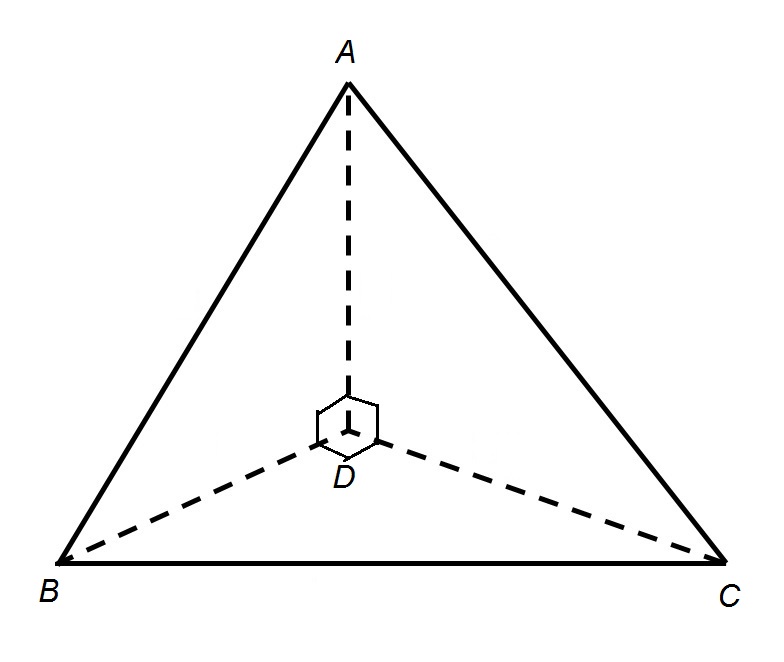
Note: Figure NOT drawn to scale.
Refer to the above tetrahedron or triangular pyramid.  .
.
Calculate the surface area of the tetrahedron.
Statement 1:  has perimeter 60.
Statement 2:  has area 100.
Note: Figure NOT drawn to scale.
Refer to the above tetrahedron or triangular pyramid.
Calculate the surface area of the tetrahedron.
Statement 1:
Statement 2:
Tap to reveal answer
 ,
,  , and
, and  , all being right triangles with the same leg lengths, are congruent, and, consequently, their diagonals are congruent, making
  equilateral.
Assume Statement 1 alone. The sidelength of equilateral is one third of its perimeter of 60, or 20. This is also the common length of the hypotenuses of isoseles right triangles , , and , so by the 45-45-90 Theorem, each leg length can be computed by dividing 20 by  :
:

Assume Statement 2 alone. has area 100; since the area of a right triangle is half the product of the lengths of its legs, we can find the common leg length using this formula:



This is the common length of the legs of the three right triangles; by the 45-45-90 Theorem, each hypotenuse - and each side of equilateral - is  times this, or
  .
.
Therefore, from either statement alone, the lengths of all sides of the tetrahedron can be found, and the area formulas for a right triangle and an equilateral can be applied to find the areas of all four faces.
Assume Statement 1 alone. The sidelength of equilateral
Assume Statement 2 alone.
This is the common length of the legs of the three right triangles; by the 45-45-90 Theorem, each hypotenuse - and each side of equilateral
Therefore, from either statement alone, the lengths of all sides of the tetrahedron can be found, and the area formulas for a right triangle and an equilateral can be applied to find the areas of all four faces.
← Didn't Know|Knew It →
What is the surface area of the tetrahedron?
- The length of an edge measures
 .
.
- The volume of the tetrahedron is
 .
.
What is the surface area of the tetrahedron?
- The length of an edge measures
- The volume of the tetrahedron is
Tap to reveal answer
The surface area of a tetrahedron is found by  where
where  represents the edge value.
Situation 1: We're given our  value so we just need to plug it into our equation.


Situation 2: We use the given volume to solve for the length of the edge.
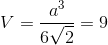

Now that we have a length, we can plug it into the equation for the surface area:

Thus, each statement alone is sufficient to answer the question.
The surface area of a tetrahedron is found by
Situation 1: We're given our
Situation 2: We use the given volume to solve for the length of the edge.
Now that we have a length, we can plug it into the equation for the surface area:
Thus, each statement alone is sufficient to answer the question.
← Didn't Know|Knew It →
Note: Figure NOT drawn to scale.
Refer to the above tetrahedron or triangular pyramid. .
Calculate the surface area of the tetrahedron.
Statement 1: has perimeter 60.
Statement 2: has area 100.
Note: Figure NOT drawn to scale.
Refer to the above tetrahedron or triangular pyramid.
Calculate the surface area of the tetrahedron.
Statement 1:
Statement 2:
Tap to reveal answer
, , and , all being right triangles with the same leg lengths, are congruent, and, consequently, their diagonals are congruent, making equilateral.
Assume Statement 1 alone. The sidelength of equilateral is one third of its perimeter of 60, or 20. This is also the common length of the hypotenuses of isoseles right triangles , , and , so by the 45-45-90 Theorem, each leg length can be computed by dividing 20 by :
Assume Statement 2 alone. has area 100; since the area of a right triangle is half the product of the lengths of its legs, we can find the common leg length using this formula:
This is the common length of the legs of the three right triangles; by the 45-45-90 Theorem, each hypotenuse - and each side of equilateral - is times this, or .
Therefore, from either statement alone, the lengths of all sides of the tetrahedron can be found, and the area formulas for a right triangle and an equilateral can be applied to find the areas of all four faces.
Assume Statement 1 alone. The sidelength of equilateral
Assume Statement 2 alone.
This is the common length of the legs of the three right triangles; by the 45-45-90 Theorem, each hypotenuse - and each side of equilateral
Therefore, from either statement alone, the lengths of all sides of the tetrahedron can be found, and the area formulas for a right triangle and an equilateral can be applied to find the areas of all four faces.
← Didn't Know|Knew It →
What is the surface area of the tetrahedron?
- The length of an edge measures .
- The volume of the tetrahedron is .
What is the surface area of the tetrahedron?
- The length of an edge measures
- The volume of the tetrahedron is
Tap to reveal answer
The surface area of a tetrahedron is found by where represents the edge value.
Situation 1: We're given our value so we just need to plug it into our equation.
Situation 2: We use the given volume to solve for the length of the edge.
Now that we have a length, we can plug it into the equation for the surface area:
Thus, each statement alone is sufficient to answer the question.
The surface area of a tetrahedron is found by
Situation 1: We're given our
Situation 2: We use the given volume to solve for the length of the edge.
Now that we have a length, we can plug it into the equation for the surface area:
Thus, each statement alone is sufficient to answer the question.
← Didn't Know|Knew It →
Note: Figure NOT drawn to scale.
Refer to the above tetrahedron or triangular pyramid. .
Calculate the surface area of the tetrahedron.
Statement 1: has perimeter 60.
Statement 2: has area 100.
Note: Figure NOT drawn to scale.
Refer to the above tetrahedron or triangular pyramid.
Calculate the surface area of the tetrahedron.
Statement 1:
Statement 2:
Tap to reveal answer
, , and , all being right triangles with the same leg lengths, are congruent, and, consequently, their diagonals are congruent, making equilateral.
Assume Statement 1 alone. The sidelength of equilateral is one third of its perimeter of 60, or 20. This is also the common length of the hypotenuses of isoseles right triangles , , and , so by the 45-45-90 Theorem, each leg length can be computed by dividing 20 by :
Assume Statement 2 alone. has area 100; since the area of a right triangle is half the product of the lengths of its legs, we can find the common leg length using this formula:
This is the common length of the legs of the three right triangles; by the 45-45-90 Theorem, each hypotenuse - and each side of equilateral - is times this, or .
Therefore, from either statement alone, the lengths of all sides of the tetrahedron can be found, and the area formulas for a right triangle and an equilateral can be applied to find the areas of all four faces.
Assume Statement 1 alone. The sidelength of equilateral
Assume Statement 2 alone.
This is the common length of the legs of the three right triangles; by the 45-45-90 Theorem, each hypotenuse - and each side of equilateral
Therefore, from either statement alone, the lengths of all sides of the tetrahedron can be found, and the area formulas for a right triangle and an equilateral can be applied to find the areas of all four faces.
← Didn't Know|Knew It →
What is the surface area of the tetrahedron?
- The length of an edge measures .
- The volume of the tetrahedron is .
What is the surface area of the tetrahedron?
- The length of an edge measures
- The volume of the tetrahedron is
Tap to reveal answer
The surface area of a tetrahedron is found by where represents the edge value.
Situation 1: We're given our value so we just need to plug it into our equation.
Situation 2: We use the given volume to solve for the length of the edge.
Now that we have a length, we can plug it into the equation for the surface area:
Thus, each statement alone is sufficient to answer the question.
The surface area of a tetrahedron is found by
Situation 1: We're given our
Situation 2: We use the given volume to solve for the length of the edge.
Now that we have a length, we can plug it into the equation for the surface area:
Thus, each statement alone is sufficient to answer the question.
← Didn't Know|Knew It →
Note: Figure NOT drawn to scale.
Refer to the above tetrahedron or triangular pyramid. .
Calculate the surface area of the tetrahedron.
Statement 1: has perimeter 60.
Statement 2: has area 100.
Note: Figure NOT drawn to scale.
Refer to the above tetrahedron or triangular pyramid.
Calculate the surface area of the tetrahedron.
Statement 1:
Statement 2:
Tap to reveal answer
, , and , all being right triangles with the same leg lengths, are congruent, and, consequently, their diagonals are congruent, making equilateral.
Assume Statement 1 alone. The sidelength of equilateral is one third of its perimeter of 60, or 20. This is also the common length of the hypotenuses of isoseles right triangles , , and , so by the 45-45-90 Theorem, each leg length can be computed by dividing 20 by :
Assume Statement 2 alone. has area 100; since the area of a right triangle is half the product of the lengths of its legs, we can find the common leg length using this formula:
This is the common length of the legs of the three right triangles; by the 45-45-90 Theorem, each hypotenuse - and each side of equilateral - is times this, or .
Therefore, from either statement alone, the lengths of all sides of the tetrahedron can be found, and the area formulas for a right triangle and an equilateral can be applied to find the areas of all four faces.
Assume Statement 1 alone. The sidelength of equilateral
Assume Statement 2 alone.
This is the common length of the legs of the three right triangles; by the 45-45-90 Theorem, each hypotenuse - and each side of equilateral
Therefore, from either statement alone, the lengths of all sides of the tetrahedron can be found, and the area formulas for a right triangle and an equilateral can be applied to find the areas of all four faces.
← Didn't Know|Knew It →
What is the surface area of the tetrahedron?
- The length of an edge measures .
- The volume of the tetrahedron is .
What is the surface area of the tetrahedron?
- The length of an edge measures
- The volume of the tetrahedron is
Tap to reveal answer
The surface area of a tetrahedron is found by where represents the edge value.
Situation 1: We're given our value so we just need to plug it into our equation.
Situation 2: We use the given volume to solve for the length of the edge.
Now that we have a length, we can plug it into the equation for the surface area:
Thus, each statement alone is sufficient to answer the question.
The surface area of a tetrahedron is found by
Situation 1: We're given our
Situation 2: We use the given volume to solve for the length of the edge.
Now that we have a length, we can plug it into the equation for the surface area:
Thus, each statement alone is sufficient to answer the question.
← Didn't Know|Knew It →
Note: Figure NOT drawn to scale.
Refer to the above tetrahedron or triangular pyramid. .
Calculate the surface area of the tetrahedron.
Statement 1: has perimeter 60.
Statement 2: has area 100.
Note: Figure NOT drawn to scale.
Refer to the above tetrahedron or triangular pyramid.
Calculate the surface area of the tetrahedron.
Statement 1:
Statement 2:
Tap to reveal answer
, , and , all being right triangles with the same leg lengths, are congruent, and, consequently, their diagonals are congruent, making equilateral.
Assume Statement 1 alone. The sidelength of equilateral is one third of its perimeter of 60, or 20. This is also the common length of the hypotenuses of isoseles right triangles , , and , so by the 45-45-90 Theorem, each leg length can be computed by dividing 20 by :
Assume Statement 2 alone. has area 100; since the area of a right triangle is half the product of the lengths of its legs, we can find the common leg length using this formula:
This is the common length of the legs of the three right triangles; by the 45-45-90 Theorem, each hypotenuse - and each side of equilateral - is times this, or .
Therefore, from either statement alone, the lengths of all sides of the tetrahedron can be found, and the area formulas for a right triangle and an equilateral can be applied to find the areas of all four faces.
Assume Statement 1 alone. The sidelength of equilateral
Assume Statement 2 alone.
This is the common length of the legs of the three right triangles; by the 45-45-90 Theorem, each hypotenuse - and each side of equilateral
Therefore, from either statement alone, the lengths of all sides of the tetrahedron can be found, and the area formulas for a right triangle and an equilateral can be applied to find the areas of all four faces.
← Didn't Know|Knew It →
What is the surface area of the tetrahedron?
- The length of an edge measures .
- The volume of the tetrahedron is .
What is the surface area of the tetrahedron?
- The length of an edge measures
- The volume of the tetrahedron is
Tap to reveal answer
The surface area of a tetrahedron is found by where represents the edge value.
Situation 1: We're given our value so we just need to plug it into our equation.
Situation 2: We use the given volume to solve for the length of the edge.
Now that we have a length, we can plug it into the equation for the surface area:
Thus, each statement alone is sufficient to answer the question.
The surface area of a tetrahedron is found by
Situation 1: We're given our
Situation 2: We use the given volume to solve for the length of the edge.
Now that we have a length, we can plug it into the equation for the surface area:
Thus, each statement alone is sufficient to answer the question.
← Didn't Know|Knew It →
Note: Figure NOT drawn to scale.
Refer to the above tetrahedron or triangular pyramid. .
Calculate the surface area of the tetrahedron.
Statement 1: has perimeter 60.
Statement 2: has area 100.
Note: Figure NOT drawn to scale.
Refer to the above tetrahedron or triangular pyramid.
Calculate the surface area of the tetrahedron.
Statement 1:
Statement 2:
Tap to reveal answer
, , and , all being right triangles with the same leg lengths, are congruent, and, consequently, their diagonals are congruent, making equilateral.
Assume Statement 1 alone. The sidelength of equilateral is one third of its perimeter of 60, or 20. This is also the common length of the hypotenuses of isoseles right triangles , , and , so by the 45-45-90 Theorem, each leg length can be computed by dividing 20 by :
Assume Statement 2 alone. has area 100; since the area of a right triangle is half the product of the lengths of its legs, we can find the common leg length using this formula:
This is the common length of the legs of the three right triangles; by the 45-45-90 Theorem, each hypotenuse - and each side of equilateral - is times this, or .
Therefore, from either statement alone, the lengths of all sides of the tetrahedron can be found, and the area formulas for a right triangle and an equilateral can be applied to find the areas of all four faces.
Assume Statement 1 alone. The sidelength of equilateral
Assume Statement 2 alone.
This is the common length of the legs of the three right triangles; by the 45-45-90 Theorem, each hypotenuse - and each side of equilateral
Therefore, from either statement alone, the lengths of all sides of the tetrahedron can be found, and the area formulas for a right triangle and an equilateral can be applied to find the areas of all four faces.
← Didn't Know|Knew It →
What is the surface area of the tetrahedron?
- The length of an edge measures .
- The volume of the tetrahedron is .
What is the surface area of the tetrahedron?
- The length of an edge measures
- The volume of the tetrahedron is
Tap to reveal answer
The surface area of a tetrahedron is found by where represents the edge value.
Situation 1: We're given our value so we just need to plug it into our equation.
Situation 2: We use the given volume to solve for the length of the edge.
Now that we have a length, we can plug it into the equation for the surface area:
Thus, each statement alone is sufficient to answer the question.
The surface area of a tetrahedron is found by
Situation 1: We're given our
Situation 2: We use the given volume to solve for the length of the edge.
Now that we have a length, we can plug it into the equation for the surface area:
Thus, each statement alone is sufficient to answer the question.
← Didn't Know|Knew It →
Note: Figure NOT drawn to scale.
Refer to the above tetrahedron or triangular pyramid. .
Calculate the surface area of the tetrahedron.
Statement 1: has perimeter 60.
Statement 2: has area 100.
Note: Figure NOT drawn to scale.
Refer to the above tetrahedron or triangular pyramid.
Calculate the surface area of the tetrahedron.
Statement 1:
Statement 2:
Tap to reveal answer
, , and , all being right triangles with the same leg lengths, are congruent, and, consequently, their diagonals are congruent, making equilateral.
Assume Statement 1 alone. The sidelength of equilateral is one third of its perimeter of 60, or 20. This is also the common length of the hypotenuses of isoseles right triangles , , and , so by the 45-45-90 Theorem, each leg length can be computed by dividing 20 by :
Assume Statement 2 alone. has area 100; since the area of a right triangle is half the product of the lengths of its legs, we can find the common leg length using this formula:
This is the common length of the legs of the three right triangles; by the 45-45-90 Theorem, each hypotenuse - and each side of equilateral - is times this, or .
Therefore, from either statement alone, the lengths of all sides of the tetrahedron can be found, and the area formulas for a right triangle and an equilateral can be applied to find the areas of all four faces.
Assume Statement 1 alone. The sidelength of equilateral
Assume Statement 2 alone.
This is the common length of the legs of the three right triangles; by the 45-45-90 Theorem, each hypotenuse - and each side of equilateral
Therefore, from either statement alone, the lengths of all sides of the tetrahedron can be found, and the area formulas for a right triangle and an equilateral can be applied to find the areas of all four faces.
← Didn't Know|Knew It →
What is the surface area of the tetrahedron?
- The length of an edge measures .
- The volume of the tetrahedron is .
What is the surface area of the tetrahedron?
- The length of an edge measures
- The volume of the tetrahedron is
Tap to reveal answer
The surface area of a tetrahedron is found by where represents the edge value.
Situation 1: We're given our value so we just need to plug it into our equation.
Situation 2: We use the given volume to solve for the length of the edge.
Now that we have a length, we can plug it into the equation for the surface area:
Thus, each statement alone is sufficient to answer the question.
The surface area of a tetrahedron is found by
Situation 1: We're given our
Situation 2: We use the given volume to solve for the length of the edge.
Now that we have a length, we can plug it into the equation for the surface area:
Thus, each statement alone is sufficient to answer the question.
← Didn't Know|Knew It →
Note: Figure NOT drawn to scale.
Refer to the above tetrahedron or triangular pyramid. .
Calculate the surface area of the tetrahedron.
Statement 1: has perimeter 60.
Statement 2: has area 100.
Note: Figure NOT drawn to scale.
Refer to the above tetrahedron or triangular pyramid.
Calculate the surface area of the tetrahedron.
Statement 1:
Statement 2:
Tap to reveal answer
, , and , all being right triangles with the same leg lengths, are congruent, and, consequently, their diagonals are congruent, making equilateral.
Assume Statement 1 alone. The sidelength of equilateral is one third of its perimeter of 60, or 20. This is also the common length of the hypotenuses of isoseles right triangles , , and , so by the 45-45-90 Theorem, each leg length can be computed by dividing 20 by :
Assume Statement 2 alone. has area 100; since the area of a right triangle is half the product of the lengths of its legs, we can find the common leg length using this formula:
This is the common length of the legs of the three right triangles; by the 45-45-90 Theorem, each hypotenuse - and each side of equilateral - is times this, or .
Therefore, from either statement alone, the lengths of all sides of the tetrahedron can be found, and the area formulas for a right triangle and an equilateral can be applied to find the areas of all four faces.
Assume Statement 1 alone. The sidelength of equilateral
Assume Statement 2 alone.
This is the common length of the legs of the three right triangles; by the 45-45-90 Theorem, each hypotenuse - and each side of equilateral
Therefore, from either statement alone, the lengths of all sides of the tetrahedron can be found, and the area formulas for a right triangle and an equilateral can be applied to find the areas of all four faces.
← Didn't Know|Knew It →
What is the surface area of the tetrahedron?
- The length of an edge measures .
- The volume of the tetrahedron is .
What is the surface area of the tetrahedron?
- The length of an edge measures
- The volume of the tetrahedron is
Tap to reveal answer
The surface area of a tetrahedron is found by where represents the edge value.
Situation 1: We're given our value so we just need to plug it into our equation.
Situation 2: We use the given volume to solve for the length of the edge.
Now that we have a length, we can plug it into the equation for the surface area:
Thus, each statement alone is sufficient to answer the question.
The surface area of a tetrahedron is found by
Situation 1: We're given our
Situation 2: We use the given volume to solve for the length of the edge.
Now that we have a length, we can plug it into the equation for the surface area:
Thus, each statement alone is sufficient to answer the question.
← Didn't Know|Knew It →