Triangles - GMAT Quantitative
Card 1 of 1096
A triangle has sides of length 9, 12, and 16. Which of the following statements is true?
A triangle has sides of length 9, 12, and 16. Which of the following statements is true?
Tap to reveal answer
This triangle can exist by the Triangle Inequality, since the sum of the lengths of its shortest two sides exceeds that of the longest side:

The sum of the squares of its shortest two sides is less than the square of that of its longest side:

This makes the triangle obtuse.
Its sides are all of different measure, which makes the triangle scalene as well.
Obtuse and scalene is the correct choice.
This triangle can exist by the Triangle Inequality, since the sum of the lengths of its shortest two sides exceeds that of the longest side:
The sum of the squares of its shortest two sides is less than the square of that of its longest side:
This makes the triangle obtuse.
Its sides are all of different measure, which makes the triangle scalene as well.
Obtuse and scalene is the correct choice.
← Didn't Know|Knew It →
There is a big square that consists of four identical right triangles and a small square. If the area of the small square is 1, the area of the big square is 5, what is the length of the shortest side of the right triangles?

There is a big square that consists of four identical right triangles and a small square. If the area of the small square is 1, the area of the big square is 5, what is the length of the shortest side of the right triangles?
Tap to reveal answer
The area of the big square is 5, and area of the small square is 1. Therefore, the area of the four right triangles is 5-1=4.
Since the four triangles are all exactly the same, the area of each of the right triangle is 1. We know that the longer side is 2 times the shorter side, so we can represent the shorter side as x and the longer side as 2x. Then we are able to set up an equation:
$\frac{1}{2}$times xtimes 2x=1.
Therefore, x, the length of the shortest side of the right triangle, is 1.
The area of the big square is 5, and area of the small square is 1. Therefore, the area of the four right triangles is 5-1=4.
Since the four triangles are all exactly the same, the area of each of the right triangle is 1. We know that the longer side is 2 times the shorter side, so we can represent the shorter side as x and the longer side as 2x. Then we are able to set up an equation:
$\frac{1}{2}$times xtimes 2x=1.
Therefore, x, the length of the shortest side of the right triangle, is 1.
← Didn't Know|Knew It →
What is the side length of a right triangle with a hypotenuse of  and a side of
  ?
?
What is the side length of a right triangle with a hypotenuse of
Tap to reveal answer
We need to use the Pythagorean theorem:






We need to use the Pythagorean theorem:
← Didn't Know|Knew It →
Using the following right traingle, calculate the value of 
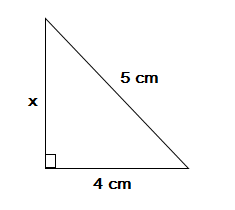
(Not drawn to scale.)
Using the following right traingle, calculate the value of
(Not drawn to scale.)
Tap to reveal answer
We can determine the length of the side by using the Pythagorean Theorem:

where 
Our equation is then:



We can determine the length of the side by using the Pythagorean Theorem:
where
Our equation is then:
← Didn't Know|Knew It →
Calculate the length of the side of the following right triangle.
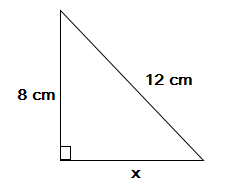
(Not drawn to scale.)
Calculate the length of the side of the following right triangle.
(Not drawn to scale.)
Tap to reveal answer
We can calculate the length of the side by using the pythagorean theorem: 
where our values are 
we can then solve for  :
:



We can calculate the length of the side by using the pythagorean theorem:
where our values are
we can then solve for
← Didn't Know|Knew It →
A right triangle has a hypotenuse of 13 and a height of 5. What is the length of the third side of the triangle?
A right triangle has a hypotenuse of 13 and a height of 5. What is the length of the third side of the triangle?
Tap to reveal answer
In order to find the length of the third side, we need to use the Pythagorean theorem. The hypotenuse, c, is 13, and the height, a, is 5, so we can simply plug in these values and solve for b, the length of the base of the right triangle:



In order to find the length of the third side, we need to use the Pythagorean theorem. The hypotenuse, c, is 13, and the height, a, is 5, so we can simply plug in these values and solve for b, the length of the base of the right triangle:
← Didn't Know|Knew It →
The hypotenuse of a  triangle has length
  . Which of the following is equal to the length of its shortest leg?
The hypotenuse of a
Tap to reveal answer
The shortest leg of a  triangle is one half the length of its hypotenuse. In this triangle, it is

The shortest leg of a
← Didn't Know|Knew It →
The sides of a triangle are 4, 8, and an integer  . How many possible values does
  have?
have?
The sides of a triangle are 4, 8, and an integer
Tap to reveal answer
If two sides are 4 and 8, then the third side must be greater than  and less than
  . This means
  can be 5, 6, 7, 8, 9, 10, or 11.
If two sides are 4 and 8, then the third side must be greater than
← Didn't Know|Knew It →
Two sides of a triangle measure 5 inches and 11 inches. Which of the following statements correctly expresses the range of possible lengths of the third side  ?
?
Two sides of a triangle measure 5 inches and 11 inches. Which of the following statements correctly expresses the range of possible lengths of the third side
Tap to reveal answer
By the Triangle Inequality, the sum of the lengths of two shortest sides must exceed that of the third.
Case 1:  is the greatest of the three sidelengths.
Then 
Case 2:  is not the greatest of the three sidelengths - that is, 11 is.
Then  , or, equivalently,
  .
.
Therefore,  .
.
By the Triangle Inequality, the sum of the lengths of two shortest sides must exceed that of the third.
Case 1:
Then
Case 2:
Then
Therefore,
← Didn't Know|Knew It →
Which of the following is true of a triangle with sides that measure 15, 17, and 21?
Which of the following is true of a triangle with sides that measure 15, 17, and 21?
Tap to reveal answer
The triangle can exist by the Triangle Inequality, since the sum of the two smaller sides exceeds the greatest:

To determine whether the triangle is acute, right, or obtuse, add the squares of the two smaller sides, and compare the sum to the square of the largest side.

Since this sum is greater, the triangle is acute.
The triangle can exist by the Triangle Inequality, since the sum of the two smaller sides exceeds the greatest:
To determine whether the triangle is acute, right, or obtuse, add the squares of the two smaller sides, and compare the sum to the square of the largest side.
Since this sum is greater, the triangle is acute.
← Didn't Know|Knew It →
Let the three interior angles of a triangle measure  , and
, and  . Which of the following statements is true about the triangle?
Let the three interior angles of a triangle measure
Tap to reveal answer
If these are the measures of the interior angles of a triangle, then they total  . Add the expressions, and solve for
  .
.


One angle measures  The others measure:


Since the largest angle measures greater than  , the angle is obtuse, and the triangle is as well. Since the three angles each have different measure, their opposite sides do also, making the triangle scalene.
If these are the measures of the interior angles of a triangle, then they total
One angle measures
Since the largest angle measures greater than
← Didn't Know|Knew It →
In  ,
,  and
and  . Which of the following values of
  makes
makes  a scalene triangle?
In
Tap to reveal answer
The three sides of a scalene triangle have different measures, so 15 can be eliminated.
By the Triangle Inequality, the sum of the lengths of the two smaller sides must exceed the length of the third side. Since  , 8 violates this theorem; since
  , 22 does as well.
10 is a valid measure of the third side, since  ; it makes all three segments of different length, so it is the correct choice.
The three sides of a scalene triangle have different measures, so 15 can be eliminated.
By the Triangle Inequality, the sum of the lengths of the two smaller sides must exceed the length of the third side. Since
10 is a valid measure of the third side, since
← Didn't Know|Knew It →
 is a scalene triangle with perimeter 30.
  . Which of the following cannot be equal to
  ?
?
Tap to reveal answer
The three sides of a scalene triangle have different measures. One measure  cannot have is 12, but this is not a choice.
It cannot be true that  . Since the perimeter is
 , we can find out what other value can be eliminated as follows:


Therefore, if , then  , and the triangle is not scalene. 9 is the correct choice.
The three sides of a scalene triangle have different measures. One measure
It cannot be true that
Therefore, if
← Didn't Know|Knew It →
 is a scalene triangle with perimeter 33; the length of each of its sides can be given by a prime whole number. What is the greatest possible length of its longest side?
Tap to reveal answer
By trial and error, we get four ways to add distinct primes to yield sum 33:


In each case, however the Triangle Inequality is violated - the sum of the two shortest lengths does not exceed the third.
No triangle can exist as described.
By trial and error, we get four ways to add distinct primes to yield sum 33:
In each case, however the Triangle Inequality is violated - the sum of the two shortest lengths does not exceed the third.
No triangle can exist as described.
← Didn't Know|Knew It →
 is an isosceles triangle with perimeter 43; the length of each of its sides can be given by a prime whole number. What is the greatest possible length of its longest side?
Tap to reveal answer
We are looking for ways to add three primes to yield a sum of 43. Two or all three (since an equilateral triangle is considered isosceles) must be equal (although, since 43 is not a multiple of three, only two can be equal).
We will set the shared sidelength of the congruent sides to each prime number in turn up to 19:


By the Triangle Inequality, the sum of the lengths of the shortest two sides must exceed that of the greatest. We can therefore eliminate the first three.  ,
,  , and
, and  include numbers that are not prime (21, 15, 9). This leaves us with only one possibility:
 - greatest length 19
19 is the correct choice.
We are looking for ways to add three primes to yield a sum of 43. Two or all three (since an equilateral triangle is considered isosceles) must be equal (although, since 43 is not a multiple of three, only two can be equal).
We will set the shared sidelength of the congruent sides to each prime number in turn up to 19:
By the Triangle Inequality, the sum of the lengths of the shortest two sides must exceed that of the greatest. We can therefore eliminate the first three.
19 is the correct choice.
← Didn't Know|Knew It →
The lengths of the sides of a scalene triangle are all prime numbers, and so is the perimeter of the triangle. What is the least possible perimeter of the triangle?
The lengths of the sides of a scalene triangle are all prime numbers, and so is the perimeter of the triangle. What is the least possible perimeter of the triangle?
Tap to reveal answer
A scalene triangle has three sides of different lengths, so we are looking for three distinct prime integers whose sum is a prime integer.
One of the sides cannot be 2, since the sum of 2 and two odd primes would be an even number greater than 2, a composite number. Therefore, beginning with the least three odd primes, add increasing triples of distinct prime numbers, as follows, until a solution presents itself:
 - incorrect
 - correct
The correct answer, 19, presents itself quickly.
A scalene triangle has three sides of different lengths, so we are looking for three distinct prime integers whose sum is a prime integer.
One of the sides cannot be 2, since the sum of 2 and two odd primes would be an even number greater than 2, a composite number. Therefore, beginning with the least three odd primes, add increasing triples of distinct prime numbers, as follows, until a solution presents itself:
The correct answer, 19, presents itself quickly.
← Didn't Know|Knew It →
 is a scalene triangle with perimeter 47; the length of each of its sides can be given by a prime whole number. What is the greatest possible length of its longest side?
Tap to reveal answer
A scalene triangle has three sides of different lengths, so we are looking for three distinct prime integers whose sum is 47.
There are ten ways to add three distinct primes to yield sum 47:


By the Triangle Inequality, the sum of the lengths of the shortest two sides must exceed that of the greatest. We can therefore eliminate all but four:


The greatest possible length of the longest side is 23.
A scalene triangle has three sides of different lengths, so we are looking for three distinct prime integers whose sum is 47.
There are ten ways to add three distinct primes to yield sum 47:
By the Triangle Inequality, the sum of the lengths of the shortest two sides must exceed that of the greatest. We can therefore eliminate all but four:
The greatest possible length of the longest side is 23.
← Didn't Know|Knew It →
The largest angle of an obtuse isosceles triangle has a measure of  . If the length of the two equivalent sides is
  , what is the length of the hypotenuse?
The largest angle of an obtuse isosceles triangle has a measure of
Tap to reveal answer
The height of the obtuse isosceles triangle bisects the  angle and forms two congruent right triangles. The hypotenuse of each of these triangles is either side of equivalent length, and we can see that the base of either triangle makes up half of the hypotenuse of the obtuse isosceles triangle. Because we know the angle opposite each base is half of
  , or
, or  , we can use the sine of this angle to find the length of the base. As there are two congruent right triangles that make up the obtuse isosceles triangle, the length of either base makes up half of the overall hypotenuse, so we then multiply the result by
  to obtain the final answer. In the following solution,
  is the length of the base of one of the right triangles,
  is the length of the two equivalent sides, and
  is the length of the hypotenuse:


The height of the obtuse isosceles triangle bisects the
← Didn't Know|Knew It →
A given equilateral triangle has a side length of  . What is the perimeter of the triangle?
A given equilateral triangle has a side length of
Tap to reveal answer
An equilateral triangle with a side length  has a perimeter
  .
.
Given:
 ,
,
 .
.
An equilateral triangle with a side length
Given:
← Didn't Know|Knew It →
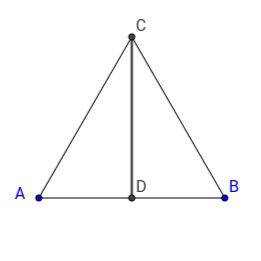
The area of an equilateral triangle  is
is  . What is the perimeter of
  ?
?
The area of an equilateral triangle
Tap to reveal answer
The area is given, which will allow us to calculate the side of the triangle and hence we can also find the perimeter.
The area for an equilateral triangle is given by the formula
 , where
  is the length of the side of the triangle.
Therefore,  , where
  is the area.
Thus  , and the perimeter of an equilateral triangle is three times the side, hence, the final answer is
  .
.
The area is given, which will allow us to calculate the side of the triangle and hence we can also find the perimeter.
The area for an equilateral triangle is given by the formula
Therefore,
Thus
← Didn't Know|Knew It →