Cubes - GMAT Quantitative
Card 1 of 312
What is the length of the diagonal of a cube if its side length is  ?
?
What is the length of the diagonal of a cube if its side length is
Tap to reveal answer
The diagonal of a cube extends from one of its corners diagonally through the cube to the opposite corner, so it can be thought of as the hypotenuse of a right triangle formed by the height of the cube and the diagonal of its base. First we must find the diagonal of the base, which will be the same as the diagonal of any face of the cube, by applying the Pythagorean theorem:



Now that we know the length of the diagonal of any face on the cube, we can use the Pythagorean theorem again with this length and the height of the cube, whose hypotenuse is the length of the diagonal for the cube:



The diagonal of a cube extends from one of its corners diagonally through the cube to the opposite corner, so it can be thought of as the hypotenuse of a right triangle formed by the height of the cube and the diagonal of its base. First we must find the diagonal of the base, which will be the same as the diagonal of any face of the cube, by applying the Pythagorean theorem:
Now that we know the length of the diagonal of any face on the cube, we can use the Pythagorean theorem again with this length and the height of the cube, whose hypotenuse is the length of the diagonal for the cube:
← Didn't Know|Knew It →
 is a cube and face
 has an area of
  . What is the length of diagonal of the cube
  ?
?
Tap to reveal answer
To find the diagonal of a cube we can apply the formula  , where
  is the length of the diagonal and where
  is the length of an edge of the cube.
Since we are given an area of a face of the cube, we can find the length of an edge simply by taking its square root.

Here the length of an edge is 3.
Thefore the final andwer is  .
.
To find the diagonal of a cube we can apply the formula
Since we are given an area of a face of the cube, we can find the length of an edge simply by taking its square root.
Here the length of an edge is 3.
Thefore the final andwer is
← Didn't Know|Knew It →
What is the length of the diagonal  of cube
  , knowing that face
  has diagonal equal to
  ?
?
What is the length of the diagonal
Tap to reveal answer
To find the length of the diagonal of the cube, we can apply the formula, however, we firstly need to find the length of an edge, by applying the formula for the diagonal of the square.
 where
where  is the diagonal of face ABCD, and
  , the length of one of the side of this square.
The length of  must be
  , which is the length of the edges of the square.
Therefore we can now use the formula for the length of the diagonal of the cube:
 , where
  is the length of an edge.
Since  , we get the final answer
  .
.
To find the length of the diagonal of the cube, we can apply the formula, however, we firstly need to find the length of an edge, by applying the formula for the diagonal of the square.
The length of
Therefore we can now use the formula for the length of the diagonal of the cube:
Since
← Didn't Know|Knew It →
If a cube has a side length of  , what is the length of its diagonal?
If a cube has a side length of
Tap to reveal answer
The diagonal of a cube is the hypotenuse of a right triangle whose height is one side and whose base is the diagonal of one of the faces. First we must use the Pythagorean theorem to find the length of the diagonal of one of the faces, and then we use the theorem again with this value and length of one side of the cube to find the length of its diagonal:



So this is the length of the diagonal of one of the faces, which we plug into the Pythagorean theorem with the length of one side to find the length of the diagonal for the cube:



The diagonal of a cube is the hypotenuse of a right triangle whose height is one side and whose base is the diagonal of one of the faces. First we must use the Pythagorean theorem to find the length of the diagonal of one of the faces, and then we use the theorem again with this value and length of one side of the cube to find the length of its diagonal:
So this is the length of the diagonal of one of the faces, which we plug into the Pythagorean theorem with the length of one side to find the length of the diagonal for the cube:
← Didn't Know|Knew It →
A given cube has an edge length of  . What is the length of the diagonal of the cube?
A given cube has an edge length of
Tap to reveal answer
The diagonal  of a cube with an edge length
  can be defined by the equation
  . Given
  in this instance,
  .
.
The diagonal
← Didn't Know|Knew It →
A given cube has an edge length of  . What is the length of the diagonal of the cube?
A given cube has an edge length of
Tap to reveal answer
The diagonal  of a cube with an edge length
  can be defined by the equation
  . Given
  in this instance,
  .
.
The diagonal
← Didn't Know|Knew It →
A given cube has an edge length of  . What is the length of the diagonal of the cube?
A given cube has an edge length of
Tap to reveal answer
The diagonal  of a cube with an edge length
  can be defined by the equation
  . Given
  in this instance,
 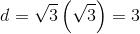 .
.
The diagonal
← Didn't Know|Knew It →
What is the volume of a cube with a side length of  ?
?
What is the volume of a cube with a side length of
Tap to reveal answer


← Didn't Know|Knew It →
The length, width, and height of a rectangular prism, in inches, are three different prime numbers. All three dimensions are between six feet and seven feet. What is the volume of the prism?
The length, width, and height of a rectangular prism, in inches, are three different prime numbers. All three dimensions are between six feet and seven feet. What is the volume of the prism?
Tap to reveal answer
Six feet and seven feet are equal to, respectively, 72 inches and 84 inches. There are three different prime numbers between 72 and 84 - 73, 79, and 83 - so these are the three dimensions of the prism in inches. The volume of the prism is
 cubic inches.
Six feet and seven feet are equal to, respectively, 72 inches and 84 inches. There are three different prime numbers between 72 and 84 - 73, 79, and 83 - so these are the three dimensions of the prism in inches. The volume of the prism is
← Didn't Know|Knew It →
The distance from one vertex of a cube to its opposite vertex is twelve feet. Give the volume of the cube.
The distance from one vertex of a cube to its opposite vertex is twelve feet. Give the volume of the cube.
Tap to reveal answer
Since we are looking at yards, we will look at twelve feet as four yards.
Let  be the length of one edge of the cube. By the three-dimensional extension of the Pythagorean Theorem,


 yards.
Cube this sidelength to get the volume:
 cubic yards.
Since we are looking at yards, we will look at twelve feet as four yards.
Let
Cube this sidelength to get the volume:
← Didn't Know|Knew It →
The length of a diagonal of one face of a cube is  . Give the volume of the cube.
The length of a diagonal of one face of a cube is
Tap to reveal answer
A diagonal of a square has length  times that of a side, so each side of each square face of the cube has length
  . Cube this to get the volume:

A diagonal of a square has length
← Didn't Know|Knew It →
The length of a diagonal of a cube is  . Give the volume of the cube.
The length of a diagonal of a cube is
Tap to reveal answer
Let  be the length of one edge of the cube. By the three-dimensional extension of the Pythagorean Theorem,


Cube the sidelength to get the volume:


Let
Cube the sidelength to get the volume:
← Didn't Know|Knew It →
Which choice comes closest to the volume of a cube with surface area  square centimeters?
Which choice comes closest to the volume of a cube with surface area
Tap to reveal answer
The suface area of a cube is six times the square of the length of one side, so solve for  in the following:


This is the sidelength in centimeters; since we are looking at meters, divide this by 100 to convert to  meters.
Cube this to get volume
 cubic meters.
Of the given choices, 3.5 cubic meters comes closest.
The suface area of a cube is six times the square of the length of one side, so solve for
This is the sidelength in centimeters; since we are looking at meters, divide this by 100 to convert to
Cube this to get volume
Of the given choices, 3.5 cubic meters comes closest.
← Didn't Know|Knew It →
An aquarium is shaped like a perfect cube; the area of each glass face is  square meters. If it is filled to the recommended
  capacity, then how much water will it contain?
Note:  cubic meter
  liters.
An aquarium is shaped like a perfect cube; the area of each glass face is
Note:
Tap to reveal answer
A perfect cube has square faces; if a face has area 6.25 square meters, then each side of each face measures the square root of this, or 2.5 meters. The volume of the tank is the cube of this, or
 cubic meters.
Its capacity in liters is  liters.
80% of this is
 liters.
A perfect cube has square faces; if a face has area 6.25 square meters, then each side of each face measures the square root of this, or 2.5 meters. The volume of the tank is the cube of this, or
Its capacity in liters is
80% of this is
← Didn't Know|Knew It →
A sphere with surface area  is inscribed inside a cube. Give the volume of the cube.
A sphere with surface area
Tap to reveal answer
The sidelength of the cube is the diameter of the inscribed sphere, which is twice that sphere's radius. The sphere has surface area  , so the radius is calculated as follows:


The diameter of the sphere - and the sidelength of the cube - is twice this, or  .
.
Cube this sidelength to get the volume of the cube:

The sidelength of the cube is the diameter of the inscribed sphere, which is twice that sphere's radius. The sphere has surface area
The diameter of the sphere - and the sidelength of the cube - is twice this, or
Cube this sidelength to get the volume of the cube:
← Didn't Know|Knew It →
A sphere with volume  is inscribed inside a cube. Give the volume of the cube.
A sphere with volume
Tap to reveal answer
The sidelength of the cube is the diameter of the inscribed sphere, which is twice that sphere's radius. The sphere has volume  , so the radius is calculated as follows:


The diameter of the sphere - and the sidelength of the cube - is twice this, or 6. Cube this sidelength to get the volume of the cube:

The sidelength of the cube is the diameter of the inscribed sphere, which is twice that sphere's radius. The sphere has volume
The diameter of the sphere - and the sidelength of the cube - is twice this, or 6. Cube this sidelength to get the volume of the cube:
← Didn't Know|Knew It →
A cube is inscribed inside a sphere with volume  . Give the volume of the cube.
A cube is inscribed inside a sphere with volume
Tap to reveal answer
The diameter of the circle - twice its radius - coincides with the length of a diagonal of the inscribed cube. The sphere has volume  , so the radius is calculated as follows:


The diameter of the sphere - and the length of a diagonal of the cube - is twice this, or 6.
Now, let be the length of one edge of the cube. By the three-dimensional extension of the Pythagorean Theorem,


The volume of the cube is the cube of this, or

The diameter of the circle - twice its radius - coincides with the length of a diagonal of the inscribed cube. The sphere has volume
The diameter of the sphere - and the length of a diagonal of the cube - is twice this, or 6.
Now, let
The volume of the cube is the cube of this, or
← Didn't Know|Knew It →
The distance from one vertex of a cube to its opposite vertex is one foot. Give the volume of the cube.
The distance from one vertex of a cube to its opposite vertex is one foot. Give the volume of the cube.
Tap to reveal answer
Since we are looking at inches, we will look at one foot as twelve inches.
Let be the length of one edge of the cube. By the three-dimensional extension of the Pythagorean Theorem,


 inches.
Cube this sidelength to get the volume:
 cubic inches.
Since we are looking at inches, we will look at one foot as twelve inches.
Let
Cube this sidelength to get the volume:
← Didn't Know|Knew It →
A cubic pool is usually filled at about  of its total volume. If one side of the pool is
  m, how many liters of water will fill the pool to the desired capacity?
A cubic pool is usually filled at about
Tap to reveal answer
To find the volume of a cube we use the formula:

In our case the total volume of the pool is 103 cubic meters.
Filling the pool to 95% of its total volume will require:  cubic meters.
Now we need to convert from cubic meters to liters in order to answer the question.
Remember  cubic meter =
  liters.
Thus,
 .
.
Therefore, the number of liters of water needed is 950000 liters.
To find the volume of a cube we use the formula:
In our case the total volume of the pool is 103 cubic meters.
Filling the pool to 95% of its total volume will require:
Now we need to convert from cubic meters to liters in order to answer the question.
Remember
Thus,
Therefore, the number of liters of water needed is 950000 liters.
← Didn't Know|Knew It →
A sphere with surface area  circumscribes a cube. Give the volume of the cube.
A sphere with surface area
Tap to reveal answer
The diameter of a sphere is equal to the length of a diagonal of the cube it circumscribes. We can derive the radius using the formula for the volume of a sphere, but first, we have to solve for the radius using the formula for the surface area of a sphere:


The diameter is twice this, or  . This is the length of the diagonal of the cube. By the three-dimensional extension of the Pythagorean Theorem,


The volume is the cube of this:
 , which is not given as one of the choices.
The diameter of a sphere is equal to the length of a diagonal of the cube it circumscribes. We can derive the radius using the formula for the volume of a sphere, but first, we have to solve for the radius using the formula for the surface area of a sphere:
The diameter is twice this, or
The volume is the cube of this:
← Didn't Know|Knew It →