Right Triangles - GMAT Quantitative
Card 1 of 400
A triangle has sides of length 9, 12, and 16. Which of the following statements is true?
A triangle has sides of length 9, 12, and 16. Which of the following statements is true?
Tap to reveal answer
This triangle can exist by the Triangle Inequality, since the sum of the lengths of its shortest two sides exceeds that of the longest side:

The sum of the squares of its shortest two sides is less than the square of that of its longest side:

This makes the triangle obtuse.
Its sides are all of different measure, which makes the triangle scalene as well.
Obtuse and scalene is the correct choice.
This triangle can exist by the Triangle Inequality, since the sum of the lengths of its shortest two sides exceeds that of the longest side:
The sum of the squares of its shortest two sides is less than the square of that of its longest side:
This makes the triangle obtuse.
Its sides are all of different measure, which makes the triangle scalene as well.
Obtuse and scalene is the correct choice.
← Didn't Know|Knew It →
There is a big square that consists of four identical right triangles and a small square. If the area of the small square is 1, the area of the big square is 5, what is the length of the shortest side of the right triangles?

There is a big square that consists of four identical right triangles and a small square. If the area of the small square is 1, the area of the big square is 5, what is the length of the shortest side of the right triangles?
Tap to reveal answer
The area of the big square is 5, and area of the small square is 1. Therefore, the area of the four right triangles is 5-1=4.
Since the four triangles are all exactly the same, the area of each of the right triangle is 1. We know that the longer side is 2 times the shorter side, so we can represent the shorter side as x and the longer side as 2x. Then we are able to set up an equation:
$\frac{1}{2}$times xtimes 2x=1.
Therefore, x, the length of the shortest side of the right triangle, is 1.
The area of the big square is 5, and area of the small square is 1. Therefore, the area of the four right triangles is 5-1=4.
Since the four triangles are all exactly the same, the area of each of the right triangle is 1. We know that the longer side is 2 times the shorter side, so we can represent the shorter side as x and the longer side as 2x. Then we are able to set up an equation:
$\frac{1}{2}$times xtimes 2x=1.
Therefore, x, the length of the shortest side of the right triangle, is 1.
← Didn't Know|Knew It →
What is the side length of a right triangle with a hypotenuse of  and a side of
  ?
?
What is the side length of a right triangle with a hypotenuse of
Tap to reveal answer
We need to use the Pythagorean theorem:






We need to use the Pythagorean theorem:
← Didn't Know|Knew It →
Using the following right traingle, calculate the value of 
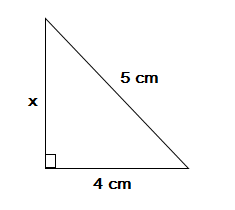
(Not drawn to scale.)
Using the following right traingle, calculate the value of
(Not drawn to scale.)
Tap to reveal answer
We can determine the length of the side by using the Pythagorean Theorem:

where 
Our equation is then:



We can determine the length of the side by using the Pythagorean Theorem:
where
Our equation is then:
← Didn't Know|Knew It →
Calculate the length of the side of the following right triangle.
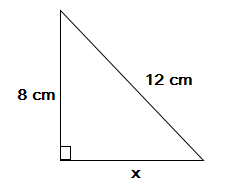
(Not drawn to scale.)
Calculate the length of the side of the following right triangle.
(Not drawn to scale.)
Tap to reveal answer
We can calculate the length of the side by using the pythagorean theorem: 
where our values are 
we can then solve for  :
:



We can calculate the length of the side by using the pythagorean theorem:
where our values are
we can then solve for
← Didn't Know|Knew It →
A right triangle has a hypotenuse of 13 and a height of 5. What is the length of the third side of the triangle?
A right triangle has a hypotenuse of 13 and a height of 5. What is the length of the third side of the triangle?
Tap to reveal answer
In order to find the length of the third side, we need to use the Pythagorean theorem. The hypotenuse, c, is 13, and the height, a, is 5, so we can simply plug in these values and solve for b, the length of the base of the right triangle:



In order to find the length of the third side, we need to use the Pythagorean theorem. The hypotenuse, c, is 13, and the height, a, is 5, so we can simply plug in these values and solve for b, the length of the base of the right triangle:
← Didn't Know|Knew It →
The hypotenuse of a  triangle has length
  . Which of the following is equal to the length of its shortest leg?
The hypotenuse of a
Tap to reveal answer
The shortest leg of a  triangle is one half the length of its hypotenuse. In this triangle, it is

The shortest leg of a
← Didn't Know|Knew It →
What is the perimeter of a  traingle?
What is the perimeter of a
Tap to reveal answer
A  triangle is a right triangle. To find the perimeter, we must add up all the sides of the triangle.

A
← Didn't Know|Knew It →
What is the perimeter of a 30-60-90 triangle?
-
One of the sides measures 10 inches.
-
One of the sides measures 20 inches.
What is the perimeter of a 30-60-90 triangle?
-
One of the sides measures 10 inches.
-
One of the sides measures 20 inches.
Tap to reveal answer
The hypotenuse of a 30-60-90 triangle measures twice its shorter leg; its longer leg measures  times its shorter leg. Given one side length alone, there is no indication which of the three sides it measures; but given two, one of which is twice the other, as is the case here (10 and 20), 10 must be the shorter leg and 20 the hypotenuse. The longer leg is therefore
  , and the perimeter is
 .
.
Therefore, both statements together are sufficent but neither alone is sufficient.
The hypotenuse of a 30-60-90 triangle measures twice its shorter leg; its longer leg measures
Therefore, both statements together are sufficent but neither alone is sufficient.
← Didn't Know|Knew It →
A right triangle has legs of length  feet and and
  feet. Give the perimeter of this triangle in yards.
A right triangle has legs of length
Tap to reveal answer
We can use the Pythagorean Theorem to calculate the hypotenuse  of the triangle by setting
 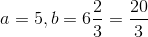 in this formula:

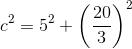

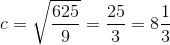
The perimeter is  feet.
feet.
Divide by 3 to convert to yards:
 yards
yards
We can use the Pythagorean Theorem to calculate the hypotenuse
The perimeter is
Divide by 3 to convert to yards:
← Didn't Know|Knew It →
A right triangle has a hypotenuse of length 13 yards and a leg of length 5 yards. Give the perimeter of this triangle in inches.
A right triangle has a hypotenuse of length 13 yards and a leg of length 5 yards. Give the perimeter of this triangle in inches.
Tap to reveal answer
We can use the Pythagorean Theorem to calculate the length of the second leg  in yards of the triangle by setting
  in this formula:



The perimeter of the triangle is yards is
 yards. Multiply this by 36 to covert to inches:
 inches.
We can use the Pythagorean Theorem to calculate the length of the second leg
The perimeter of the triangle is yards is
← Didn't Know|Knew It →
A right triangle has a base of 4 and a height of 3. What is the perimeter of the triangle?
A right triangle has a base of 4 and a height of 3. What is the perimeter of the triangle?
Tap to reveal answer
We are given two sides of the right triangle, so in order to calculate the perimeter we must first find the length of the third side, the hypotenuse, using the Pythagorean theorem:



Now that we know the length of the third side, we can add the lengths of the three sides to calculate the perimeter of the right triangle:

We are given two sides of the right triangle, so in order to calculate the perimeter we must first find the length of the third side, the hypotenuse, using the Pythagorean theorem:
Now that we know the length of the third side, we can add the lengths of the three sides to calculate the perimeter of the right triangle:
← Didn't Know|Knew It →
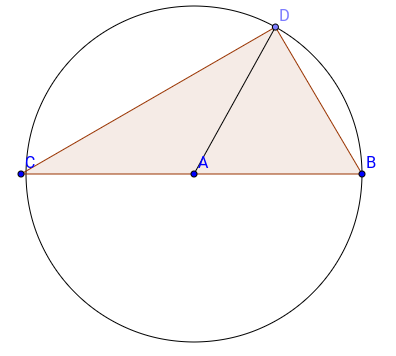
 is a right triangle and
  and
and  . What is half the circle's circumference added to the triangle's perimeter?
Tap to reveal answer
As you see that a right triangle as sides 3 and 4, you should always remember that, this right triangle is a Pythagorean Triple, in other words, its sides will be in the ratio  where
where  is a constant, this will save you a lot of time. Here we can say that the hypotenuse will be 5. Therefore, the circumference will be
  . To get the final answer, we should just divide the circumference by 2 and add the perimeter, being
  or 12.
As you see that a right triangle as sides 3 and 4, you should always remember that, this right triangle is a Pythagorean Triple, in other words, its sides will be in the ratio
← Didn't Know|Knew It →
What is the hypotenuse of a right triangle with sides 14 and 48?
What is the hypotenuse of a right triangle with sides 14 and 48?
Tap to reveal answer
For starters, we know that the hypotenuse is the longest side of a triangle, so we can immediately cross off 25 as an answer choice because it is smaller than one of the legs, 48. To find the hypotenuse, we can use the Pythagorean Theorem.
$hypotenuse^{^{2}$} = $14^{2}$ + $48^{2}$ = 2500
hypotenuse = 50
For starters, we know that the hypotenuse is the longest side of a triangle, so we can immediately cross off 25 as an answer choice because it is smaller than one of the legs, 48. To find the hypotenuse, we can use the Pythagorean Theorem.
$hypotenuse^{^{2}$} = $14^{2}$ + $48^{2}$ = 2500
hypotenuse = 50
← Didn't Know|Knew It →
What is the length of a right triangle hypotenuse if the the other two sides are  and
and  units long?
What is the length of a right triangle hypotenuse if the the other two sides are
Tap to reveal answer
To find a length of a side in a right triangle, we can use the Pythagorean theorem:


To find a length of a side in a right triangle, we can use the Pythagorean theorem:
← Didn't Know|Knew It →
A right triangle has a height of 8 and a base of 15. What is the length of its hypotenuse?
A right triangle has a height of 8 and a base of 15. What is the length of its hypotenuse?
Tap to reveal answer
We are given the length of the height and the base, so we can use the Pythagorean theorem to calculate the length of the hypotenuse:


We are given the length of the height and the base, so we can use the Pythagorean theorem to calculate the length of the hypotenuse:
← Didn't Know|Knew It →
What is the hypotenuse of a right triangle with legs of lengths  and
and  ?
?
What is the hypotenuse of a right triangle with legs of lengths
Tap to reveal answer
In order to find the value of the hypotenuse  , we need to plug the values of the legs
  and
and  into the Pythagorean Theorem:


In order to find the value of the hypotenuse
← Didn't Know|Knew It →
What is the hypotenuse of a right triangle with legs of length  and
and  ?
?
What is the hypotenuse of a right triangle with legs of length
Tap to reveal answer
In order to find the value of the hypotenuse  , we need to plug the values of the legs
  and
and  into the Pythagorean Theorem:


In order to find the value of the hypotenuse
← Didn't Know|Knew It →
What is the hypotenuse of a right triangle with an area of  and a leg length of
  ?
?
What is the hypotenuse of a right triangle with an area of
Tap to reveal answer
In order to find the value of the hypotenuse  given area
  and leg length
  , we first need to calculate the length of the other leg length
  . Given the area equation
  :
:


Plugging in  and
and  :
:


Now we need to plug the values of the legs  and
and  into the Pythagorean Theorem:


In order to find the value of the hypotenuse
Plugging in
Now we need to plug the values of the legs
← Didn't Know|Knew It →
Each leg of a  triangle has length
  . Give the length of its hypotenuse.
Each leg of a
Tap to reveal answer
The hypotenuse of a  triangle has length
  times that of a leg, which here is
 .
.
The hypotenuse of a
← Didn't Know|Knew It →