x and y Intercept - GRE Quantitative Reasoning
Card 1 of 56
What is the y-intercept of the line that goes through the points (–2, 1) and (5, 6)?
What is the y-intercept of the line that goes through the points (–2, 1) and (5, 6)?
Tap to reveal answer
The slope can be calculated from m = (y2 – y1)/(x2 – x1) = (6 – 1)/(5 + 2). Having calculated the slope, we can now use point-slope form of a line, y – y1 = m(x – x1), and using the second point (5, 6): y – 6 = (5/7)(x – 5). This can be rearranged into slope-intercept form to obtain: y = (5/7)x + (17/7). Because the equation is now in slope intercept form, we know that the y-intercept is 17/7.
The slope can be calculated from m = (y2 – y1)/(x2 – x1) = (6 – 1)/(5 + 2). Having calculated the slope, we can now use point-slope form of a line, y – y1 = m(x – x1), and using the second point (5, 6): y – 6 = (5/7)(x – 5). This can be rearranged into slope-intercept form to obtain: y = (5/7)x + (17/7). Because the equation is now in slope intercept form, we know that the y-intercept is 17/7.
← Didn't Know|Knew It →
Find the x-intercept of the equation x-y=4y+10
Find the x-intercept of the equation x-y=4y+10
Tap to reveal answer
The answer is 10.
x-y=4y+10
In order to find the x-intercept we simply let all the y's equal 0
x-0=4(0)+10
x=10
The answer is 10.
x-y=4y+10
In order to find the x-intercept we simply let all the y's equal 0
x-0=4(0)+10
x=10
← Didn't Know|Knew It →
Quantity A:
The  -intercept of the line
Quantity B:
The  -intercept of the line

Quantity A:
The
Quantity B:
The
Tap to reveal answer
The key to these quantitative comparison problems is to figure out the worth of both quantities, or figure out whether evaluating the quantities is even possible. In this case, evaluating the quantities is a fairly straightforward case of figuring out the intercepts of two different lines, which is possible. Therefore, you can already discount "the relationship cannot be determined from the information given".
To solve quantity A:  is in
is in  form, where
  is the
  -intercept. Therefore, the
  -intercept is equal to
  .
.
To solve quantity B:  , you have to sole for the
  intercept. The quickest way to figure out the answer is to remember that the
  axis exists at the line
  , therefore to find out where the line crosses the
  axis, you can set
  and solve for
  .
.
 -3.5 = .5x - 1.5


Both quantity A and quantity B  , therefore the two quantities are equal.
The key to these quantitative comparison problems is to figure out the worth of both quantities, or figure out whether evaluating the quantities is even possible. In this case, evaluating the quantities is a fairly straightforward case of figuring out the intercepts of two different lines, which is possible. Therefore, you can already discount "the relationship cannot be determined from the information given".
To solve quantity A:
To solve quantity B:
Both quantity A and quantity B
← Didn't Know|Knew It →
What is the  -intercept of the following equation?

What is the
Tap to reveal answer
To find the  -intercept, you must plug
  in for
  .
.
This leaves you with
 .
.
Then you must get you by itself so you add  to both sides
 .
.
Then divide both sides by  to get
 .
.
For the coordinate point,  goes first then
  and the answer is
  .
.
To find the
This leaves you with
Then you must get you by itself so you add
Then divide both sides by
For the coordinate point,
← Didn't Know|Knew It →
What is the y-intercept of the line that goes through the points (–2, 1) and (5, 6)?
What is the y-intercept of the line that goes through the points (–2, 1) and (5, 6)?
Tap to reveal answer
The slope can be calculated from m = (y2 – y1)/(x2 – x1) = (6 – 1)/(5 + 2). Having calculated the slope, we can now use point-slope form of a line, y – y1 = m(x – x1), and using the second point (5, 6): y – 6 = (5/7)(x – 5). This can be rearranged into slope-intercept form to obtain: y = (5/7)x + (17/7). Because the equation is now in slope intercept form, we know that the y-intercept is 17/7.
The slope can be calculated from m = (y2 – y1)/(x2 – x1) = (6 – 1)/(5 + 2). Having calculated the slope, we can now use point-slope form of a line, y – y1 = m(x – x1), and using the second point (5, 6): y – 6 = (5/7)(x – 5). This can be rearranged into slope-intercept form to obtain: y = (5/7)x + (17/7). Because the equation is now in slope intercept form, we know that the y-intercept is 17/7.
← Didn't Know|Knew It →
Find the x-intercept of the equation x-y=4y+10
Find the x-intercept of the equation x-y=4y+10
Tap to reveal answer
The answer is 10.
x-y=4y+10
In order to find the x-intercept we simply let all the y's equal 0
x-0=4(0)+10
x=10
The answer is 10.
x-y=4y+10
In order to find the x-intercept we simply let all the y's equal 0
x-0=4(0)+10
x=10
← Didn't Know|Knew It →
Quantity A:
The -intercept of the line
Quantity B:
The -intercept of the line
Quantity A:
The
Quantity B:
The
Tap to reveal answer
The key to these quantitative comparison problems is to figure out the worth of both quantities, or figure out whether evaluating the quantities is even possible. In this case, evaluating the quantities is a fairly straightforward case of figuring out the intercepts of two different lines, which is possible. Therefore, you can already discount "the relationship cannot be determined from the information given".
To solve quantity A: is in form, where is the -intercept. Therefore, the -intercept is equal to .
To solve quantity B: , you have to sole for the intercept. The quickest way to figure out the answer is to remember that the axis exists at the line , therefore to find out where the line crosses the axis, you can set and solve for .
-3.5 = .5x - 1.5
Both quantity A and quantity B , therefore the two quantities are equal.
The key to these quantitative comparison problems is to figure out the worth of both quantities, or figure out whether evaluating the quantities is even possible. In this case, evaluating the quantities is a fairly straightforward case of figuring out the intercepts of two different lines, which is possible. Therefore, you can already discount "the relationship cannot be determined from the information given".
To solve quantity A:
To solve quantity B:
Both quantity A and quantity B
← Didn't Know|Knew It →
What is the -intercept of the following equation?
What is the
Tap to reveal answer
To find the -intercept, you must plug in for .
This leaves you with
.
Then you must get you by itself so you add to both sides
.
Then divide both sides by to get
.
For the coordinate point, goes first then and the answer is .
To find the
This leaves you with
Then you must get you by itself so you add
Then divide both sides by
For the coordinate point,
← Didn't Know|Knew It →
What is the slope of the line whose equation is 8x+12y=20?
What is the slope of the line whose equation is 8x+12y=20?
Tap to reveal answer
Solve for y so that the equation resembles the y=mx+b form. This equation becomes -$\frac{2}{3}$x+\frac{5}{3}$. In this form, the m is the slope, which is -$\frac{2}{3}$.
Solve for y so that the equation resembles the y=mx+b form. This equation becomes -$\frac{2}{3}$x+\frac{5}{3}$. In this form, the m is the slope, which is -$\frac{2}{3}$.
← Didn't Know|Knew It →
Which of the following equations has a  -intercept of
  ?
?
Which of the following equations has a
Tap to reveal answer
To find the  -intercept, you need to find the value of the equation where
  . The easiest way to do this is to substitute in
  for your value of
  and see where you get
  for
for  . If you do this for each of your equations proposed as potential answers, you find that
  is the answer.
Substitute in  for
for  :
:

To find the
Substitute in
← Didn't Know|Knew It →
If  is a line that has a
  -intercept of
  and an
  -intercept of
  , which of the following is the equation of a line that is perpendicular to
  ?
?
If
Tap to reveal answer
If  has a
has a  -intercept of
  , then it must pass through the point
  .
.
If its  -intercept is
  , then it must through the point
  .
.
The slope of this line is  .
.
Therefore, any line perpendicular to this line must have a slope equal to the negative reciprocal, which is  . Only
 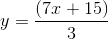 has a slope of
  .
.
If
If its
The slope of this line is
Therefore, any line perpendicular to this line must have a slope equal to the negative reciprocal, which is
← Didn't Know|Knew It →
What is the slope of the line whose equation is 8x+12y=20?
What is the slope of the line whose equation is 8x+12y=20?
Tap to reveal answer
Solve for y so that the equation resembles the y=mx+b form. This equation becomes -$\frac{2}{3}$x+\frac{5}{3}$. In this form, the m is the slope, which is -$\frac{2}{3}$.
Solve for y so that the equation resembles the y=mx+b form. This equation becomes -$\frac{2}{3}$x+\frac{5}{3}$. In this form, the m is the slope, which is -$\frac{2}{3}$.
← Didn't Know|Knew It →
Which of the following equations has a -intercept of ?
Which of the following equations has a
Tap to reveal answer
To find the -intercept, you need to find the value of the equation where . The easiest way to do this is to substitute in for your value of and see where you get for . If you do this for each of your equations proposed as potential answers, you find that is the answer.
Substitute in for :
To find the
Substitute in
← Didn't Know|Knew It →
If is a line that has a -intercept of and an -intercept of , which of the following is the equation of a line that is perpendicular to ?
If
Tap to reveal answer
If has a -intercept of , then it must pass through the point .
If its -intercept is , then it must through the point .
The slope of this line is .
Therefore, any line perpendicular to this line must have a slope equal to the negative reciprocal, which is . Only has a slope of .
If
If its
The slope of this line is
Therefore, any line perpendicular to this line must have a slope equal to the negative reciprocal, which is
← Didn't Know|Knew It →
What is the y-intercept of the line that goes through the points (–2, 1) and (5, 6)?
What is the y-intercept of the line that goes through the points (–2, 1) and (5, 6)?
Tap to reveal answer
The slope can be calculated from m = (y2 – y1)/(x2 – x1) = (6 – 1)/(5 + 2). Having calculated the slope, we can now use point-slope form of a line, y – y1 = m(x – x1), and using the second point (5, 6): y – 6 = (5/7)(x – 5). This can be rearranged into slope-intercept form to obtain: y = (5/7)x + (17/7). Because the equation is now in slope intercept form, we know that the y-intercept is 17/7.
The slope can be calculated from m = (y2 – y1)/(x2 – x1) = (6 – 1)/(5 + 2). Having calculated the slope, we can now use point-slope form of a line, y – y1 = m(x – x1), and using the second point (5, 6): y – 6 = (5/7)(x – 5). This can be rearranged into slope-intercept form to obtain: y = (5/7)x + (17/7). Because the equation is now in slope intercept form, we know that the y-intercept is 17/7.
← Didn't Know|Knew It →
Find the x-intercept of the equation x-y=4y+10
Find the x-intercept of the equation x-y=4y+10
Tap to reveal answer
The answer is 10.
x-y=4y+10
In order to find the x-intercept we simply let all the y's equal 0
x-0=4(0)+10
x=10
The answer is 10.
x-y=4y+10
In order to find the x-intercept we simply let all the y's equal 0
x-0=4(0)+10
x=10
← Didn't Know|Knew It →
Quantity A:
The -intercept of the line
Quantity B:
The -intercept of the line
Quantity A:
The
Quantity B:
The
Tap to reveal answer
The key to these quantitative comparison problems is to figure out the worth of both quantities, or figure out whether evaluating the quantities is even possible. In this case, evaluating the quantities is a fairly straightforward case of figuring out the intercepts of two different lines, which is possible. Therefore, you can already discount "the relationship cannot be determined from the information given".
To solve quantity A: is in form, where is the -intercept. Therefore, the -intercept is equal to .
To solve quantity B: , you have to sole for the intercept. The quickest way to figure out the answer is to remember that the axis exists at the line , therefore to find out where the line crosses the axis, you can set and solve for .
-3.5 = .5x - 1.5
Both quantity A and quantity B , therefore the two quantities are equal.
The key to these quantitative comparison problems is to figure out the worth of both quantities, or figure out whether evaluating the quantities is even possible. In this case, evaluating the quantities is a fairly straightforward case of figuring out the intercepts of two different lines, which is possible. Therefore, you can already discount "the relationship cannot be determined from the information given".
To solve quantity A:
To solve quantity B:
Both quantity A and quantity B
← Didn't Know|Knew It →
What is the -intercept of the following equation?
What is the
Tap to reveal answer
To find the -intercept, you must plug in for .
This leaves you with
.
Then you must get you by itself so you add to both sides
.
Then divide both sides by to get
.
For the coordinate point, goes first then and the answer is .
To find the
This leaves you with
Then you must get you by itself so you add
Then divide both sides by
For the coordinate point,
← Didn't Know|Knew It →
What is the slope of the line whose equation is 8x+12y=20?
What is the slope of the line whose equation is 8x+12y=20?
Tap to reveal answer
Solve for y so that the equation resembles the y=mx+b form. This equation becomes -$\frac{2}{3}$x+\frac{5}{3}$. In this form, the m is the slope, which is -$\frac{2}{3}$.
Solve for y so that the equation resembles the y=mx+b form. This equation becomes -$\frac{2}{3}$x+\frac{5}{3}$. In this form, the m is the slope, which is -$\frac{2}{3}$.
← Didn't Know|Knew It →
Which of the following equations has a -intercept of ?
Which of the following equations has a
Tap to reveal answer
To find the -intercept, you need to find the value of the equation where . The easiest way to do this is to substitute in for your value of and see where you get for . If you do this for each of your equations proposed as potential answers, you find that is the answer.
Substitute in for :
To find the
Substitute in
← Didn't Know|Knew It →