How to divide square roots - GRE Quantitative Reasoning
Card 1 of 104
Simplify:

Simplify:
Tap to reveal answer
Let's combine the two radicals into one radical and simplify.

Remember, when dividing exponents of same base, just subtract the power.
The final answer is  .
.
Let's combine the two radicals into one radical and simplify.
Remember, when dividing exponents of same base, just subtract the power.
The final answer is
← Didn't Know|Knew It →
Which of the following is equal to 
Which of the following is equal to
Tap to reveal answer
 We then multiply our fraction by
  because we cannot leave a radical in the denominator. This gives us
  . Finally, we can simplify our fraction, dividing out a 3, leaving us with
← Didn't Know|Knew It →
Rationalize the denominator:

Rationalize the denominator:
Tap to reveal answer
We don't want to have radicals in the denominator. To get rid of radicals, just multiply top and bottom by that radical.

We don't want to have radicals in the denominator. To get rid of radicals, just multiply top and bottom by that radical.
← Didn't Know|Knew It →
Simplify:

Simplify:
Tap to reveal answer
There are two methods we can use to simplify this fraction:
Method 1:
Factor the numerator:

Remember, we need to factor out perfect squares.
Method 2:
You can combine the fraction into one big square root.

Then, you can simplify the fraction.

There are two methods we can use to simplify this fraction:
Method 1:
Factor the numerator:
Remember, we need to factor out perfect squares.
Method 2:
You can combine the fraction into one big square root.
Then, you can simplify the fraction.
← Didn't Know|Knew It →
Simplify:

Simplify:
Tap to reveal answer
Let's factor the square roots.

Then, multiply the numerator and the denominator by  to get rid of the radical in the denominator.

Let's factor the square roots.
Then, multiply the numerator and the denominator by
← Didn't Know|Knew It →
Which of the following is equivalent to  ?
?
Which of the following is equivalent to
Tap to reveal answer
We can definitely eliminate some answer choices.  and
and  don't make sense because we have an irrational number. Next, let's multiply the numerator and denominator of by
  . When we simplify radical fractions, we try to eliminate radicals, but here, we are going to go backwards.

 , so
, so  is the answer.
We can definitely eliminate some answer choices.
← Didn't Know|Knew It →
Rationalize the denominator and simplify:

Rationalize the denominator and simplify:
Tap to reveal answer
We don't want to have radicals in the denominator. To get rid of radicals, just multiply the numerator and the denominator by that radical.


Remember to distribute the radical in the numerator when multiplying.
This may be the answer; however, the numerator can be simplified. Let's factor out the squares.

Finally, if we factor out a  , we get:

We don't want to have radicals in the denominator. To get rid of radicals, just multiply the numerator and the denominator by that radical.
Remember to distribute the radical in the numerator when multiplying.
This may be the answer; however, the numerator can be simplified. Let's factor out the squares.
Finally, if we factor out a
← Didn't Know|Knew It →
Simplify:

Simplify:
Tap to reveal answer
Let's get rid of the radicals in the denominator of each individual fraction.

Then find the least common denominator of the fractions, which is  , and multiply them so that they each have a denominator of .

We can definitely simplify the numerator in the right fraction by factoring out a perfect square of  .
.

Finally, we can factor out a  :
:

That's the final answer.
Let's get rid of the radicals in the denominator of each individual fraction.
Then find the least common denominator of the fractions, which is
We can definitely simplify the numerator in the right fraction by factoring out a perfect square of
Finally, we can factor out a
That's the final answer.
← Didn't Know|Knew It →
Simplify:

Simplify:
Tap to reveal answer
To get rid of the radical, we need to multiply by the conjugate. The conjugate uses the opposite sign and multiplying by it will let us rationalize the denominator in this problem. The goal is getting an expression of  in which we are taking the differences of two squares.

This answer is the same as  . Remember to distribute the negative sign.
To get rid of the radical, we need to multiply by the conjugate. The conjugate uses the opposite sign and multiplying by it will let us rationalize the denominator in this problem. The goal is getting an expression of
This answer is the same as
← Didn't Know|Knew It →
Simplify.

Simplify.
Tap to reveal answer
To get rid of the radical, we need to multiply by the conjugate. The conjugate uses the opposite sign and multiplying by it will let us rationalize the denominator in this problem. The goal is getting an expression of in which we are taking the differences of two squares.

To get rid of the radical, we need to multiply by the conjugate. The conjugate uses the opposite sign and multiplying by it will let us rationalize the denominator in this problem. The goal is getting an expression of
← Didn't Know|Knew It →
Solve for  :
:

Solve for
Tap to reveal answer
If we multiplied top and bottom by  , we would get nowhere, as this would result:
  . Instead, let's cross-multiply.


Then, square both sides to get rid of the radical.


Divide both sides by  .
.

The reason the negative is not an answer is because a negative value in a radical is an imaginary number.
If we multiplied top and bottom by
Then, square both sides to get rid of the radical.
Divide both sides by
The reason the negative is not an answer is because a negative value in a radical is an imaginary number.
← Didn't Know|Knew It →
Solve for  :
:

Solve for
Tap to reveal answer
To get rid of the radical, multiply top and bottom by  .
.


Square both sides.

To get rid of the radical, multiply top and bottom by
Square both sides.
← Didn't Know|Knew It →
Simplify:
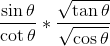
Simplify:
Tap to reveal answer
 is "opposite over adjacent," or
  . (This is because
  .)
.)
Let's substitute into the equation for and multiply the numerator and the denominator by  .
.

Now we can multiply the result by  :
:
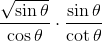
 is the inverse of
  , or
, or  :
:
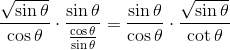
We can reduce the resulting to  :
:

By multiplying top and bottom by  , we can cancel out the
  in the numerator:

The resulting fraction can be simplified:
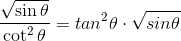
Let's substitute
Now we can multiply the result by
We can reduce the resulting
By multiplying top and bottom by
The resulting fraction can be simplified:
← Didn't Know|Knew It →
Which of the following is equal to
Which of the following is equal to
Tap to reveal answer
We then multiply our fraction by because we cannot leave a radical in the denominator. This gives us . Finally, we can simplify our fraction, dividing out a 3, leaving us with
← Didn't Know|Knew It →
Rationalize the denominator:
Rationalize the denominator:
Tap to reveal answer
We don't want to have radicals in the denominator. To get rid of radicals, just multiply top and bottom by that radical.
We don't want to have radicals in the denominator. To get rid of radicals, just multiply top and bottom by that radical.
← Didn't Know|Knew It →
Simplify:
Simplify:
Tap to reveal answer
There are two methods we can use to simplify this fraction:
Method 1:
Factor the numerator:
Remember, we need to factor out perfect squares.
Method 2:
You can combine the fraction into one big square root.
Then, you can simplify the fraction.
There are two methods we can use to simplify this fraction:
Method 1:
Factor the numerator:
Remember, we need to factor out perfect squares.
Method 2:
You can combine the fraction into one big square root.
Then, you can simplify the fraction.
← Didn't Know|Knew It →
Simplify:
Simplify:
Tap to reveal answer
Let's factor the square roots.
Then, multiply the numerator and the denominator by to get rid of the radical in the denominator.
Let's factor the square roots.
Then, multiply the numerator and the denominator by
← Didn't Know|Knew It →
Which of the following is equivalent to ?
Which of the following is equivalent to
Tap to reveal answer
We can definitely eliminate some answer choices. and don't make sense because we have an irrational number. Next, let's multiply the numerator and denominator of by . When we simplify radical fractions, we try to eliminate radicals, but here, we are going to go backwards.
, so is the answer.
We can definitely eliminate some answer choices.
← Didn't Know|Knew It →
Rationalize the denominator and simplify:
Rationalize the denominator and simplify:
Tap to reveal answer
We don't want to have radicals in the denominator. To get rid of radicals, just multiply the numerator and the denominator by that radical.
Remember to distribute the radical in the numerator when multiplying.
This may be the answer; however, the numerator can be simplified. Let's factor out the squares.
Finally, if we factor out a , we get:
We don't want to have radicals in the denominator. To get rid of radicals, just multiply the numerator and the denominator by that radical.
Remember to distribute the radical in the numerator when multiplying.
This may be the answer; however, the numerator can be simplified. Let's factor out the squares.
Finally, if we factor out a
← Didn't Know|Knew It →
Simplify:
Simplify:
Tap to reveal answer
Let's get rid of the radicals in the denominator of each individual fraction.
Then find the least common denominator of the fractions, which is , and multiply them so that they each have a denominator of .
We can definitely simplify the numerator in the right fraction by factoring out a perfect square of .
Finally, we can factor out a :
That's the final answer.
Let's get rid of the radicals in the denominator of each individual fraction.
Then find the least common denominator of the fractions, which is
We can definitely simplify the numerator in the right fraction by factoring out a perfect square of
Finally, we can factor out a
That's the final answer.
← Didn't Know|Knew It →