How to find proportion - GRE Quantitative Reasoning
Card 1 of 104
You have a rope of some length, but 2/3rds of it is cut off and thrown away. 1/4th of the remaining rope is cut off and thrown away. What proportion of the original rope remains?
You have a rope of some length, but 2/3rds of it is cut off and thrown away. 1/4th of the remaining rope is cut off and thrown away. What proportion of the original rope remains?
Tap to reveal answer
If 2/3 is cut off and thrown away, that means 1/3 of the original length remains. Of this, 1/4 gets cut off and thrown away, meaning 3/4 of 1/3 still remains. Multiplying 3/4 * 1/3, we get 1/4.
If 2/3 is cut off and thrown away, that means 1/3 of the original length remains. Of this, 1/4 gets cut off and thrown away, meaning 3/4 of 1/3 still remains. Multiplying 3/4 * 1/3, we get 1/4.
← Didn't Know|Knew It →
Flour, eggs, sugar, and chocolate chips are mixed by weight in the ratio of 12 : 5 : 3 : 5, respectively. How many pounds of chocolate chips are there in 75 pounds of the mixture?
Flour, eggs, sugar, and chocolate chips are mixed by weight in the ratio of 12 : 5 : 3 : 5, respectively. How many pounds of chocolate chips are there in 75 pounds of the mixture?
Tap to reveal answer
First, add up the four parts of the ratio. This equals 25 parts. These 25 parts make up the 75 pound mixture, which means the 75 pound mixture is composed of 3 times the 25 parts (25x = 75 so x = 3).
This allows you to know that the number of pounds of chocolate chips is 3 times the ratio, i.e. 3 * 5 = 15. The mixture includes 15 pounds of chocolate chips. The answer is 15.
First, add up the four parts of the ratio. This equals 25 parts. These 25 parts make up the 75 pound mixture, which means the 75 pound mixture is composed of 3 times the 25 parts (25x = 75 so x = 3).
This allows you to know that the number of pounds of chocolate chips is 3 times the ratio, i.e. 3 * 5 = 15. The mixture includes 15 pounds of chocolate chips. The answer is 15.
← Didn't Know|Knew It →
If there are 120 men and women on a committee, and the ratio of men to women is 5 : 1, how many more men are on the committee than women?
If there are 120 men and women on a committee, and the ratio of men to women is 5 : 1, how many more men are on the committee than women?
Tap to reveal answer
The best approach is to add the numerator and denominator of the ratio (5 + 1 = 6), and then divide the total by that sum (120/6 = 20). This gives you the value for 1 part when the total is divided into 6 parts and, luckily for us, there is only 1 part women for every 5 parts men. Now set up equal ratios: men/women = 5/1 = x/20. Solve for the number of men by cross multiplying (5 * 20 = 1x). So there are 100 men and 20 women, which makes 80 more men than women.
The best approach is to add the numerator and denominator of the ratio (5 + 1 = 6), and then divide the total by that sum (120/6 = 20). This gives you the value for 1 part when the total is divided into 6 parts and, luckily for us, there is only 1 part women for every 5 parts men. Now set up equal ratios: men/women = 5/1 = x/20. Solve for the number of men by cross multiplying (5 * 20 = 1x). So there are 100 men and 20 women, which makes 80 more men than women.
← Didn't Know|Knew It →
If the sum of a, b and c is 400, and a is 1/3 b and b is 1/4 c, what is the value of a?
If the sum of a, b and c is 400, and a is 1/3 b and b is 1/4 c, what is the value of a?
Tap to reveal answer
Answer: 25
Explanation: For this type of problem, build an equation that represents the relationships between the quantities and solve for the quantitiy you need. The problem states that b=1/4c and a = 1/3b. Thus, a = 1/3(1/4)c, or 1/12 of c. Now put everything in terms of c, thus 1/12c + 1/4c +c = 400. Now comes the tricky step--combine like terms and create the improper fraction (1/12c + 3/12c + 12/12c = 16/12c). Reduce the fraction to 4/3. So 400 is 4/3 of c. Thus c is 3/4 of 400, or 300. a is 1/12 of 300, or 25.
Answer: 25
Explanation: For this type of problem, build an equation that represents the relationships between the quantities and solve for the quantitiy you need. The problem states that b=1/4c and a = 1/3b. Thus, a = 1/3(1/4)c, or 1/12 of c. Now put everything in terms of c, thus 1/12c + 1/4c +c = 400. Now comes the tricky step--combine like terms and create the improper fraction (1/12c + 3/12c + 12/12c = 16/12c). Reduce the fraction to 4/3. So 400 is 4/3 of c. Thus c is 3/4 of 400, or 300. a is 1/12 of 300, or 25.
← Didn't Know|Knew It →
Erin went to the movies with her friends. She spent 1/4 of her allowance on movie tickets and 3/5 of the remaining money on popcorn. If her allowance is $10, how much money remains?
Erin went to the movies with her friends. She spent 1/4 of her allowance on movie tickets and 3/5 of the remaining money on popcorn. If her allowance is $10, how much money remains?
Tap to reveal answer
Since she spent 1/4 on the ticket, 3/5 of the remaining 3/4 of the money was spent on popcorn: 3/5 x 3/4 = 9/20. This means 9/20 of the money was spent on popcorn so in total: 1/4 + 9/20 = 14/20 = 7/10 of her money was spent. This leaves 3/10 of her money behind: 3/10x 10 = 3.00.
Since she spent 1/4 on the ticket, 3/5 of the remaining 3/4 of the money was spent on popcorn: 3/5 x 3/4 = 9/20. This means 9/20 of the money was spent on popcorn so in total: 1/4 + 9/20 = 14/20 = 7/10 of her money was spent. This leaves 3/10 of her money behind: 3/10x 10 = 3.00.
← Didn't Know|Knew It →
Fudge sells at $18.50 for 5 pounds. What is the cost for 2 pounds?
Fudge sells at $18.50 for 5 pounds. What is the cost for 2 pounds?
Tap to reveal answer
Set up a proportion: 18.50/5 = x/2. Cross multiply and solve for x: 37 = 5x.... x = 7.40.
Set up a proportion: 18.50/5 = x/2. Cross multiply and solve for x: 37 = 5x.... x = 7.40.
← Didn't Know|Knew It →
3 men can paint 3 rooms in 3 hours. How long would it take 1 man to paint 1 room?
3 men can paint 3 rooms in 3 hours. How long would it take 1 man to paint 1 room?
Tap to reveal answer
It's tempting to pick 1 hour, but that is a trick answer! Picture 3 men each painting 1 room. All 3 of the rooms are done after 3 hours, so each man actually spends 3 hours painting his room, not 1 hour.
It's tempting to pick 1 hour, but that is a trick answer! Picture 3 men each painting 1 room. All 3 of the rooms are done after 3 hours, so each man actually spends 3 hours painting his room, not 1 hour.
← Didn't Know|Knew It →
Bob can paint a house in 3 hours. If Bob and his friend Ron work together to paint the house, it takes 2 hours. How long would it take Ron to paint the house if he worked alone?
Bob can paint a house in 3 hours. If Bob and his friend Ron work together to paint the house, it takes 2 hours. How long would it take Ron to paint the house if he worked alone?
Tap to reveal answer
The easiest way to solve this is with a rate formula: 1 / combined time = 1 / Bob's time + 1 / Ron's time. We know the combined time and Bob's time, so we can solve for Ron's time:
1/2 = 1/3 + 1/Ron's time
1/Ron's time = 1/2 – 1/3 = 1/6
Ron's time = 6 hours
The easiest way to solve this is with a rate formula: 1 / combined time = 1 / Bob's time + 1 / Ron's time. We know the combined time and Bob's time, so we can solve for Ron's time:
1/2 = 1/3 + 1/Ron's time
1/Ron's time = 1/2 – 1/3 = 1/6
Ron's time = 6 hours
← Didn't Know|Knew It →
$\frac{x}{y}$=\frac{3}{5}$
Quantity A: 
Quantity B: 
$\frac{x}{y}$=\frac{3}{5}$
Quantity A:
Quantity B:
Tap to reveal answer
Although it seems as though "Quantity B is greater" is the correct answer at first glance, a further analysis indicates that this answer is a trap. If  and
and  are negative numbers, such as
  and
and  , then
  would be the larger number. Similarly,
  is larger if both
  and
and  are positive numbers. Thus, it cannot be determined which variable is larger simply based on the information given.
Although it seems as though "Quantity B is greater" is the correct answer at first glance, a further analysis indicates that this answer is a trap. If
← Didn't Know|Knew It →
Jane has a collection of coins consisting of pennies, nickels, and dimes in the ratio 6:3:5.
If there are 42 coins in total, how many pennies are in the collection?
Jane has a collection of coins consisting of pennies, nickels, and dimes in the ratio 6:3:5.
If there are 42 coins in total, how many pennies are in the collection?
Tap to reveal answer
First count the total number of parts in the ratio.

Then we can set up a proportion representing 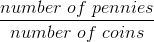 .
.
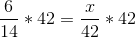
As the initial ratio shows, there are 6 pennies for every 14 total coins. In the total set, we have X pennies and 42 total coins. Plugging these numbers into the proportion gives  .
.
Finally, we multiply both sides times 42 to isolate x.

First count the total number of parts in the ratio.
Then we can set up a proportion representing
As the initial ratio shows, there are 6 pennies for every 14 total coins. In the total set, we have X pennies and 42 total coins. Plugging these numbers into the proportion gives
Finally, we multiply both sides times 42 to isolate x.
← Didn't Know|Knew It →
16 ounces of lemonade mix makes 2 gallons of lemonade (one gallon is equivalent to 4 quarts).
Quantity A: Amount of mix needed to make 3 quarts of lemonade
Quantity B: 6 ounces of mix
16 ounces of lemonade mix makes 2 gallons of lemonade (one gallon is equivalent to 4 quarts).
Quantity A: Amount of mix needed to make 3 quarts of lemonade
Quantity B: 6 ounces of mix
Tap to reveal answer
2 gallons of lemonade equals 8 quarts of lemonade. To make 3 quarts of lemonade, you need  of the amount needed to make 2 gallons of lemonade, or 6 ounces of mix.
2 gallons of lemonade equals 8 quarts of lemonade. To make 3 quarts of lemonade, you need
← Didn't Know|Knew It →
In a class with  students, if
  are taking Calculus and
  are taking Chinese, what is the lowest amount of students possible in the class that are taking both Calculus and Chinese?
In a class with
Tap to reveal answer
This problem states that there are  students in the class taking Calculus. Because the class has a total of
  students, that means there are only
  students in the class not taking Calculus. The problem also states that there are
  students in the class taking Chinese. Because only
  students in the class aren't taking Calculus, this means that there is a minimum of
  students in the class that are taking both Calculus and Chinese.
This problem states that there are
← Didn't Know|Knew It →
If an a train is traveling at 8 feet per second, how many feet does it travel in 2 hours?
If an a train is traveling at 8 feet per second, how many feet does it travel in 2 hours?
Tap to reveal answer
For this problem, you must do conversions of from hours to seconds.
Two hours is equal 120 minutes
 .
.
120 minutes is equal to 7200 second
 .
.
The train travels 8 feet per second so in 7200 seconds it travels 57600 feet
 .
.
For this problem, you must do conversions of from hours to seconds.
Two hours is equal 120 minutes
120 minutes is equal to 7200 second
The train travels 8 feet per second so in 7200 seconds it travels 57600 feet
← Didn't Know|Knew It →
You have a rope of some length, but 2/3rds of it is cut off and thrown away. 1/4th of the remaining rope is cut off and thrown away. What proportion of the original rope remains?
You have a rope of some length, but 2/3rds of it is cut off and thrown away. 1/4th of the remaining rope is cut off and thrown away. What proportion of the original rope remains?
Tap to reveal answer
If 2/3 is cut off and thrown away, that means 1/3 of the original length remains. Of this, 1/4 gets cut off and thrown away, meaning 3/4 of 1/3 still remains. Multiplying 3/4 * 1/3, we get 1/4.
If 2/3 is cut off and thrown away, that means 1/3 of the original length remains. Of this, 1/4 gets cut off and thrown away, meaning 3/4 of 1/3 still remains. Multiplying 3/4 * 1/3, we get 1/4.
← Didn't Know|Knew It →
If the sum of a, b and c is 400, and a is 1/3 b and b is 1/4 c, what is the value of a?
If the sum of a, b and c is 400, and a is 1/3 b and b is 1/4 c, what is the value of a?
Tap to reveal answer
Answer: 25
Explanation: For this type of problem, build an equation that represents the relationships between the quantities and solve for the quantitiy you need. The problem states that b=1/4c and a = 1/3b. Thus, a = 1/3(1/4)c, or 1/12 of c. Now put everything in terms of c, thus 1/12c + 1/4c +c = 400. Now comes the tricky step--combine like terms and create the improper fraction (1/12c + 3/12c + 12/12c = 16/12c). Reduce the fraction to 4/3. So 400 is 4/3 of c. Thus c is 3/4 of 400, or 300. a is 1/12 of 300, or 25.
Answer: 25
Explanation: For this type of problem, build an equation that represents the relationships between the quantities and solve for the quantitiy you need. The problem states that b=1/4c and a = 1/3b. Thus, a = 1/3(1/4)c, or 1/12 of c. Now put everything in terms of c, thus 1/12c + 1/4c +c = 400. Now comes the tricky step--combine like terms and create the improper fraction (1/12c + 3/12c + 12/12c = 16/12c). Reduce the fraction to 4/3. So 400 is 4/3 of c. Thus c is 3/4 of 400, or 300. a is 1/12 of 300, or 25.
← Didn't Know|Knew It →
Erin went to the movies with her friends. She spent 1/4 of her allowance on movie tickets and 3/5 of the remaining money on popcorn. If her allowance is $10, how much money remains?
Erin went to the movies with her friends. She spent 1/4 of her allowance on movie tickets and 3/5 of the remaining money on popcorn. If her allowance is $10, how much money remains?
Tap to reveal answer
Since she spent 1/4 on the ticket, 3/5 of the remaining 3/4 of the money was spent on popcorn: 3/5 x 3/4 = 9/20. This means 9/20 of the money was spent on popcorn so in total: 1/4 + 9/20 = 14/20 = 7/10 of her money was spent. This leaves 3/10 of her money behind: 3/10x 10 = 3.00.
Since she spent 1/4 on the ticket, 3/5 of the remaining 3/4 of the money was spent on popcorn: 3/5 x 3/4 = 9/20. This means 9/20 of the money was spent on popcorn so in total: 1/4 + 9/20 = 14/20 = 7/10 of her money was spent. This leaves 3/10 of her money behind: 3/10x 10 = 3.00.
← Didn't Know|Knew It →
Fudge sells at $18.50 for 5 pounds. What is the cost for 2 pounds?
Fudge sells at $18.50 for 5 pounds. What is the cost for 2 pounds?
Tap to reveal answer
Set up a proportion: 18.50/5 = x/2. Cross multiply and solve for x: 37 = 5x.... x = 7.40.
Set up a proportion: 18.50/5 = x/2. Cross multiply and solve for x: 37 = 5x.... x = 7.40.
← Didn't Know|Knew It →
3 men can paint 3 rooms in 3 hours. How long would it take 1 man to paint 1 room?
3 men can paint 3 rooms in 3 hours. How long would it take 1 man to paint 1 room?
Tap to reveal answer
It's tempting to pick 1 hour, but that is a trick answer! Picture 3 men each painting 1 room. All 3 of the rooms are done after 3 hours, so each man actually spends 3 hours painting his room, not 1 hour.
It's tempting to pick 1 hour, but that is a trick answer! Picture 3 men each painting 1 room. All 3 of the rooms are done after 3 hours, so each man actually spends 3 hours painting his room, not 1 hour.
← Didn't Know|Knew It →
Bob can paint a house in 3 hours. If Bob and his friend Ron work together to paint the house, it takes 2 hours. How long would it take Ron to paint the house if he worked alone?
Bob can paint a house in 3 hours. If Bob and his friend Ron work together to paint the house, it takes 2 hours. How long would it take Ron to paint the house if he worked alone?
Tap to reveal answer
The easiest way to solve this is with a rate formula: 1 / combined time = 1 / Bob's time + 1 / Ron's time. We know the combined time and Bob's time, so we can solve for Ron's time:
1/2 = 1/3 + 1/Ron's time
1/Ron's time = 1/2 – 1/3 = 1/6
Ron's time = 6 hours
The easiest way to solve this is with a rate formula: 1 / combined time = 1 / Bob's time + 1 / Ron's time. We know the combined time and Bob's time, so we can solve for Ron's time:
1/2 = 1/3 + 1/Ron's time
1/Ron's time = 1/2 – 1/3 = 1/6
Ron's time = 6 hours
← Didn't Know|Knew It →
$\frac{x}{y}$=\frac{3}{5}$
Quantity A:
Quantity B:
$\frac{x}{y}$=\frac{3}{5}$
Quantity A:
Quantity B:
Tap to reveal answer
Although it seems as though "Quantity B is greater" is the correct answer at first glance, a further analysis indicates that this answer is a trap. If and are negative numbers, such as and , then would be the larger number. Similarly, is larger if both and are positive numbers. Thus, it cannot be determined which variable is larger simply based on the information given.
Although it seems as though "Quantity B is greater" is the correct answer at first glance, a further analysis indicates that this answer is a trap. If
← Didn't Know|Knew It →