How to find the area of a figure - HSPT Math
Card 1 of 644
What is the area of a square with a side length of 4?
What is the area of a square with a side length of 4?
Tap to reveal answer
The area of a square is represented by the equation Area = $side^{2}$.
Therefore the area of this square is $4^{2}$=16.
The area of a square is represented by the equation Area = $side^{2}$.
Therefore the area of this square is $4^{2}$=16.
← Didn't Know|Knew It →
What is the area of a triangle with a base of  and a height of
  ?
?
What is the area of a triangle with a base of
Tap to reveal answer
The formula for the area of a triangle is Area=\frac{1}{2}$times basetimes height.
Plug the given values into the formula to solve:
Area=\frac{1}{2}$times 12times 3
Area=\frac{1}{2}$times 36
Area=18
The formula for the area of a triangle is Area=\frac{1}{2}$times basetimes height.
Plug the given values into the formula to solve:
Area=\frac{1}{2}$times 12times 3
Area=\frac{1}{2}$times 36
Area=18
← Didn't Know|Knew It →
The area of the square is 81. What is the sum of the lengths of three sides of the square?
The area of the square is 81. What is the sum of the lengths of three sides of the square?
Tap to reveal answer
A square that has an area of 81 has sides that are the square root of 81 (side2 = area for a square). Thus each of the four sides is 9. The sum of three of these sides is  .
.
A square that has an area of 81 has sides that are the square root of 81 (side2 = area for a square). Thus each of the four sides is 9. The sum of three of these sides is
← Didn't Know|Knew It →
What is the area of a triangle with a base of 5 and a height of 20?
What is the area of a triangle with a base of 5 and a height of 20?
Tap to reveal answer
When searching for the area of a triangle we are looking for the amount of the space enclosed by the triangle.
The equation for area of a triangle is 
Plug in the numbers for base and height into the equation yielding 
Then multiply the numbers together to arrive at the answer which is  .
.
When searching for the area of a triangle we are looking for the amount of the space enclosed by the triangle.
The equation for area of a triangle is
Plug in the numbers for base and height into the equation yielding
Then multiply the numbers together to arrive at the answer which is
← Didn't Know|Knew It →
What is the area of a rectangle with length  and width
  ?
?
What is the area of a rectangle with length
Tap to reveal answer
The formula for the area,  , of a rectangle when we are given its length,
  , and width,
  , is
, is  .
.
To calculate this area, just multiply the two terms.

The formula for the area,
To calculate this area, just multiply the two terms.
← Didn't Know|Knew It →
A trapezoid has height 32 inches and bases 25 inches and 55 inches. What is its area?
A trapezoid has height 32 inches and bases 25 inches and 55 inches. What is its area?
Tap to reveal answer
Use the following formula, with  :
:

Use the following formula, with
← Didn't Know|Knew It →
Square A has sides measuring 5 meters. A second square, Square B, has sides that are 2 meters longer than the sides of Square A. What is the difference in area of Square A and Square B?
Square A has sides measuring 5 meters. A second square, Square B, has sides that are 2 meters longer than the sides of Square A. What is the difference in area of Square A and Square B?
Tap to reveal answer
The area of Square A is 5 * 5, or 25 m2.
Since each of Square B's sides is 2 meters longer, the sides measure 7 meters. Therefore, the area of square B is 49 m2.
Subtract to find the difference in areas: 
The area of Square A is 5 * 5, or 25 m2.
Since each of Square B's sides is 2 meters longer, the sides measure 7 meters. Therefore, the area of square B is 49 m2.
Subtract to find the difference in areas:
← Didn't Know|Knew It →
A trapezoid has a height of  inches and bases measuring
  inches and
  inches. What is its area?
A trapezoid has a height of
Tap to reveal answer
Use the following formula, with  :
:

Use the following formula, with
← Didn't Know|Knew It →
What is the area of a square with perimeter 64 inches?
What is the area of a square with perimeter 64 inches?
Tap to reveal answer
The perimeter of a square is four times its sidelength, so a square with perimeter 64 inches has sides with length 16 inches. Use the area formula:

The perimeter of a square is four times its sidelength, so a square with perimeter 64 inches has sides with length 16 inches. Use the area formula:
← Didn't Know|Knew It →
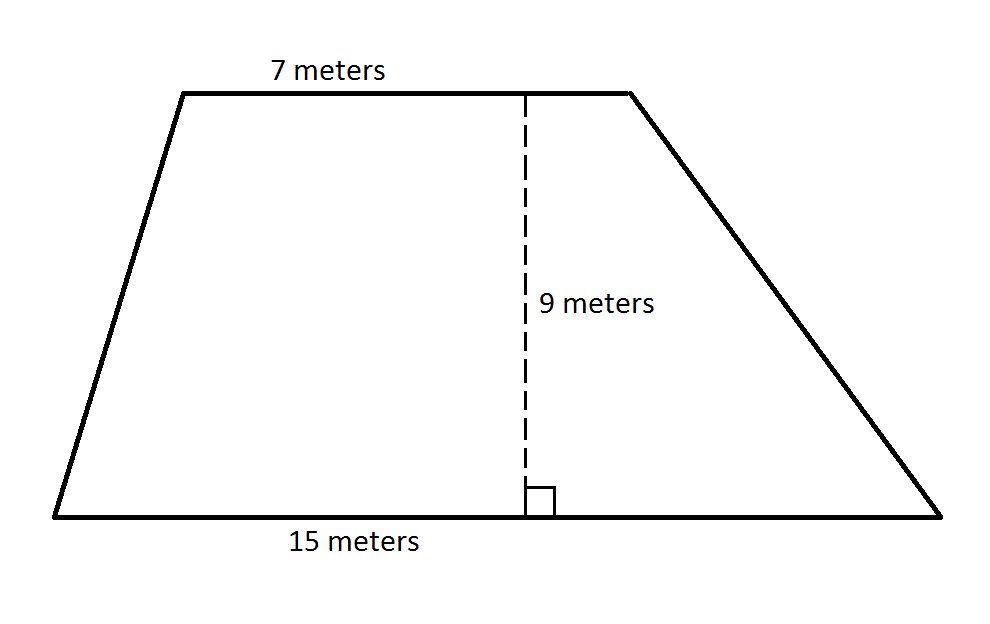
What is the area of the trapezoid?
What is the area of the trapezoid?
Tap to reveal answer
To find the area of a trapezoid, multiply the sum of the bases (the parallel sides) by the height (the perpendicular distance between the bases), and then divide by 2.

To find the area of a trapezoid, multiply the sum of the bases (the parallel sides) by the height (the perpendicular distance between the bases), and then divide by 2.
← Didn't Know|Knew It →
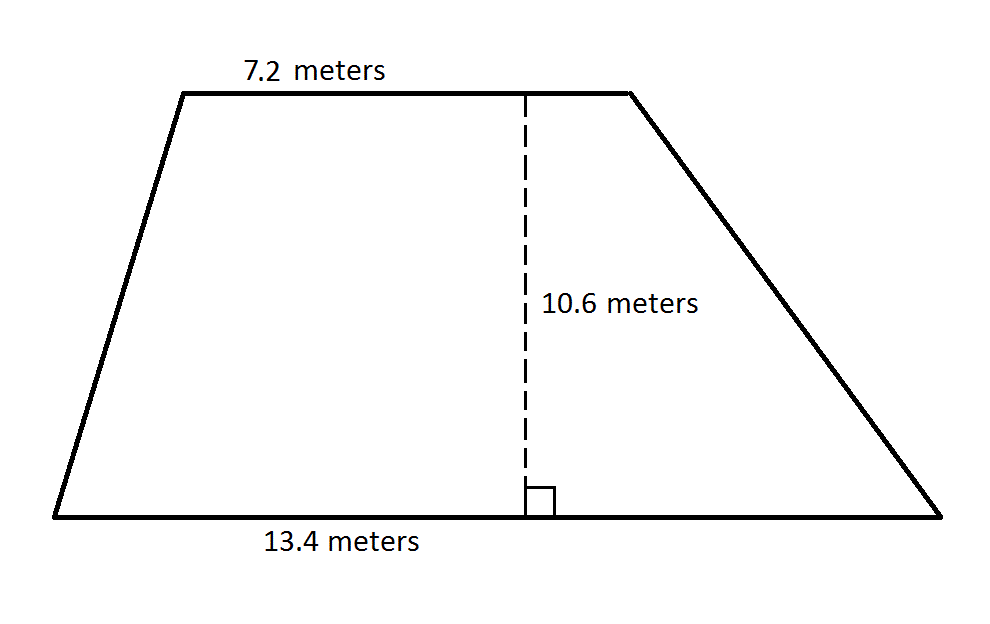
What is the area of the above trapezoid?
What is the area of the above trapezoid?
Tap to reveal answer
To find the area of a trapezoid, multiply one half (or 0.5, since we are working with decimals) by the sum of the lengths of its bases (the parallel sides) by its height (the perpendicular distance between the bases). This quantity is

To find the area of a trapezoid, multiply one half (or 0.5, since we are working with decimals) by the sum of the lengths of its bases (the parallel sides) by its height (the perpendicular distance between the bases). This quantity is
← Didn't Know|Knew It →
What is the area of a triangle with a base of 22 cm and a height of 9 cm?
What is the area of a triangle with a base of 22 cm and a height of 9 cm?
Tap to reveal answer
Use the area of a triangle formula

Plug in the base and height. This gives you  .
.
Use the area of a triangle formula
Plug in the base and height. This gives you
← Didn't Know|Knew It →
A triangle has a base of  and an area of
  . What is the height?
A triangle has a base of
Tap to reveal answer
The area of a triangle is found by multiplying the base by the height and dividing by two:

In this problem we are given the base, which is  , and the area, which is
  . First we write an equation using
  as our variable.

To solve this equation, first multply both sides by  , becuase multiplication is the opposite of division and therefore allows us to eliminate the
  .
.
The left-hand side simplifies to:

The right-hand side simplifies to:

So our equation is now:

Next we divide both sides by  , because division is the opposite of multiplication, so it allows us to isolate the variable by eliminating
  .
.


So the height of the triangle is  .
.
The area of a triangle is found by multiplying the base by the height and dividing by two:
In this problem we are given the base, which is
To solve this equation, first multply both sides by
The left-hand side simplifies to:
The right-hand side simplifies to:
So our equation is now:
Next we divide both sides by
So the height of the triangle is
← Didn't Know|Knew It →
Bill paints a triangle on his wall that has a base parallel to the ground that runs from one end of the wall to the other. If the base of the wall is 8 feet, and the triangle covers 40 square feet of wall, what is the height of the triangle?
Bill paints a triangle on his wall that has a base parallel to the ground that runs from one end of the wall to the other. If the base of the wall is 8 feet, and the triangle covers 40 square feet of wall, what is the height of the triangle?
Tap to reveal answer
In order to find the area of a triangle, we multiply the base by the height, and then divide by 2.

In this problem we are given the base and the area, which allows us to write an equation using  as our variable.

Multiply both sides by two, which allows us to eliminate the two from the left side of our fraction.
The left-hand side simplifies to:

The right-hand side simplifies to:

Now our equation can be rewritten as:

Next we divide by 8 on both sides to isolate the variable:


Therefore, the height of the triangle is  .
.
In order to find the area of a triangle, we multiply the base by the height, and then divide by 2.
In this problem we are given the base and the area, which allows us to write an equation using
Multiply both sides by two, which allows us to eliminate the two from the left side of our fraction.
The left-hand side simplifies to:
The right-hand side simplifies to:
Now our equation can be rewritten as:
Next we divide by 8 on both sides to isolate the variable:
Therefore, the height of the triangle is
← Didn't Know|Knew It →
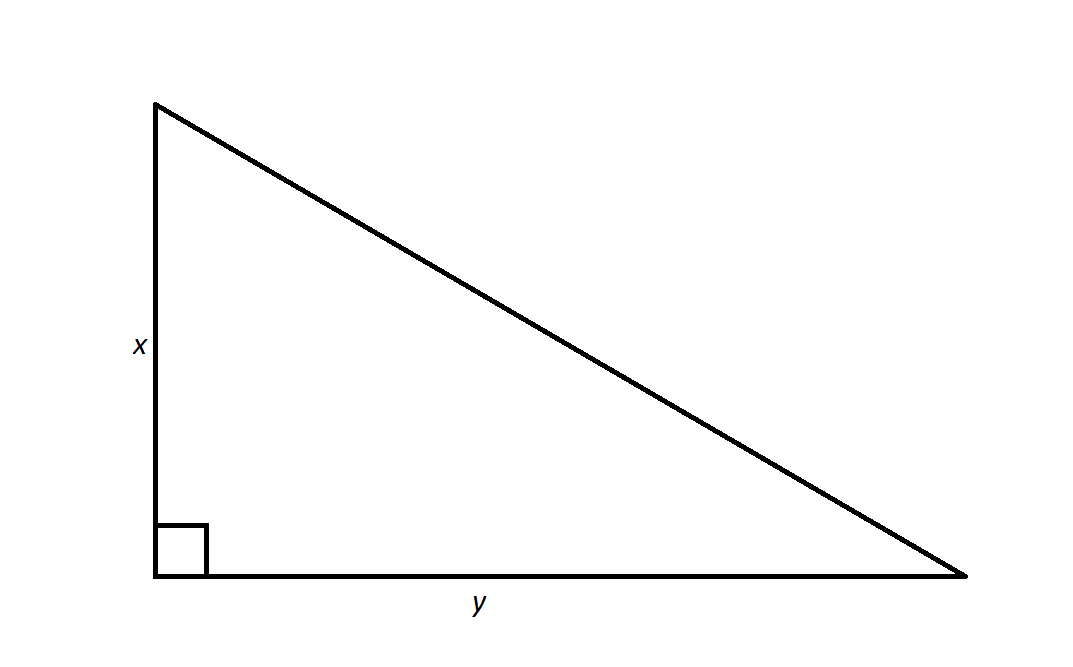
Note: Figure NOT drawn to scale.
The above triangle has area 36 square inches. If  , then what is
  ?
?
Note: Figure NOT drawn to scale.
The above triangle has area 36 square inches. If
Tap to reveal answer
The area of a triangle is one half the product of its base and its height - in the above diagram, that means
 .
.
Substitute  , and solve for
  .
.


The area of a triangle is one half the product of its base and its height - in the above diagram, that means
Substitute
← Didn't Know|Knew It →
Order the following from least area to greatest area:
Figure A: A rectangle with length 10 inches and width 14 inches.
Figure B: A square with side length 1 foot.
Figure C: A triangle with base 16 inches and height 20 inches.
Order the following from least area to greatest area:
Figure A: A rectangle with length 10 inches and width 14 inches.
Figure B: A square with side length 1 foot.
Figure C: A triangle with base 16 inches and height 20 inches.
Tap to reveal answer
Figure A has area  square inches.
Figure B has area  square inches, 1 foot being equal to 12 inches.
Figure C has area  square inches.
The figures, arranged from least area to greatest, are A, B, C.
Figure A has area
Figure B has area
Figure C has area
The figures, arranged from least area to greatest, are A, B, C.
← Didn't Know|Knew It →
The area of the following rectangle is  . Solve for
  .
.

The area of the following rectangle is
Tap to reveal answer
The area of a rectangle can be found by multiplying the length by the width.


The area of a rectangle can be found by multiplying the length by the width.
← Didn't Know|Knew It →
Find the area of the following parallelogram:
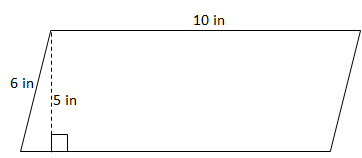
Note: The formula for the area of a parallelogram is  .
.
Find the area of the following parallelogram:
Note: The formula for the area of a parallelogram is
Tap to reveal answer
The base of the parallelogram is 10, while the height is 5.


The base of the parallelogram is 10, while the height is 5.
← Didn't Know|Knew It →
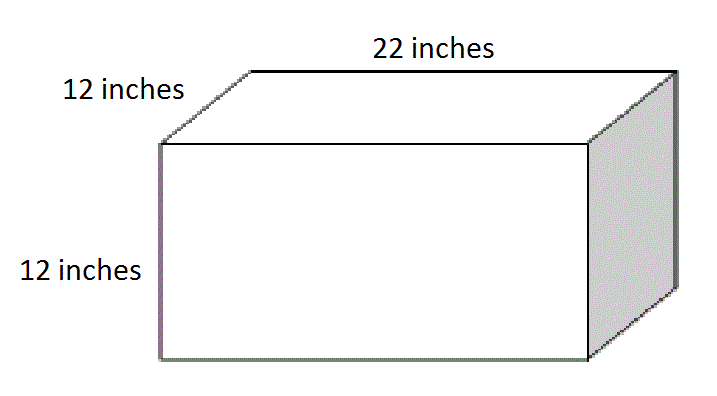
Give the surface area of the above box in square inches.
Give the surface area of the above box in square inches.
Tap to reveal answer
Use the surface area formula, substituting  :
:


 square inches
Use the surface area formula, substituting
← Didn't Know|Knew It →
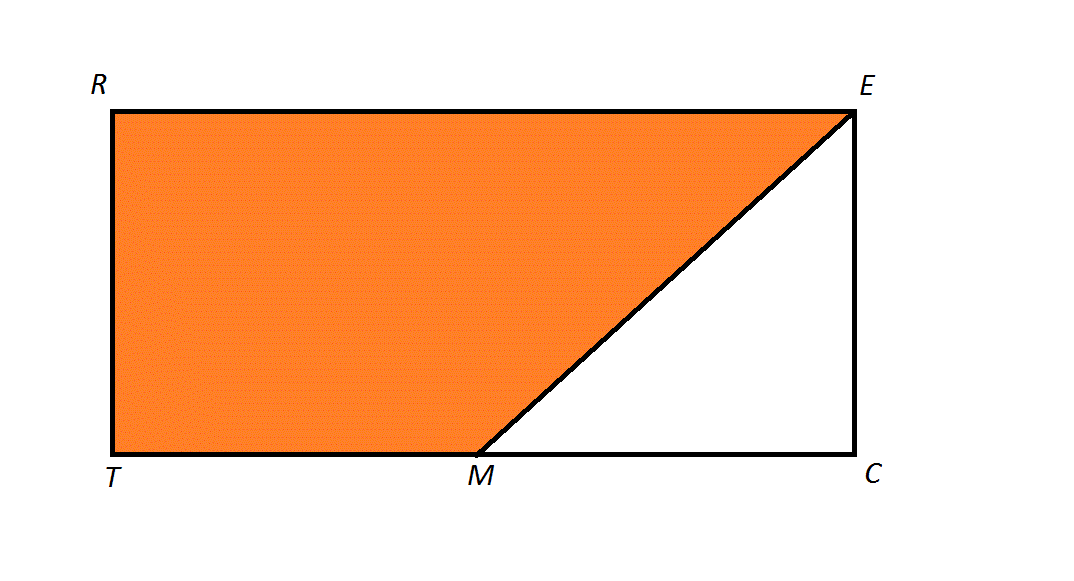
The above diagram depicts a rectangle  with isosceles triangle
  . If
. If  is the midpoint of
  , and the area of the orange region is
  , then what is the length of one leg of
  ?
?
The above diagram depicts a rectangle
Tap to reveal answer
The length of a leg of  is equal to the height of the orange region, which is a trapezoid. Call this length/height
  .
.
Since the triangle is isosceles, then  , and since
  is the midpoint of
  ,
,  . Also, since opposite sides of a rectangle are congruent,

Therefore, the orange region is a trapezoid with bases  and
and  and height
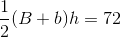
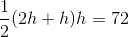
  . Its area is 72, so we can set up and solve this equation using the area formula for a trapezoid:


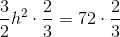


This is the length of one leg of the triangle.
The length of a leg of
Since the triangle is isosceles, then
Therefore, the orange region is a trapezoid with bases
This is the length of one leg of the triangle.
← Didn't Know|Knew It →