How to simplify expressions - HSPT Math
Card 1 of 888
Suppose you know the values of  ,
,  , and
, and  , and you want to evaluate the expression below.

Which of the following is the first step you must complete?
Suppose you know the values of
Which of the following is the first step you must complete?
Tap to reveal answer
Use the order of operations, PEMDAS: Parentheses, Exponents, Multiplication, Division, Addition, Subtraction
In our expression, there are no parentheses, so square  first.
Use the order of operations, PEMDAS: Parentheses, Exponents, Multiplication, Division, Addition, Subtraction
In our expression, there are no parentheses, so square
← Didn't Know|Knew It →
If you rewrite the phrase "the product of nine and a number added to the sum of six and twice the number" as an algebraic expression, then simplify the expression, the result is:
If you rewrite the phrase "the product of nine and a number added to the sum of six and twice the number" as an algebraic expression, then simplify the expression, the result is:
Tap to reveal answer
"The product of nine and a number" is  . "Twice the number" is
  , and "The sum of six and twice the number" is
  .
.
"The product...added to the sum..." is  ; simplify to get

"The product of nine and a number" is
"The product...added to the sum..." is
← Didn't Know|Knew It →
Simplify the expression: 
Simplify the expression:
Tap to reveal answer







← Didn't Know|Knew It →
Simplify: 
Simplify:
Tap to reveal answer

← Didn't Know|Knew It →

Tap to reveal answer
First find the exponent value: 
Then find the value of 
Finally, solve the entire expression with the known values: 
The answer is 36.
First find the exponent value:
Then find the value of
Finally, solve the entire expression with the known values:
The answer is 36.
← Didn't Know|Knew It →

Tap to reveal answer
First convert each mixed number into and improper fraction

Then convert the operation to multiplication and flip the second fraction

Reduce where possible and multiply to solve:

The answer is 
First convert each mixed number into and improper fraction
Then convert the operation to multiplication and flip the second fraction
Reduce where possible and multiply to solve:
The answer is
← Didn't Know|Knew It →
Multiply:

Multiply:
Tap to reveal answer
Use the distributive property:

Use the distributive property:
← Didn't Know|Knew It →
Simplify:
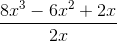
Simplify:
Tap to reveal answer

← Didn't Know|Knew It →
Simplify:

Simplify:
Tap to reveal answer




← Didn't Know|Knew It →
Simplify:

Simplify:
Tap to reveal answer





← Didn't Know|Knew It →
Simplify:

Simplify:
Tap to reveal answer

When solving this problem we need to remember our order of operations, or PEMDAS.
PEMDAS stands for parentheses, exponents, multiplication/division, and addition/subtraction. When you have a problem with several different operations, you need to solve the problem in this order and you work from left to right for multiplication/division and addition/subtraction.
Parentheses: We are not able to add a variable to a number, so we move to the next step.
Multiplication: We can distribute (or multiply) the  .
.


Addition/Subtraction: Remember, we can't add a variable to a number, so the  is left alone.


When solving this problem we need to remember our order of operations, or PEMDAS.
PEMDAS stands for parentheses, exponents, multiplication/division, and addition/subtraction. When you have a problem with several different operations, you need to solve the problem in this order and you work from left to right for multiplication/division and addition/subtraction.
Parentheses: We are not able to add a variable to a number, so we move to the next step.
Multiplication: We can distribute (or multiply) the
Addition/Subtraction: Remember, we can't add a variable to a number, so the
← Didn't Know|Knew It →
Simplify

Simplify
Tap to reveal answer
In order to add variables the terms must be like. In order for terms to be like, the variables must be exactly alike also being raised to the same power by the exponent.
In this case the like terms are  and
and  . Just because there is a 1 in the exponent for the first term doesnt mean it is different from the second term. With exponents if a variable does not show an exponent, that means it is still to the first power.
We add the coefficients of the like terms. The coefficient is the number in front of the first variable, in this case it is 1 for both terms because of the identity property of multiplication stating any variable, term, or number multiplied by 1 is itself.

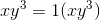
Our last term is not like because the  variable is raised to a different power than the other two. In this case we do not combine it to the like terms, we just add it to the end of the term.
In order to add variables the terms must be like. In order for terms to be like, the variables must be exactly alike also being raised to the same power by the exponent.
In this case the like terms are
We add the coefficients of the like terms. The coefficient is the number in front of the first variable, in this case it is 1 for both terms because of the identity property of multiplication stating any variable, term, or number multiplied by 1 is itself.
Our last term is not like because the
← Didn't Know|Knew It →
Simplify the following:

Simplify the following:
Tap to reveal answer

When solving this problem we need to remember our order of operations, or PEMDAS.
PEMDAS stands for parentheses, exponents, multiplication/division, and addition/subtraction. When you have a problem with several different operations, you need to solve the problem in this order and you work from left to right for multiplication/division and addition/subtraction.
Parentheses: We are not able to add a variable to a number, so we move to the next step.
Multiplication: We can distribute (or multiply) the  .
.


Addition/Subtraction: Remember, we can't add a variable to a number, so the  is left alone.
Now we have 

When solving this problem we need to remember our order of operations, or PEMDAS.
PEMDAS stands for parentheses, exponents, multiplication/division, and addition/subtraction. When you have a problem with several different operations, you need to solve the problem in this order and you work from left to right for multiplication/division and addition/subtraction.
Parentheses: We are not able to add a variable to a number, so we move to the next step.
Multiplication: We can distribute (or multiply) the
Addition/Subtraction: Remember, we can't add a variable to a number, so the
Now we have
← Didn't Know|Knew It →
Simplify:

Simplify:
Tap to reveal answer






← Didn't Know|Knew It →
Solve for B

Solve for B
Tap to reveal answer
This problem looks strange since it mostly contains variables, in particular unknown variables. Still remember the order of operations: parentheses, exponents, multiplication, division, addition, and subtraction. We still use those operations in this case. All we must do is move the variables around to solve for  .
.
In this case we can subtract (additive inverse)  to the other side first.

Rewrite our problem.

Stop for a moment and look at the progress. Go back to the original question, solve for  . Our problem shows
  about to be multiplied to
  , but we do not necessarily have to multiply because we can divide by
  to both sides of the equation, which would save us a step as well as have B by itself.
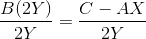
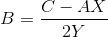
This problem looks strange since it mostly contains variables, in particular unknown variables. Still remember the order of operations: parentheses, exponents, multiplication, division, addition, and subtraction. We still use those operations in this case. All we must do is move the variables around to solve for
In this case we can subtract (additive inverse)
Rewrite our problem.
Stop for a moment and look at the progress. Go back to the original question, solve for
← Didn't Know|Knew It →

Tap to reveal answer
Multiply the numbers and multiply the variables:

Answer: 
Multiply the numbers and multiply the variables:
Answer:
← Didn't Know|Knew It →

Tap to reveal answer
Add the numbers and keep the variable:

Answer: 
Add the numbers and keep the variable:
Answer:
← Didn't Know|Knew It →

Tap to reveal answer
Multiply the numbers and multiply the variables:

Answer: 
Multiply the numbers and multiply the variables:
Answer:
← Didn't Know|Knew It →

Tap to reveal answer
Subtract the numbers and keep the variable:

Answer: 
Subtract the numbers and keep the variable:
Answer:
← Didn't Know|Knew It →

Tap to reveal answer
Add the numbers and keep the variable:
Answer: 
Add the numbers and keep the variable:
Answer:
← Didn't Know|Knew It →